Don't Waste Your Windfall! IBC Strategy for Uncertainty
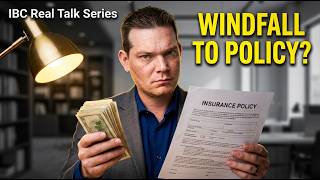
Richard Canfield breaks down when to fund an Infinite Banking policy with a windfall and when to wait. He compares two cases: a professional with a $300k buyout and spouse's income, where a phased plan works, versus a single earner with $40-50k and high debt, where it's too risky. The key is protecting your foundation first.
Chapters
If someone is unsure of their future income or cash flow, would you recommend that they use a current windfall, a lump sum of money, to start a policy just to get something in place? You know, there's a version of financial advice that just makes me cringe, and it's when someone gets a yes or a no before anyone's even asked a single question, before anyone's taken the time to actually understand who Who you are, who are you, what you've built, what do you owe, what's coming, and where's it all going? Stuff like that kind of drives me crazy because in this world, in the IBC world especially, context is everything. Speaking of context, context changes the answer completely. So when JJ asked us for our IBC Real Talk series, if someone is unsure of their future income or their cash flow, would you recommend that they use a current windfall to start a policy just to get something in place? Well, JJ, great question, by the way. My honest answer is I wouldn't recommend anything. Not yet, at least. Not until I've had a real deep dive conversation with that person. So in my opinion, no advisor worth their salt would do that. But you have a great question here, so I want to unpack it a little bit more and talk through When might that make sense and what are some of the factors that we would include? So what we're going to do is we're going to walk through some of those key factors. These are things I think you would absolutely need to unpack at a minimum. And then we're going to talk through two, you know, possible examples. One where this, yeah, maybe this does make sense and one where it clearly does not. So let's go ahead. Let's get into it. Factor number one, how much is the windfall? What kind of money are we talking about here? Is it enough to fund a meaningful policy and still leave a buffer in place? Are we going to do it in a transitional format? Are we going to use every single dollar and have nothing left over, which would be very dangerous? You need to have a runway to weather uncertainty and without touching the policy early necessarily. Just because you can do something, you can access capital immediately, doesn't necessarily mean you should. If we want to protect and preserve this resource of a windfall event, and then we're immediately going to put it into— try to get it into a policy, or as much of it as we can right away, and then borrow from it immediately to go and pay our bills. That's going to be a dangerous scenario. That has, you know, Rob Peter to pay Paul type of a situation all over it, because we're not putting any focus or attention on ongoing future premiums. We're not putting focus and attention on policy loan repayments. And if we have an unstable or uncertain income potential, Well, how are we factoring that in? So, so it could get pretty tricky right away, and people need to be informed on that. Okay, so that's my, my take on the first one. Factor number 2: what is the realistic income expectation? Is this a temporary gap, or is it a January 'I have no idea'? Hey, it's slow right now, but things are coming is very different than 'I have no idea if I'll make any money again'. So the timeline and the probability of that income returning means a great deal. Is this a brand new business that someone's starting with really high hopes, um, but has no uncertainty? Like, yeah, I did a business plan, it looks good. Well, anyone who started a business— and feel free to comment below if you've done that— yeah, you have great expectations and maybe you've done a lot of research, but that doesn't mean any money comes in in the first year or the second year. Like, it could go really well or it could go sideways really fast. And it could actually just suck up more of your money because you keep reinvesting in the beast to try to generate something more. And we all know the stats aren't friendly. Like, a lot of businesses fail. Most businesses fail in the first 5 years. So your probability of being a statistic, unfortunately, is pretty high. In which case, do we want to build and transition your nest egg or this chunk of capital into that? Without having a prudent relationship for what the potential income might be. Okay, next thing, is there a stabilizing income? Your spouse's? Do you have passive income from an investment? Is there a pension you can fall back on? So are you completely income, you know, like decimated? Is there nothing coming in? Is there something coming in? Are you able to cover your basic expenses or most of them? Like, what is the situation? Are Like, here's an example. Let's say you— your basic monthly expenses are $5,000 a month, and you have a pension, let's say, that you can turn on, and you have some passive income from an investment, and, uh, and then your spouse's income. We put it all together and it's $4,000 a month. Okay, so that's not covering what you need, and your bare minimum is $5,000, so we probably need to pad up a little bit. So let's say we need to be planning for $6,000 a month. So we actually have a $2,000 a month gap that we're missing. Okay, well, if you get a lump sum amount of money that's $300,000 and you need $2,000 a month, well, could we set aside 3 years of that $2,000 a month, just hypothetically? So you got $24,000 times 3 years. What do we got? $48,000. That's, uh, what do I got? $72,000 or whatever. So could we carve that chunk off set it into an annuity or a savings account or something that you know you're not going to touch, but it's going to produce that consistent income stream so that you can level out your expectation. And then we still have a chunk of that nest egg. So, you know, now you've got a 3-year run rate to get things up and running and going again. So like, that's an example of how you could reasonably discuss that and then determine comfortability, reasonability. Income potential, income expectation, making sure your basic needs are covered for your family, etc. Like, you have to make sure those things are done. Okay, so, uh, next factor, factor number 3, is going to be the timeline. What's the timeline? How long until income stabilizes? This is a 3-month gap. Is this a 2-year gap? That's a pretty big distinction. So a policy can be structured with a ton of flexibility, but that flexibility and all those factors, they kind of have to come together in a reasonable way. The client needs to understand those key elements and then be able to commit to them. Commitment matters in this type of a plan. Factor number 4, what are the existing obligations? Do we have debt payments, mortgage? Are there dependents? Do you have kids? Are there business expenses? Do you have access to an emergency fund somewhere that's not credit, right? Like what are, what do you have set aside? The windfall may need to serve some of these other roles first or be chunked aside to do some of those things. And, you know, those need to be clearly understood before any action is taken, um, and any recommendation is really made. So a policy can't be the hero if the foundation isn't solid. You got to have some key things taken care of. Factor number 5: do they already have coverage or do they need it? So if death benefit protection is needed urgently, like there's nothing in place, hey, we need to consider putting something. But maybe we just solve that with basic term insurance. We solve the basic need for right now, but it's still a reason to act. It doesn't mean that we're going to take a nest egg and dump it into a policy. Like, that isn't necessarily real. Although, does it make sense that we combine some strategies together because that, that urgent need is there? Hey, there's definitely a reason to act. But what is the situation around that? Um, it also means if someone doesn't have coverage, well, they're probably just getting started in this process, which means they have a lot to learn. So that means there's going to be extra care, probably a smaller program would need to be considered. The coverage does matter if there's a demonstrated need, but, uh, you know, what's the knowledge base already? Whereas if you have someone who wants to maximize this as a generational way, uh, to, to house that resource and make sure that they can create both a legacy event, maybe increase possible passive income, like a number of things they want to do, and they want to combine it with an existing IBC game plan. Well, then you might have some more availability because they probably have liquidity with other policies. They've got a focused mindset. They might have some existing practice at the concept already. They've paid some loan repayments, so they have demonstrated behaviors. Well, that demonstrated behavior is going to determine some of the potential of that conver— like, how's that conversation go? We might be able to reasonably work with a larger amount of the resource. A, because they've got more stability. B, they've got mindset, energy, effort, practice, knowledge base. So, their ability to interpret and understand this probably makes more sense as well. That actually leads us right to factor number 6, which is the human element. What's the drive? What's the attitude? What resources? This one to me is the absolute biggest one. If someone's resourceful, they're motivated, they have a clear plan, It's a completely different candidate than someone who has practice, has a policy or two, they've demonstrated the right behaviors, you know, versus someone who's just like, I'm learning this for the very first time, I've never done this before, seems like a good idea, I really want to do this, but I've never— you know, like someone who's coming in from that status point versus someone who's already been doing it for 5 years, it's a really big different conversation. You have to remember IBC is a concept. It only works for people who are willing to stick with it. Resources plus mindset together, that's kind of the real answer. That's how I would boil it down. So, let's unpack an example of this and I'll just kind of, I'll go through a couple of variations. We'll go through the kind of green light scenario where this might make more sense. So, let's assume that you have a professional, someone that had a decent career, maybe they've got 12 to 20 years of that career. They just went through a corporate buyout. Their company that they're working for got amalgamated. They had an opportunity to have a strategic exit. They kind of got a buyout from that situation. So not really in crisis. Let's assume they had $300,000 from the buyout and they have time. They don't need to rush into a new job or position right away. Their spouse is working, so that covers all of their basic expenses already. Doesn't mean that they have, you know, they can go out and get ice cream and go for steak dinners every night, but it means that, you know, they can be reasonably looked after and okay in that situation. They already have existing investments. They've got a dividend portfolio. Maybe it's producing a little bit of passive income. They don't need to draw it down, but they could if it was required. That extra income, a couple hundred thousand dollars a month, could take care of things without depleting their nest egg. Cool. That puts them in a good position. So they're not rushing, like I say, to get back to work. They're just waiting for the right opportunity. If anyone's worked in the corporate world, you know, I speak with clients and sometimes they're just like, they can't wait to get out, you know, and I've had people who've gone through a similar experience like this. In fact, I just spoke with somebody, geez, I don't know, maybe in the last 5 or 6 days that had a similar experience from an engineering scenario. So, you know, they're confident that they'll get back to a similar income within the next 18 months because they've got, they've got the the clout, the experience, great resume. They could even do consulting. And even if the income isn't exactly the same amount, maybe it's 10% less, they're already covered for a lot of things and they've got what they need. They might be able to work fewer hours or find a better role or enjoy it more, but still have a similar earning power and they don't need to be in a rush. So, well, what does that tell us? There's no financial fragility in this situation. You know, it's a, It's a reasonable plan to transition. So the income is a gap, but it's not a crisis. And the gap solve or the reasonability of that solve is pretty high. And they feel that confidence, right? So it's one thing if I think it's high, my opinion doesn't mean squat. What do they think? It's their life. They know their industry. They know the job market. They know where they live. They know the economic lay of the land. They have contacts in the industry. They know their skill set, their potential. They have a degree of confidence about this. I don't need to have that confidence. I need to have confidence in them. They need to have confidence in, in their future. That's kind of how that would work. So, you know, again, there could be a real realistic timeframe in the next 3 to 18 months, 24 months on the far end. They're probably back to a similar income potential. Even if it was, even if it was 15% less income, they've already established a proper financial base that allows them to do something like this. So now it makes sense. Okay, we've got $300,000 they want to work with. Maybe we can structure that into a program over a couple of years, maybe 4 to 10 years, 4 to 8, something like that, depending on their comfort, you know, their comfortability, the circumstance, the age. Like, there's a lot of factors at play, but we wouldn't try to get it all in at once like that. Probably wouldn't make sense in a lot of ways because a policy always has a base premium that needs to be paid, and you want to make sure that that base premium can be paid and, and the person has the mindset potential and the opportunity to pay it on an ongoing basis. That's, that's going to give them the best long-term run rate. So we want to consider that. Now let's extend this example a little bit further. All right, uh, let's assume that we put that $300,000 in over I don't know, I'll just say 8 years. I'm— I didn't look at the numbers. I'm just going to run it on my calculator here and see what that looks like. Okay, so that's about $37,000 a year. Picked a number. Well, maybe they could do $40,000 just to make it a clean number, and then they're parking it in, as an example, a guaranteed income annuity, a savings account, another investment, whatever they want to use, uh We could put it into an annuity life company. There's a few different things you could do where it's earning interest so we can earn up some of that $40,000 level so that we can transition it over a number of years, in this case 8 years. Okay, well, let's just say that if it's $40,000, well, maybe the minimum required premium— I just want to keep the numbers super simple here for our example— is $10,000 a year. So $10,000 is a minimum, uh, $40,000 is the max. Great, we've got a 10-year They want to continue doing the $10,000 a year, the base premium, and they still have potential to do more. But we want to make sure, is it still reasonable for them to do that at the end of that time frame? Well, in this scenario, with the type of income potential, it is. But, you know, as that person transitions out to a, you know, later retirement stage, well, can that be funded by, let's say, Social Security, or in Canada, you know, Canada Pension Plan, Old Age Security, these, these government benefits or a pension. Can we make sure that there's a stable income source there that can help them continue funding that, or at least they can see that ongoing funding potential and what that's going to do for them long term? So those are kind of things that I would consider in the situation. Um, what do they have a need for capital right now, and is that going to play a role? And, and do they need that max liquidity, or can they get liquidity from the policy instead, as an example? So if they need maybe more liquidity, but they wanted to come from the policy. Maybe we take that 8-year time frame and we try to shrink it down a little bit more. You know, it's all relevant, right? Next thing, okay, well, they have kids. All right, well, the youngest child turns 21 in 8 years. So going back to my 8-year timeline, well, now all the kids are out or gone, or they're— even if they're home, they're, they're independent. Maybe they're paying rent, they're doing things of that nature. So, you know, they're not spending money on soccer practice and hockey gear and, you know, all the kids' activities. And so a lot of those expenses are going to start to shift and disappear, which means that cash flow that's currently in their budget is going to be essentially back available for them to maybe work with. That's what's going to fund ongoing future premiums, including the flexible premium. Like, there's a lot of potential there. So when you think about all those things, like the relevance of time, that has a really important aspect. So yeah, in that situation, maybe there's a pretty good green light there. Ultimately, it makes it— it has to be the client that makes that, that decision. So what about an example where it doesn't make sense? Okay, someone receives a small inheritance. It's $40,000 to $50,000. It was unexpected. It wasn't planned. They're a single-income household. They have no spousal income as a backup. Their mortgage is still pretty high relative to their income. They still have a little bit of consumer debt. They basically have very little investments. They have some like group plans like a 401k or an RSP with their company. They don't really have a lot of else to work with other than some home equity, which, you know, there's nothing they can access there because they need a home to live. So the income situation is generally a little bit unclear, and they've only been at the new position that they're in maybe for 12 months, 6 months. Like, it's a new job. Like, Hey, there's some uncertainty there. If the person that we're speaking about in this scenario, they might be knowledgeable and skilled, but maybe they don't have a degree or a trade or a piece of paper that says, hey, this piece of paper, you know, gives me high qualification to be able to enter into a similar job role with any company. So if I lose this one, I can go to this one. Like, as an example, if someone was, uh, maybe they were a laborer and they were making okay money as a laborer, but it's, it's labor work that doesn't have a skill attached to it. So it's not same as like a journeyman electrician or a journeyman plumber or a journeyman welder, as an example. Nothing wrong with that type of work, but it, it, it does play a role on what the potential of income consistency might look like if we're thinking about a situation like this. So, so that has a big factor, um, you know. So they might be excited and motivated, but they don't have the same foundation and, you know, $40,000 or $50,000 resource to get that into a program over a couple of years and, and also still have stability. So if the person does have enough positive cash flow, or that maybe they can afford a nice, good, clean, consistent base premium payment, uh, monthly, let's just say. Well, maybe there's a way that we can say, okay, if you don't need this resource today, maybe we can earmark— you want to, you want to try recapturing the consumer debt. You only have a little bit there. If we slide this money into a policy over a number of years and then we borrow from it to recapture the third-party debt, if that's the strategy you wanted to go from, we can free up that cash flow payment eventually. and then that can repay policy loans. So, so there's some possibility there, but man, it's, it's pretty tricky. It all hinges on like, can they be consistent on making that base income payment? You know, what, what is, what is the overall confidence and stability in their situation? So, you know, windfalls can look really different. The opportunity with the person, their age, their family dynamic, all looks different. And so the whole goal is that you want to have the policy become become a hero. You want it to be something that is a win. It's, it's, it's a, it's something you're excited about and you, you are clear and you know what it's going to do for you. If it becomes a burden, then either, either the, the policy owner did something wrong or they weren't listening or paying attention, or the advisor set something up that was maybe too aggressive. Sometimes both of those things can exist, and there's no perfect science for it. What there is, is there are good strategic conversations, and then those strategic conversations turn into lifelong client relationships if they do them correctly. So, there you go. The verdict is you got to protect your foundation first, and you need to consider what are all the variables. Lots of factors. I only gave you 6. I unpacked each one, but we probably could add some more if we really wanted to. So, there you go. JJ, great question. Thanks for asking it. For those of you tuning into our IBC Real Talk series, of course, make sure you leave a comment below. What's a question you have about your financial life or about the infinite banking concept that you'd like answered? Go ahead, put that question down below and check out this next video.
More from Richard





How Do You Use a Policy Loan to Buy Dividend Stocks? #dividendstocks #infinitebanking #shorts


Can Compounding Dividends Pay Your Bills? #wealthbuilding #investment #financeeducation


Should a Corporate Policy Offset Your Personal Coverage? #shorts #insurancetips

What Is Human Life Value? #shorts #insurancetips #dividend #wholelifeinsurance