Four Characters in the Financial Play | R. Nelson Nash's Wisdom
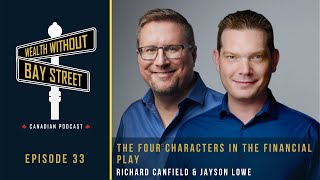
Richard Canfield and Jason Lowe explain R. Nelson Nash's Infinite Banking concept through four roles: depositor, borrower, banker, and bank owner. Mastering all four gives you control over your own banking function instead of handing that power to traditional banks.
Chapters
You are listening to the Wealth Without Bay street podcast, a Canadian guide to building dependable wealth. Join your host, Richard Canfield and Jason Lowe as they unlock the secrets to creating financial peace of mind in an uncertain world. Discover the strategies and mindsets to a financial future that you can bank on. Do you want to create passive income and connect with like minded people? If you're an entrepreneur or a high earning business professional and you want to join others just like you are who want to build wealth, save on tax and secure their financial future, then join our community. We want you join us over@wealthwithoutbaystreet.com community. Can't wait to see you there.
All right. Welcome back to another episode of Wealth Without Bay street, joined today by my amazing colleague, amazing co host, the Richard Canfield, also known as Richard Canfield, coming to us live from Chilliwack, British Columbia. And I'm coming to you live of course from our wealth of Hope Bay street headquarters in Edmonton, Alberta. Richard, good to be with you. The hq, the hq, the headquarters.
I felt, I felt out of place over in my new jurisdiction because I didn't have a fancy, you know, promotional sign for the podcast. So I had to go get one made and now I feel like, I feel like I'm back on the, you know, it's like I've got my little mini studio going on here and it's pretty, it's pretty fantastic.
Oh, that's amazing, man. And you know, we want to give a quick shout out to all of our listeners and we want to say thank you. We sincerely want to thank you for tuning in for all of your amazing feedback, emails, text messages, snail mail, courier drops, all the things that you've been doing to express how much value you're getting from our podcast. It just, it fills our hearts with joy. Thank you, thank you for continuing to be a listener of Wealth Without Bay Street.
And we've had some really, really good comments coming from, I know, from existing clients and also from just, you know, some new people that are listening in on the, on the YouTube channel and as well on, on some of the podcast episodes through the, your regular podcast player. Um, it's kind of weird when you're like, your podcast is on all these different platforms and then there's kind of figuring out where the central hub for these comments go. So we're learning through how to respond to some of those things and reply and that's part of the joy of learning. And so we appreciate your patience also as listeners with us in the same.
Format well, and we do have also been sharing with listeners that if you have a guest in mind, someone that you think would bring a lot of value. If there's a topic that you would like us to address on the Wealth Without Bay street podcast, please go ahead and send that feedback to us. You can comment on the youtubes, you can comment in the Facebooks, you can send us correspondence. There are show notes where you can click through to an email and send your feedback in. Keep it coming. We appreciate it very much. Today's episode. Richard, I'm super excited about today's episode because we get to talk about something that's so important to understand as it relates to becoming your own banker. And that is the four characters in the financial play.
This is one of Jason's hot button type topics. We used to do these live sessions together and we're going to be doing more of those, of course, once we're able to have real life events again. But Jason would always unbutton the sleeves and roll them up and he would grab a couple of board marker pens and like, let's talk about the characters in the play. Kind of get all amped up about it. So this is an awesome topic. I think people will enjoy.
All right, and let's dive in. So when we're describing the process of becoming your own banker. So quite often and rich, you can attest to this where people, when they're first learning about it, they can go down one of two tracks. They can go down the product focused track where they're emphasizing their time and attention and they're learning on the tool that is utilized to implement the process. So they're focused on the policy or the system of policies, the anatomy of the insurance contract, which life company it is. Yeah, all that stuff, the life company's.
History, how the life company blows their.
Nose, all that stuff. And. Or which, I mean, hey, that's great. It's part of your learning and it's part of what helps you get to clarity and to understand the tool. And then other people are very focused on the process and understanding how do I do this? How do I go about doing this in my life? And right in between, there is developing an understanding of the four characters in the financial play because, like, a bridge between those things.
Yeah, yeah, totally.
Because without having a very clear understanding of. Of the characters in the financial play, then you just don't have the ability to really, truly understand the process. And so I'll list what those characters are and then we'll dive into them together and Just have a really good expanded discussion for the benefit of listeners. So there are four characters. The first character is the depositor. The second character is the borrower, which is, by the way, the most important character in the equation because without the borrower, nothing else happens. The third character is the banker and the fourth character is the bank owner. Now, when we meet with people, for the most part, they are only two of the four characters in the financial play. They are the depositor and the borrower. So when you think about this in terms of ridiculous simplicity, you deposit money onto the books of someone else's bank. I say that again. You deposit money onto the books of someone else's bank. So think about how you earn income. Doesn't matter what the source is, interest income, dividends, T4, a combination of all three.
Fake income from the federal government during the pandemic.
Right.
That doesn't really technically exists because it has to be paid for by the future generations. Right?
Whatever that source is, most often the bank sees the money before you do. And so recognizing that, playing the role of depositor, well, if you don't become all four characters in the financial play, then it's impossible to achieve what someone is achieving. Who is all four characters in the financial play? I know that sounds very rudimentary, but it's true. And the reason I bring that up is because all too often when we talk about the product track and the process track, the human mind goes into comparison mode or alternatives. I need to choose one or the other. I'm either going to practice the process of becoming your own banker, or I'm going to put my money in real estate. I. I'm either going to become my own banker or I'm going to put my money in stocks, bonds, mutual funds, gold, silver, whatever widgets, whatever financial tool or product product there is, we're not grasping the point of becoming your own banker. It's all about making it an either or. All the depositor understands is that your money must reside somewhere. And so the safest place for me to store that money, because I've been conditioned that way, is to store it on the books of someone else's bank, while the borrower, the borrower and the depositor are one in the same, in the sense that you've been told to put your money into all these different things, mutual funds, stocks, bonds, etc. Everything that we just mentioned. And then you go to the bank when you need access to the money.
And it's not your money anymore. Now it's the bank's Pile of money, which is a representation of all the deposits of everyone else who's left money there.
So it's absurd. Put your money away, hand it over to someone else who thinks they can do better with it than you can. And then when you need access to money to finance the things that you need in your life, you got to go to the bank and you got to go through the gatekeepers, the toll takers. You have to go through the banker to gain access to someone else's pile of money. And what you've been taught is to hand your money over to someone else. It's absurd. So if you are the depositor and the borrower, but you're not the banker and you're not the bank owner, you can't achieve what someone is achieving. Who is all four? Well, the banker. Who's the banker? Rich?
The banker is the gatekeeper and the toll taker. That's the person who dictates the terms of the loan arrangement. Well.
And determines whether or not you get access to.
Yeah. Can you even access this pile of money we have? Prove to us that you don't need our money and that you actually shouldn't even be borrowing any because you are a good steward of money already and that you don't require any money from our lending institution. Prove to us that we. You don't need it, then we'll give you some.
Right, good point. And so the banker is in a very good position. The banker gets to practice the golden rule, and that is, whomever possesses the gold makes all the rules. And so.
And the banker, the other thing that the banker is going to do is the banker is going to take collateral in as many instances as possible. They want to figure out how can they secure their downside risk. And they're not lending you the money because they're lending you the money because of your ability to make the payments. Totally. They want the cash flow, the stream of payments coming in. Because every time a payment comes back into the bank, well, that payment doesn't just sit there and do nothing, it immediately goes back to work again. For the benefit of who, the bank owner?
Completely. Completely. And really for most people, and I think you would agree, Richard, who we speak with for the first time.
They'Ve.
Maybe read Arnelson Nash's book, so they have some glimpse into the essence of four characters in the financial play and the importance of that. But once we put the glue together, it's like an aha moment. It's like an epiphany. So you mean to Tell me that I can become my own banker and I can invest in real estate and I can put my money into financial products that are appealing to me. The answer is yes, absolutely. The process of becoming your own banker has nothing to do with changing your financial objectives. It has everything to do with helping you achieve them by implementing a different process. The function of banking goes on no matter what is happening. And so it's not about choosing either or. People really have little to no understanding of just how important this function is in their lives, and they abdicate the responsibility and the opportunity as it relates to banking and that function in the economy. And what we don't realize is that the banker is the individual who controls access to capital. The banker is the individual who sets the terms, as you've said. And then we have the fourth character in the play who's the bank owner. And the bank owner has an expectation of profit. Carry on your business, Mr. Banker. But as the bank owner, I have an expectation of profit. And so you're required to be responsive to me, the bank owner, not the depositor or the borrower. You're required to be responsive to me. And so if you envision this as it relates to your own life.
If.
You are able to, because someone has to perform the function of distribution as it relates to money in your life. So when you create the entity, you have your policy, your system of policies. You now have a platform built on which you can practice a process. And you need access to money. You're going to need that for the rest of your lifetime. It has to come from somewhere. And so if someone and some organization has control over a pool of financial value that has to flow at a cost to meet someone else's need, well, if you now become the person who's in control of that growing pool of financial value that can and should flow at a cost to meet your needs. And then you control the function of banking. You control the repayment schedule of your loans. You become all four characters in the financial play. You're the depositor, you're the borrower, you're the banker, and you're the bank owner. And what that means is that you get to become that one character in the play who makes the most money.
Yeah, look at any downtown core of any major center. Well, what are the names in all the buildings down there? They're banks, right? Like, I don't think they got to that point by being silly. It's obviously, they're making money. So we want to. We want to mirror and model as much as is reasonable in the relationship to our personal economy.
Absolutely.
How we, how we can control as much of that by implementing the same thinking and principles that allow banks to be profitable. We're just taking that environment and we're, we're creating a microcosm of that in your own personal world. But it starts, all begins with Nelson would stay. He would start every session that he did it all. It's all about how you think. It's all about how you think. It's all about how you think.
Wow, that was really. That was intense, Richard.
Well, that's how you would do it.
And if you think about. No pun intended. I want to read an excerpt from Nelson's book on page 32. Brilliant, brilliant book. And again, this is one of those moments Rich where we emphasize R. Nelson Nash's book Becoming youg Own Banker. Very important to add this to your library. 92 page read. Takes less than an afternoon to get through. We sell it for less. We'll ship it anywhere in Canada. Get your hands on a copy of the book. You'll be glad you did.
It's like Nike. Just do it.
Just do it. Page 32, Nelson indicates. This explains what I mean when I say most people know there is a play going on out in the world, but they don't understand it. Worse than that, they can't get the characters in the play straight. Recalling that Shakespeare said, all the world is a stage and the people are actors thereon. People just don't play their role properly in the scheme of things. They have abdicated their opportunity and responsibility as it relates to the banking function in the economy. They are depending on someone else to perform that job. And that character in the play is making most of the money, and rightly so. Because of the golden rule. Those who have the gold make the rules. It can be no other way. And the one thing that jumps out of that to me is that they are depending on someone else to perform the banking function. Guess who that character is? The banker. And so in order for you to achieve the highest degree of financial abundance, in order for you to understand that the only thing preventing you from moving away from stress to being relaxed financially is to control the banking function as it relates to your needs has nothing to do with comparing it to something else. Regardless of what you're doing financially already or what you're contemplating to do financially, that will be radically improved if you can introduce this process and become all four characters in the financial play.
For anyone listening in, there was a slight sound there of a pen dropping that was Jason's mic drop moment, which I'm glad you used a pen instead of the very expensive mic that's in front of your face right now.
You know, it was a split second thing, Richard. No, I think the pen is the better alternative.
You could have went into the storage, the storage area there and like grab one of the extra mics that's kicking around and just done it. And I'm like, oh, please don't, please don't do that. So Interesting enough and I want to. Perfectly well said. I want to circle back a little bit because there's people listening into this and I think sometimes there's a, there's just a gap around thinking through the financing aspect and especially. And then you have people who, they've done a really good job of maybe getting out or staying out of debt and they, you know, the, oh, I don't have any debt. Well, you still have payments price to someone. There's, there's someone who was receiving payments from you. But the reality is, is that we, we then get into the world. Okay, well, we have our cash purchaser, our cash buyer. Well, I don't really finance anything. Well, that's not accurate because Nelson says it very clearly right at the beginning of the book. I believe it's on page three. You finance everything that you buy.
That's right.
You're either going to give up the interest potential on your own money or you're going to pay up interest to some third party for accessing their big fat pile of money. A pile of money must exist for you to go do stuff. It's either your pile or someone else's pile. If you're using someone else's pile, you're going to pay for it. You got to pay to access it. And as long as you want to access it, if it's your pile, you're still going to pay. You just don't see it. It's not visually available to you. What you're paying is the opportunity cost on what that money could do for you for the rest of your natural life. And if you're doing what Nelson's been teaching us to do, one of his primary golden rules is you got to think long range. Nelson as a forester, he Learned to think 70 years beyond the road. And by the time that he passed, he was talking about thinking two generations down the road. You got to learn how to think beyond your own lifespan, think beyond your own generation. If you're, if you're incorporating that mindset into your realm. If you take Money out of your bank account. That's a save money. You were the depositor. You saved it in ABC bank and you take 30 grand out and you go purchase a car with it or whatever. That $30,000 is now transitioned into something else. It's not earning any longer for you. It's not only not earning for you in that environment, it's also not earning for the future generations that come after you.
Well, someone else now is profiting off of the use of that capital. It doesn't have to be that way. It just doesn't. And if people were as passionate about becoming all four characters in the financial play as they were about paying cash for things, the world would be a much, much different place. Much different place. Because it's impossible to owe nobody nothing. We talk about, you mentioned it. We meet with people who have done a really, really amazing job managing their finances. They spend less than what they earn, and they don't take on what we would refer to as bad debt. They're not revolving in a bunch of credit card debt or anything like that. They manage their financial situation extremely well. Remember what we talked about earlier. Anything that you're already doing financially is radically improved when you introduce the process of becoming your own banker. So for the person who has no loans, no credit card debt, et cetera, you still need to use some money. It has to flow. Someone has to perform the function of distribution. Go back to the four characters in the financial play. Hey, I pay cash for everything. That's great. You're a depositor. You're also a borrower because like Richard mentioned, you're always working with borrowed money. $30,000 in the account. You had to pile it up there. So you were making payments onto the books of someone else's bank. You withdrew the money. Now the money is no longer there. You hand the money over to someone else. You achieve your objective to purchase whatever it is that you saved up for, and you permanently give up the opportunity to earn interest on that money for the rest of your lifetime and everyone who comes after you. Whereas if you're all four characters in the financial play, you're a depositor, premium pair. You're the borrower. You access the policy loans without interrupting any of your daily accumulation of cash value. The whole pile of your financial value is still growing uninterrupted. You are going to save money in someone else's bank. The best way to save money is to make policy loan repayments. And you get to reuse everything you put back in and the company that you Partly own produces profit thanks to your contribution to that profit and you get to participate in that. So you become all four characters in the financial play. So whatever the financial objective is, doesn't matter. If you take the person who just pays cash and you take the person who implements the process of becoming your own banker, they both have the same objective. They just use a different process to achieve it. One person is going to come out ahead, farther ahead than the other.
Well, and you like to talk about financial energy and energy is neither like created or destroyed. It's just transitioned into a different format. And so when we think about financial energy, payments are going to be made. If you're paying cash, well, you have to re. Save up. You, you're saving up the money somewhere. Again, it has to happen. Yeah, most people who are doing that, they're just not doing it intentionally. It's not like, oh, I, if because I purchased this item, I actually shouldn't put a specific amount of. I should commit to a payment stream of this amount and replenish my pool and put more back in than what I took out.
Right.
Which is part of the thinking model around that. Nelson's principles teach us. It's, that's around the grocery store, which I know we've talked about on the podcast before and not the purpose of this episode. I'm sure we'll, we'll go deep dive on the grocery store at another time. But the energy you're transferring, if you're going to provide your energy back to a commercial bank that you don't own and the commercial bank is getting that energy back and they're going to repurpose it and put it back to work for the bank owner, the, the stockholders of the bank. Well, if you can choose to put the money to work there or put the money back to work and transfer the financial energy to an insurance company that you co own with a bunch of other people, which is what mutual insurance is all about. It's free people in a voluntary free contract with one another through this magical thing called mutual life insurance where we all co own this pool. Where do you want your financial energy to go? Well, I know for me and my family and for you and the people that we work with, we want our financial energy going back to the life company as a steward of the money. Who's putting the money back to work for the benefit of who? Everyone that co owns that company.
Precisely.
And it didn't. Doesn't matter what the interest rate is because it's not, it's not what it's about, it's about where's the energy going? Is it going back to an area where you have more control over it and it's a part of an entity that you co own, or is it going away from that? You want the energy going towards this environment?
Here's something that we're going to introduce in the wealth without Bay street world. And this is what will come to be known as phrase that pays. No, I have to give credit.
I love how I'm hearing about this at the first time as everyone else on the podcast.
Well, I have to give full credit to a gentleman that we're actually going to have on as a guest. Now, this gentleman's name is Reza. I don't want to, you know, call him out entirely on our podcast. We're going to have him on as a guest. Phenomenal guy. And he's. I was meeting with him this morning and we were having a. Just a discussion about basically some content for. For a book. And Rich is. I'm gonna let Rich let the cat.
Out of the bag here.
We're gonna be doing some amazing things, wealth without Bay street, and provide any. I don't want to steal. Yeah, I'll let Rich talk about that. So we're having the conversation and Reza says, you know what he says throughout our discussion? All these phrases that you're using. And I said, yeah, I mean, I'm the sum parts of everyone who's mentored me. So these are things that, you know, I've picked up from a lot of great mentors over the years. And he said it brought me back to a time when I was in science class and my professor would say, it's time for the phrase that pays. And so he would, you know, he would share things like, you know, don't ever build a house on a fault line or in a floodplain. That's a phrase that pays.
Right?
Water is the ultimate solvent. You know, give it enough time and it'll dissolve anything. You know, just things like that. So I immediately thought to myself, we have to do. We have to adopt phrase that pays on wealth without Bay Street. So here it goes. Here's the first phrase that pays. Your money must reside somewhere. What better place to have it reside than here? Everybody say, ooh, ah.
If you're listening to this podcast in your car and your family's around, they're going to wonder why you're doing that. I think it would be personally very comical.
So the phrase that pays. Now, if anyone has a phrase that pays that you'd like us to share with our listeners, please send that to us.
It's got to be PG13.
Totally. And before we forget, if at any time during our podcast episode you find yourself thinking, hey, this is an interesting subject, I want to discover more. Then just ease on over to the website provided in the show notes we're at. Where are we at for the books, Rich or we're wealth without Bay Street Dot?
I don't remember what the book's link is, but I do know that the best way to get a copy of the book is to just get the masterclass, because that's easy. So you can just go to wealthwithoutbaystreet.com masterclass.
Let's just do that.
And then you're going to get access to some great content to deepen your knowledge and learn. And one of the ways that we find people learn best, like most things in life, is actually through repetition. So it's, it's, it's kind of like Nelson would say, the more you see, the more you see you didn't see. So as you engage more you read the book more, you go back to it, you listen to you maybe go to a webinar or a podcast that you listened to previously, you hit it again, something new is going to jump off, off the page at you. That wasn't there before. And it's not that it was, wasn't always there. It's that our mindset has shifted to a point where we can see it in a new light now. And, and, and we can put some more context around the edges. We can shape it with a little bit more color where it might have just been, you know, great black and white on the page previously. Agreed.
Absolutely. And you know, when you think about, again, you know, we give Nelson credit in every single episode.
And.
One thing that he would always say is that this process is ridiculously simple. It does not need to be sensationalized. And he, he would also say that if you don't understand the problem, the solution just won't matter. So when we're talking to someone who reaches out and has. We were just sharing this this morning when we were having our prophet first conversation as a team and we were talking about, hey, you know, what are some questions that come up? Like when people are connecting with you? And there's a number of, again, product focused questions. And it takes us back to, you know, if you don't understand the problem well, then the product just doesn't matter. And if you truly understand the problem, the Product still doesn't matter. Like you're comparing life insurance companies, dividend scale, interest rates, how soon can I borrow money? How much can I get access to? All this noise where if you don't truly understand the problem, it just won't matter to you anyway because it's just a product, it's just a tool. And you may not purchase policies or, you know, a policy from us, but if you do, we absolutely recommend that you have a good coach. And what does that look like, Richard, when we say it's important to have a good coach, what does that mean?
Well, I mean, I'm sure anyone listening is they've been involved in some kind of sports and you know, the coach doesn't get on the court or get on the ice and, you know, run the puck down, down the ice and make all the, you know, get all the goals and win the playoffs. Like, that's not what the coach does. They, they can help formulate plays. They can see things that are happening on the ice while the play is going on as. And then they can discuss and they can sketch out. Here's what we can try next. Let's try this. Let's do this. And it's, it becomes that team environment, it's that team atmosphere. But ultimately the individual is the one who's on the ice. They're the one doing the work. And that's how it works always. It's how it's always been in our financial life. The problem is a lot of people just don't think that that's the case because they've been abdicating the responsibility of their financial life to someone else. And I was actually on a call earlier today, Jason, with a, with a wonderful, nice lady. And she said she'd been, she'd been, you know, her words were she had been burned by a number of financial advisors in the past. And she says there was one person who, although they, they were very nice and they were good, we were able to get out of the, the epic meltdown of 2008 before, you know, kind of the crash happened. But then we wanted to put the money into someplace safe. That Safe Haven was some kind of a alternative investment real estate development project. Right. And although it was a great piece of land and a great commercial building and it had all these benefits and long term leases, the company that managed the thing was no good. And so they went belly up and they lost everything anyway. And it, so the end result is it still came crashing down. And it wasn't necessarily the financial advisor's fault. The responsibility lies with us at the individual level. It's in our decision making process. On deciding, okay, am I going to go and learn enough, get educated, get, get focused and practice what's going on, this financial thing I'm learning about, or am I just going to, you know, be an ostrich? I'm going to practice ostrich financial planning and jam my head in the sand and just, you know, not look around and see what's going on. You have to take an active role in your financial life. Good coaches are going to empower you to do that and they're going to raise you up and lift you up when things don't go exactly as planned. And they're there to help keep you on track with your goals and your objectives. But you're the one that has to.
Walk the path completely.
No one will care more about your money than you. You have to be in the driver's seat of your money. That's all there is to it.
Here's another phrase that pays. Lifeguard won't swim for you.
Where do you get these from?
Scott Rich. That one, honest to God, came up during my conversation with Reza.
Is that right? That's a good one.
I like it. Yes. And he thought, he was like, that is so good because I said, you know, I was talking to somebody last night, we did a webinar. Like it was phenomenal. We had. Just so you know, I know I gave you the number yesterday, but it was 211 people that enrolled in the webinar.
That's awesome.
And so here's what's interesting. You know, during the conversation, one of the, in the chat window, one of the attendees had asked, you know, how small can I get started with? You know, I really don't have very much spare capital to get going. And so what's the lowest amount? Like, what's the smallest amount? I said, well, you know, when you, when you decide to learn how to swim, you've never swam before. Nobody's going to suggest that you dive into the deep end of the pool. We want you to, but the fact of the matter is that you can't learn unless you get in the water. And then I made the remark, you know, the lifeguard's not going to do the swimming for you. The lifeguard is going to make sure that if you get into trouble in the water, they know exactly what steps to take to make sure that you're not in any life threatening danger, that you're removed from that situation and you're going to be. Okay, well, our role as coaches in this process, and we have. And Rich, you can attest to this, we have an amazing team of coaches.
Totally.
And our coaches understand.
And we need some more of them.
We do. We need help. Oh, my goodness. We need help because we are expanding so rapidly. It's amazing us.
If you're an advisor listening into this and you want to figure out how to help your clients become their own banker and do it in a way that is absolutely phenomenal and have a boatload of fun doing it, you should reach out.
Agreed. And so we thought we communicate to people that, you know, our coaches are amazing, but they're responsible to you, not for you. And so this is all about becoming your own banker. And you need a good coach to help you do that. Someone who's thoroughly familiar with the process. Someone who's an authorized infinite banking practitioner with the Nelson Nash Institute. Here's what that means. That means that that person's been through a course of study. They've been vetted by the board of directors of the institute before even being admitted to the program. They come through the program. They're required to complete a mentoring process with an experienced practitioner. And so make sure that you're working with an authorized practitioner. And all of our coaches are authorized practitioners with the Nelson Nash Institute. They wouldn't be coaching anybody if they weren't. And part of our painted picture vision as the bigger team, and the big thing that we're doing here is to actively promote the Nelson Nash Institute because we thoroughly believe in how relevant that is to making sure that this message is brought to the marketplace the way that Nelson intended it to be.
And. And it's also about. It's about honoring Nelson. It's about going back to the source. And, you know, we all can suffer something called the curse of knowledge. Yeah, this is something that our friend Winnie Lau talks about a little bit. And it's. We know you get to develop a certain amount of knowledge around a subject matter, and sometimes it can be harder to see maybe somebody new or somebody else coming in their frame of reference. It would. Might not be the same. And so what's beautiful about the Institute is that the individuals that are there, David Stearns, Carlos Lara, Robert Murphy, they have a different take on things. They're. They're experiencing. They practice in their own life, but they're not advisors. They're not in. They're not in the insurance industry. They're outside of the industry. You know, Robert Murphy's an economist, and you tune into the podcast episode that we did with him, we had a great interview with Carlos Lara.
Great episode.
I think by the time that this episode airs, that that one will also be available for people to listen to. And we had an amazing. Our first guest was David Stearns. Yeah. And we have just. We just have such tremendous respect for these gentlemen because they are the people who were chosen by Nelson Nash to carry forward his message into the world. And by default, as an extension, as practitioners, we have a responsibility to make sure that we're maintaining that, and we're. We're honoring what the Institute is putting forth in Nelson's light, and we're able to shed that out for others because Nelson said, you know, he tell. He. Remember, he would tell the story about his. His mentor, Leonard Reed. And, you know, he used to bring Leonard up for a speech every year, and he would gather a group of people together, and he says one time they were in this. They were in this event center, and he had the. He had a Rio stat with a lot with a. Just a regular light bulb attached to it. They gathered everybody in. It was. It was late. It was like dusk. And so the. The lights had come down. They turned off all the lights in the building, and nobody could see anything. And then what he. What Leonard did is he just turned the dial up just a little bit, so the light just flickered just to its lowest point. And what happens within the room is everybody's room. Regardless of where in the room you were, your eyes are drawn instantly to the light. Yeah, you can't help yourself. It's. It's a magnet for your attention. And then he would. He just stopped it right there, and he let everybody get acclimatized. And then you can start to see through the shadows, more people. And then people start looking at the light because now they can see, and they start looking around again. And he would say, look, we have enough light here that we could do business, we could conduct business. Notice how everyone's attention went light, but now that you're acclimatized to it, you start looking around at other places, Right. Well, the more that we start turning the rheostat up and it brightens the room again, your eyes come right back to focus on the light. And so our job and what Nelson was sharing this message to us in, my interpretation of that is that our job is to spread light in this format around infinite banking and to become your own banking process, so that we are drawing the attention to people and we're giving them liberation on their financial life.
Absolutely.
And I believe that's what Nelson wanted, and that's what the Institute's job is, to help help us as practitioners and to showcase Nelson's message to the general public so that people know there's a resource that they can go back to. To. To receive that. That shining force of light.
Oh, it's so good. So good. And think about, oh, man, like, it's so good. Going back to the four characters in the play. Excellent, excellent client story that came up where clients said, hey, you know, put these policies in place. And had a policy in place for myself and my spouse and. And then our firstborn came along, put a policy in place in our firstborn's life. And two years into our deal, we paid off the remaining car loan on his wife's vehicle. And they understood, being all four characters in the financial play, that they had to be an honest banker. So they had to finish the original loan schedule that they already had in place with that existing car finance company. So there were a couple years left on the loan that they would have otherwise paid to someone else. So they moved that money back into their own system. Then at the fifth year, these folks have been clients for several years. At the fifth year, they bypassed outside lenders altogether, purchased a brand new SUV right through their own system. Depositor, borrower, banker, bank owner, all four characters in the financial play. Fast forward to the seventh year. So you may have met Dave Klein. He's a wonderful guy, great family man. And so he's been a client, as I've said, for many years. And we're actually going to interview him on the podcast.
Sweet.
He just doesn't know it yet. So, Dave, if you're listening.
We'Re going.
To have you on as a guest. And he goes on to say that mortgage came up and they accessed basically policy loans to the degree where they were able to eliminate the commercial bank altogether.
Boom.
They have truly, truly embraced this process and understanding that, you know, his. And I'll let him expand and share his story. But his father worked for Revenue Canada for decades. He's a police officer. And so, you know, his investigative instincts and his high degree of initial skepticism, you know, he was looking for, okay, how can I. Where are the holes in this process? They've got to be somewhere. And I'm going to conduct my investigation and try to identify that. And he just kept coming back to the same conclusion, that this makes perfect sense for my family and I to implement and fast forward to where they are today. And life is completely different financially for them today. Than it was prior to them implementing this process. And so if you can do this for vehicles and property, we asked on the webinar last night, think of all the money that you've spent up to this point in your lifetime. Just try to put a number on all the money that you've spent for all the things that you've required up to this point in your life. Recreational vehicles, cars, property, business expenses, personal overhead, taxes.
Smart tv.
The list goes on and on and on. And if you think about all the money that you've earned up to this point in your lifetime, which I would say that's a gross misclassification. Think about all the money that you've handled up to this point in your lifetime. And could you write Richard and I a check for that amount of money today? Is there any listener that could write us a check for that amount of money right now, today? The answer is no.
By the way, you don't have to send checks to the podcast. We're not going to die.
Yeah, sorry. Just for clarification, just to make sure.
Everyone'S good on that.
Send any checks.
Checks, please.
Do wealth without Bay street, please. So the key teaching moment there is that you've spent your whole lifetime handling money and transferring it away to someone else. There is a incalculable advantage to changing that where you still handle money, but you have it flowing to you, not away from you. Notice how we didn't say anything about, you've got to change your financial objectives in life. I say to my kids all the time, don't ever, ever let me, your mom, a sibling, a friend, a colleague, a neighbor. Don't let any human being on the planet tell you that your dreams, your aspirations, where you want to go and what you want to do in life can't be done. Never allow anyone to take that away from you.
Agreed.
Ever. And so whatever your dreams are financially, whatever ambition you have, don't ever let anyone take that away from you. If you're structured properly and you become all four characters in the financial play, you can achieve it.
There's a second mic pen drop for our audio listeners.
God, I love talking about this stuff. Richard, it's Friday.
Yep. Podcast Friday.
It's podcast Friday. It's a happy Friday.
I love it. How our podcast is now basically scheduled to be released on Tuesdays, and everyone's like, oh, my God, these guys like, seriously, it's not Friday. I'm like, well, technically, it frosted us, so. Still good.
Richard, any. Any parting comments? Anything that you'd like to share with our listeners.
I think the last thing I would kind of leave it as is that just don't, you don't have to over complicate this. And what Nelson said about being simple is it is very simple. The over complication comes when we're trying to dissect all these components of a life company and all these things. And it's like the illustration that you see for about a policy isn't infinite banking. It's just an illustration. What makes it infinite banking is what you do because what you do as the owner of the policy determines the output of the policy. It's not what the insurance company does. Right. It's what the owner does.
That's a very, very insightful closing comment for our listeners. Thank you to all of our listeners for joining us for another episode of Wealth Without Bay Street. It's always a pleasure being with you. We wish you and yours an incredible, incredible weekend. If you are listening to this on a Friday, if you're listening it onto a Tuesday, then we wish you a wonderful hump day.
Yeah. And upcoming weekend.
Upcoming. Yeah. So either way, a weekend's coming regardless of the day that you're listening.
We hope it's great.
So thank you all again. We encourage you to smash the like button. Literally. Subscribe to the youtubes Make a comment on Facebook Now. We want you to spend at least an hour of your life dedicated to leaving us a five star review. Commenting on Facebook, commenting on YouTube, smashing the like button, liking our Facebook page, visiting our website, purchasing the masterclass. What else are we asking people to do?
I would just say, like read Nelson's book.
Okay, good. Thank you everybody for tuning in.
See you, Jason.
See you, Rich.
Thanks for listening to the Wealth Without Bay street podcast where your wealth matters. Be sure to check out our social media channels for more great content. Hit subscribe on your favorite podcast player and be sure to rate the show. We definitely appreciate it. And don't forget to share this episode with someone you care about. Join us on the next episode where we continue to uncover the financial tools, strategies and the mindsets that maximize your wealth.
More from Richard





How Do You Use a Policy Loan to Buy Dividend Stocks? #dividendstocks #infinitebanking #shorts


Can Compounding Dividends Pay Your Bills? #wealthbuilding #investment #financeeducation


Should a Corporate Policy Offset Your Personal Coverage? #shorts #insurancetips

What Is Human Life Value? #shorts #insurancetips #dividend #wholelifeinsurance