Guaranteed Retirement Income Using Infinite Banking Canada | Wealth Without Bay Street
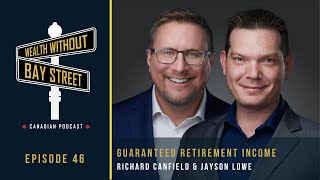
Podcast episode (Wealth Without Bay Street) with hosts Richard Canfield and Jason Lowe discussing using the Infinite Banking Concept (participating whole life insurance) in Canada to engineer guaranteed retirement income. They contrast policies with registered retirement plans (RRSP/RRIF), highlighting risks in registered accounts (market, tax, mandatory RRIF withdrawals starting at age 71, and longevity risk). They explain that participating whole life cash value is contractually guaranteed to grow to match the participating death benefit by age 100, describe borrowing against policy cash value in retirement (loan that is extinguished by death benefit), and give family/estate examples (e.g., $1M in RRSPs vs. $2M+ tax-free life insurance windfall) to show how insurance can provide certainty, liquidity for taxes, and tax-free transfers to heirs. Episode date references: hosts say the recording occurs January 8, 2021.
Questions this video answers
January 8, 2021.
Starting the year you turn age 71 you are required to begin withdrawals (convert RRSP to RRIF and take prescribed withdrawals).
They state the cash value is contractually guaranteed to rise to match the participating whole life death benefit by age 100.
Example: combined $1,000,000 in registered retirement savings plans — $500,000 for each spouse (mom and dad).
Example: Dad has a $1,000,000 life insurance death benefit and Mom has a $1,000,000 life insurance death benefit.
Chapters
Well, and here's the other really cool thing about that. You talked about certainty, Jay, and that you know, well, what do you want? Do you want certainty? Well, you can build and plan around that certainty. Now, the day that you set that plan in motion or you beat, you begin going down that journey and the day of certainty that you're looking for in between, there's a gap of time and there's, that's where a whole bunch of more life is going to take place. Well, along that road of life, what will also take place, it must, because it happens for everyone. We just often can't see it. Opportunities are going to come knocking at your door. And you now, because you've instituted the plan that creates the certainty you want or you're looking for, you also have built in the opportunity fund that allows you to now make good decisions or may be able to access and take advantage of these opportunities that will arise. Because Nelson said that opportunities will hunt you down when you start building up a reservoir of capital. You are listening to the Wealth Without Bay Street Podcast, a Canadian guide to building dependable wealth. Join your hosts Richard Canfield and Jason Lowe as they unlock the secrets to creating financial peace of mind in an uncertain world. Discover the strategies and mindsets to a financial future that you can bank on.
Being able to grow guaranteed retirement income income.
Richard Sounds good.
Welcome. Welcome to the show.
It must be too good to be true. Jason. Well, there's no way that that could happen, right?
Let's have a conversation about it and let's, let's see what conclusions our listeners draw.
Ooh, excellent. So seriously, if you can actually draw and you're listening in and you can draw out in your own like, you know, like a doodle of some kind that you want to send us, that would be cool. We need like a submit your submit your we without Bay street doodles here email address.
And being that today is January 8, 2021, this, you know, early in the new year we start to see a lot of messaging in the marketplace, messaging around and articles and things on Google and you know, talking about and now Facebook talking about retirement. And the most common I guess method that people go about saving for retirement is they maximize registered retirement savings plans. I think that would be something that would be most common. Would you agree?
Well, I would agree but I would quantify that. I'd add an extra or in brackets statement there that the way that you said the way that most people or most Canadian families go about doing that is through their savings is through registered retirement savings but you and I both know, and most of our clients know, that that is not actually savings. That is an account that has been misclassified and mislabeled that simply tracks how the government will tax you on that money at some future point in time. It's generally invested in something, typically with your local bank or your, your primary banker or your group company plan in some form of investment vehicle, generally wide paintbrush in mutual funds, which seems to be the common theme. And so it's actually an investment plan, not a savings plan.
Very good clarification there. And we would ask those listening to this episode, if you had the option to create guaranteed retirement income versus non guaranteed, which option would you choose? Now, logic would dictate that you choose the guaranteed option if you're motivated to have a guaranteed retirement income. And the more often that we talk about becoming your own banker. The infinite banking concept. Nelson stated very clearly. R. Nelson Nash, the developer, the pioneer of the process, he said this process is not about addressing the yield of an investment. It's all about how you go about financing the things in your life, which can certainly include investment. It's all about taking control of a function. But we also get the question, it's coming up often where people say, okay, well what happens when I'm in retirement? So if you understand the truth that your money must reside somewhere and you're exposing money to the risk of loss, which is the inherent definition of risk, that's a person's privilege. They could choose to do that. Whereas if you're putting money inside of a policy or system of policies, the insurance companies have aptly named that phase of a person's utilization of the policy as a preferred retirement solution. Now we're going to take that a little bit further and clarify that. Again, the policy itself or the system of policies, they're unilateral contracts. They're not an investment. And we know that the accumulation of cash value inside of those contracts is contractually guaranteed. Say that again. Contractually guaranteed to rise to match the total death benefit by age 100. And so let's map out a real simplistic scenario.
I want to quantify something on there real quick, Jason. So to match the total participating whole life insurance death benefit at age, not any other types of death benefit, they may be added into that, such as a term rider. Term rider, which might have a variety of rationale reasons for existing, but the cash is going to grow to equal the participating dividend paying whole life death benefit at age 100. Whatever that value becomes as Progresses forward.
And so you've got, in this scenario, so you've got a fellow who's 45 years old and he runs a, basically a dental practice. So to put that together, you know, the gentleman had to build basically his operatories, hire staff, put equipment in place and you know, to, to run the.
Practice, take about 15 years worth of school, mess around in people's mouths to figure it all out.
Yeah. And you know, thinking, okay, I'm, I'm, I'm running my business and I know that someday I'm going to exit this business. I'm either going to retire, I'm going to get sick, I'm going to die, or I'm going to sell my business. And the question is whether you're a business owner or a T4 income earner, asking yourself the question, are you prepared? And what does prepared really mean? It's having a crystal clear understanding of what you believe you're going to need, how long you believe you're going to need it for. People are living longer than ever. The fastest growing segment of our aging population are centurions. And so the question I would ask is, what if you live to age 100? Because when we talk to people, for whatever reason, people have it cemented in their minds, right? Because they say, well, I'm not going to live to age 100. You're probably right then.
Right.
You become what you think about all day long.
All day long.
And so it's again going back to this dentist starts putting money into a policy and is using that policy or system of policies to finance things that they would have gone to an outside lender for X ray machines, operatories, inventory, just things that they need to run their practice. Well, think about the person who's out there working and earning a T4 income. If they have discretionary money, they have to store it somewhere. They start putting it inside of a policy or system of policies. They're financing through their system the things that they need throughout the course of their lifetime and then they reach the age of retirement or what we like to say is taking yourself out of service. And a cautionary note to everybody who's listening, when you reach retirement, if you're not keeping yourself mobile both mentally and physically, then there's one force that you're fighting against and that force is gravity. And gravity wants to pull you right into the ground.
Yeah, about six feet under generally.
Don't be low hanging fruit for gravity. Keep yourself busy, keep yourself in service and stay mobile mentally and physically. Well, you need money and so if you've accumulated money inside of a tax deferred tax postponement plan, well, first of all, you have no idea what the guaranteed balance of that account is going to be, not only at the time of your retirement, but throughout your retirement. You have tax risk, you've got market risk. And so if you're able to eliminate those risks by utilizing a policy or a system of policies, logic would dictate that's probably the better solution or the optimum solution for you.
There's one other risk too, and that's longevity risk. Very good point. And that's more, that's even more, more prevalent when you look at that type of account. So we're referencing a registered retirement savings account, which has, again, specific tax regulations and rules around it. But starting the year that you turn age 71, you, you are required, you're mandated under the prescribed rules to start withdrawing out of that. Because the government's been waiting for their tax dollars for a period of time to get them, and they're not waiting any longer. They have no sense of humor at all. They're not going to wait any longer. And they're going to force you to start withdrawing that and taking their tax component of it out of the equation. Well, that rate of withdrawal, it adjusts yearly so that they can make sure they get all the tax that they're due to over a period of time. And so it also creates another risk around, like if you're living longer, how, how much you're taking out of that machine isn't necessarily up to you.
Well, the longevity risk. The fact of the matter is, is that longevity risk is what drives all those other risks that I just mentioned. Because the longer you live, the longer you're exposed to those risks. And so if you, if your objective is to ensure that you have enough money available to you throughout your retirement years, then what better place to have it reside and available to you than your policy or your system of policies? Because when you're accessing money, you're not withdrawing from your policy or your system of policies. You're borrowing against it and you have a death benefit that will extinguish your loan balance when you die. And that day will come. Anyone who's listening, you have a best before date. Whereas if your money is exposed to tax risk and market risk and longevity risk, et cetera, then you will experience volatility throughout retirement. And what would a person rather have? Well, the dentist says, listen, when I'm ready to exit my practice, I want to make sure that I have guaranteed retirement income. Okay, that can be put into place for you, the T4 income earner, hard working Canadian family who says, look, when we reach the age of retirement, we want to make sure that we have a guaranteed stream of income available to see us through the rest of our lives. That can be engineered as an outcome for you without hoping and praying, without ever losing control of your money, without taking on unnecessary risk. That is possible. So not only did you realize the advantages of becoming your own banker, the infinite banking concept, throughout all your working years, and you've been able to change the flow of the money and have it coming back to your family and then have a guaranteed stream of income throughout retirement. Well, when you die, you have a death benefit that extinguishes any indebtedness that you have and then it replenishes the asset back to the family. And that can be engineered to be all the premium that you've ever put into the policy or the system of policies, or all the premium and all the money that you've ever spent. And so that gets people excited about that retirement phase of their life. And what we're trying to do as coaches is be able to share and emphasize that you've got to stay mobile mentally and physically. It's so important. Otherwise you become low hanging fruit. Forget for gravity, which you don't want to do. And.
Well, I want to speak to that one more time too, Jason. We're using again, we're using society's word. We're using the word that we've been trained to use, which is this retirement word. Right? And, and that's because that's what people are accustomed to, is what they're familiar with. But, you know, I'm happy to say in the podcast that I personally think that's the biggest swear word in the English language because I don't, you know, I really dislike, I personally dislike the vocabulary and the word, the word choice. And part of that's because I learned that from Nelson. Nelson didn't believe in the word retirement. You know, and Nelson worked right up until, you know, he was calling people and reaching out to people right up until his very last day. That's because he was passionate about what he did. And so he believed in the work and the value of work. And the reality is because he loved what he did, it may not have felt or seemed like work, even though that's what it was. So when we think about the idea or the concept of what retirement is, it's to, it's to stop working. Or working at the current thing that you're doing. So what I would just encourage people to think on is maybe that's define what retirement really means for you. But if it's to stop working entirely, then replace some component of that with something that you are passionate about and start working on that so that perhaps that what retirement is. And so that's what Nelson said. This idea of people retiring at age 65, well that's a concept that came into being when people weren't even living to age 65.
That's right.
And so people are living way, way longer. But we haven't moved the other date forward to in progression with that. So he really suggested that people should at least be focusing on working until they're 70. Because you know, really today like 70 is the new 65 like people are. We have with all the health advantages that we have today and in our population base is, you know, all the, all the amazing, amazing health technology that's coming out. And so really consider, and what would that do for you? What could that, that extra five years create in, in the next 30 years of your life by doing it? And so it's just a way to think, think it through a little bit differently. And, and I know you and I both listen to Peter Diamandez. He's got a great podcast with Dan Sullivan called Exponential Wisdom that's really helped me reframe my thinking around what longevity looks like. And it's been good context for me to, to start think, challenging my own thinking around that environment so that with.
Our listeners, oh, that is so good. And people want certainty. When you have certainty, your stress levels go down. You feel more hopeful, you feel more optimistic, you feel more relaxed. And so being able to structure things in a way that provides you with certainty has ancillary benefits outside of what accumulates inside of the policy and what's available to you and what shows up as a tax free windfall when you pass away. And you can do this both as a business owner and as a household. Your corporation can be the owner, the premium payer, basically structuring this so that the corporation is taking care of you in your retirement years and you're still transferring wealth to the next generation on a tax free basis. And you're avoiding double dipping from the government in terms of triggering taxable events. You're replenishing the asset back to the family. You're automatically increasing the value of the business if you decide to sell it. If you're a household understanding that in the future you've Got certainty of income. You have certainty of knowing that no matter how long you live, in fact, the longer you live, the better it gets. So if you die early, you'll be a hero to your family. If you live long, you'll also be a hero to your family.
It's also Bob Shields used to say, right, you did okay if you lived, you did okay if you died.
Yeah, yeah, good point. Exactly. And if you think about, again, the fundamental truth, your money must reside somewhere. So what better place to have it reside than inside of an instrument that guarantees the outcome and provides you with certainty, which triggers all of those other ancillary benefits that I've already mentioned, versus we're talking to people every single day who say, look, the government is spending money at record pace. Someone has to pay the bill. And do you believe, and Richard, I'll ask you this question. Do you believe that the government's going to require more or less money in the future? Which one is it more and where's that money going to come from?
It can only come from one location, and that's taxable accounts. Taxable accounts, yeah.
And so whether it's taxable income, taxable retirement savings plans, whomever has the gold makes all the rules. And so do you want to be in possession of the gold and making all the rules? If so, then exploring this process is one thing. But even if you chose not to implement, becoming your own banker, the infinite banking concept, understanding that the policy is a tool and as it relates to creating guaranteed retirement income, it's the best tool for the job.
Well, and here's the other really cool thing about that. You talked about certainty, Jay, and that you know, well, what do you want? Do you want certainty? Well, you can build and plan around that certainty. Now, the day that you set that plan in motion or you beat, you begin going down that journey and the day of certainty that you're looking for in between, there's a gap of time, and that's where a whole bunch of more life is going to take place. Well, along that road of life, what will also take place? It must, because it happens for everyone. We just often can't see it. Opportunities are going to come knocking at your door. And you now, because you've instituted the plan that creates the certainty you want or you're looking for you, you also have built in the opportunity fund that allows you to now make good decisions or may be able to access and take advantage of these opportunities that will arise. Cause Nelson said that opportunities will hunt you down. When you start building up a reservoir of capital. And our friend Ryan Griggs, he talks a lot about capitalization versus investment because the two are almost the antithesis of one another and the advantages that capitalization has. So I just really think it's important for people to understand that you can build a plan around certainty and then you can augment and increase and enhance that plan by having the plan itself be available to create the things that will enhance it.
Think about this. In retirement, you've got mom and dad, they're now in retirement. They have no debt, okay? House is paid for, the cars are paid for. They're carrying around a purse in a wallet with credit cards that have no balances on them. And they've got this enormous reservoir of capital that they've accumulated throughout their working years. They have a system of policies in place. They have certainty. Their adult children are living in homes that aren't paid for, driving vehicles that are financed by by someone else's bank and carrying around purses and wallets with credit cards that have revolving balances. Mom and dad have the opportunity to sit down and say this is a way for us to expand. Becoming your own banker by taking control of the banking function as it relates to our family members needs so we can access a pool of money without interrupting any of our own daily cash value accumulation for the rest of our lives. We can help our adult children, we can take over that, that banking function because someone has to perform the function. And now the kids are changing the flow of the money used to leave.
The families, used to leave the family.
System coming back to the someone else.
Is coming back in.
And mom and dad now have money that would have been going to an outside lender. It's showing up in their pocket. They get to utilize that capital knowing that when they pass away their death benefit is going to extinguish any loan balance that they have and deliver to their surviving family a tax free windfall which can be used to backfill the banking system that the surviving family has created, which hopefully has loan balances as well.
And in that scenario, whatever payment or flow of payments that were previously heading to the third party lender that were redirected to the parents. Well, any interest component that the third party lender would have earned that went to the parents, the parents by default through the system's design are passing that interest capital back to the next surviving members of the family because of the tax free death benefit that shows up, which means you're the adult child in that situation. You know, you had your Mortgage, where you just had the parents take care of the mortgage. You wrote agreement. You sign an agreement to a commitment, because good commitments are important. You're redirecting the same payment you were giving someone else back to mom and dad. Well, you're going to get all your money back because sooner or later mom and dad aren't going to be here. That's just the course of the way the situation goes. And then that capital, that flow of money that was going to them, that they were able to use and prosper with, so you all had more family joy, is now being returned to you for your own ability to reuse.
And how often have you heard about that happening outside of this process? Here's what we see happening. We see families who have experienced this in the past where mom, dad, one of them, both of them pass away. And the affairs, the estate planning was incomplete or not even commenced with.
Nobody talked about money in the family. Nobody talked about it because subject.
No, everybody thinks, oh, you know what, it's going to be fine. You know, the affairs are in order to. And then they have to go through basically taking care of the terminal tax returns and valuing the estate and going through this process, which takes time. And if there are taxable events that get triggered as a result of deemed disposition, well, now you're in a situation where the family is uncertain. There's stress, there's pressure. There's definitely going to be arguments because not everyone's going to be on the same page in terms of what did mom and dad want us to do? How do they want us to take care of all these things? And a fight can erupt over something with even little to no sentimental value. And it erupts into this volcano and then it breaks families apart from. And it creates animosity. And so that can all be avoided. It is completely avoidable. And if you can put capital inside of these policies and sleep easy at night knowing that the value is only going in one direction up, then how much capital do you want residing there?
There's another thing that happens in that whole situation too, Jay, that, that I think is important to mention. And that's, you know, you mentioned all the, obviously all the emotional, you know, turmoil and stuff that happens. That is. That is the most important part. But connected to that, because we're talking about the financial aspect of it, is the things that the parents have spent a lifetime building, you know, like getting the house paid for. Well, then the kids end up. Often end up with a house that they don't want anyway.
Right.
We live in different areas, we moved across town, we moved to another country, we're not even around. Now they got to deal with selling the house. What ends up happening is it gets settled at an estate sale, usually at a discounted price. So all the value that was built up and created by paying that thing off and then leaving something behind for the kids, they get less of the thing that they wanted to leave behind because it's not dealt with in an appropriate format. And the reality is, do the kids want the house or do they want, would they be better off just getting tax free money? Who should spend the house?
Well, let's take that one step further. You know, mom and dad have accumulated $1 million in their registered retirement savings plans. Dad has a half a million, mom has a half a million. Simple math. So actuarially, Mom's going to live a little bit longer than dad. While they're in retirement, they start withdrawing from these retirement savings plans and dad passes away and he's got a $200,000 RRSP balance that automatically rolls over to Mom. Now mom has, again, simple Math. She's got $700,000 inside of this registered retirement savings plan. At age 71, it's converted to a RRIF, she begins the minimum prescribed withdrawals. Now in this scenario, when dad died, there was no insurance, okay? So she's withdrawing, withdrawing, withdrawing. And God forbid the unthinkable happens to Mom. She passes away and she's left with a half a million dollars in the registered in the RIF account balance. That entire amount is added to her terminal tax return as income. Now I've looked at a lot of wills and I've looked at a lot of estate plans and not one will, not one estate plan has named Revenue Canada as a primary beneficiary. Can you believe that? But yet that's what ends up.
They still end up with the money.
They still end up with the money. And let's change gears for a second. Rewind. Let's go back. A million bucks in registered retirement savings plans. Half a million for dad, half a million for Mom. Dad has a life insurance policy with $1,000,000 death benefit. Mom has a life insurance policy with $1 million death benefit. Dad passes away. 200,000 automatically rolls over to mom. She has 700 grand inside of the RSPS, plus $1,000,000 tax free windfall. She passes away. Half a million dollars inside the rifle and $2 million tax free money that's been left behind to whomever she's named as beneficiaries. There's no probate. There's no waiting to settle the estate. There's no arguing, fighting, arm wrestling. The money is there to pay the tax bill on the terminal tax event that happened when mom died with her rifle. And there's a large windfall of tax free money to take care of anything else in the estate for mom. And then what have we done? We've transferred money to the next generation and Revenue Canada wasn't invited to that. It's non taxable money. And so if you look at it from that vantage point, in which scenario do you believe there would be the most certainty and the least amount of stress, the most amount of hope? Everyone's relaxed. Well, obviously it's the scenario where the insurance was involved.
And on that note, Jay, the insurance being involved based on the ages that you're talking about with these individuals, well, could they have term insurance to do that? It's possible, but it's highly unlikely because by the time they get out to that age, they've likely gotten rid of whatever term insurance they have. The cost of it to maintain it for that period has become cost prohibitive. So had they not made decisions previously to be able to start implementing some permanent coverage in place to make that a reality, then, then, you know, so this is a beautiful scenario, but it takes some planning and some plotting and some decisions to get to that phase. And so the key thing, the takeaway here is that when's the best time to plant a tree? 20 years ago. The second best time is right now. Today.
Right now. We people tell us all the time, Rich. Oh, where were you guys 10 years ago?
I wish I would have known this.
Well, you can't say it 10 years from now. You're listening to this episode right now. And so if you want to engineer guaranteed retirement income, then you've got to do one of two things. You've got to connect with your coach that you're already working with. Hopefully it's with our organization. And secondly, if you're not, if this is your first exposure to this discussion and this process, then take that important action step. Schedule a time, have a discovery call. Let's see what we can do to help you engineer a guaranteed retirement income. That concludes this broadcast. And for those of you on the YouTubes, as always, take a look at the playlist. There's some recommended there or here.
We got a point of these directions, a link to click on another really cool video that probably has one of our smiling faces on it.
If you're new to wealth without Bay Street Welcome. Please take in some videos, some more episodes. There's a lot of great content for you. There'll be some information in the show notes if you want to have an expanded conversation on engineering a guaranteed retirement income. There'll be some details in the show notes on how you can schedule a discovery call and and start down that path.
And really quick. Just something that popped in for me. Just kind of a little trivia tidbit here. So looks like we have a ton of our listeners who are using Apple podcasts or itunes or equivalent. Okay. But we've had a huge rise and increase in people using Spotify as a platform for their podcast listening.
Maybe we can get a hundred million.
Dollar deal if Joe Hogan hey, we can get some life insurance, but I just thought it was really interesting. So whatever platform you're listening to us on, whether it's on the YouTube or it's on your preferred podcast player, we appreciate you just coming in to get the content and fill your brain, fill your soul with some stuff. And we look forward to you staying tuned for the next episode. Cheers.
Thanks for joining us.
Thanks for listening to the Wealth Without Bay street podcast where your wealth matters. Be sure to check out our social media channels for more great content. Hit subscribe on your favorite podcast player and be sure to rate the show. We definitely appreciate it. And don't forget to share this episode with someone you care about. Join us on the next episode where we continue to uncover the financial tools, strategies and the mindsets that maximize your wealth.
More from Richard





How Do You Use a Policy Loan to Buy Dividend Stocks? #dividendstocks #infinitebanking #shorts


Can Compounding Dividends Pay Your Bills? #wealthbuilding #investment #financeeducation


Should a Corporate Policy Offset Your Personal Coverage? #shorts #insurancetips

What Is Human Life Value? #shorts #insurancetips #dividend #wholelifeinsurance