RPU vs Policy Loans Explained | Whole Life Insurance Myths Busted (Nelson Nash’s Rules)
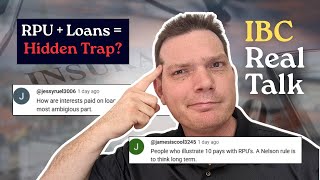
Richard Canfield explains reduced paid-up policies and policy loans in whole life insurance using Nelson Nash's framework. RPU permanently cuts your death benefit and stops premiums, and should only be used to preserve a policy. Policy loans charge interest (example: $10,000 at 5% costs $500 yearly), and paying that interest back plus extra grows your cash value.
Questions this video answers
Page 54.
Bottom of page 58.
$500.
Chapters
All right, it's Richard here with wealth on Main Street. Got a couple of great comments, great questions. These come from one from Jesse, one from James. So I'm just going to reply to these and hopefully you guys get some great value out of this. So the first one is illustrating ten pays with rpus. And what exactly does that mean? So an RPU is something that a lot of people may not be familiar with. It's insurance acronym, it stands for reduced paid up. Essentially what happens when a policy is in air quotes rpued. It means we take the total cash value or whatever is available in that policy and we're saying to the life company, hey, at this point in time we're, we've got this asset, we don't want to put any more premiums in. Can you take what we have and give us a paid up policy that never requires more premiums in the future? In other words, we're going to reduce the total death benefit, but we're going to have it fully paid up. So if we wanted to pay more premiums, we actually can't do that. We're not allowed anymore. It still has all the same contractual elements, however. It's now a reduced policy, but it's fully paid up, meaning you can't pay any more premium because once a policy is paid up, you're not allowed to pay any more premium. So that's kind of what that works like. Now people illustrate these and that may vary based on US and Canada. Of course there's very differences there. A lot of times when people are looking at different illustrations with an advisor or they might see an illustration that shows a limited amount of years where a policy is funded. As an example, 7 years, 10 years, 20 years, 25 years to age 65. Insert whatever number you want here. Just because that's being illustrated doesn't mean that's what's actually happening. Okay. Sometimes a person will look at, in fact, this happened in a client experience with me the other day. I was looking at an illustration and showing them something for the purposes of having a discussion, not for the purpose of here's what you're going to be doing. And, and in that discussion we explored what would happen if we, you know, if the client decided to not put any more premium in at a certain point in time. So for the sake of my example, let's say we looked at 10 years and then starting in year 11, there was no more premiums that they were going to contribute. That is not a reduced paid up policy that we looked at. Instead it is a policy that is a life paid age 100. But we were showing in year 11 that there was no more premiums coming out of pocket. A premium was still needed. There's a base premium to the policy and there was a premium still required. But in the example I was looking at for our discussion, that base premium was now funded from internally in the policy. So there's external money coming in, external premiums, that's from your cash flow from savings, et cetera, paying your premium out of your own pocket. And then there's internal premium paying. That's where as an example, dividends are now being used to pay the premium or the bulk of the premium. And if the dividend isn't big enough, let's say the premium is $5,000 and the dividend is only $3,000. We have a gap. There's a $2,000 gap missing. Where is that gap coming from? Well, in the scenario of that we refer to it as dividend offset. I'm using a lot of air quotes here, but dividend offset, that's where. Now we're going to use the dividend to pay the premium, but we're going to, if there, if the dividend is not large enough, we have to sell back or effectively surrender paid up addition death benefit that's been accumulated to fill that gap that's there. Okay, so that's called a dividend surrender. In fact, if you have Nelson's book, Nelson shows a variety examples in his book where that exact same thing takes place. And just to give you an example, for anyone who's got a copy of the book in their hands, if you go to the Equim financing section and we look at the very first illustration, it's the easiest place in the book to find that. You'll find that on page 54. Okay. Of Nelson's book. And in the, in the book you'll see he's putting premiums in only for four years and then he's showing no more premium outlay. It doesn't mean that a premium is not being paid. This isn't a reduced paid up policy. It is a policy where the, the, the policy is, still has the ability to pay a premium. He's just not showing it coming out of the, the person's pocket. It's coming from the internal machine of the policy. And the way you can verify that is if you scroll over to the total dividend column and it's about the fourth or fifth column and you scroll down, eventually you will find a point where at line 17, sorry, year 17. If you scroll across, you'll see the dividend in that example is $15,634. Well, the dividend at that stage is now large enough to pay the entire minimum Premium, which is $15,000. And so you can see in the book, there's highlighted areas where there's, you know, different numbers highlighted. You'll notice that the death benefit went up, up, up to year four. And then in year five, it starts to come down, it continues to come down until line 17 where it begins to go back up again. That's because we were surrendering paid up insurance to fill that gap between the size of the dividend and the 15,000 premium that was necessary. So that's what an example of dividend offset is. So sometimes when we're looking or, you know, a client or an advisor, they're having a discussion and they're looking at various illustration examples, there might be discussions about the uniqueness or the circumstance of that individual's life. So they might look at examples where maybe they're showing premiums not being funded for a period. But if you're working with our team, we're always talking about and educating on the importance of continually paying that premium. Take you back to Nelson's book on page 85. Point number two is if you knew at passive income time you would be getting back every single dollar you put into a system potentially tax free, would you ever object to putting more into it? The answer, obvious answer, is no. It's a rhetorical question. So it's always important to have the ability, the contractual right, the contractual authority, to be able to pay a premium. If you choose not to pay it in a given year because the policy is strong enough, or there's a circumstance in your life where you're not able to, then you want to have the ability to choose maybe to opt out or to not pay a premium, but you don't want to give up the ability to pay a premium. If you have a windfall event, you have an inheritance, you sell a rental property, you have a large tax refund, you sell a bunch of things on ebay, your stamp collection, whatever the circumstance is, you start a new side business. Any number of things could happen in your life. You always want the capacity to be able to pay a premium. You never want to be able to turn that off. So not a fan of reduced paid up policies. I think they should only be utilized in extremely select circumstances where as an example, there's been a major financial change or a hiccup at the policy owner level and they're no longer able to afford the premiums for some drastic reason. Or perhaps they have simply given up incorporating this process in their life and they've decided, you know what, I'm considering canceling the policy hypothetically. And if that's the case, then you might give up all death benefit and not have any protection for their family and not even for their final expenses should they pass prematurely. And if they're older or they're a stage where they're uninsurable, they now run the risk of no longer being able to get coverage if they change their mind. So that's a scenario where a reduced paid up might make sense given the circumstance. And it's an option that should be presented to individuals if they're facing those type of financial circumstances or mindset circumstances where they're for whatever reason no longer interested in maintaining a policy. That's the only time that I believe personally, and this is my opinion, that a retirement reduced paid up should be considered. There are individuals who exist out in the marketplace in on the YouTube and the TikToks and the tweeters and all these different places who might show or promote an example of a reduced paid up. But it should be, you know, utilized in extremely limited scenarios and in my opinion should not be part of a financial strategy. It's part of a preservation mechanism if things go sideways. Yes. Part of an actual strategy that's built up. Absolutely not. Okay, so just be clear, what is a reduced paid up? Okay, it's an actual official change to the policy. It's a permanent change. It can't be undone. Once it's done, it's complete. You can't fix it. It eliminates the ability to pay more premium. Because it's fully paid up, they can't accept more premium. It stunts the policy drastically, which is another reason why I don't think it should be considered. And it's not really thinking long term. And so it really does defy one of Nelson Nash's primary rules, which is to think long range. It also defies one of his rules, which is don't be afraid to capitalize. If we were moving to reduce paid up, we can no longer capitalize ever. So it's now in contravention of Nelson's rule, don't be afraid to capitalize. So there you go, that's what it is, paid up. Now the next question we got is how our interest on policy loans or paid paid on loans are recovered. If you're paying interest on a policy loan that it's a bit ambiguous and it's. You're correct, it is a bit ambiguous. So let's be clear about some of the technical aspects here. So when you take a policy loan, if I take a policy loan, let's just say I took $10,000. And to keep things, just keeping everything very, very simple, let's say the interest rate was 5%. If I send zero payments for 365 days an entire year, I will accumulate interest on that loan of $500. $10,000. 5% equals $500. That means I have increased the loan from 10,000 to now 10,500. It would accumulate that interest and it would now roll over. Let's say that was the policy anniversary date. It now rolls over and the new loan is $10,500. So interest is accumulating to the life insurance company. That's where I borrowed the money from. The life insurance company must charge interest. They have to charge it because they have to put money to work. Anything that's in the big giant pool of the insurance company must be put to work for the benefit of the policy owners. Well, if I'm the policy owner and I took a policy loan and they're going to charge me interest, they're collecting that interest to benefit everyone, including me. Because I co own that asset of that pool, they're required to, to steward that money for the benefit of all the parties involved. Okay. It's kind of like a closed loop ecosystem. There's a lot of people in the aquarium, if that makes any sense. Now, if I actually repaid that interest and I pay, I paid the policy loan back, plus whatever interest the life insurance company charged, that interest goes to life insurance company for the benefit of everybody. But they are investing money and putting money to work in multiple areas. One of the areas is with me as a policy owner, they collect all that together and they use it to offset other costs and all the things that are going on. And then there's dividends at the end of the year that they pay out of the profits. So they have profits. They take some of the profits and set some aside for a contingency fund. And then they distribute profits as a dividend. Well, that's where it comes back to me. Now, the exact interest I paid, let's just say it was 500. It doesn't mean I get the exact equivalent of that back because it's all part of a larger ecosystem. That being said, here's again, here's where the technicality comes in, because I borrowed capital from the life insurance company. My capital, my asset of cash value continued to grow uninterrupted over the exact same time frame. So over the span of that same year, the cash value increased because I'm still alive. I'm taking air into my lungs, I'm still breathing. So that cash continues to rise because it's chasing after a future death benefit. So now if I did repay the loan, I have access to that $10,000 again. Plus I have the increased value over that timeframe where the policy was going to increase anyway. So I didn't get the exact interest I paid the life company back. But you could say that from a proposition of similarity, there is an accumulation in cash value which could represent, or you could look at as similar to what I paid in interest to the life company. So it's not the same thing. We're not saying that you recaptured all the interest that way. However, you could say that because the policy is still accumulating, there's the effect of appearing as though interest was recovered. Interest I pay, the life company goes to life company. Life company pays dividends to policy owners. Those dividends come back, the dividend, a portion of that dividend is going to be interest that's paid on all policies that go to benefit everyone in the life company. So that's kind of a roundabout way of looking at it. So I hope I answered that question. Yeah, it is a bit ambiguous because we like to oversimplify things. The reality is you take policy loans, you pay interest, the interest goes to life company, you co own the life company. If you're a good steward of money and you're paying yourself interest, which means you're paying more, more than what is required by the life company. And I'll reference Nelson's book again. This is often overlooked section of Nelson's book, probably one of the most important pieces and it tends to be a very confusing component. We've got lots of content on this. This is page 58, bottom of page 58. There's a footnote at the bottom of that page in Nelson's book. I'll read the footnote here. It says actually this interest, and this is in air quotes is not really interest. It is additional premium or capital that has been paid into the policy that equals the interest that was being paid to the finance company. That is the reason it is adding to the cost basis of the policy. So Nelson's specifically referencing the equipment financing example and he's showing why the equipment financing numbers get better each and every time. It's not because the business owner was taking policy loans. It's because he was paying himself more than was necessary to repay the loans he took out. He was paying himself the equivalent $1,500 a month payment that he had to give the original finance company for buying trucks. And he was making sure that those payments, that extra interest component that he would have paid the third party, was going into premiums in his system. That's why you can see, if you look at equipment financing, why the capital outlay, cumulative net outlay column continues to rise over time. That's a representation of extra premiums that went in. The only thing that makes a policy grow more is more premium. So how are you getting that premium in? And that's where the mindset and the education, training and coaching comes in. By working with an advisor one on one and attending, you know, group sessions and continually learning, you start to figure out how to implement that in your life. The way that you move money in and out of your life right now might be unique to you. There's some, there's similarities that we all have, but there's going to be differences in the daily activities and the annual activities that you take. How are we working with what you're doing already and making subtle and slight changes and then doing them on a regular recurring basis so that you can optimize your behavior and policy activity to create a really good outcome. And keeping in mind the core elements that Nelson taught us, okay, you got to think long range. Don't be afraid to capitalize. Don't steal the P's. In other words, don't take a policy loan without having a provision for how you're going to pay, make payments back and put more back than what you took in. That's pay yourself an extra interest so that you have more capital available for future endeavors. And then we've got, of course, don't do business with banks. So as soon as it's reasonable, try to cut those banks, third party banks out of your life. And then lastly is rethink your thinking. So you're always going to be reevaluating this as you learn more, grow more, you're going to tweak and adjust and modify how you use the machine that you built. So I hope that's helpful. Let me know if you have any more questions. Go ahead, leave a comment below. And we love tackling these questions as we go. Cheers.
More from Richard





How Do You Use a Policy Loan to Buy Dividend Stocks? #dividendstocks #infinitebanking #shorts


Can Compounding Dividends Pay Your Bills? #wealthbuilding #investment #financeeducation


Should a Corporate Policy Offset Your Personal Coverage? #shorts #insurancetips

What Is Human Life Value? #shorts #insurancetips #dividend #wholelifeinsurance