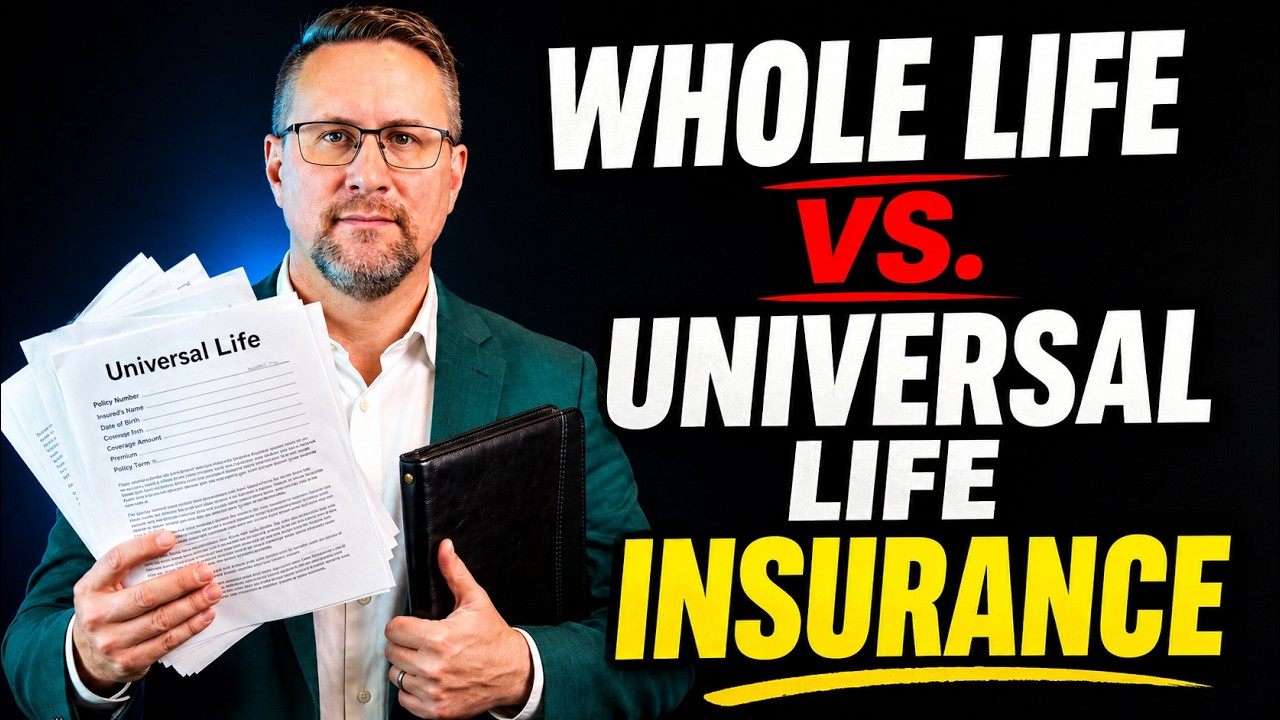
In this conversational video, host Jason and insurance expert Richard Canfield compare dividend‑paying participating whole life insurance with universal life (UL) policies. They explain that whole life offers contractually guaranteed daily growth, a fixed death benefit, and the policyholder bears no investment risk because the insurer manages the cash value. UL, by contrast, is described as a term‑life base with a “slot‑machine” cash account that the policyholder must actively manage, exposing it to market returns, fluctuating costs of insurance, and the risk of policy lapse if premiums rise. The discussion highlights how UL policies can implode when market conditions change or when owners fail to fund them properly, citing class‑action lawsuits against advisors who sold poorly structured ULs. They note that whole life policies, especially participating ones, provide stable, tax‑advantaged growth and are suitable for strategies like Infinite Banking, whereas UL requires ongoing effort and carries higher uncertainty. The segment also includes a promotional plug for the Elite Advisor Network, aimed at financial advisors seeking advanced training and AI integration. Canadian versus U.S. UL structures (YRT/ART vs. level cost) are briefly mentioned, underscoring cost‑of‑insurance volatility in UL.
Chapters
Universal life is like term life insurance with a slot machine attached to it. Not that that's a bad thing. A par whole life contract, it has engineered outcomes. Universal life is assembled.
You meet people constantly who have these kinds of structures that they might have looked good on paper when they were sold originally, but the market has changed. Their behavior got in the way. They're going to end up with an imploding policy when they need the coverage the most. They end up not having it. What is the difference between whole life and universal life?
Dividend-paying whole life insurance contracts are unilaterally binding. 100% of the risk is with the life insurance carrier, not the policy owner. Universal life is like term life insurance with a slot machine attached to it. Not that that's a bad thing. You have an insurance component, you have a cash account, That gets invested in whatever you choose to invest it in. With dividend-paying whole life insurance contracts, you have guarantees. You've got contractually guaranteed daily growth. You've got contractually guaranteed access to capital. You've got permanent, ever-increasing coverage if the policy is structured that way. You've got contractually guaranteed daily accumulation that you're paying no tax on. You've got a guaranteed death benefit that if it's set up properly, you pay no tax on. You earn dividends because you have a co-ownership interest in the company. You're focused on long-term stability. The insurance company itself manages the investment function of the capital in the insurance company. You have no say, engagement, involvement, opinion in how the life insurance company deploys and invests that capital, which they're far better at it than you'll ever be. Universal life, flexible, more moving parts. Now, for full disclosure—
A lot of moving parts, actually.
I've never illustrated one. I've never sold one. I've never purchased one. I would never utilize a universal life insurance policy for the implementation of the Infinite Banking Concept. It's an investment-oriented contract. You're dependent upon market returns, investment selections, Cost, right, can increase over time depending on the structure. It requires more active management. A par whole life contract is— it has engineered outcomes. Universal life is assembled. That's actually pretty—
That's actually— yeah, that is really good. And the outcome, however, depending on how it's assembled and then maintained, Is extremely variable.
And I would say that neither is automatically good or bad.
Correct.
Neither one.
And then additionally, so like, so there's, there's no maintenance or effort really in a dividend-paying whole life insurance policy. So you can have whole life that's not participating. Pretty boring, relatively useless. Would never recommend anyone have that. But there's a, there's a valid reason case for it that exists for a reason. You can have— so there's some plain old vanilla whole life. There is dividend-paying participating whole life, and then there's a variety of ways to structure those. But in comparison to how many different ways you can structure a universal life policy, I mean, there's a, there's a much wider category because they keep coming out with new additions and variations of them over the years. Hey, if you're a whole life advisor already doing strong numbers, but you know that you could be operating at a totally different level, listen up. We've launched the Elite Advisor Network to serve people just like you. We meet four times a year in person for real workshops with real accountability. You walk out with the exact tips and strategies that you can implement the very next day. We run ninety-day sprints and show you how to crush it in both your business and your life, and how those two things intersect. You'll also learn how to integrate AI as a key teammate so you can become more efficient and deliver more value to your clients. Apply to join now: eliteadvisornetwork.ca, eliteadvisornetwork.ca. And I will say this. So for— in Canada, there is 2 primary ways you can choose to start one of those universal life contracts. And one is with what's called a YRT or an ART. It stands for yearly or annual renewable term layer. And then there's a level cost of insurance layer. Now, in the United States, from what I understand from our colleagues and everyone I've spoken to, you only have the one option, and that option is a yearly renewable or annual renewable term layer. And so it's really low in the early years, but as you age up and you get older and older, well, you have a hockey stick exponential spike as the cost of insurance, as you reach closer to natural mortality, spikes up, which means it, it's got to pull that value from somewhere. So in a world where we've been trained that we quote unquote don't want to pay a premium or want to reduce our outgoing expenses, people want to stop paying premiums. Right at the point in time where the cost of required premium goes up exponentially. And the result is it has to get that money from somewhere to survive. A premium is required for the policy to survive. So it's either got to come from your cash flow out of your pocket and resources, or it has to come from the internal resources, the internal pocket of the insurance contract itself. Now, the same thing applies to a whole life policy. The difference is When you lock it in, you lock in a fixed price point for an actuarially solid, determined period that never goes up. It's inflation adjusted, locked in place. That is not the case with a universal life policy in most scenarios. There is a level cost option in Canada. It's very infrequent. I don't see it very often. Jason, in 18 years, how frequently do you see one of those?
Never. For me, I like— I just don't look at universal life policies You know, that would be like a dentist looking at an MRI.
Like, well, you know, to add some context, so we've had a number of guests on the, on the platform. We've had Todd Langford of Truth Concepts explaining a lot about how these things break down, but we've also had a lawyer whose sole main job right now is dealing with class-action-style lawsuits against life companies and, and, and advisors who sold products based on universal life structures that have never panned out. And we hear constantly and we meet people constantly who have these kinds of structures that they might have looked good on paper when they were sold originally, but the market has changed. They didn't fund it properly. They didn't do this. They took a policy loan. What they thought about loans wasn't accurate. Like, all of the things that they remember or told are totally different, and they didn't follow through on anything because their behavior got in the way. And so, Even if the market performed, which it didn't in most cases, they, they're going to end up with an imploding policy or something that is going to, that potentially will, when they need the coverage the most, they end up not having it. And that is happening unfortunately to a really, really vast degree. So again, it doesn't make it good or bad or otherwise, but being aware of how it is built and the amount of extra energy and effort it takes to make it viable. Versus the— I don't want to say it, but the more closely set it and forget it style of structure because of the built-in guarantees with whole life is just a drastic difference.
Totally is.
The description of a slot, a Vegas-style slot machine with a term insurance policy attached to the side of it is, I think, the most appropriate visual way of considering how a universal life structure for the average There you go. Click here for the next amazing video. And if you want, check the links down below and you can get access to a free book that we've written right to your inbox. Go ahead, do that now.