Why Nelson Nash Called This a Personal Monetary System
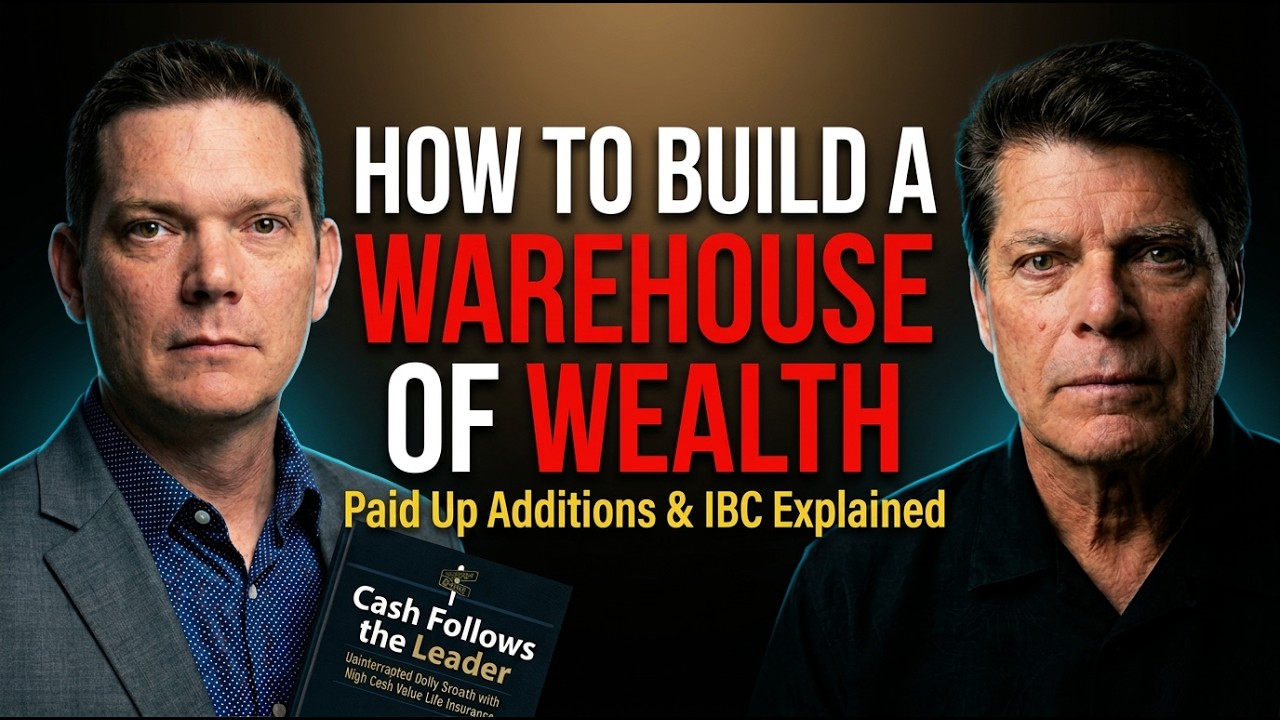
Richard Canfield and Mike Smela explain how dividend-paying whole-life insurance works as a personal monetary system. A $10,000 premium instantly adds $50,000 in death benefit and borrowable cash value. Policy owners can become their own bankers by using the insurer's money as collateral for loans.
Chapters
It's all about building your own warehouse of wealth. It's completely backwards from what we've always been taught. Is it a coincidence that through all the major financial events we've encountered in the past 100+ years that the life insurance companies remain the most financially solvent companies in the world? Not a chance, folks. Think about all the financing needs over our lifetime. It is considerably more than the amount of the total death benefit that we start with.
Hey, it's Richard Canfield here. We've got a great new series that we're launching on Wealth on Main Street. I'm excited for this. One of our incredible advisors, Mike Smela, is going to be walking through our book Cash Follows the Leader. He's going to be going chapter by chapter, sharing all of his notes, his incredible observations, and the critical takeaways— the things that really stood out for him along the way. Now, he brings a breadth of experience and life experience on running different businesses, of course, and embracing this concept of becoming your own banker in his own life. Plus how he is now teaching that concept to other people. So you're gonna get a lot of practical real-world breakdowns from this book. You're gonna get a lot out of it. So let's jump right in.
Hi again, it's Mike, and we are on to the next segment of Cash Follows the Leader: Uninterrupted Daily Growth with High Cash Value Life Insurance by my good friends Jason Lowe and Richard Canfield. We are in Chapter 2 on page 36. We were talking about Kim and Jack and their ability to have both the base premium and their paid-up additions. Base premium being the amount that they need to contribute every year. The paid-up additions are optional premiums, optional deposits, or optional capitalization, however you want to think of it, that creates an ever-compounding effect within their warehouse of wealth. So we are on page 36, Cash Follows the Leader. As the policy owner, you possess the authority to purchase paid-up additions. You are not obligated to. That is what's called control. Understand that purchasing paid-up additions has a remarkable positive and lasting impact on on the total death benefit growth, which forces immediate growth of your total cash value. How much do you want to buy? As much as you can. Therefore, if you live a long life, you'll be the hero to your family by accumulating a growing pool of financial capital that you can use as you see fit. If you don't, you'll also be a hero to your family to the rapidly increasing tax-free death benefit that will have a lasting impact if you pass away early. It's a financially good situation either way. Let's look at Kim and Jack's example from slightly different vantage point. When Kim and Jack use $10,000 of their disposable income to buy paid-up additions, they simultaneously add on to their death benefit, which is far more than the $10,000 put in. Respecting their privacy, we'll use arbitrary numbers to highlight this point. For example, their policy had a starting death benefit of $500,000. In exchange for the $10,000 voluntary premium payment, they purchased $50,000 of the paid-up addition death benefit. So $10,000 in premiums purchased them $50,000 $50,000 of death benefit. Remember, cash follows the leader. We did just increase the death benefit by $50,000 for a one-time contribution of $10,000. The total death benefit is now $550,000. Again, a one-time payment meant they now have a lump sum additional death benefit instantly. They will never be required to pay any future premium for this newly acquired $50,000 death benefit. The insurance company is contractually obligated to grow the total cash value asset that Kim and Jack control to equal the total cumulative death benefit, which will continue to increase with every new paid-up addition premium and dividends added. In essence, they've traded $10,000 today for $50,000 of stable, long cash growth without market risk and guaranteed payment upon death. A substantial amount of this is readily available as collateral via a policy loan immediately. As this value grows each year, they will accumulate an ever-increasing total cash value that can be used strategically as collateral to achieve their lifelong purchasing needs and investing opportunity. That's a big part too. Remember, this creating our own system of banking, becoming our own banker, is not something that we tell people to stop what you're doing, stop investing in real estate, stop investing in businesses and do this. No, add this on. This becomes the foundation. As your cash value and accessibility to capital increases, you have the ability to then use those funds. Remember, you're borrowing the life insurance company's money. We're using our policy as the collateral for that, but we use their money so ours continues to grow, and then we utilize their money to go invest in other things. So we're utilizing their money to make money over here while at the same time our soul keeps continually growing as well.
Boom, baby!
That's a good thing. How is this possible? A question often asked is, how is this possible? Why would the life insurance company provide this? Is it a coincidence that through all the major financial events we've encountered in the past 100+ years— Spanish flu, Great Depression, all the recessions, Black Monday, SARS, COVID-19, all the rest of that stuff— that the life insurance companies remain the most financially solvent companies in the world? Not a chance, folks. It is an engineered outcome based on actuarial science and more than 176 years of experience. When dealing with mutual life insurance carriers that provide dividend-paying participating whole life contracts, they are not chasing the next quarter or being pressured by stockholders. They are only focused on meeting the guarantees of the contracts and supporting long-term stable dividends for their participating policyowners. And who are they? Oh, that's you. That's me. That's all of us. Oh, cool.
How exactly does cash follow the leader? Well, you can find out by getting a copy at CashFollows.com. Hopefully you're enjoying this video as we're walking through the book chapter by chapter, but make sure you have a copy in your hands as we go through it. That's CashFollows.com.
They must put premium dollars to work efficiently over long periods of time to meet their contractual obligation to policyowners. And the actuaries, much like engineers, overbuild everything, which is a very good thing for you and me. Going back to Kim and Jack's example, the life insurance company they co-own has an entire $10,000 of paid-up additions put to work and multiply an immediate obligation of $50,000 more in total benefit. So it's an immediate obligation to the life insurance company, when we use $10,000 to buy $50,000 of additional death benefit as paid-up additions, we created a liability to the insurance company that they by contract do perform on. How cool is that? An immediate obligation of $50,000 more in total death benefit is also created. But they also understand the possibility or the probability of Jack dying prematurely is very low. Yet when each paid-up death benefit is added, the acquisition cost that the life insurance company needs to guarantee this lifelong benefit for Jack is recovered from the premium immediately. The remainder instantly shows up as paid-up cash values for the policy owner. Constant cash accumulation begins from that day forward inside Jack's whole life policy. The best part, him and Jack have ready access to more money on demand on their terms. And when they borrow money from the life insurance company using their total cash value as collateral, they essentially co-own the lender. When you co-own the lender, you'll also want repay your loans with principal plus interest like Kim and Jack do. If you own a business, would you want it to be profitable? Of course you do. The more profitable your business is, the more revenue sharing potential for you. As long as you own that business, the more capital you put in, the more you get out. It is ridiculously simple. I'm starting to get to a point in my knowledge base, in my internal thinking, that I want to capitalize as much as I possibly can. I'm not in a position where every dollar that I create and earn right now can go in and capitalize a policy. Eventually I want to get there, and hopefully you can start to see that too. It's a stress-free and peaceful thing, feeling, and it's more about the knowledge that we possess. We didn't have this knowledge beforehand. Now that we own it and possess it, it can become very comfortable. Not comfortable in a way of I'm going to sit back and just, and sit on my laurels, but comfortable in the way of stress-free. So in summary, cash value accumulation may be the result of what happens when you purchase a paid-up addition, but the sequence of operations Obligations is the key. When you purchase a paid-up addition, you are paying a premium that buys an immediate permanent death benefit increase, and just the base policy must contractually grow the cash value to equal the initial starting benefit. The same exact contract obligation is locked in for the increased paid-up addition death benefit. The total cash value must equal your total death benefit by age 100 or 121 of the life insured. Therefore, the total death benefit is ultimately what drives the growth of your total cash cash value. Hence the title, Cash Follows the Leader. The leader is the death benefit, the cash value follows that. When we refer to the Infinite Banking Concept or becoming your own banker, we are describing a process, not a product. And based on our expert experience for these past 15+ years of helping people just like you, this process is best implemented in the way that R. Nelson Nash, the developer and creator of the concept, intended. On the other hand, Nelson often said that dividend-paying participant participating whole life insurance, the product used to implement the process, is grossly misclassified. If he could, he would have renamed it, as Nelson referred to it, personal monetary system with a death benefit thrown in on the side for good measure. Correct classification of anything is important and should always be based on whatever the major characteristics are. Hopefully it is becoming very clear that dividend-paying participating whole life engineered to implement, implement Nelson's concept has far more more financing characteristics than life insurance characteristics. He took it one step further, indicating that if you assessed your real need for financing over a lifetime and you solved for this need via this product, then you would have to insure every single person you have an insurable interest on in getting that job done. Think about all the financing needs over our lifetime. It is considerably more than the amount of the total death benefit that we start with. So we need to build a system of policies not for life insurance, but to create financing capabilities and the cash value availability that we have to borrow and leverage against that we control. And that puts the risk or the impetus to perform on the life insurance company. It's completely backwards from what we've always been taught, and in an absolutely wonderful way for us. Hence, taking control of the banking function or becoming a banker in your life requires multiple policies, a system to finance all the things you need. It's all about building your own warehouse of wealth. An ever-increasing pool of money that never leaves your control. You set about purchasing and investing in all the things you desire throughout your life while your own money, the total cash value, continues growing daily uninterrupted inside of an entity that you own and control, completely shielded from loss. So this again becomes the foundation. Every other financial strategy that you may doing now, or you may have the opportunity to do in the future. Create your foundation. Or if you're already doing something, if it's good, that's great. Create a foundation underneath it. So continue building, build this too, because as this builds, it's only going to improve what you're doing. If you're in a situation where you don't have a solid foundation or you don't have something like this built and you've got debt to pay off, you've got other things, but you do have more cash flow. There are a lot of people I know that have good jobs, they bring in good income, But they do have debt too, and they're currently paying more on their debt. Okay, that's fine. Maybe we look at shifting, building their foundation, and then start little by little transferring the debt from someone else's ability to make money on it into our own and into the ability for us to recapture that interest. And eventually, as Nelson talks about, gets the, the dragons out of our lives. So we'll continue on with chapter 3 as the next part. Of this book series. Have a great time.
Thank you. All right. I hope you enjoyed the incredible experience of going through this chapter, this section, this inside of the book Cash Balls Leader with Mike Smella. Make sure you tune into the next section.
More from Richard





How Do You Use a Policy Loan to Buy Dividend Stocks? #dividendstocks #infinitebanking #shorts


Can Compounding Dividends Pay Your Bills? #wealthbuilding #investment #financeeducation


Should a Corporate Policy Offset Your Personal Coverage? #shorts #insurancetips

What Is Human Life Value? #shorts #insurancetips #dividend #wholelifeinsurance