With Infinite Banking Cash Value Follows The Leader | Wealth Without Bay Street
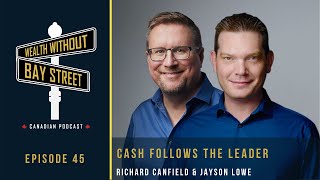
Richard Canfield and Jason Lowe explain infinite banking using life insurance: you overfund a policy with paid-up additions so cash value grows alongside the death benefit. They call it "cash follows the leader" because the death benefit leads and cash value trails behind it as you add to the policy.
Chapters
If you understand the problem, the solution becomes clear and you'll know exactly what to do. And you'll recognize that the policy, or ideally a system of policies, is merely a platform for you to implement a process people can commingle. Becoming your own banker, the infinite banking concept with policy, policy design, and the two are completely unrelated. The policy is a product. And when you purchase a product, there's different features, different things that you can add to the product that you can leave, that you can exclude from the product. When you understand becoming your own banker, the infinite banking concept, you understand that it's a process which you cannot implement without the product.
You are listening to the wealth without Bay street podcast, a Canadian guide to building dependable wealth. Join your hosts, Richard Canfield and Jason Lowe, as they unlock the secrets to creating financial peace of mind in an uncertain world. Discover the strategies and mindsets to a financial future that you can bank on.
Cash following the leader. And the leader is the death benefit. Richard, that is really interesting. Can you tell us?
Doesn't that sound good? Yeah, totally. So we get all kinds of questions. We have such fun discussions with people day in and day out, and everyone's at a different place in their discovery of this process. And often when people come to us, Jason, there's a high level of excitement. Would you agree? Oh, yeah, yeah. They're amped up. It's like, I just want to get going, explain to me how this works. Or there's one piece of the equation, whether it's in Nelson's book or there's some component that an individual tends to latch onto, and they need to really understand that one piece to be able to, you know, make their decision about moving forward or whatever it is. Right. Well, one of the things that Nelson talks about in his book, and a lot of this, you can, you know, if you've got the book in hand or whatever you're following along, you can find some of this conversation on page 38 of Becoming your own banker. Nelson's talking a little bit mec rules and different policy designs and stuff. And there's definitely some components of this piece that I've found for some people can. Can kind of be confusing or they can jump to. Jump to their own conclusions a little bit when they read the material. And that's why, as we preach on here, multiple readings of Nelson's book is very important because you might capture it the first time and get the gist, but then to let dial it in, you need to go back a second and a third time to kind of start, you know, really letting that information sit with you a little bit. Right. Different than you and I have done. And so, you know, I was, you know, I have conversations with people every once in a while and they'll, they'll say some commentary such as, hey, yeah, I just, I want to get that. That policy one that Nelson talked about, his book, the one that has the least amount of death benefit. Like, okay, well that's great. We absolutely. That when we design policies, we design them in such a way where we deemphasize the death benefit, which is what Nelson talks about. Right. And what he, what he really means by that is, is it doesn't mean that. It means that the typical insurance discussion. So separate out the infinite banking, become your own banker discussion with just an insurance discussion, which is what people are accustomed to. That's what Nelson's using as a, as a barometer to kind of, you know, is that people are looking to determine, hey, how much, you know, how much insurance coverage can I get in total for the least amount of money. That is the typical discussion that's had with most professionals versus what Nelson's talking about, which is, hey, I want to put in the most amount of money I possibly can that's reasonable within my circumstance. And in doing that, I want the least amount of death benefit for what.
I'm contributing to begin with.
To begin with. So that's the diff. That's the difference because he's always, he.
References in the book. He's. He really makes reference to the base policy. So he's not. There's nowhere in the book where he refers to term riders or other ways where you have to greatly increase the total death benefit from the start in order to make this work, to make.
It work or whatever.
There's so much noise out there in the industry about policy design. And what Nelson taught us is that it all begins with the base. It all begins with the base of the policy. And when you deemphasize the death benefit related to the base, setting aside any other term insurance or anything like that, just the base to de. Emphasize that death benefit.
And when we say the base, for those of you listening, if this is your first time, what we're talking about is the, the original contract starting death benefit. What is the base policy? Okay, and Nelson, in this page, on page 38, he talks about, he's got a drawing on here, he talks about different, different payment periods. You can get different payment periods when you get a contract. And he, you know, he starts off by talking about, hey, well, you know, in order to do this, you should consider getting the contract with the shortest payment period is better suited for this concept. However, he further goes on in the next column and he expands on that. He says the way you actually create that environment is that it is best to select a plan or the base policy. He says the base policy that is in the middle of the scale, such as an ordinary life or a life paid up to 65, then add the paid up additions rider. By varying the amount of these portions, it allows you to create the environment that he's talking about. Right. To give you the ability to put in the most amount of deposit capital at the least amount of death benefit line. And so Nelson's saying right on here. Now there's some companies that offer life to pay it up, but here in Canada they're less prevalent. But ordinary life, what Nelson would be referred to as a life pay policy or life pay to 100. In the States they have life pay to 121 contracts because apparently everyone's living forever out there. I don't know in Canada, something about the cold, I guess we die off early. I don't know what the deal is with that. But so we're still operating on a endowment contract of life paid age 100. And so what's interesting about this, Nelson says that the irony in doing it this way will result in providing more death benefit at the point where death will probably occur than any other plan that you could choose on the scale. So he says we're going to start you because of the way we're designing with this lower base policy, lower base premium, but having the ability to add extra capital into it, extra premium capital on top of it. The paid up additions rider, which. Well, what Nelson is sharing with us is that by adding the paid up addition rider, that rider will increase the size of the death benefit each time it's a paid up addition, it's an additional chunk of fully paid for death benefit. And so there's a lot of confusion out there where people assume, well, I just want the cash, you know, I'm doing this for cash or for cash value. Well, yes, that's true. That's what you want to accomplish. However, you can't have one without the other. It's actually the death benefit that is the driving force that allows the cash value to grow. So if you want to grow a cash accumulating pile of capital that you can work with throughout your living years, the way that you actually accomplish that objective is by ramping up the paid up Death benefit, which forces the cash value to accumulate. So sequence of operation is really important in a lot of different types of environments. As an example, driving a car, if you're listening to this, maybe you're driving your car listening to us on the, on your radio right now, in which case that's awesome. Stay safe. Hands on the wheel. When you get into your car, though, you first, you got to open up the door. You gotta, you gotta see, you gotta get, you know, get your seatbelt on you, you start the engine. You have a sequence of steps you have to do before you could put that vehicle into drive or in reverse. So you don't drive into your garage so that you can actually get to your destination. There's a sequence that you have to follow to make that logical. You can't just jump in and instantly expect the car to start driving, you know, on its own. So sequence of operation is really important in these participating policies. So when you get the policy in place, you have the base policy of the original contract that Nelson's talking about. You're overfunding that contract, which is, is really a simplistic way of saying adding extra premium. You're not actually overfunding. You're paying a premium. And the premium that you're paying is called a paid up additional premium. It's a paid up addition rider. But that extra premium is extra capital. And that capital buys a chunk of death benefit instantly. You now own it.
It's optional.
It's optional. You decide how to put it in or not put it in. Once it's there and it's accumulated, you own it outright. It's like the equivalent of a single premium miniature life policy. What happens now is you've now forced the insurance company's hand on the contract, which is by age 100, the cash value must equal the death benefit.
The total death benefit.
The total death benefit. If you've just increased that death benefit and you've locked in, it's fully paid for. Well, they have to start growing the cash component to chase after the new death benefit immediately.
Hence, why creates a positive leader.
So the leader is the death benefit. It's literally like the game Follow the Leader you played as kids. It's like it's an epic lifelong game of tag, right? Cash value is chasing after the death benefit. And at age 100, it's going to go tag. I gotcha.
And here's the deal. You know, one of the questions that comes up periodically when you meet with someone who first focuses on things like the policy design. We Always want to affirm that person's understanding of the problem. Because if you understand the problem, the solution becomes clear and you'll know exactly what to do, and you'll recognize that the policy, or ideally a system of policies, is. Is merely a platform for you to implement a process people can commingle. Becoming your own banker, the infinite banking concept with policy, policy design, and the two are completely unrelated. The policy is a product. And when you purchase a product, there's different features, different things that you can add to the product that you can leave, that you can exclude from the product. When you understand becoming your own banker, the infinite banking concept, you understand that it's a process which you cannot implement without the product. And in Nelson's book, on page 38 or any other page, you know, he didn't say there's only one way to design a policy, and this is it. And anything else is incorrect.
Yeah. And stop reading right now. Throw this book in the garbage. Light it on fire, you know, and so he's getting people to think in the book. And. And everyone's financial situation is different. Jason, what is it you say? It's like, it's like a fingerprint. We all have a unique fingerprint, right? Well, your financial life is as a fingerprint for you. And then when you're meeting with a coach and you're talking about plan design, that plan discussion and design is based on all the. It's based on your financial junk drawer, what's going on in your financial junk drawer. And then what are the objectives that you have? How do we take what's going on here to try to go and meet this thing that's. That you've got in your mind's eye. Using policies to meet that environment.
There's nothing more satisfying than taking control of the banking function as it relates to your needs. And this is a way for you to construct your own warehouse of wealth. Your money must reside somewhere. And so working with an authorized infinite banking practitioner through the Nelson Nash Institute is really important because people who are listening, you may. You may not implement a policy or system of policies with us, but we would highly recommend that you have a coach. It's really important. The individuals, families, business owners that we work with who are successful in this process, they all have a good coach. And there are a lot of great coaches out there, a lot of great coaches. But we would recommend that you be careful about how the policy is designed because it can be designed in such a way where there can be future implications that are very important to be aware of and the particular life company that you utilize, which is not a one size fits all. There are options in Canada, more than one. Now, one is preferable based on what Nelson describes in his book, but there are more than one option. And then lastly, as previously mentioned, working with somebody who is an authorized Infinite Banking practitioner, here's what that means. They've gone through a course of study through the Nelson Nash Institute, and beginning the past few years would have gone through a mentoring process where they were coached by an experienced practitioner who could help guide them along the way and help them be able to implement this in the way that Nelson intended and then be able to more importantly, serve and coach the client on an ongoing basis.
And so even on top of that, Jason, I think it's roughly about four years ago, I mean, we're at the beginning of 2021 at this recording. So approximately four years ago, they actually instituted an interview process at the board of directors of the Nelson National Institute. So, so it was Nelson, Carlos, Bob and David, all four would interview everyone who, they wouldn't accept anyone's money to join the practitioner program and pay their fee until they had been approved unanimously by the board of directors. And so that process still happens today. There's an interview process to determine if they think you're going to be a fit for the institute before they'll even willingly accept your, your, your application and your deposit to join the program. Right. And, and so that, that is a vetting process that I think is really important because they want to have the right, I guess, the right people on the bus when it comes to presenting, who are going to honor the integrity of Nelson's message. And it's a phenomenal experience. And you and I, we preach this a number of times on the podcast. The people that you and I associate with, that we know that are good friends or colleagues in this industry. We've learned so much from them in community and in discussion about and in sharing on how we can mutually benefit, mutually help one another grow our own business, our own practice. But the way that we do it is with the focus on growing and helping our clients. How can we maximize our ability to help our clients? And so we often are in discussions, mastermind type environments with our colleagues south of the border and here in Canada where we, we talk openly about how we can help one another in doing this process to support Nelson's message with our clients. Yeah, it's a phenomenal environment to be a part of.
Well, it is. And you know what people should know, I mean through wealth without Bay street in our organization, you know, powered by Ascendant Financial. All of our coaches are authorized with the Nelson Nash Institute. We also have a few mentees who are currently going through the mentoring process, which is. It's great to help them along and to watch them flourish and grow. But our entire organization practices what we teach. Every single team member in our organization is a policy owner. Every single team member in our organization implements the process so that we can speak from a place of integrity and authenticity when we're dealing with people who reach out to us Canadians coast to coast. And quite often the discussion, if a person has not been through our process, the discussion begins with product. Hey, I'm looking for this type of policy or I'm wondering if you can tell me which life insurance companies you deal with.
And.
As part of our process, we take that all back to the right. Starting point is describing the problem in your own words. Can you take a moment to describe to us what the problem is? Sometimes you get the response of, gosh, I'm not really sure what you mean. What described the problem, I don't quite understand. And then we move someone back into the process of reading Nelson Nash's book Becoming youg Own Banker, getting familiar with the problem and the solution. So that when you have a policy or a system of policies in place, you know why you're implementing the process versus just remembering what you purchased. Because that if all you remember is what you purchased and you're enamored by the things we're describing, cash value is growing every day and it's chasing the leader, the death benefit. Which is a brilliant analogy, by the way. And understanding that, okay, we know that that's happening inside of a product, but you can put the best tool for the job in the hands of someone who doesn't know how to use it. And not only are they not going to turn out any good work with the tool, they're likely going to break the damn tool. And so that's why you need.
I use a different way of explaining that, by the way. I say, look, have you ever used a chainsaw before? No. Okay, so if I fired one up, made sure the blade was sharp, handed it over to you, got the engine revving a couple times and just handed it to you and walked away without any protective equipment, what do you think's gonna happen? What's the chance you might seriously injure yourself or wreck the machine? It's like pretty high. Okay, great. Well, we don't want to do that in your Financial life, do we?
Right, exactly. That's a good analogy. Nelson said, often this process of becoming your own banker, the infinite banking concept, is ridiculously simple. It doesn't need to be sensationalized. It's fundamental to understand the truth. And the truth is that your money must reside somewhere and someone must perform the banking function in your life as it relates to your needs. Who is the banker in your life today if it isn't you? That's a problem. That's a big problem. And the solution is to take control of that function as it relates to your needs. But a person's unable to take control of something if they don't understand the problem that they're trying to solve. Life insurance is a great tool. It's applicable in a multitude of circumstances outside of the process of becoming your own banker.
And so, yeah, it's still awesome, but, oh yeah, if you, if you can incorporate the process by using the tool, man, that's pretty phenomenal. Right?
Well, any, anything that you're doing in your life financially is radically improved because you're taking control of this function. And so if you can store, if you, if you could put your money inside of an instrument where you know that that money is going to grow every single day uninterrupted. There's no global pandemic, bad economy, real estate cycle, stock market volatility. There is nothing that can take away that accumulating value. How much capital do you want residing there?
As much as I can get into it.
Right.
You got to pay premium. Now, on that note, so there's a couple of things that came up for me. So one of my favorite. As you know, Jason, one of my favorite pages of Nelson's book is page 85. Yes, I'm in love with this page. I just, I think it's great. And so I actually, for me, I encourage people, when they get the book, read page 85 first, then go back to the beginning, and then you land at page 85 again. So point number seven on page 85, which ties into our discussion about cash fall as a leader, your need for finance during your lifetime. In other words, Nelson's saying your need for capital outlay of things that you were going to buy and acquire throughout your life exceeds your need for life insurance protection. Right? Just, just think about that for a second. How much money has already flowed through your hands for stuff that you've bought and purchased and used in your lifetime. Mortgage payments, cars, vehicles, you name it, computers, whatever. And, and you're still living today. If you're listening to this boy.
How much of that money do you have?
How much of that money do you have exactly? So if you solve for that need, your, in other words, your need for acquisition of purchasing items in your life, then you will end up with so much insurance cash value. So if you solve for that need through insurance cash values, which you can only do by paying a premium, it's the only way you can get it done. You will end up with so much life insurance death benefit. Because cash follows the leader. You can't get it past the underwriters. They won't issue you the policy. They'll say, sorry, you got too much coverage, we won't give you any more. And you're going to be like, great, who else can I insure? Which Nelson follows up? You will have to insure every person in which you have an insurable interest. How often did Nelson tell us a story of the. He had five business partners that he insured throughout his lifetime, three of which were still alive when Nelson passed away. And the policy still exists to this day. They've been handed down to the next generation. But Nelson experienced two death claims on ex business partners in his lifetime. And Nelson would say to us, he'd say, didn't that cancel out a lot of mistakes I made in life? So really good context there. And another thing I want to point out real quickly in this, I think it ties in really well point number five. Nelson says wealth has got to reside somewhere. Where would you prefer to have it reside? He lists a couple items and then he says or free contract with other free persons and in brackets, life insurance. From this base of financial operation, this base of financial operation, you can do any of the other things in life that you desire. Just love it. So good. Love it.
Cash follows the leader and the leader is the death benefit. That is so good. That's actually going to be another blog article. We should do that as a blog article and a shout out to any because we've been getting contact because we put a lot of content out there, which is great. Strap yourself in for 2021 because the amount of content that Richard and I are putting out there is going to be mind boggling.
Just a shout out to mind boggling or mind bottling. It's when your mind gets all wrapped up in a bottle. Isn't that. Doesn't Will Ferrell use that on one of the movies?
Yeah, he does. Yeah, exactly. So, you know, we want to say to all of our esteemed colleagues out there whom we appreciate you, we, we wish you well, in a prosperous 2021 as well. When we get contacted from people who say, hey, I've already, you know, I've got. I put a policy in place and, you know, I'm. I'm kind of kicking myself, you know, I wish I would have discovered wealth without Bay street sooner. I wish I would have, you know, been in touch with you guys sooner. Trust, trust that you're in good hands, you know, with the person that, that you're already working with. And when we know who that is, we'll send you a quick message. Hopefully you'll keep us on your Christmas card list. And, you know, we hope you get as much value out of this content as the general public does as well. Because this is meant to really share the message. It's. It's not about any one person. It's not a vanity project. It's about getting the message out to Canadians that you really, truly can. You can improve or expand your wealth without Bay Street.
And I want to add to that one piece because, you know, Nelson would say, so what if the policy isn't exactly what you originally thought or wanted? The best policy is the one you started.
Work with what you got.
Work with what you got, he would say. And, you know, he would hear people, know, moan and complain about how they didn't have enough funding possibility on their policy or something. He would just kind of. He would do this little, like, kind of a laugh because he's like he's son. They didn't have that stuff when I was buying policies. I did okay. Yeah, it didn't exist. When Nelson got all of his policies started, that wasn't a possibility. He had to pay the premium. His capitalization requirements were more involved even than what we have to do today. Not to say that you wouldn't continue doing it. It's just don't take for granted what amazing things we have available to work with today. We're in a blessed, blessed environment, in my opinion.
And if you don't have enough room in your existing policy, start another one. All right, well, that concludes this episode of wealth without Bay Street. Cash in following the leader and the leaders, the death benefit. Be sure to tune in to. You'll see if you're on the YouTubes, you'll see the playlist with recommendations on episodes to continue watching. And Rich, I'm super excited for 2021. We're off to a start. Can't wait to share more great value with our existing listeners and our future subscribers. So we want to wish you and yours a prosperous 2021. See you soon.
Thanks for listening to the Wealth Without Bay Street Podcast where your wealth matters. Be sure to check out our social media channels for more great content. Hit subscribe on your favorite podcast player and be sure to rate the show. We definitely appreciate it. And don't forget to share this episode with someone you care about. Join us on the next episode where we continue to uncover the financial tools, strategies and the mindsets that maximize your wealth.
More from Richard





How Do You Use a Policy Loan to Buy Dividend Stocks? #dividendstocks #infinitebanking #shorts


Can Compounding Dividends Pay Your Bills? #wealthbuilding #investment #financeeducation


Should a Corporate Policy Offset Your Personal Coverage? #shorts #insurancetips

What Is Human Life Value? #shorts #insurancetips #dividend #wholelifeinsurance