Ask Julie Anything - Episode 8 With Canine Herbalist Rita Hogan
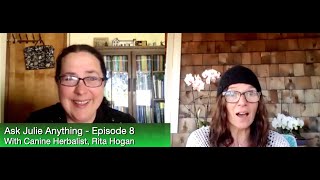
This is a YouTube video titled "Ask Julie Anything - Episode 8 With Canine Herbalist Rita Hogan" recorded in 2025, featuring a conversational Q&A session with Rita Hogan, a canine herbalist, along with hosts Caitlin and Julianne. The discussion covers holistic herbal treatments for dogs, including remedies for ticks, allergies, detoxification, ear infections, and general canine health, with detailed advice on herbs, dosages, and natural care practices.
Anything. We are here with Julie and Rita Hogan. I've known Rita Hogan for a while now. Hey. Rita is a canine herbalist. So Rita works one on one with dogs and their owners and has for over 20 years. Her holistic herbal practice combines nutritional therapy, herbs, and environmental analysis to address your dog's individual needs. And I know this because she has done this for me, my dogs, and it's amazing. So Rita writes for Dogs Naturally magazine. She also speaks on canine herbalism and teaches classes to promote holistic canine herbalism. She's also a cannabis educator and works with dogs of all kinds.
Yay.
Welcome. Okay, I'm going to hand it over to you, Julie, and I'll let you know when we have. When we have a few questions piled up. You guys just want to chat for a bit? Okay.
Yeah. Thank you so much, Kaylin. So, you guys, we were all just being super silly, and for all you girls out there, we were. We were just being really super girly and laughing our guts out. Just so awesome. It's. It's a. I feel like laughing when we laugh that hard. I feel like it's like medicine.
Yeah, I was screaming. I feel like.
Pardon?
I was screaming.
Yeah, like. Like, it's such a screaming and I really do. I feel like it's. It's sort of. We were talking about energy medicine.
Oh, yeah.
I. My mom used to always say laughter is the best medicine. It's an old thing, but it's so true. It's just so awesome. So I'm excited to have you on because I was saying that even though I absolutely love herbs, not that I'm scared to use them, I just. I kind of just go. I respect them so much, you know, Like, I have such a high regard and high respect for herbs. My mom. My mom did a lot of herbalism, and I kind of went the homeopathy route.
So you use a lot of herbs in homeopathy, though?
Oh, my God, tons.
So you use herbs. Just a different dosage. I love it.
Yeah, I definitely. And that. That, you know that in school, materia medica, that used to be like my. Like the doctrine of signatures, when we would really learn about the. The. The actual crude substance that goes in the medicine. That was my favorite part is just getting us a really, really strong sense of the emotional element of the herbs and the, you know, where they're living and how they react and. Well, not just herbs, but rocks and all kinds of stuff. Right.
Well, and I think it's great to connect, like, you connect with the. You Know, you got homeopathy and you have herbalism. And homeopathy allows access to so many plants and poisonous plants that you cannot use the way that I use them. So, you know, in order to have access to something like belladonna, you know, you have to use it homeopathically. So, I mean, I think it's. I think it's a win win.
It is. It's pretty cool. But I still love plant medicine, like, real plant medicine. I think the older I get, the more I'm actually drawn to it. So I'm excited to hear you answer questions. And normally what we do, I think people are putting questions in the question and answer and then also in the chat. But what. How long have you been, like, what made you decide to do dogs? That's. That was one of the questions I always wanted to ask.
Well, I grew up on a farm, so my dad taught me herbalism, even though he wasn't an herbalist. And I guess we weren't thinking about herbalism at the time. He would just say, you know, go in the field and get me the little purple flower that's about this tall over in the right hand side. Pick a bunch of them and bring them here, you know. Then he would show me. Used a lot of herbs with the pigs and chickens and cows and then our dogs. He didn't know much about dogs. He just knew about horses, chickens, pigs, and cows. We didn't have any sheep. That's pretty much it. And then I studied Ayurveda when I was in my 20s. And I like it, but it didn't. It just didn't, you know, I kind of went back to my roots. So when I was 29, I started teaching myself herbalism again. And I moved to a farm in Tennessee, where I started boarding dogs in a kennel free environment. And they were all sick. Like, all of them were sick. And it was just so sad. And I started studying nutrition, and then I opened a holistic pug dog rescue. Yeah. Where we didn't vaccinate and things like that. And I worked with my herbal remedies drop dosing, which is just small amounts for chronic disease Drop dosing, It's using like between 1 and 10 drops, depending on the dog. But let's just take a pug. Like, I probably wouldn't use more than five drops ever, unless it was something acute. And I used herbalism on all of those dogs under the supervision of this lovely vet name, Kevin Bromick. And I kind of taught him a little, and he taught me a Lot not about herbs, but about pugs and dog surgery and surgery and why I could never be a vet. Definitely like no. And yeah, it was super fun, but. And that's when I started making those salves for that pug dog rescue. And then I started using herbs on my clients and getting those people to start stop vaccinating, you know, so much and working with that and working with nutrition and then just I did apprenticeships. This lovely little guy, he's now deceased. His name is Ralph Tin Overstreet. He was like, again, he wouldn't call himself an herbalist, but he knew every single plant in that forest, how to use it on animals on the farm. And I just took a lot of that and started using it with dogs. And then I read Matthew's book, Matthew Wood's book, Seven Plants, seven Teachers. I didn't know about Matthew because I was on that hill and the Internet had just come out and it was in the 90s and late 90s, early 2000. And I read Matthew Wood's book and it was about drop dose. It had drop dosing in it and it really just kind of verified what I was doing. And then everything that he wrote I just started gobbling up. And then I worked with some. Like when I moved here, I joined the. I think it was the Dandelion School of Medicine. Sean Crop was the teacher there to learn the plants in the Pacific Northwest. And yeah, it's been about 20 years.
Well, you know, when you were talking about that man, probably one of the most brilliant herbalists I've ever met in my whole life. Her name was Virginia and she lived in Ontario and she was our herbal kits or degrees or anything like that. But her great great grandmother, she. She still had tinctures that they were. It was almost homeopathic because they were dilut. But tinctures from maybe not diluting them, but adding alcohol, I think.
Yeah.
Because they were so old. Like she had stuff from. Oh my gosh, I don't even know how.
And they don't go back. They really don't.
And she was. No. And she was just the most brilliant person that like not just brilliant about herbs, what teach that wiseness. She was just amazing. And she was the one that when my dog Rudy got. Got cancer, this is what started me on my whole journey. And because I was in conventional vet medicine at that point. And I was so devastated because he was 4 years old. And I went to my mom and I was like, what do I do? And she said, call Virginia, you know what to do call Virginia, because she couldn't stand all this conventional stuff that I was trying to get her to do. And make a very long story short, the tumor was an intestinal tumor, and it was really large. And they had to. They were going to resect his bowel. Part of his. Part of the bowel. And I took him to, like, an internal medicine specialist in Ontario for surgery and stuff. And they're like, okay, you know, they couldn't get him. They couldn't see him for almost two weeks. And they said he'd probably be hospitalized for five days. So she was making, literally, suppositories. She was. We were doing suppository, like, anal suppositories, rectal suppositories. She had him on so many herbs, like, he was running away from me, what we were doing, but the same thing. And get him off that dog food, blah, blah, blah, blah. Everything my mom and my grandma were telling me to do. And by the time I took him back, he didn't even have to stay. He stayed overnight. And that was it. It was so. It had shrunk so much. Still the size of a small walnut, but it was. It was encapsulated. And they didn't have to resect anything from. From all the herbs. And he's the nicest man. And he said to me, I don't. I don't know what you're doing, and I don't know if I want to, but just keep doing it. This was a long time ago, right? It was like, in the 80s.
Yeah. Most people just don't want to know. It's so weird.
No, So I was just, like, so blown away. And that just started me on my whole journey. But that was all herbs, you know, it was. It was. It was just so incredible. She made the most amazing essay act and just. Yeah. Nurse Case.
I didn't hear you.
I think. I think she actually knew Nurse Case from the essiac. Yeah. So she was like a full timer. All right, so, Kaylin, we. We should start answering questions we have.
Yeah, they just keep piling in.
So I'm gonna shut up. I'm actually gonna mute myself. So I shut up. Because I could keep asking you stuff all day long. So we'll do that another time.
All right?
I'm gonna mute, so go for it, Kaylin.
Okay, so we have a bunch of questions here, Rita. The first one is from Kerry. Hi, Kerry. Thank you for your question. Are there any herbs to give after you remove a tick from a dog.
Externally? Yes. So my favorite Herb to give to a dog externally is neem, a really just pure cold pressed neem. Oil in the tick bite is excellent. Also there's an herb called karanja that works really well for that. And then internally olive leaf. But you got to be careful with olive leaf because it can make your dogs puke. And so what I like to use is I like to use the now brand of olive leaf, which is only 12% oleoprin, which is the active ingredient in olive leaf because it's never made any dogs puke. But you got to give it with food. And like a small dog, let's say like a, let's just say a yorkie under 10 pounds would probably be about 150 milligrams twice daily. With food a like maybe 15 to 20 pounds, 25 pound dog would be about 250 to 300 milligrams. Medium dog 500. A large dog between 5 and 800. And then a really big dog would be a thousand milligrams twice daily. And one of the things that I found out on my farm because we had tons of Ehrlichia ticks on our farm, every single dog that I had had Eur leakia, that was my dog. I had 10 of them, they all had Eur leakia and I got rid of all of their euhea with olive leaf. And then also an olive gemotherapy or phytoembryonic therapy which is the plant buds of olive leaf. So I like to use the mixture of that but just a regular olive leaf. If your dog has a tick or if you are in tick country and your dogs are going to get ticks, I would keep them on the olive leaf as long as they don't get nauseated from it. If they do, do not just discontinue it, but I would put them on the olive leaf through tick season.
Oh, sorry. I muted myself and unmuted myself and muted myself. Perfect. I've heard some great things about olive.
Leaf, but it can make you and yours puke if you're not careful. Make sure you have it. Don't take it on an empty stomach ever. And oh, and more is not better. Like sometimes you'll see extra strength olive leaf. No, don't do that with your dog. If you're puking, it's a different story. Watching your dog hack 10 times in a row isn't fun.
No, definitely not. Pauline has a question. So Pauline says my dogs are raw fed, but I cannot always afford or find organic pasture raised meats for them. There are things, are there things I can do to protect them from the crap the glycophates, antibiotics, etc. That their proteins are eating. So I think that are in the proteins they're eating.
I understand what she's saying. So, you know, one comment is that I doubt that most people in general feed themselves all organic meat. So, you know, people have all this. This huge guilt factor where, you know, sometimes you're not going to be able to find organic meat, but just regular raw food is 1000 times better than kibble. So just remember that. But I think that a. Giving a good digestive enzyme is really important. Number two, cleansing. Doing a cleanse like quarterly or like twice a year in the spring and then in the fall. Milk thistle. Blessed thistle, I like milk thistle is pretty neutral. Blessed thistle can be used as well. I like mountain pine Gemotherapy, which is Julie Ann can be a homeopathic. It's a 1 to 200 dilution. Is really good at getting pharmaceuticals along with juniper general therapy. And do you want me to give dosages? I'm not sure. Julienne. Can I give dosages?
Oh, if you'd like to.
Okay. So the mountain pine and the juniper general therapy. The juniper general therapy is really good at getting pharmaceuticals out of the body and any type of chemical. So you only want to give it for eight weeks. Otherwise it starts to push the kidney. And so you want to put it on a calendar and then you can give it like once a week or once a month, but the dosages are very small. So with the gemotherapy, which is when you see it on the bottle, it's going to say 1 200. Okay, if it says 110 or 1 20, then that's a mother tincture. And the dosage is really small. And you can always just email me through my website, k9herbalist.com if you get confused. But we're just going to do with the demo therapy, which is the 1 to 200, it's a homeopathic dilution. The dosage for juniper for an extra small dog is about 5 drops, for a small dog is about 10 drops and for a medium dog about 15 large 20 extra large 25 to 30 drops twice daily for about 8 weeks. The mountain pine can be given in the same dosages for about 12 weeks. There's other things like for dogs that are more cool. Black currant gemotherapy is really good for that. Blackthorn gemotherapy is good for that. Those are the main things I use to get chemicals out. And then milk thistle is good. And then there's globe artichoke. Julianne has an excellent liver cleanse. I think that's Greg Tilford's. Right.
It's our formula. But he makes it.
Oh, Greg makes it. Okay. I knew that Greg had something to do with. And Greg's a great herbalist, so he's one of my elders, of course. And that's a really good liver cleanse that you use temporarily. You could use that in the spring and the fall. But yeah, that's my answer to that question. And then also. Wait, hold on one second. And then for dogs that are warm, you know, you can give those greens like chlorella and wheatgrass and phytoplankton. Phytoplankton is pretty neutral. So you can give that for dogs that are warm and cool. And then for dogs that are more on the cool side, spirulina is a good green to help detox chemicals as well.
And what I was going to say too, like, if you have your choice between ethic, I think if you're really looking, if you can just even find, even in superstores and in bigger stores, ethically raised. I think if you do ethically raised, rather than if you can't find organic or you can't find pasture raised, if you can look for ethically raised, that's even one step above the regular factory farmed ones. And then it has less cortisol in the meat. And it's another way to go. If you can't get really good meat, which a lot of people can't, especially right now. It's insane. The places around here don't have hardly anything organic, like the grocery stores.
I mean, so like non GMO if it's. If it's non GMO certified, at least when it's being like corn finished, it's not. It's not GMO corn. But ethically, yes, because they're not as stressed out.
Yeah, yeah.
Okay. Sorry. What. Hi, Bev. This is from Bev. What can I do for environmental allergies? My girl is itching a lot.
My first go to for environmental allergies is nettles. Nettle leaf is really good for environmental allergies. And also mixing that with quesartin, that would be my go to. I mean, that would be a good place to start.
Okay, we have one here. And I know Julie's probably gonna speak to this quite a bit too, but Alison has a question. Experimental studies have indicated l', Arch, and I cannot say that big long Arabino galactin can stimulate natural killer or NK cell cytotoxicity, enhance other functional aspects of the immune system, inhibit the metastase of tumor cells. Yes, thank you. To the liver. I'm very excited about this as three of your wonderful products in the leaky gut protocol contain this. And I've been using these wonderful products in rotation. Would the dosage then be adjusted for a dog with cancer versus one that took this for digestive health? Okay.
No, it doesn't have to be. But if she have a dog with cancer. Is that what she's asking?
I'm not sure. Allison, if you want to pop in.
The chat, she's going in rotation. She should make sure she puts the phytosplurora one in because of the canine species probiotic in it.
Okay. She says no, she's. Her dog doesn't. But she's asking for cancer dogs.
Yes, cancer dogs make sure that they get that they rotate with the phytosphlora.
Okay.
I'm trying to read something.
Yes, sorry, there's. There's a bunch about our product questions and I, and I try to. Sorry, everybody. I try to kind of skip over them a little bit.
They can also ask them when I do my own one. Right?
Yeah, absolutely. Absolutely. Joy. Hi, Joy. Joy says. I know this is not a simple answer, but I'm working on a protocol for rescues for overall well being. Where is a good place to start?
Wow.
Go ahead, pug lady.
Oh, okay. Sorry, I didn't know who was asking. She's working on a pro. I wonder what type of protocol. So just overall well being. Yeah, that's a complicated answer because dogs are individuals. But if you're doing just like a general protocol, then you always want to just begin by supporting the kidney and the liver in the digestive system. So a good digestive enzyme, a good probiotic. If the dogs are more warm, which a lot of rescue dogs are either very like quite cold or quite hot. And when their stress levels come down, you kind of can see where their energetics kind of sit. So, you know, I would do like. Milk thistle is pretty neutral, so start with like milk thistle. I'd probably do nettles to fortify and strengthen. And also nettles are really good for things that just kind of stop working. So I like nettle leaf for that. You can do freeze dried nettles or you can do a tincture of nettles. Burdock root is a good place to start as well because it helps the body process fats and Oils and a lot of hormones and the endocrine system is really dependent on fats and oils. These dogs are really messed up hormonally. So I think that that would be a good thing. For dogs that are more on the cool side, there's a. It's a. I would say a 1 to 20 mixture. That's 1 colon 20, or the homeopathic of a black currant bud is really, really strengthening to the immune system. I think that's a good place to start. And then, you know, fortifying with greens. If a dog is really warm, get them on some good greens and start strengthening the body. And of course, a little jar of anti vaccinosis would go a long way because, you know, some of those rescue dogs are vaccinated two and three times by the time they get to an owner. Just because it's the weirdest thing. Like, we didn't vaccinate. And I knew that. I gave like a class on health and vaccination before they were adopted out. And holistic food. Holistic food was required, but I knew they were going to go to their vet and get vaccinated right after I adopted them, so there was no point in me vaccinating. Plus, I didn't believe in it at the time.
And they're so. Especially the ones that are coming from countries and stuff.
Holy.
It's terrible. At my clinic, I would see a lot of them that were coming from Mexico and China and all over, and you would see pictures of them when they were, oh, I'm getting this puppy or I'm getting this dog, or this is the one I'm getting. And they don't. They look half decent. Then they come over and three months later, they have no fur or they're full of Demodex or they're. They've had the. They've been vaccinated at the yin yang. They're strength to the max. So I would all. I would also say, like, the anti vaccinosis for sure really is helpful, like as routine, like when they first come in. But also homeopathic aconite. It can make. It's for shock and stress and, you know, and the two. They're all. They're off. They're often grieving too. Right?
Yeah. Rescue remedy might be a good addition to the acne as well. We did it right across the board for like, I'd say 90 days for each dog. You know, rescue remedy. Rescue remedy. Rescue remedy. And. And whatever. Julie said aconite and of course, the anti vaccinosis.
Yeah, yeah. And just like you said, try to get them on some really good food and slowly incorporate things. Don't just overwhelm their little bodies because they're already pretty overwhelmed.
Yeah. Try not to. Kitchen sink.
Yeah. Terrible what we do to them. But, I mean, hopefully they all get to be. I know. Well, let's just go on a tangent.
Next question.
We're all rescue people here. There can be a lot of tangents.
Herself. Anytime soon, she's gonna mute herself.
Yeah.
I have a question here from Leith. Hi, Leith. As we lean into the warmer months, what are Rita's favorite herbs to work for? Work with for clearing heat from the body?
Okay, so the warmer months, definitely working on the large intestine and the heart. And so, you know, I'm only going to do a couple because I know we got a lot of questions, but hawthorn berry is a very good remedy for the summer months to support the heart. Then for dogs that are really, really warm, one of my favorite remedies to clear heat from the body is peach leaf and twig. But sometimes it's just peach leaf. I make peach leaf and twig. I macerate the bark. But peach leaf is excellent for clearing really kind of severe heat from the body. And another thing is cucumber water and watermelon seed water. So I like to use organic. You have to use organic cucumber. You don't necessarily have to use organic watermelon, but you have to use organic cucumber because the energetics of the regular cucumber is completely different than the organic cucumber. But you slice it, you let the water sit in the cucumber water, strain it and give it to your dog. And most dogs that suffer heat will drink it right up. It's a refrigerant. So you can go from like a dog completely panting to a dog not panting within 15 minutes of drinking it. Then if you don't have cucumbers, you can use watermelon seeds. So you can eat the watermelon and then take the seeds, let them soak overnight for about 12 hours in the water and just drain the water and give it to your dog.
Oh, we seem to have lost you there, Rita. You're all frozen.
Am I frozen?
No, you're all good. It's just Rita. Not sure what happened there. I'm sure she'll figure it out in a minute and come back.
Oh, yeah. You know what? In the meantime, till she does. What I was gonna say, too, about the person that was asking about glycophates and stuff, a really good dirt for glycophates is humic and fulvic acid. So it works like a detox, like a collation chelation therapy. So I bet she's probably just logged off and a log back on.
Yeah.
Do you want to ask me? Anyways, I wanted to. I wanted to talk about that too. And also for already said about probiotics. So definitely gut health because gut health is the gut brain access. There she is.
I don't know what happened. It just kicked me off.
You froze up and then disappeared.
Got too cool.
I don't know what the last you heard you froze.
Cucumber water. Cucumber water.
Oh, cucumber water. And then watermelon seed water.
You were right in the middle of saying about the watermelon seed water.
Yeah, you just take watermelon seeds and you soak them overnight and use that water as well. So hawthorn berry, peach leaf and twig, cucumber water and watermelon seed. And then another one of my favorites for summer is marshmallow root. It helps cool the body. So love marshmallow root. And it helps coat the large intestine and bring down inflammation. And another one is plantain. I love plantain for summer. The intestine gets really inflamed and flares up in summer. And then yellow dock root in really small little tincture amounts, like one to three drops, no matter how big the dog is, is really good for when dogs get really nasty skin during the summer.
How about like animals that are really sensitive to flea bites? You know, like some dogs or cats can get like flea bite dermatitis and things like that. Anything else with bites or midge, like black flies or anything like that.
My Restore salve from Farm Dog Naturals works great on all bites, however. Restore, it's called restore. Yeah, it stops itching and it's for flea dermatitis. Because my dog Seamus had flea dermatitis and he just passed away. So he was 17. And yeah, I made that salve for him about 17 years ago. So. But there's a general therapy called Cedars of Lebanon. Cedars of Lebanon and. Or Lebanon Cedars of Lebanon. That works really well when you've got that itchy, horrible, just like raw, just scratched up skin, you can take it. What I like to do is I take that. I usually use the mother tincture. So the 1 to 20 and herbal gem in Canada has the mother tincture. And then in the United States, pse.
Pse.
I carry them in my shop. I can't remember who makes them. Pse. Hold on, I'm gonna get the name.
What did she say then? What, what was that?
Cedar psc. PSC is the. You can get the mother tinctures from PSC in. These are from Italy, but they. They're the distributor in America. Makes the mother. But you can also use the gem therapy, the 1 to 200. But you take Cedars of Lebanon and you take about. Of the mother tincture, you take about 10 drops. And of the gentle therapy, I take about probably 30 drops in an 8 ounce bottle of spring water. Mix that with crabapple, flower essence and spray works phenomenal. Wow. Awesome. For the flea dermatitis.
That's good because that's nasty.
Yeah, it's nasty.
We have.
Sorry, there's a question here and loca's on my lap being a little brat and I just scrolled right past it. But somebody asked about what you would do for ear infection.
Okay.
So as Julianne can probably account, you know, the ear. The ear is the last to go in healing. It is a pain in the rump. And you. It just depends on what's in the ear. Okay, so we've got bacterial ear infections and then we've got yeast ear infections and then we've got just regular old icky ear that you need to manage. So the ear opens up to the kidney. Okay. So I would definitely support the kidney with any ear infection. Then if it's yeast, you know, you can use patiarco, you can use mullein, you can use garlic. I'm not talking about any essential oils, just to be clear on that. But you can use different things. You can use echinacea, the actual flower, not the root. The flower and the leaf work really well in the earth. There's a remedy that I make through Farmdog called Harmony, which is for yeasty ears that works really well in the ears. If it's true yeast and that bacteria you can use like karanja oil or neem oil. There's a product on the market that I have found works pretty well for like just maintaining the ear while you work on the inside. Because the ear really is inside health. It's not. Most of them are not an external problem. But there's a remedy called eco ears that works really well. I don't know, Julianne, if you have anything for ears.
Well, for me, I always feel like it's gut related.
Yes. Inside. Yeah.
But then what happens is that ear canal gets swollen from the overall systemic inflammation and then there's no air going down. So then it's A perfect breeding ground for different kinds of bacterias and yeasts and, and all that stuff. So for, for me, what I would do is, is like from a, from a product point of view is we in Canada, we still don't have it in the US but we will be soon. It's called, called your go to and it's just aconite and arnica. And why it helps so much, you know what really helps is because the thuja is really good for yeast. Thuja is amazing for yeast and silica helps to push out the debris, right, to just get the ear cleared. But arnica is really good. Arnica just to get inflammation down so that the air can start to circulate in the ear. But I agree it's definitely internal. And sometimes from a managing point of view, we used to use at our clinic is something called Zymox.
But be careful.
What happens is they'll use them with cortisone because there's court. You can buy cortisone and non cortisone and then they have all like the cleaners. And I don't like to get it so gucky. Like I like to try to let it dry out and not put so much liquid down their ear because if it's swollen you can't, you squish it down but then you can't get it back up. So I, I just use their enzyme and it's, it's a, it's a, it's like an enzyme that helps to break down the debris. I don't ever use their cleaners. I don't use anything like that. I just use their zyme mox enzyme and don't do it if you're not gonna work on the inside, like just totally.
Right.
You gotta work inside our ears for sure.
Yeah.
Okay. So Jennifer asks if you were going to start a small herb garden for your pups, what would you consider mandatory? Rita?
Calendula. Super important. I love self heal well. I grow marshmallow root milk thistle. Echinacea is really, really important. I love echinacea. I love growing echinacea. It's beautiful. I grow St. John's Wort, which is another really nice one. To make some healing oils from calendula is a definite. Let's see what else? Well, you know, if you can grow dandelions, I like to grow wild. Like I like to use like little vine supports and I like to grow chickweed and cleavers and different things that I find wild. So that would be a good start. But clentil is absolutely the number one that I would grow. And it's easy to grow. And then greens for your dog. You can grow those in your garden. There's lots of roots. You know, you can grow burdock root really well, which is also really good.
When you say green. So that's what I was wondering. Can you make little gardens that they can go and just forage on their own?
Yeah, absolutely. My dogs eat a lot of my front yard. I just plant it for them and they eat it. So they do a lot of self foraging in my front yard. And then my garden gardens on my side yard that I don't want them in. But. Yeah, but self heal and calendula and echinacea are my top three.
And can they self forage on those? On those ones if they want.
They're not gonna self forage on the calendula. It's too resin. Yeah. But they might eat the self heal for sure.
Okay. And what would plant.
Bee balm's really good too.
Is bee balm and.
Wild bergamot. Yes. Monarda fistulosa.
Okay.
That's the Latin name for both of those. But yeah.
Okay. Well, thank you. That was some great suggestions.
I was writing chamomile and peppermint. Sorry, I forgot about those kids. Those are really good, too. Chamomile should be in everyone's garden.
Everything. Yeah. Topically, internally, everything. Eh, yeah.
Yeah. Chamomile is wonderful.
You know, my grandma used to say about chamomile, she said she used to plant chamomile with other plants. And she said that she did that because her grandmother told her that the chamomile plant soothes other plants.
Yeah, I've heard that before. And yarrow is another one of those things. Yarrow is like the herbal warrior. And it's actually a communication like a lot of herbalists, and I believe this too, that yarrow helps other plants communicate with each other. So chamomile would be a great soother. It's like the grandmother of plants.
Plants. Yeah. Cool.
Yeah. Yarrow would be another plant that I would definitely plant.
Sorry, I was busy writing.
I've got. But yeah, yarrow is wonderful. And one thing to do with summer, a lot of people don't know this and of course you can't market it because you gotta get in America. You got to get all the fda, blah, blah, blah, blah. But yarrow oil is an excellent sunscreen. I mean, really, really great. So, yeah, I would plant yarrow and make an infused oil with it and you can use it as a sunscreen on your dogs and yourself.
Oh, wow, that's good to know.
Yeah.
Okay. Susan asks. Oh, sorry, Judy.
No, go ahead, Kellen.
Susan asks, can pups have aloe? Any suggestion for pups who get overheated? Vet says he has liver heat and Shen disturbance.
I would not give aloe. You can use aloe on your dog, but I wouldn't give it internally. Yucca. You can do yucca, but I wouldn't use aloe. But again, I would use. If your dog has a heat in its liver, I would definitely use probably the peach leaf and twig. The peach leaf is a really good one, and it's safe.
I was just gonna say that we have aloe in our guts. Who. But it is a specific, really specific fractionized part of the plant. Because if there's. There's part of the aloe plant that can be really toxic. If it's.
I was just thinking about, like, liquid aloe. I'm like, I wouldn't. You know, I wouldn't. In your dog. Yeah, I know the one product that you have. I wouldn't worry about that. But, like, if, you know, if you sell, you can give aloe. They're gonna go grab a plant and start.
My God, no. Yeah, don't do that.
Okay. Carrie asks, is there another name for Self Heal? Because Herb Farm doesn't recognize it.
I would use its Latin name. One moment, please. That is. Hold on, hold on. Self. Latin name is. Yeah, Prunella vulgaris. Yeah, Prunella vulgaris. So type in Prunella vulgaris. I don't know if Herb Farm has it. I have it in my store canineherbalist.com but I don't know if Herb Farm. Herb Pharm is not. Is a little short on some things because of COVID But I would type in the Latin name Prunella vulgaris.
Okay, perfect.
The Latin name's really important when you're looking for herbs and stuff. And Violet. Violet's very soothing. If it's a. Especially for a female dog, it's very cooling to the body. Chickweed really cools well. Cleavers cools well. And any dog that is really warm. Cleavers is my number one. Go to. For warm dogs in very small amounts, like you'd use a tincture. And for a large dog, you probably do five drops twice daily. And then medium, four, small three or two, and then small, small one. Because that really helps cool the body down and it helps get that lymphatic start to go. And then the the lymphatics and the circulatory system is the body's coolant. So if your fluids aren't circulating and your body has stagnation, your dog can't cool itself down. So lymphatic is really important. So for warm dogs, cleavers, for cool dogs, calendula. Those two are really like low on the lymphatic pole. They're a good place to start.
Hey, Kim.
I'm not sure if I'm saying her name right. Besan. I've been giving my doggo slippery elm bark prepared with broth to help coat her throat after she has a coughing episode. She's a senior Chihuahua with collapsing trachea. Any info or opinions on slippery elm bark from this?
Well, one thing you need to understand is that slippery elm bark stays in the body for about 36 hours. So you do not need to dose that that herb every single day. And if the slippery elm works for your dog with collapsing trachea, great, then go ahead and use it. But another one I like for collapsing trachea is fig. I like for collapsing trachea and marshmallow root, I like to use the liquid marshmallow mixed with the. The dried herb, marshmallow, the powder, I like to do the part I like. You could do it. You could do it like the liquid before eating. But I like. What I like to do is I like to use the marshmallow as a part of a protocol. If there's collapsing trachea or a lot of dryness or inflammation in the gut, I like to use the liquid right before they eat. And then I like to use the dried marshmallow right before they go to bed. And so that it's sitting in a pill in the intestinal tract at night without anything competing for it. And I find that that works really well.
And also don't forget that the trachea is. It's like a cartilage, right? So bone, broth, collagen things to still try and keep some ability of strength. Right? And N acetylglucosamine for inflammation of the trachea is really good too. And obviously she's probably not using a collar, I would imagine even. But even coats, like I've seen, I've seen little guys, like little tiny dogs, like Chihuahuas and stuff, they always have jackets on or they always have shirts on or even T shirts. Just watch where they are because sometimes they can get so sensitive that even if they're just a tad up, it's just a constant irritation, right? This is Just constant irritation there. So I would be careful with that as well. And diet. Right.
Is there any building back or is there just maintenance?
Well, there's two things that happen. It gets weak, right. So it starts to collapse. But then when it starts to collapse it gets there, it's not moving them. It can get phlegmy, it can get dry, it can get irritated and then it creates more of an issue. Right. So homeopathic phosphorus is homeopathic arnica phosphorus and even their jump for joints really good for trachea stuff because it focuses on cartilage and ligaments and tendon and all that stuff. Right. It's not for joints per se. So there's lots of things you can do for trachea stuff to try and keep, keep them from getting worse. And it's amazing like what you were saying, like if you can, you can keep the inflammation down and you can keep it as smooth as possible, you can sort of derail it from getting worse and worse and worse. Right.
Okay. Donna. Hi. Donna asks, will olive leaf and black walnut tincture work as a parasite preventative?
I be really careful with black walnut. So I wouldn't, you know, I'm not really into the parasite preventative very much because a lot of the anti parasitic herbs are really hard on the body. So I'm more of if your dog has a parasite to deal with the parasite versus to giving something every day to keep them from getting parasites. Olive leaf would be a better choice there because it's not hard on the body. But you can do some damage with black walnut if you don't know what you're doing and if you overdo it and it's not something you want to give long term whatsoever. The alkaloids in black walnut can really, really be at a detriment to the liver. So I just wouldn't do that. And along with wormwood and Artisana, I just would not do that. I would definitely treat the parasite. Once your dog has the parasite. That's not that if difficult at all. But doing a prevent like a wormer just because I don't recommend that at all.
I don't either.
Pumpkin seeds are great. You know, pumpkin seeds are great. That's a nice anti parasitic actually pumpkin puree, pumpkin seeds, chamomile. Chamomile is a nice dewormer that it's just it makes the body inhospitable to like lots of worms. A lot of people don't understand that chamomile is just like, you know, it's kind of like that it is that Granny Herb Julianne that, you know, Granny's going to take you by the ear when you're being a dork and she's going to slap you upside the head and tell you to knock it off and, and that's what grannies do. But like don't underestimate the sweetness of chamomile. Like chamomile is a very gentle herb but it's also very powerful herb and pumpkin is like that as well. Chamomiles are very good. If you want to do like a parasitic preventative. I would give pumpkin seeds maybe three, four times a week, ground pumpkin seeds and also just give chamomile tea. It makes worms don't like it, they don't like it. It makes the environment more inhospitable to worms than it would be without it. So. And you cannot hurt your dog with chamomile tea.
And what you just said, I mean that's the whole, that's the whole thing about the environment, right? Like a certain amount of parasites is not a bad thing. Right. We don't want to eradicate every single parasite on the planet.
Parasites have a very symbiotic relationship to the body and there's some really cool studies which I'm sure you know about. Julianne, about parasites and how when you remove that parasite, your dog gets cancer or your human gets cancer. There's this really like we've been living with parasites for a millennia. I mean, you know, people have been putting the soil in their mouths and they, you know, the big ones that come out your other end. Like I had round worms when I was a kid. That was no fun. Yeah, you want something to get rid of roundworms and tapeworm. But there are lots of parasitic organisms that live in your body and your dog's body that actually help keep them healthy. And for you to give a dewormer all the time I think is at a detriment to your dog.
It is. It's like with horses too. Like they have them on daily wormers and things like that. It's crazy. Crazy. But I think, I think the best way is to keep the gut environment healthy with as many diverse probiotic species and strains, right? Like all different things that the more merrier and you know, really good food. Like parasites are parasites, right? That's what they are. They're opportunists. So in a healthy animal the parasite load should be balanced. You know, we shouldn't, it shouldn't be completely void of all parasites and they shouldn't be Overrun by parasites.
When they are overrun with parasites, you'll know. I mean, the skin and coat's gonna suffer. You might see something in the stool, you know, then, yeah, we need to get rid of those particular worms or parasites. But one thing I do wanna add is calendula. One of the things I really love about it internally, for dogs that are not hot. No hot. Cleanse it with hot dogs. But for dogs that are slightly warm to cool, it's been lovely bacteriostatic. And what that means is that it goes into the gut and it normalizes the gut flora and it normalizes the terrain that the gut flora is feeding on so that harmful bacteria cannot have a party. It's not an antibacterial at all because antibacterials are not good, Even natural antibacterials. You want to deal with the terrain first. You want to build a healthy gut. And I know, Julianne, you're all about this. Calendula is a really great bacteriostatic that allows negative bacteria, they have to stay apart. It's social distancing from negative bacteria in the gut. That's what calendula is. Calendula is social distancing. And it's absolutely wonderful that way. And it's a really. It can also be. The resin in Calendula can also be a really great prebiotic. So just wanted to tell you, I.
Was going to say that it can work as a really awesome prebiotic.
Yeah, we need a T shirt. Calendula. Social distancing for the gut, perfecting herb. I am such a nerd. Okay.
This could be like a really big long question, but Carrie asks Rita, can you speak to using garlic for dogs and for yeast, etc.
Okay, so I'm not going to make this long and drawn out. So on my canine herbalist website, there is a guide to using garlic for your dog. K nineherbalist.com, it's in the blog section. Just put in garlic, it'll come up. It's got a great visual of how much to give. Here's my thing with garlic. Nothing wrong with garlic as long as you use it correctly. Do not use it for warm dogs, okay? Dogs that have a hard time regulating their body temperature, dogs that are warm, dogs that are overweight. Most dogs that are overweight are more on the hot side. Sometimes it's false heat, which I'm not going to get into, but sometimes it's not. But usually even with false heat, you're going to have more of a thin exterior. A thin Body makeup. But you want to make sure your dog's not like if your dog starts to pant more when you put them on garlic, it's not going well. My thing is use fresh, organic, freshly chopped garlic within 30 minutes on the food. Proper amounts, you know. Also there are some supplements out there. I actually use one for my pugs. I live on the saltwater and there's terrible fleas in my yard and they actually work very well for fleas in my yard, not necessarily in everyone's yard. And that has a little granulated garlic, organic granulated garlic in it, the supplement that I use. But I only use that during the summer months. And both of my pugs are cool, so they're very cool. They always want to sleep under the blankies. They always want warmth on them all the time. You'll see them sitting in the sun sweating, you know, they love heat. So garlic is very warming. And garlic's very anti parasitic. It's antibiotic and remember that. So you don't want to give a ton of it. It's very good. It's very good for most cool dogs. It helps warm from the core, which is very important to warm from the core. But so does calendula. Calendula warms from the core, but you want to use organic freshly cut garlic. Freshly cut garlic. And there's a lovely little garlic thing on my website that you can go and learn everything you need to know about garlic and how much to you.
They just put it in the chat so everyone will have it.
That way I don't have to go through it. And it's a visual. You can download it without.
And I know one of the things you taught me about garlic, Rita, was do not feed it right away. And there's a reason you have to let it sit before you feed it.
Yeah, that's way that it pontinizes when you let it sit. The allicin in. It needs to. Needs to breathe a little bit.
Like wine.
Yes, like wine. Red wine. We are at 8 o', clock, but would you have time a couple more? Everybody's good with a couple more. All right. Sorry, my dogs are psycho tonight. There was a really great one here that I was looking at. Sorry, now I lost it. Oh, Rita, what are your thoughts on full spectrum CBD oil for relieving allergy symptoms?
That is from Donna for relieving allergy symptoms. I guess CBD could be used for relieving allergies symptoms. I might mix it with nettles just because it turns on the echocannabinoid. System or the endocannabinoid system which is going to help bring down histamine in the body. I mean I would use it for a lot of other things besides allergies, but if your dog is responding to it for allergies, then I would say go ahead and do it. It's not something I recommend for allergies on a normal basis, but I think black currant gem motherapy works really well for allergies. It's really anti histamine. So are nettles quercetin those things in the body? But yeah, I don't recommend like recommend CBD for allergies. But I'm sure if anything that turns on the endocannabinoid system is going to help with the histamine response. But like the endocannabinoid system can be turned on with just organic hemp seed oil as well. Being that CBD is really expensive. So I probably use it for, you know, for other things as well in the body.
I think that I've recommended it for allergies is when they're. And you know how you were saying like you have to work in the body before the ears. We're going to get better. Yeah. Times they're so flipping itchy.
They're going mental and calm that nervous.
System down on the nervous system down with cbd. So long as it's full spectrum so that they're not so like their cortisol levels not so crazy and that it just slows down their adrenaline and just. Yeah, yeah.
Well that part. Absolutely. For the neurosis that follows. Really bad. Yeah.
Yeah.
Great question.
Okay.
Yes. Sorry. What is this one?
It is.
Oh, I'm sorry. That's about our anti vaccinosis. There was one here. I was just trying to find it. It was up near the front. It was about. Oh, Carrie, are there any herbs and. Or mushrooms that will increase urination or urinary leakage? I recently started my Hannah. A spayed six year old vizula. Sorry, Libby. Stop Bunny. Thank you. On Solaris from Dr. Harvey's. And I noticed that she's been leaking a bunch and wanting to go out to the potty frequently.
Yeah, there's. Let me look at Solaris. So Dr. Harvey. Nice dude. Dr. Harvey uses a lot of herbs in his formulas. But let me look at Solaris here. Okay, here we go. So is that the ingredients? Oh, wait, we've got. Hold on, I'm just making sure I'm looking at the right one. Okay. Solaris. Okay, so we've got Organic burdock root. That's not going to do it. Pine bark is not going to affect that. Cordyceps, Milk thistle, burdock root, red clover. Red clover, dandelion root, cinnacrella. Nutritional leasing Bupropolis. So it's probably the red clover and the cordyceps. So it's probably the red clover and the cordyceps that is probably having the issue. If, if it is the solaris, you know, all you would have to do is stop. It says sunrise and sunset. Is that part of the solaris? Is it like a two part. Oh, it looks like it's a two part thing. So let me. Hold on, let's see the sunrise formula. Just looking at it. It's mushrooms and the evening formula. Red clover and the cordyceps. So I would say that it's the red clover or the cordyceps that's probably causing the issue and, and maybe the sheep sorrel as well. Sorry, I just was looking that up but I'm not sure why you're giving that formula but it's a lot to take in. It's very detailed formula. It's a very highly nutritional formula for sure. I don't know if the mushrooms are activated or not. It might be just nutritional mushrooms, not. You know there's a big difference between nutritional mushrooms and medicinal mushrooms. So mushrooms have to be activated. They need what most of them need hot water extraction because of they have a chit cell structure and it needs to be broken down. So a lot of times you'll do ground mushrooms for. There's lots of nutritional value but they're not medicinal value. So it didn't say that they were hot rod extracted. But some of those mushrooms can have an action on the kidney and they're all going to be processed by the kidney because they're water soluble instead of the liver. So that's going to activate the kidney as well. I would just go off the formula, see if the kidney balances out and then can go back on it and see if the leakage happens again. It just may not be working for your dog. Doesn't mean that the formula is anything wrong with the formula. It's just not working for your dog. But, but there are many, many herbs. Anything diuretic in nature, it can cause your dog to leak.
Okay, there was one here from anonymous attendee. My dog has a bald spot on the top of his head and the tips of inside of his ears, the red bumpy and scaling. Is there an herb that can help with that?
Well, I would need to know a lot more about that dog. However, with the bald patch, I would definitely just start fortifying the dog. So. Nettles, digestive enzymes, probiotics, good food. Yellow dock root in like, I don't know how big the dog is, but if it was a small dog, one drop medium dog, two drops large dog, three drops twice daily mixed with dandelion root, two drops for a small dog, medium dog, probably four to five drops large dog, six to seven drops and like eight drops for a larger dog. Mix those two together, they have a really good way to help hair grow back. Salvation salve from farm dog Naturals will help grow hair back pretty well, but it depends on why the hair is gone and then the little bumps in the ears. I mean, I wouldn't know. You could do a calendula salve for that and see if it helps. I don't. I'm not sure because there's lots of missing information there. But it's probably nutritional.
Yeah, nutritional or hormonal.
Yeah, which can also be nutritional.
I'm just gonna say which. Hormonal.
Yeah. But lots of. Yeah, lots of missing information on that one.
Kim has a question here, which I don't think we've really gotten to. And I have this problem with my pug too. Help for acid reflux. My dog runs hot. Also has had two mild pancreatic attacks. Working on the diet with luck, with no luck so far in regards to the acid reflux.
Okay, so acid reflux is heat in the liver. And I would do marshmallow root, the liquid tincture before eating and the herb before bed. I would probably also supplement with Julianne's formula with the marshmallow root and the glucan. What is it?
Gut soothe.
The gut soothe would be a good one, plus extra marshmallow root. It's not going to end it like right overnight, but it will help get rid of the acid reflux for sure. And then I would work on getting that heat out of liver. I might try the peach leaf. It's my first. It's just my go to and make sure that you get them on some cleavers, the liquid cleavers. Just a little bit. All of this is, you know, this is a chronic problem. So very small amounts. And you can always tag me on Facebook or send me an email and I can tell you how much amounts because I, you know, I have no idea how big the dog is.
And sometimes I don't know whether it's on raw or not. But if it's had pancreatic Issues. I've noticed that especially with acid reflux too, you could be looking at like small intestinal overgrowth like sibo. But I've had to take. I've had to get people to cook their animals food for a while, treat them, work on it, work on their gut, use herbs, do whatever and then slowly put them back, slowly cook their food less and less and put them back on raw. Sometimes they just. I don't even know what happens. It's sort of like a shift in their. In the acidity when they. When they get. When they're really acute and they have to be adjusted back onto it gradually so that if there's. They haven't been able to find a solution for that, that often helps. And then feeding them before bed sometimes for a snacky. Pardon?
A little snacky before bed or bed.
A small amount of their meal before they go to bed. And then they could put the marshmallow root or the gutsu on so that it's sitting in their overnight. That is helpful too.
Great idea. Do we have time for one more quick one? From 655642. This person asks, are there any natural remedies to help calm an anxious dog? Like if they're afraid of noises, for example.
Well, I work on a lot of afraid of noises cases and that is always kidney, kidney, kidney. So support the kidney. Skullcap would be my first go to. Because of the whole rabies vaccine. I would definitely do like 8 to 12 weeks of skullcap liquid tincture. 1 drop for an extra small dog, 2 drops for a small dog, 3 drops for a medium dog, 4 drops for a large dog and 5 drops for an extra large dog twice daily before eating 12 weeks. And then I'd stop that. There's lots of, you know, the nervous system. There's always a nervous system component to any type of disease. As an herbalist, I don't treat disease, but I just balance out the systems of the body. So I always think of. In systems of the body and fear really is based in kidney energy. And so I always work on the kidney and the fear goes away. So I like gravel root and goldenrod a lot. I'd say gravel root I usually don't use more than eight weeks, but it just depends on the dog. For the kidney. Nettles is a good place to start. Nettles is really safe nettle. If there's an extreme fear of noise, I start off with nettle seed and very small again. 1, 2, 3, 4, 5, 5. Being extra large dog.
Sorry Rita. You cut out There a little bit at the beginning.
What did I say?
All we got was three, four, five.
Oh, nettle seed. If there's extreme fear, I start off with nettle seed, and it's much more powerful than the leaf. As far as for the kidney and. Can you hear me? No, it just cut out again.
But it was good.
Yes, nettle seed. Better for the kidney if there's extreme fear.
I can hear you, Kaylin.
I can hear.
Oh, okay. And I was saying 1, 2, 3, 4, 5, meaning 1 for an extra small dog, 5 for, like, a Great Dane twice daily before eating. But, yeah, I always work with the kidney for fear and then flower essences as well. And, you know, an easy way to start off with is the rescue remedy. But there's always a nervous system component to any type of imbalance in the body. People forget about the nervous system just like they forget about the gut.
Would you use CBD in that case at all?
Yeah, you can use cbd, sure. You can definitely use cbd. You can use CBD for sure. I don't necessarily use CBD for, like, extreme fear cases. I don't find it very. That effective. It's more kind of sedating to the nervous system where I'm trying to look to balance that nervous system out.
I think that's amazing. I never knew what you just said. Yeah, that's incredible.
Any. Are we doing more questions or.
Well, we've lost our chat commentator. She had to go. But if you have time to do one more.
I have time to do one more.
Yeah, I have to. I have to. I've got, like, five minutes I can do.
There was one. Oh, my goodness. Sorry. And I'm not being very responsible with my chat here. Okay. What are Rita's recommendations for safe herbal options that can be used as mosquito repellents?
Oh.
So.
Well, I'm just gonna go with this one. Before I mentioned the Cedars of Lebanon gemotherapy, you can mix that 10 drops of cedars of Lebanon to 8 ounces of water again with crabapple and spray. It's a great mosquito repellent. Yeah, I'm gonna go with that. You know, if you Google, you know, flea and tick repellents, Rita Hogan, you can find some articles I've written on that, but I don't want to get into essential oils at all, so.
Okay, well, thank you. Thank you so much, everybody. Thank you.
Rita.
We have a ton more questions. We could be here another hour, but we all have things to do and places to go, so my psycho dogs.
Need a Walk, you know about your, like, your courses and your. Just tell me what you're gonna. Can you just tell everybody what you're going to do with. You said you're going to publish that thing? When's that going to happen?
Oh, I'm working on a book, an introduction to canine herbalism book that should be out next year. And my part one of my monograph book. And it will be 50 herbs that I use most in my practice and how to like specifically use them with detailed instructions and different types of parts systems in the body and how to use them with detailed instructions and energetics as well. And then I will have a level one canine herbalism course coming out probably by the end of the year. And then that will be followed with a level two and a level three over the next three years. They're going to be amazing courses to help people with rescue or people that want to practice or things like that. And then eventually, within the next five years, I'll have a practitioners course coming out.
That's awesome. And they can find all that on your website, right?
Well, there's not much about anything I just said on my website right now, but they can look for it. Like, they can look for it. They can look.
And I'll have you back on too, so you can let us kind of give this countdowns and stuff.
You can follow me on Facebook Canine Herbalists, it's a private group follow me on Facebook and I have a business page. But the private group gets more of my attention.
And what is the best way for somebody to get a hold of you, Rita?
Canine herbalistmail.com and through my website, I do consults all over the world.
Yes, it was. It was in the chat. So that's good. Yeah.
All right, everybody. Okay, thank you. Thank you so much, Rita. That was awesome. So much information. And everybody, the recording will be on our YouTube channel. So just go to YouTube and search the Adored Beast apothecary and you will find this up there tomorrow.
And everyone that's in love with Rita, like we all are, keep an eye on adored Beast Facebook because we're going to be doing a big Super Cool event June 19th. I'm not going to it because it's going to be all special, but Rita is going to be with us. So that's going to be really awesome. And it's free of charge and it's going to be really great. So we'll be back together soon too. With a bunch of us.
Yeah. And Caitlin, I just want to say that if anyone has a question question for me. That's more detailed. You can use the. I have a function on my website called Ask the Herbalist, and you can go through there and ask me questions.
Yeah, perfect. Okay. Well, thank you so much, everybody.
Thank you for coming. Rita.
Thanks, Julianne. Thanks, Caitlin.
Bye.
We'll talk to you.
Night, everybody.
Bye, everyone. Crazy.
More from Rita





Food Energetics for Dogs & Cats - Sept. AJA with Canine Herbalist Rita Hogan & Julie Anne Lee DCH





NATURAL DETOX FOR DOGS: Which herbs to use and how to use them with Canine Herbalist Rita Hogan
