Pure Pawsitivity & Rita Hogan: The Herbal Dog Podcast! #herbs #pets #healthyeating #raw #podcast
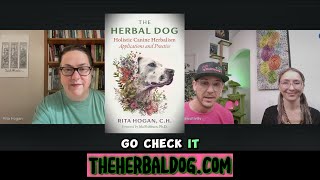
Bobby and Eden talk with canine herbalist Rita Hogan about using herbs for dog health and longevity. She critiques modern veterinary practices and pet insurance while sharing how herbal medicine can support dogs' wellness.
All right, welcome back to the show, guys. I'm Bobby. My beautiful wife Eden. And together we're pure positivity. This is where we. We focus on helping people build deeper, healthier relationships with their pets. And today we're super humbled and pretty excited to have a guest on who has had a massive impact on how we see canine health. Rita Hogan. She's a world class canine herbalist. But more than that, she's someone who truly listens to dogs, to plants, to the natural rhythms of healing that so many of her forgotten. If you've ever wondered how to support your dog beyond just reacting to the symptoms, how herbs actually work with the body instead of against it, or how we can return to a more instinctive way of caring for our animals, you've come to the right place. Today we're going to dive into her work, her philosophy, and some of the wisdom that she's gathered over the decades that she's been doing this. So, Rita, welcome to the show.
I'm so excited to be here. I'm really glad that you guys have asked me to come on.
Yeah, we're really grateful to have you here today. Just gonna jump right in here. Just one of the first things that kind of, you know, stood out to me in your book. Was that in your book, by the way, guys, Amazing. The Herbal Dog Handbook by Rita Hogan. Go check it out. We'll have some links in the. In the bio and all that stuff. But your. The thing that stood out was your childhood dog, Susie, lived to be how old?
Well, we know it's 24 at least. Wow. But it could be 27. But my dad, who has passed away would be the deciding factor there, and he would know. But my mom can't remember. But we know it's at least 24 because she was still alive when I went to college. And she was there before I was born, and I. She was there before my sister was born. So she's at least 24. She's at least 24.
It was a shepherd collie mix, so it wasn't like a small dog.
Yeah, yeah.
Really beautiful thing, you know, and it's just. It seems like that's like almost impossible today.
Yeah. You know, and it wasn't impossible then My. My late partner, their dog, I think. I think his name was Reer Madness 60s. And, you know, their dog lived until I think, like 23.
Yeah.
And, you know, and. And got hit by a car.
So.
So I think it was hit by a car. Don't quote me on that. But I Think it was hit by a car. I remember that didn't get put down for a health reason. I'm pretty sure they got hit by a car. But like, yeah, I mean, that was the normal thing. It was normal. And dogs were geriatric when they hit 15 or 16, you know, and now they're geriatric at 7.
Yeah.
And their expectation is, you know, between 11 and 16. Dogs who make it past that are like, you know, cutting edge, phenomenal. Like, oh my God. And the sad thing, the sad thing to me, and one of the reasons why I wrote the book is that we are being conditioned right now. Like right now. And it's so subtle and I'll explain why in a minute, but right now we're being conditioned that a dog is winning when they pass away at 10, that they are winning if they're 12, and that they are geriatric when they're, you know, 6, 7, 8 years old. So that all of the mischief givings and failings of modern veterinary care can be justified like that. It's, it's not a big deal. And I love my veterinary friends. I'm not saying anything. I'm talking about our schools and how we're, how we are training our veterinarians as the same way we're training our doctors. Nobody is healing anything. There is no money in getting better. And so, you know, like, just like this year, I don't know, I'm not good at timelines, I'm just not good at them. And it could have been three months ago, it could have been six months ago. But I was working with a client, they wanted like a very, like easy diet that they could give and they were feeding a pretty poor kibble. So anything was a good improvement. So I looked at this air dried food for them. They wanted, you know, something air dried that wasn't kibble, but wasn't raw, it wasn't freeze dried. And I'm like, okay, well how about an air dry kibble? Like an, or an air dried, like it looked like little pieces of meat. We all know it wasn't, but I think it was Sundays. Sundays, pet food, it's not terrible, not good, but whatever. It's a step in the right direction. I try to meet people where they're at. But what was crazy is I had to fill out a form to find out what was in the food. And it was a little questionnaire and then it said, what age is your dog? And it had, you know, between 1 and 3, 4 and 6. And then it had like 7 and 7 and 9 or 7 and 8. And it labeled it geriatric. Yeah, Right. So the more that we see that. Right. The more that we keep seeing it, the more accepting we are of it. And that is a travesty for. For dogs everywhere, for animals everywhere. The more. Like, my cat died when he was 23. Or, no, going to be 23. 22, going on 23. I think he could have lived longer. But, like, that's not a. That's. That is not, in my opinion, for a cat. Like, oh, my God, that's amazing. And all I hear is, oh, my God, it's amazing. People's cats are dying at, like, 12. That is not normal for a cat. Like, all not normal. You know, if a coyote gets your cat. Yeah, that's. That's not. That has nothing to do with longevity. That has to do with your cat being in the wrong place at the wrong time. Right.
Nature.
Nature, Right. And no. I lost a cat to a coyote a couple years ago. It was sucked.
Our first pet together was a cat that we lost to coyote. And so it was horrible.
Now my cats go out on a harness and a leash. So, like. But they spend plenty of time in the yard. They just are not able to route, you know, run about. And they don't kill songbirds anymore. So I'm. I'm pretty happy. And they are, you know, they are too. But it's, you know, it's a travesty. Guys, like, is so sad that we're being conditioned that way. And it's called baseline theory. And if you know anything about baseline theory, it's how the baseline is pushed farther and farther and farther towards this idea that dogs are geriatric at 7 and 8 so that we can have the acceptance of really poor preventative care. Two days ago, I was talking to somebody and they mentioned that a lot of the pet health. I don't have pet health insurance. I don't go to the vet. And I am willing to pay the money if there is an emergency. But, like, they are requiring flea and tick meds and vaccinations in order to have pet health insurance. And I implore everyone, if you have that type of pet health insurance, get rid of it. Let these people know, you know what? I'm not taking your pet health insurance. I know that they don't all do it, but let's put our money into a pet health insurance. And also, you know, my. Here's my. Here's my thing. It's a lot cheaper for that insurance company to insure A healthy pet. Right. Who never goes to the vet. And the, I, you know, the, the fact that they, the timeline for them getting sick is going to be way out there. So they can, they can collect their insurance premiums. Right. I'm fine for that. I would buy that insurance. I have no problem with that. But now they're requiring things like groomers require, which is unneeded. I had a boarding kennel for years that I talk about in my book. I didn't require vaccinations. They all came vaccinated. Right. I never had one case of kennel cough in my kennel. I never had anything come up. Nothing. And you know, rabies is required by law. Totally get that. I have a protocol for that in my book. I get it. It's your choice to follow the law. I can't say anything about it. But all the other vaccines are not required by law and they're being circumvented by these pet health insurance companies that are required. And literally I see people look me straight in the face and say, well, I really want that pet health insurance. At what cost? They're requiring flea and tick meds monthly. Right. And they're checking it off with the vet. So. And they're requiring the vaccines being monthly. Not monthly, but yearly given. Right. And that Bordetella twice a year just to have the pet insurance. That's insane.
Yeah, yeah, you're right. We feel the same way.
And that's just funneling money into the pharmaceutical companies. And you know, I'm not a conspiracy theorist person at all. I don't spend my time in that realm of possibility or even giving my energy to stuff like that. I sign my petitions every day and call it done and do what I can, but I think being the change is more powerful in my opinion. And like, you know, pet health insurance is not enough. And I want, you know, I'm going to ask my pet health people, insurance people, hey, which ones don't require it? And those are the ones that I'm going to promote. And I'm going to start promoting them like, hey, I'm going to support you. I. There's more money in a healthy pet if you're selling insurance.
Yeah, well, let me know if you find any of those because I have a very strong feeling that list is going to be pretty short of company.
Yeah, the list probably is like one or two, but less we give them our money, the better. Like money talks. And it's just like, hey, writing a letter. Hey, I'm, I'm going to go to this health insurance company because they don't force me to do vaccine. I want to have a healthy pet. And like, you know, sorry, you know, but there are a lot of great holistic vets that are fighting for over vaccination and things like that. And the reason why I wrote my book is plain and simple, organ health. You know, we need it.
Organ health, the pets, the dogs, they need it really bad. You need. They need help getting past these genetic problems that are starting to happen more and more regularly. So we love what you're doing. My wife, she grew up in a really awesome way going to a thing called city yoga. And so, like, Ayurveda was really kind of one of those things they talked a lot about. So did you want to ask her something about. I think you wanted to ask something that kind of, like, was about her approach.
Well, if you studied before diving into herbalism, how did that shape, I guess, the way you approach dog health today? Like, because I grew up kind of understanding it for our health and then correlating it with, like, my. My own health issues, even as time goes on fixing with purees and herbs and whatnot, trying to. And then we wanted to do it for the animals. But how did that resonate with you to go from, you know, your. Your learnings to animals?
So, you know, like, in my book, I talk about that I studied Ayurveda in the beginning. You know, I went to the University of Minnesota. I didn't study it there. I started eastern, studied eastern religion, Buddhism, and I looked at Ayurveda as a. A system of medicine. And while it's an awesome system of medicine, and a lot of my mentors really practice the vada pinakapha kind of experience for humans, it's a little harder to put on dogs. And, you know, so much is lost in translation. You know, when you speak the Hindi language, you really like. My friend was Hindi. She was a janist, and she spoke Hindi and she was lovely. And she explained to me that, you know, so much is lost in the translation of the text into English because a lot of.
More from Rita





Food Energetics for Dogs & Cats - Sept. AJA with Canine Herbalist Rita Hogan & Julie Anne Lee DCH





NATURAL DETOX FOR DOGS: Which herbs to use and how to use them with Canine Herbalist Rita Hogan
