Learning from Infomercials: How to describe your product
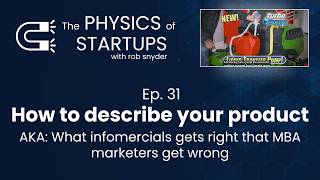
In this podcast episode, host (Speaker A) and guest Rob dissect the structure of TV infomercials to extract a repeatable framework for B2B SaaS founders and sales teams. They argue that most founder pitches start from the supply side—heavy on technology, vision, and features—while infomercials begin with the customer's immediate problem (the "pull"), briefly introduce the product (the "supply"), and then show how it fits the pull. By analyzing two real infomercials—the Turbo Pump and the Breathe Easy humidifier—they illustrate how a 10‑second pull‑supply‑fit sequence can instantly create a "light‑bulb" moment for the buyer. They contrast this with typical founder pitches that overload the prospect with technical detail, causing confusion and disengagement. The conversation yields concrete takeaways: start every sales call or pitch by articulating the prospect’s current pain, keep the product description minimal and directly tied to that pain, demonstrate fit in a few seconds, and compress information to only what the buyer needs to decide. They also discuss the limits of the infomercial format (one‑way, pre‑programmed) and how to adapt its principles to interactive sales calls. Finally, Rob offers a diagnostic service where he reviews founders’ sales calls to surface demand‑side misalignments.
Chapters
Well, Rob, welcome back, man. How you doing?
Doing great. Sick as all get out. And we're gonna, we're gonna see if I survive this. This, this podcast might be the, the straw that broke the camel's back on this one.
Yeah. You're, you're wearing apparently like 47 layers right now.
So I, I'm wearing 47 layers. I have the heat on and that's not enough. I have a, my own personal space heater and I'm wearing a ton of layers.
Let's go. Oh man. And right, right in the middle of PMF camp too. Well, sorry you're not, not feeling well. Thanks for hanging in there. I'm excited for today's conversation. We're jumping into the world of infomercials. Infomercials. We are locked and loaded, ready to overanalyze something that is simple and beautiful and does not need two Harvard MBAs to opine about it.
Yeah. Did you, did you ever think that after Bain, after HBS, you would be freaking podcasting? Podcasting about infomercials.
Is that—
yeah, there's this question at HBS which is like, how do you want to spend your one precious life, or whatever, something like that.
This is it.
Yeah, that is like— this is, this is the, this is the pinnacle. We made it.
Um, I— so this was a new addition to this, uh, this roundabout in the, in the PMF camp. Like, you refresh the materials for each one, and this was— this has been my favorite part so far. But why don't we— I'm going to start with setting the context for why this is relevant. And the short of it is there is zero making fun of it and 100 like trying to learn from exactly the way that they're— they've honed their art. But basically this is what you write. I'm pulling from the end of your Substack. The Substack is called How to Describe Your Product: A Harvard MBA Overthinks Infomercials. So this is what you write. Our pitches— talking about not about infomercials, talking about B2B SaaS founders or in general founders, our pitches are massive, broad, future-oriented, and deeply technical. All things that sound impressive to us, but confuse the crap out of would-be customers who are trying to accomplish something right now. Instead, the art of describing our product is to define the thing that fits their pull right now with the fewest words, concepts, and visuals so that they understand that it fits. And I don't have to think very hard in order to say, yeah, Yes and buy. Uh, Rob, why don't you give context on, um, like why is this top of mind? Who's it for? Um, and what are you seeing from founders?
Yeah, I just think this is like, one is just the challenge that every founder has is how do I, or every founder thinks we have, is how do I convey how awesome my product is to this person so that they will want it and buy it? Right. That's the core problem. And so we massively over-rotate on what does our sales deck look like? What is our product positioning? What is our website? What are the words that go on our website? And these things come from the supply side, starting from our product, how it works, how we see the world, da da da da da. And in doing that, We basically guarantee that people will not buy it. I have watched so many sales calls, demos, whatever. And like the default sales call, sales demo is so bad in that the customer usually shows up saying like, hey, here's what I'm trying to accomplish. And the response to that could be roughly 30 seconds of both explanation of product and demo of product, right? It, it could be 30, 60 seconds and be way more effective than what we currently do, which is usually 5-minute description plus 10-minute initial demo plus booking a second longer demo so they can get all of it so they can understand it. And so, um, it's been interesting watching that and then just going super deep on infomercials specifically. We can talk about why infomercials that flip this, they just flip it entirety, like entirely on its head on how we tend to think about things. And they kind of like have evolved to work. They have evolved a pattern for doing this that actually fits. It's kind of luck. It fits the pull framework insanely well.
I'm not sure it's actually luck. You know, the, the, there's a pattern here that works and, you know, what we observed with Cyberstarts, what we're observing from the opposite direction, Uh, with infomercials and with— we're gonna get into the Turbo Pump and the Breathe Easy humidifier. Um, and then like what you're writing about, like they're converging on something similar. So I'm actually, I'm, I'm not sure it's, it's luck. It's just there's a different approach to it.
Uh, let me, let me also clarify why I picked infomercials versus just any other kind of commercial type. So you could think, right, if you watch like a car commercial, Right. There are so many different car commercials and they're all so weird. Yeah. And so like my sense is that those kinds of commercials are created by people who are too smart for their own good. And they, it, there's like some sort of logic that happens in the creation room in like the, in the marketer suite or whatever. And like, most of us look at those and are just like, what the heck are they thinking?
Right?
And it doesn't really have to, it doesn't have to do anything necessarily. And so the reason I picked infomercials and like As Seen on TV commercials specifically is because we kind of are free from the overly intellectualized people, they're not trying to win any awards. They're literally just trying to sell a product you haven't heard of as quickly as possible. And they're free from the MBAs who are telling them like, well, actually Clay Christensen said that da da da da da. And so therefore da da da da, right? Like, and so this is just an art that has developed by like grinding against reality.
It's actually a, it's interesting, like, like Fast Company's, you know, best marketing campaign or whatever might actually have a negative impact on the usefulness of, uh, uh, of how marketing works or how communicating and selling works.
It's the same thing as like how Architectural Digest, right, is probably bad for architecture generally, right? Like you, you are doing things for not to like sell and deliver something that is awesome to the end user. You're doing it for some like third-party award that is usually some sort of navel-gazing nonsense.
Sense. Yeah. Yeah. We'll have to get into awards on another time as we've applied for and gotten a couple awards and I think of them as it's like, okay, how do I do this in the least amount of time possible and only so that I can put this in front of people that care about awards, not about the award itself, but I don't even know if that's a useful approach. Okay. So I'm going to share my screen here. If you're listening on Apple podcaster or something like that, or you're just not watching, then we'll put the links so that you can check these out separately, or you can find them in Rob's Substack. And we'll just play the first 10 seconds of the Turbo Pump commercial.
Oh, that heavy gas can. It never works for filling because it's always spilling. Not anymore. Introducing Turbo Pump, the automatic cordless powered liquid transfer pump. Watch.
Okay, Rob, 10 seconds in, what's your analysis on this?
Yeah, so 10 seconds in. So what the question here, they're, they're, they didn't have to do this. They started from zero. Why did they start where they started? And why did they say the exact words they said in the exact sequence they said them? Right? This is This is the like 0 to 1 problem for how do you, how do you go 0 to 1 in somebody's mind? They start with the, oh, this heavy gas can, it never works for filling because it's always spilling. Poetry in motion. But the interesting thing here is you might look at like, what is that? What exactly is that? You might hear that and say, oh, that sounds like a problem. Or that sounds like a pain point, but that's not what it is. That is pull. They are very concisely, the first 5 seconds articulating pull, which is like a pain point would be, uh, gas cans hurt your back because they're heavy, right? There's that. Okay. That's an interesting fact. It's probably true, but that has no motion. In it. So what we're hearing here is like the project on the to-do list and when it's unavoidable, urgent, plus why the existing option isn't good enough. So what am I trying to accomplish? Well, I'm trying to fill something with a gas can, right? In this case, in the visual, it's a lawnmower. Uh, but I'm trying to fill it because I don't know, it needs gas or whatever, and My existing supply, which is just like lifting and pouring the, my existing gas can, that is not good enough because it's heavy and it spills everywhere. Right? We get that in the first 5 seconds. That pull frames the entire rest of the commercial. That sets the context because what happens next is they describe their supply. They describe the Turbopump. It is a thing that fits that. It, it, you know, they say it's introducing Turbopump, the automatic cordless powered liquid transfer pump. What that does there is it says, okay, here is Poli. You're trying to accomplish this thing, but your existing option isn't good enough. We offer this supply that fits that demand. The words they choose there, it's like 7 words or whatever, maybe 10 words. They describe what the product is. It's a, called the Turbo Pump. It is a liquid transfer pump that is automatic. Cordless and powered, AKA it, it fits Pull. It helps you transfer liquid without the limitations of your existing supply. If they had just started without framing Pull at the beginning, without just those first 5 seconds on Pull, and they had just said revolution in liquid transfer pumps. Is here. You're gonna be like, wait, what? What? Like, I can't even, I can't even process this. Like, is this for, like, where is it for? What? Why would I use it? And, and that's how most startups pitches will start, right? Like, oh, it's the new era of AI agents is here. It's like, oh, whoa. What? Like, what does that mean? And so Starting with pull and then describing supply very briefly, kind of like fits these two together perfectly and makes it so that you go 0 to 1 in your mind in those first 10 seconds.
Yeah. I find, I'm glad you hit on that, that second part on this is the equivalent of doing that in for our listener who's, you know, pitching, pitching, you know, their customers, if, if you reflect on your sales pitch, I found myself doing this. It's like, okay, we're— we've iterated on it to a certain extent. But the way that this looked for me was start with, okay, and previously this product did not exist, or like English-speaking. In my case, it was English-speaking families have access to this type of media and Spanish-speaking families don't. Like I started out with the why on educational impact rather than, I mean, we've totally flipped it, but rather than like, here is, okay, the, in my case, reaching 300,000 or, you know, 300,000 unique downloads, reaching, you know, followed by 200,000 families, like getting your brand in front of them. Like it's, you're trying to do this thing that's pull related rather than the technical background. In my case, it's not technical, but it's like, it's about the product, it's about the why, it's about the impact, which is Totally flipped.
Yep. Totally.
Yeah.
So it's, yeah, you can say things that like at this state, at the beginning, you can say things that are interesting to them that are facts, but unless it's like about their pull, they're not gonna do anything about it. It's, it's just information that's hitting them. That's not gonna kind of like fit the action, the progress they're trying to make in their lives. They'll say, oh, that's really cool that there is this place in the market that is underserved. Congratulations to you. And they're gonna get back to their jobs. They're gonna get back to their day.
Yeah. Why don't we jump forward to how they describe the technology and then we can talk about some of the other stuff that's going on here. We're gonna jump up to its second, I think 30, right?
Let's see. I've watched this like 50 times. All right. Easily and fast. The secret is the Turbo Siphon technology that pumps almost any liquid right down to the last drop. And look, Turbo Pump can drain over a gallon. Okay.
Yeah.
Yeah.
And so here I found this observation really interesting. And technical founders, before you are— before you listen to Rob's analysis on this, think about the way that you describe your product and the technical elements of it. Now, Rob, give the, you know, what are you observing from the turbopump?
Yeah. So like, how does the turbosiphon technology work? Do we know? Do we know the nuances of it? No, we have no idea. We have literally no clue. All we understand is that it makes sure that it's some sort of unique technology. That makes sure it pumps all the liquid out.
Yeah. It's literally like, there's a, there's an image of like a little spinny turbine and it's like, do I have any idea? Like, I don't even know if that thing is in there. Like I've literally, I don't know if maybe that's decorative. It, that like they, they spend zero seconds talking about it.
And, and the contrast here is that we usually, like, I think of it as kind of like pull down versus like product up. And the way that we use, or technology up even, uh, what we're watching here with the infomercial is a pull-down way of describing, which starts with pull and only describes what is relevant to pull, working its way down to the technology, but just like tickling the technology, not really actually talking about it and only talking about it in, in terms of how it refers to pull, how it fits pull. In contrast, the way that we typically do it is we're like, listen, we have this unique multi-agent architecture that we've developed in conjunction with da da da da da that has actually done it right. And it, and what we're doing there is we're starting with the technology and explaining the technology in its kind of like from, from the technology's perspective in a complete way. And then trying to work our way up to the customer. Hmm. And what that does in practice is it confuses them. It is intro— when we go with a kind of pull-down way of describing our product, we're only describing the things that fit their pull, the relevant pieces to what they are trying to accomplish and why their existing options are not good enough. When we do the technology up, we are describing everything about our technology or what we think is interesting or what we think is complete about our technology, which doesn't fit their pull by default. It's just about the technology. And so the The thing this does for customers is it causes them to think they need to understand all of this. And it's a lot of concepts for them to understand and a lot of dots for them to connect to make it to something that is relevant to them. And most of these concepts are not helpful for them. I don't need to know If turbo siphon technology is literally a siphon, I don't need to know what a siphon is. I don't even know, like, as I say these words out loud, I probably couldn't define a siphon to you at this moment.
Yeah.
And I probably, oh, this is gonna be embarrassing. I probably can't define a turbine versus a siphon, siphon, and understand the difference between those. But that isn't relevant. That doesn't matter. I don't need to understand those things. All I need to understand is that this has some unique way of making sure that I can transfer liquids in a way that won't spill or be too heavy. And these are all the, like, these are the relevant mechanics of that to me to understand. I don't need to understand anything else.
Yeah. There's, you know, two quick reactions. One is that it doesn't mean that never in the sales process are you ever going to talk about the technology. Like there, there may come a point where in order to get past procurement or something like that, you know, for security, it may, I imagine it may come up that they, but in that case, they are asking you to get into, you know, to pull back the curtain and to show it to the people that it is most relevant for, what, you know, who are probably on the IT or, or, you know, security side of things or something.
Yeah. Yeah. Maybe. Right. And what I'd say is, and that happens less than you might guess.
Hmm. And then, you know, one other quick reaction to your, your story and the way you talk through it makes me think of your first startup where, which you were running out of Google Sheets and like it, you addressed demand with, you know, early you identified demand and pull without, with, without a technical product. And so if you would have, if you would have been like, here's how it works, you know, like they just irrelevant, like it, nothing about the solution or very little about the solution was about the technical part of it, but that didn't make it a less valuable product for the, for the customer.
Yeah, exactly. So what they cared about was that they got new candidates to hire or that they found out when an employee was about to quit. That's what they cared about. That was the project on their to-do list. And they didn't care if I had a herd of trained wombats who were in the background phone calling all their employees to see how they're doing today. Like, they didn't care. They didn't care if it was me in a spreadsheet. They didn't care if it was an automated agentic da da da da da, right? Like that, that wasn't the thing that mattered to them. They, all they cared was that it was as little work for them as humanly possible. And they got the result. And so I would actually like go into calls, sales calls, not demoing anything because I didn't have anything to demo and apologizing for not having a product that they could log into until someone was like, and this kind of, this beat this lesson into me. One of the restaurant owners was like, listen, I don't care. I don't want to have to log into anything. I don't want to have to learn a new system. And I was like, oh, light bulb clicked for me then. This is kind of the process of realizing what demand is and what kind of going from pull down is. It's a, it's a lens of seeing the world. We then started just saying, hey, you know, one of the best parts of this product is you don't have to learn a new product. You don't have to learn a new software. And people are like, oh my God, that's exactly what I'm looking for.
Yeah, that's, that's fascinating. I think I still probably have the how it works too early. I was getting that. I was getting that question like, okay, what does it mean to produce with y'all? What's the process? And so I pulled it forward, but I actually think I probably pulled it forward too early. I should just allow that when it is a question to come up naturally, you know, farther in the call if it's relevant to them at that point in time. Otherwise, you know, you, you actually reflecting on it inadvertently, I'm introducing questions around like, okay, who are the guests going to be? How are, you know, what are the topics? What's the sequencing of this? That we don't actually need to get into until we are much further along in the, in the, you know, purchase process. Yeah.
What do we, what we're doing here in the, the first part of, of this where we're saying, here's your demand, here's our supply in the fewest words and concepts possible with supply kind of like designed to fit their demand. What we're doing is we're saying like, does this concept fit your pull? If it doesn't fit their pull, the rest, like nothing else is going to change that. Like nothing downstream that they're going to see is going to be relevant. So we have to, that's why these start with pull and then supply description. And then kind of like a how it fits piece that we didn't quite go into where they're in, in the Turbo Pump commercial, they, they show, right? Like here's how you transfer liquid from this thing to this thing. And it's like a 6-second or 7-second piece that comes right after the description of supply. And what this is doing is it's going from pull down. It says, okay, here's your pull, here's the supply concept. Here's what it is. Here's how it fits your pull. Here's, here's how it actually kind of, you, I could say like how it works, but I like how it fits your pull better because how it works, we could come to that from the supply side and just say, you know, oh well, here's all the different components of it and here's how you put them together and da da da da. Like that's not the right thing here. It's just, here's how this thing enables you to accomplish your, your project. Unlike the, the, to overcome the limitations of the other options. Right. And it's just, it's that. And at that point, basically 16 seconds in, 10 seconds in, you like, you've got, or 5 seconds in, you know, you, you're at that context moment where it's like, yep. Okay. I know where this thing is going to fit into my life. And I think rightly, I think it might fit into my life.
Yeah.
At 10 seconds in, you're like, okay, cool. I know what the thing is roughly. I have a sense of what it is. 16 seconds in, you are basically like, okay, cool. I know where it fits into my life and exactly how it fits into my life. And 17 seconds in, you're phoning the operator to—
no, I'm just kidding.
You're sold.
It's actually a fairly good litmus test. Like how long does it take you to get to that light bulb moment? Or when do you think you hit that? And if it's 30 minutes, it's, you know, you're, you're, it's far too long.
The, yeah, again, it was just coming back to this. The more concepts you introduce for them to understand, the less likely they are going to be to understand it and buy it. The art here is in compressing the information only to what matters, and what matters is their pull and the thing that fits it.
Yeah. Um, Rob, are there— before we move on into maybe Breathe Easy, um, what is similar and what is different? Like, what do, what do founders take away from— I can— this is, for example, and this is an infomercial, it's a one-way thing. Yes. Like, you can't interact with the infomercial, it's just gonna play. Um, another is like, it's, you know, pre-programmed. It's, you know, you're, there's a visual the entire time. What, what is the same that we take away from this and what is different from, you know, what founders should take away from, uh, like their approach to sales?
Yeah. So the same is the sequence of things. There is a sequence of things that help customers go from not understanding what they need to understand or understanding anything to understanding What our product is and, and how it fits in their life and when, what, what they would do with it and if they want it or not, right? Like if, if it fits as a concept, right? And the, the principle here is the sequence of things: pull, supply, how it fits is basically mandatory. The second piece is that we are compressing the amount of information to only what they need to know. Not too little, cuz then, right, like they, they won't understand it. Not too much because then they definitely won't understand it. And more info, we tend to think more information is better. It isn't. It's the right amount of information given the context of their pull here. And so tho, that's what's the same. What's different is one, you should not be rhyming in your sales calls. That's just, that's just weird. 2.
And is that— but if you, but if you do, please leave a comment and let us know what your rhyme is. Like if, if there's limericks or something like that, we, we would love the examples.
Yeah, I love that. Yeah. Do a, do a poem or a limerick in the, you know, with Pull and your product, you know? And, and yeah, we will read that out and lose our last subscriber as doing that.
Yeah. Our first, first and last.
First and last. Uh, so, uh, what's, what's actually different is this is treated as a presentation, right? It is a, um, I am beaming this information to you just because I can't have this conversation with you. And so what you'll see throughout the rest of, so basically the first 16 seconds of this 2-minute infomercial cover everything you need to know. The rest is just randomly trying to overcome objections you might have or probably have, and also giving you additional use cases for the turbo pump. That you might not have considered. Yeah. And then like showing additional features and then, and then kind of like trying to create urgency, trying to create enough like interest by putting an offer in front of you that you can't refuse. And like these, you know, it's like the kind of classic, but wait, there's more. Buy now and you get a second turbo pump. It's like, yes, 7 turbo pumps in my house.
One for the milk in my cereal bowl. That the— exactly. It's a, it's an interesting point on the, uh, the one way, like what you would do, what they're doing by introducing these other, um, you know, use cases or other instances of potential pull is like early on what they would do if this were a conversation is, you know, identify that pull, like what are you trying to accomplish? And then you wouldn't have to hit all these other potentialities because you already know what the person is trying to accomplish, whether it's, you know, uh, yeah, they work on their car a lot or they're— I think, you know, some of the examples were like they trying to clean a fish tank. Like, there's the other things that you would know based on our outbound and based on like the first, uh, 3 questions that you ask in, uh, in discovery.
Yeah. And like what you might do in this case, right?
Yeah.
They have the fish tank, they have clogged drains, they boat. They're just swinging here and they're just like, listen, something here. I'm gonna get you on something here. But like what you would, what you might do in a sales call is like show a slide up front that's like, hey, like it might have a boat on it. It might have like, right? Like when, when are you transferring? Like what, when are you like pouring liquid? When are you doing da da da da? Like when, which, which of these scenarios?
Okay.
And then, you know, how is the experience of your existing gas can, like pouring that? Is it heavy and spills a lot? Okay, cool. Then we've got kind of pull there.
Yeah. Yeah. Um, do we want to go ahead and jump into the Breathe Easy humidifier?
Well, actually, like, I think people can just watch that themselves. I think the difference there is only in the, the kind of like how they describe pull or, or sorry, sorry. How they, how they describe how their product fits pull. So basically in the Breathe Easy humidifier commercial, turbo pump is kind of a new thing. Right? Like I didn't know, I don't know what a liquid transfer pump is before and after I do. And so the way they describe here's how it fits your pool is they actually show the mechanics of using the product. Like, you know, here's, here's how you transfer liquids with this, with the Breathe Easy Humidifier. It's just another, it's a great one. What, what they're basically saying is like, You already have an existing humidifier. This is just replacing your existing humidifier. They don't actually have to teach you how to use a humidifier. They don't have to show you how to use a humidifier there because you've already got one based on the way that they've— so we are just swapping out one humidifier for another. What's the case they have to make? They just have to say, basically, here's, here are the pieces of this that are better than your existing humidifier, that overcome the limitations that you're already running into in your existing humidifier. And so they just talk about like, see, it's unlike your existing humidifier. This one's actually easy to clean, unlike your existing humidifier, da da da da da. Right. And like, and so they're not actually showing like, here's how you turn a humidifier on, cuz that's not relevant. That's not pulled down. That is product or technology up.
Hmm. Yeah, this one you could imagine them having developed the product after asking buyers like, what supplier do you hate? With the supplier being like a household appliance. And then like this is targeted squarely at like the, the options that, you know, they've looked at or what they're using right now, they're totally dissatisfied with and they have no idea that there's another way that's better than this. And so it's, you know, there's this slightly different, uh, entry point there.
I think the creative thing they do too, which I'll just call out, is like one of the parts of Pull is saying, okay, right, like here's why existing options are not good enough. And here's what we are. And, and, and it basically creating the contrast between your existing options and us, but it's like, hey, You already have a humidifier. We are a humidifier, right? Like how do you do that? How do you create that contrast? And the way that they do that, and I've seen other like startups do this well, is saying, yeah, these are like legacy outdated humidifiers. These are old models and we are a next generation humidifier. Right. And what that does is that allows the buyer in their mind to create two separate categories. For these things that in their mind just a second ago were one category.
How do you, how does that tie to pull, Rob? Like the, sometimes it's like, you know, we talk about, all right, this is next, next gen, what AI, you know, applied. Like when does it, when does it work to use that language and when does it not work to use that language?
I think it's basically when the, options they currently consider include something like what you are, or that is basically the same kind of thing that you are. So another example of this is Jump for AI note taker, or like a AI note taker for financial advisors. What they did in their pitch was be like, there are a bunch of other AI note takers that were around before Jump was. So what they had to, and, and their, their kind of financial advisor customers had considered or tried the existing AI note takers on the market. They just weren't a fit for them for certain reasons. And so Jump could have said, yeah, we're a better, we're a diff— a better AI note taker, which puts us all in the same grouping. And the buyer doesn't understand that. They're like, I've tried note takers before. You're telling me you're better, you're just a better note taker. No, they have to create the contrast there by saying all of these other note takers are generic note takers. We are an AI note taker that is specific to financial advisors. Hmm. And so they've created this where it was kind of like all lumped in together in the buyer's mind as a thing that didn't fit what they needed. We've kind of, we've separated it out. We've done a cell division on this thing that was once one thing, but now we've said, oh, actually it's actually two things. And the category of things you've already tried, yes, obviously we're gonna, we're gonna call that a certain, we're gonna give that a name and we're gonna give ourselves a different name that seems like it fits what you're looking for.
That's interesting. Maybe, um, uh, would be super interesting in the future, maybe at some point to get into differentiating supply and how you communicate around that in, in greater detail. How about for the infomercials? What are the takeaways? Like what should our listener like go and do as a result of this?
Yeah. So the basic question is, as you watch your own sales calls or as you're on these sales calls, what is the minimum that you can show and tell to convey to the person on the other end that you fit their pull? That's the question here. And how do you do it from their perspective, which is basically my, my pull, the thing I'm trying to accomplish, but my existing options I am coping with or blocked by, right? That's from there. What are the fewest concepts that I can say? And so what you should be doing is looking at your sales calls. And realizing that probably 85%, 90% plus of the words you say post-discovery are shooting yourself in the foot. Hmm. They're confusing the potential customer. And in fact, in most of these cases, what they are doing is they are convincing somebody who has pull that they should not buy from you. I've seen that where it's like a 2-minute description that is not fitting poll and the potential customer who shows up saying, seems like you're the exact fit. We've tried this other thing. It wasn't good enough. 2-minute founder description. Person at the end of that says, well, okay, that makes sense. Maybe this isn't for us right now. Right. And so it functionally dissuades them from buying. So what you should be doing is saying, okay, what's the, what is the least amount of words and concepts that I can say based on their pull and the least number of things I can show based on their pull so that they get that this fits their pull. That's the activity. It is a hard activity to do because by default, you're gonna approach this from the supply side.
Yeah.
You're gonna focus technology up, what you want to be true up. The art is saying who's, who has pull right now? And using that, assuming that that is fixed, you can't mess with that. And then just saying, okay, based on that, what do I say? This is what all these kinds of like people who do kind of like on the marketing side of things, they always come at it from the supply side. And that's why this stuff is, that's why we spend so much time on our websites and like, da da da, because we're coming at it from the supply side. Versus from the demand side.
Yeah, that's super interesting. And actually, you know, that's a pretty good case for why it's helpful to get another founder to watch your stuff because you, if you're building product, you're, you spend so much time, speaking firsthand, spend so much time thinking about your product that it's hard to get your brain out of that mode. And you know, for, in my case, like it's super helpful to have you look at my stuff because you're like, hey Robert, you're saying all this like nonsense that nobody cares about, like, this is the thing that they need you to say. Um, and so getting another perspective can be a really helpful way to do that.
Yeah. The demand side is like, the cool thing about demand is that it's just a claim about objective reality, the buyer's objective reality, which is, and, and so it often helps to have somebody who's just like, who doesn't care that much. Like who's, who's not, it doesn't care as much as you look at What a buyer is saying and say, okay, are they actually trying to accomplish something and they are blocked? Or are we like trying to convince them that they should want to accomplish something and are blocked, right? Like the, the, there's a subtle difference there, but demand is a statement about objective reality, not what we want to be true. And we can see it by watching how what customers talk about in sales calls.
Love it. Love it. Rob, anything else to add before we wrap today?
No, I think I'm gonna go curl up in a ball.
Yeah. Get, get to feeling better. If anybody wants to work with Rob when he is healthy, uh, we'll leave the, leave the notes, uh, or, or leave the links in the, in the show notes. One of the things Rob, Rob does is, uh, you know, he'll watch a couple of your calls in over a month or over a 3-month period, uh, help, uh, kind of do that diagnostic on like where's demand and stuff like that. So if it sounds like an extra Set of eyes would be helpful. That's something that he does.
If, if I survive this sickness, we'll see.
That's right. Time may be limited. Supply is limited based on Rob's immune system's ability to fight this off. Awesome. All right. We'll catch everybody next week.










