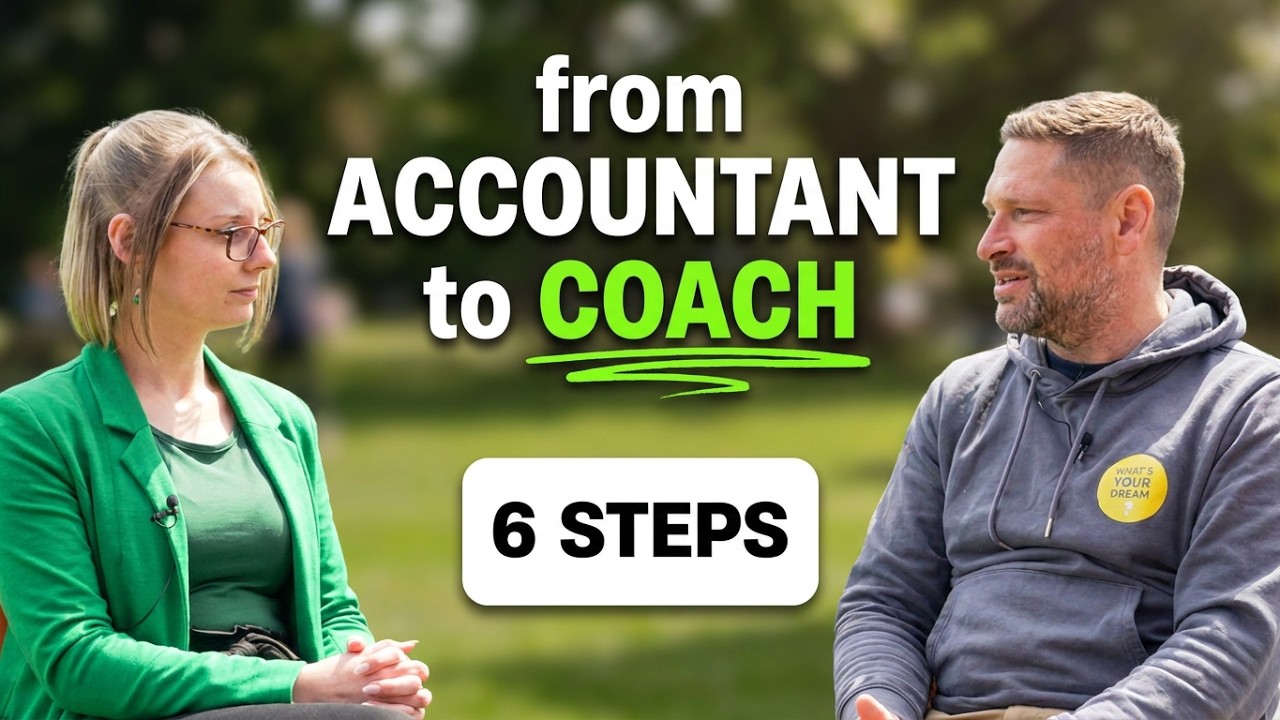
Building a $5,000/mth Coaching Business in 24 Minutes

Rob McCauley, a retail employee, works with Robin Waite to build a coaching business targeting £3,000 monthly revenue. They price a 12-week program at £1,200 (£600 upfront, two £300 payments), then map out a four-step client acquisition framework to reach entrepreneurs and small-business owners through platforms, partnerships, and podcasts.
Chapters
The goal of business is to enrol the right clients. Yeah.
Yeah.
You know, and, and to run a profitable and sustainable business.
Okay. How would I find my ideal clients? Hello.
So what's your name?
Rob McCauley.
And what's your business?
I'd really like to become an accountability coach.
Fabulous. And what's your biggest pain point, problem, or challenge right now?
Starting.
Starting. Okay. That's a common problem, right? Let's get to work. Welcome to the Business Bench.
Thank you.
So tell me a little bit about your background, accountability coaching. Why'd you want to get into that?
So, um, I've been in sales, or at least customer service, most of my life, and, um, I've got— I, you know, I've learned how to connect with people. Yeah. And, um, uh, and then I joined the Help Bank community, and I'm encouraging people to push forward with their business, but I'm doing it for free.
Okay, and, um, so you'd like to get paid for it ultimately?
Okay, I'd like to get paid for it, and I'm really enjoying it. It feels great helping these people. Yeah, and I'd like to do it full-time.
Okay, yeah, cool. And explain to me what you mean by full-time. So what's the transition then that you're about to go through?
Um, I'd like to get to the point that when I can—
Because you have a job at the moment, don't you?
I do, yeah. I work full-time in retail at the moment, but I'd like to get to the point where Even, even if I'm just part-time doing my actual job, okay, and then the rest of the time helping people push forward with their businesses and their dreams. Um, it's just really scary on how to get started in something like this.
What would you say is like this, the scariest thing from going from full-time employment into, let's say, getting your first paying customer?
Well, the, the scary thing is Having a job is all I've ever known.
Okay.
It's the fixed pay, it's the security, right? And stepping out on my own and starting my own business feels like there's a massive element of risk there.
Yeah.
And I'm a dad. I've got, you know, I've got 2 kids and I'm married with 2 kids.
And how old are you, if you don't mind me asking?
38.
38. Okay, cool. Young buck.
Pushing 40, man.
Okay, so you're 38, full-time job, you've got a little one as well that you're kind of, you know, looking after. So security is massively important to you, but you've kind of— the light has been kind of shone on you in terms of like, you know, with the work you're doing at Help Bank, that you are incredibly motivating, you know. But actually, is there a world where you could potentially get paid for this as opposed to That you're giving away your time for free essentially at the moment. And I think it's probably important to probably include within that, that the Help Bank community isn't where you want to make your money. You want your own sort of private clients from the coaching space, right?
Yeah. And, you know, I'd like to go into it morally as well. You know, I want to be helping startups. I want to be helping people that feel lost and isolated in their business journey.
Okay.
Because I've noticed that just someone saying, I believe in you, let's do it. Um, really does help them.
Yeah.
Um, how do you, how do you work out a pricing structure for someone in the startups as well? Because if you're an established business, surely it'd be quite expensive, right? Yes.
Yeah, absolutely. Okay, so where do we start then? So what would you say if you're going to be doing some accountability coaching with somebody, what would you say is like the dream outcome that you would be delivering for them? That they believe in themselves.
Okay, that's really important. And believe in themselves enough that on those hard, inevitable hard days in business, that they carry on and push through it. Yeah, um, for, for, for the actual startups, that's, you know, constant self-belief is really what I— my outcome is.
So we need to dig a bit deeper to understand really what the, the dream outcome is for those people. So So getting them motivated, I understand that, but what do they get through being more motivated?
Well, more money, more clients.
Okay.
Yeah, because if they believe, if they're more motivated, they're going to go out and more outreach, they're going to believe in their ability, and ultimately they'll be freer as well and they'll inspire other people.
Okay, so more clients, more money, but but they can do better work as well. So kind of, okay, great. So that, that, I mean, luckily with you, we only had to go like 2 layers deep and we got to the, the root cause, like, like, what is it that they really want? It's normally more money, better relationship, better career path progression, whatever it might be. So those kind of 4 main pillars of life— health, wealth, happiness, and love— they tend to be the things which people are looking for.
Yeah.
So you've drilled it down straight away. Were you just to go out and start selling coaching, how would you charge for it, do you think?
I would work out exactly what I need to cover my costs, and then I would divide that by the amount of time I want to spend on it weekly. Okay. And then do some maths, and that's my base amount I need to live and potentially save. And that would be my— does that make sense?
Kind of. So let's work it through. So How much money would you need on a monthly basis?
Um, well, I'd need to live, I'd need around £2,000.
£2,000 take-home. Okay, so start a business, there's this really annoying thing called tax obviously, which you've got to take into consideration. So let's say for argument's sake the, uh, the government take 30% of whatever you make. So actually probably need to— the business needs to make £3K a month in order to pay you £2K a month.
Okay, okay.
And maybe give you a bit of a sort of savings kitty for a rainy day fund. Okay, so let's work on the basis of it's £3K. So using your kind of thought process there of like sort of backwards calculating it, £3K a month, um, how would you then translate that into how much you charge for a client?
See, this is, this is my problem, right? When things like this happen, I get rather overwhelmed.
Yeah.
And, um, uh, kind of run away from it. And I think that's why I haven't moved as far as I should.
Okay. Um, I'll lead the witness a little bit. Yeah, that's okay. So how, how most people, when they get into, say, coaching or therapy or traditional sort of service client businesses, they typically tend to work on like a, um, an hourly rate, right, or a per session rate, right? Okay, so how much would you charge per hour on that if you were going to maybe do it on a per session basis, do you think?
Per hour? Yeah, um, it would be, I think it'd be around £50 an hour.
£50 an hour. Okay, so to make £50 an hour to get to £3K, you've got to service 60 hours worth of coaching a month. Okay, so 15 hours per week. Now, it doesn't— that doesn't sound like a lot, and actually— but the challenge is, alongside those 15 hours a week that you've got to be servicing clients, you've also got to go and find the clients and do sales calls with those clients and probably take your son to the doctors when he's poorly, or, uh, do your shopping or washing or— admin in the business. So you've got all these other things going on. So believe it or not, for most service client businesses, the most number of hours they can sell in a week is 15 hours. You're already, you're already capping your earnings potential, right?
Okay.
By charging $50 an hour, okay? Because the other 3 days a week is spent on marketing, sales, finance, admin, childcare, and all that, the rest of it, okay? So, so we know that you've already naturally created a glass ceiling for yourself there. So instead, how we look at it is slightly differently.
Okay.
So what you want to do instead is to, alongside the dream outcome, you want to start to think about the transformation which you're creating for clients. So as an accountability coach, getting to a point where they're making more money, how long do you think that transformation might take to go from A to B?
It would be a couple of months, wouldn't it? Couple of months? Yeah, couple of months. Yeah.
For the majority of people, if we were to play on the safe side, maybe 3, let's call it 3 months.
Right.
To give yourself a bit of leeway for the slow learners. Right. Right. So 12 weeks. So imagine then if you were going to charge, so we've got dream outcome, you know, make more money, get started, get motivated, fixed time period, 3 months or 12 weeks depending, or 90 days depending on which way you want to pitch it. And the final thing where we want to get to is that you're selling it for a fixed fee for those 12 weeks. Right.
Okay.
So we do some very just rudimentary maths at the moment to start to come up with that packaged up offer. So if we take 12, if it was a weekly session for an hour, 12 sessions times by £50 an hour gives us £600, okay?
Yeah.
How would you feel about, imagine you're in a consultation with a prospective client and they say, Rob, this sounds amazing, I think I'd love to work with you, I'd love your help. And then they say, how much? So how would you feel about saying, just £600?
For 3 months?
Yep.
Seems a little less, doesn't it? It doesn't seem as much.
Interesting insight. So straight away you can see that it, it, it, um, you're selling yourself short on an hourly. We haven't changed the price, by the way. It's still the equivalent of £50 an hour.
£50 an hour seems like quite a lot, or just right, but then when you bundle it all together, £600 doesn't seem like a lot at all.
And what if those entrepreneurs that you're working with, you create over those 3 months, you create a real transformation for them and it adds £50K to their top line, £100K to their top line, or even more in some cases, right? So for just £600, they could make £50 grand. You can see that the maths don't quite work.
Yeah.
So now what we're going to do, so we're going to test, like when it comes to pricing, right, there's 2 sides to it. There's the head and the heart.
Right.
Okay, so we've gone through an intellectual process so far of figuring out how much you should be charging for your product, your coaching services, right? Your accountability, your 12-week transformational accountability-like program. Um, and we've worked it out logically, £50 an hour times by 12 weeks, we've got the transformation. Okay, but what we haven't tapped into yet is your heart. We started the work there because you were like, oh, actually, yeah, that feels a bit cheap. Okay, so I don't want you to overthink this, all right? But we're going to start at £600 for the 12-week program, that transformation you're creating for those entrepreneurs.
Okay.
You know where I'm going with this, don't you?
No.
Okay.
Yes, I do.
So I'm going to, I'm going to say some numbers and I just want you just not to overthink it. Okay? So, and this is like if you, if you had to put the ideal client sat in a consultation and they ask you how much. Okay, so we're going to start off £600 £800, £1,000, £1,200, £1,500. Okay, there we go. So if you pick that up on, on the camera, so you had a very big sort of quite a big reaction to that where all of a sudden we just flip-flopped from left brain to right brain, the heart took over the head. And at what point did it feel uncomfortable, would you say?
So £1,000 felt right.
Okay.
And then once while we were going up, it felt like I was pushing my luck, and then when we got to £1,500, I thought I'm not worth that. Okay.
You know, how do you commonly like to play? Do you play a little bit outside your comfort zone? Do you like to play safe?
I regularly push my limits, lead with intention, but Yeah, comfort zone is, uh, a barrier I like to push against generally.
So between £1,200 would be about, say, £1,500 outside your comfort zone, would you say?
Yeah, yeah.
How would you like— which one would you choose?
I would choose £1,200. £1,200. Okay, great.
Yeah, so already we've doubled your prices. We've gone from £600 to £1,200. The mistake a lot of people make when they kind of price something up— £1,200, well, It nicely divides by 3. So a lot of people would say, okay, well, they'll find a client, they say how much, £1,200. Um, oh, it's £400 a month. I don't want you to do that. I want you to do it slightly differently because what we're doing is we packaged it up so that they're paying for an outcome, not your time.
Yes.
Okay, paying for an outcome, not 12 weeks of support. Okay, so what we do in this instance is we charge £600 upfront, right, to get started, and then 2 installments at £300 Okay. A month, basically. So we're front-loading the cash. Good for you as the coach. But also we're anchoring the client into, they're buying a product and an outcome, so they can't get 9 weeks through the process and then go, I'm not interested anymore. Or they have a good, a good month, they want to cancel. They have a bad month, they want to cancel. Or I don't know, you're locked in. Their cat dies and they want to cancel. Whatever it is, they're locked in for those 12 weeks because that's what they need to do in order to get the outcome.
Yeah.
Okay. Makes sense.
Yep.
Okay, where would you like to go next? Or is there anything you'd like to sort of ask or go a bit deeper on?
Well, so I know I can do this, right? I know I can motivate and help people in this space that I'd like to move into.
Yeah.
But how do I convince others that I'm the guy? You know, because I, you know, I've never done this before.
I've never been paid for this before.
How do you convince someone that your service is worth it? when you've never officially done it before?
Well, the first thing is you don't convince them, right? Okay, you shouldn't have to convince them. Okay, there's this incredible, um, uh, book which I recommend to all coaches. It, it's like one of those hallowed books that lives on my desk. Okay, and, um, it's called The Prosperous Coach by Rich Litvin.
Prosperous Coach?
Yes. Yeah, so we will, we'll make sure we get you a copy of that. I was gonna say, whether you buy it or I'll buy it for you, but, um, So Prosperous Coach, Rich Litvin, in my eyes is like world-class. He's one of the best coaches in the world, if not the best, in my opinion. And he talks about this really simple 4-step sort of framework, which you've got the initial couple of stages of it nailed just by virtue of who you are, your personality, and what I've seen of you, like in the Help Bank community, for example.
Okay.
So the 4 steps. So what he says, first of all, is to connect with people. You're doing that already.
Okay.
You're going out, you're helping people, you're connecting with lots of people. The only thing that I would suggest we do slightly differently is that you get ever so slightly more intentional.
Okay.
So you said you want to work with established entrepreneurs, so you've got to spend— rather than connecting with loads of help bankers, maybe take 10 or 20% of your time and energy that you're putting into those connections and maybe connect with more established entrepreneurs.
Okay.
Because let's face it, um, they're the ones with the need, they're the ones with the budget, They're the ones who probably need it now.
Right.
If they're not already getting some form of coaching. So connect. The second step then is to invite. So the invitation is very simple. When you start chatting with people through the connections and they, oh, I'm an accountability coach, and they go, you know, they'll start to unload on you. Oh God, I keep on starting these things and not finishing them and really struggling to focus. And so the invitation is very simple. Okay.
Right.
If somebody says that to you, all you've got to say to them is, I think I can help you with that. Would you like to sit down and have a consultation with me and we can see if we can figure a few things out?
Okay.
Yeah. So connect, invite. Okay. The 3rd step, this is where we shift then into delivering value. This is where you just do your thing as an accountability coach. The first consultation piece, so you kind of want to make it more about, more of a diagnostic sort of process. So that's the So that's the difference between the sales part and then actually delivering some coaching, okay?
Okay.
So, um, you create a client. Creating a client is essentially just about doing the work, basically a little bit of a diagnostic, but also then you've got the opportunity to coach them and see if they're amenable to coaching, because not everyone is coachable.
Okay.
So we've done connect, invite, create, and then provided you do a good job on creating a client, you get the opportunity to propose to them at the end of it. So the proposal is like very straightforward. I think a lot of people overthink this because they think, they start to think about, I'm going to close the deal, I'm going to sell to them, and all this sort of stuff. And actually, a good coach doesn't need to like really hard sell people. If you create a client, you create them well, likely it is they probably want to kind of have further conversations with you essentially.
Okay.
So at that point, the proposal is very simple. You just say, hey look, did you enjoy this conversation?
Yeah, and yeah, I did. And yeah.
Excellent. And would you like to have more conversations like this?
Yes, please.
Great. Would you like me to tell you about how I work with clients?
Yes, please.
Fantastic. So I have this amazing 12-week accountability program that's going to absolutely transform your approach to your work. It's going to get you far more focused than you are at the moment. We've already gone through some of the blind spots which you've got and reasons why you're taking on too— you're saying yes to too many things, and, you know, you're, you're not really focusing on the stuff that's going to create a big outcome. So If you'd like to change that, we can talk about getting you started on the 12-week program.
I love it. Yeah, yeah, makes a lot of sense.
And what do you think the client would ask at that point?
How much? Cool.
Well, the investment for the accountability program is just £1,200.
Excellent.
Do you see? So, so it's like a really straightforward process. There's no, no, like, convincing there. No, there's no convincing, there's no pressurizing, there's no There's nothing there which is manipulative or pushy or aggressive or anything like that, which is what a lot of salespeople teach their people to, you know, to do. For me, sales should be a very natural sort of process. It's also worth remembering as well, like, the goal of running a business is not to enroll as many clients as you possibly can do. The goal of business is to enroll the right clients.
Yeah, yeah, yeah.
You know, and to run a profitable and sustainable business.
Okay.
So now, if you're selling your services for £1,200, how many— you only need like 2.5 clients a month at £1,200, and you've hit your £3K mark, right?
Yep, yep, yep.
Now, because your program's only 12 weeks or 3 months, the most clients you'll ever be working with at any one particular point in time is going to be somewhere between probably about 6 to 9 clients, maybe 10, okay? So that's 10 hours a week, not 15, and you're making more than double the money. Sounds like a no-brainer to me. Doesn't it just? So there you go. So blueprint's simple. Go out and connect with people, invite them into a consultation, create the client, make your proposal at the end of it, and probably for every, every 3 consults you do, you'll close a client. So again, you can work backwards from that and go, okay, so to get 2.5 clients, Probably need to do 8 to 10 consults a month, 1 to 2 consultations a week. Does that feel manageable? Do you think you could manage to fit in those consultations?
Absolutely. Yeah. The amount of free time I've got, you know, hours here and there, absolutely could do that.
Great.
Quite excited about this, actually.
So I've got one challenge for you. This will probably wrap up the— wrap up this time on the Business Bench.
Cool then.
Okay. So my challenge is, could you in the next 30 days book 6 consultations? Yes. Yeah. I'm not asking you to— I don't want you to close a client, okay? If it happens naturally, great. But all I want you to do is I want you to find 6 people who will sit a consultation with you. You coach them, help them through the process, and then hopefully at the end of it they'll say, what happens next? And then you can do the pitch, the same way that I showed you. Yeah. And what we're looking for is we're not looking to sell anything.
Yeah.
It's to find and book those 6 consultations and to pitch 6 people. I can guarantee if you do that, you will get a client.
Okay.
But the goal is not to get a client. The goal is to find the clients and pitch them. That's all I'm expecting of you.
Okay.
And you've got 30 days to do that.
Okay. How would I find my ideal clients? You know, it's all right sort of intentionally reaching out, but like, I mean, I suppose how do I identify my ideal client as well?
You mentioned entrepreneurs as being one, or small business owners as being one, right? Where do they hang out?
Yeah, LinkedIn, Help Bank. Um, yeah, so isolate where they are.
Yeah, so once you've identified them, I mean, even entrepreneurs, probably you could ask, maybe it's a bit too too broad. There might be a specific type of entrepreneur you want to work with. So could be entrepreneurs with ADHD, that could be a niche. It could be entrepreneurs who work in door businesses. You probably had enough of doors. It could be entrepreneurs who run, you know, garages, mechanics.
Yeah.
Right, so you get to choose how you want to play, but then next question is, well, where do they hang out? So conferences, events, what podcasts they listen to, what YouTube channels do they watch? Hopefully this one. What magazines do they read? What blogs, newsletters are they signed up to? So the idea then is, and this is what I do, is essentially once I've figured out like where they are, I just try and position myself on those platforms. So the coup de grâce for me, the kind of the pinnacle, was the Ali Abdaal interview. I knew that there was, out of his millions of followers, there was like a nice little Venn diagram of small business owners that fit into that in his audience.
Yeah.
So if I could get onto his podcast and get in front of 300,000 people or whatever, I knew that I was going to win some business. I didn't predict how big it was quite going to be, but that was like 3,000 leads from that one interview.
Is in real life more effective than online?
I personally find in real life is much better.
Right. Okay. Yeah. So get to all the events.
Get to the events. People that you want to partner with, you know, like me, I focused on people who already have audiences. So Simon Squibb, Ali Abdaal, Christo. Daniel Priestley and several other sort of big events. I focused on like building partnerships with them because they've already built the audiences. Again, there's like a rabbit hole that people go down, which is, you know, the first thing you ask them when they're starting out a business, I've got to go and build a website, I've got to get my social media channel set up, I've got to be doing short and long-form videos, I've got to be— you're like, whoa, how about just get along to a networking meeting and speak to some business owners who are like—
Need your service. They're there. Yeah.
and there might be 50 of them, so go and chat to them and tell them what you need, you know, about what they need. You know, so sometimes flashes are the blindingly obvious. You can go down a rabbit hole of social media or find some people in real life and just talk to them.
Yeah, thank you so much for this. I really appreciate it.
You enjoyed your time on the Business Bench? Yes.
Excellent. Yes, the Business Bench is awesome.
Well, I've got a little gift for you as well, so Shameless self-promotion, but it's got to be done, hasn't it, at the end of it? So my new book, Fearless Pricing, is coming out on the 2nd of June. I'm very proud of this book. It's my 7th book. Been very well put together. I'm really pleased with like how it's looking. But this goes through a lot of the pricing principles that we talked about today.
Okay.
Plus some extra bells and whistles within there as well. Need to make sure that I sign it for you before we disappear off today. Yes, please do. Yeah, if you, if you're interested to know more about it, go and jump onto Amazon or your favorite bookseller. Or get a copy of Fearless Pricing. Do leave a review though, really important. Take a nice little selfie with you and the book. But that's yours.
Thank you very much.
Thanks.
Awesome.
Thank you, Rob.
More from Robin

Freelancer vs Business Coach: How to Build a Profitable 6-Figure Creative Business



How Timothy Armoo Finds A-Players Nobody Else Can #recruiting #scaling #business



Surrounded by People Who Don't Fear The Ask #entrepreneurship #businesstips #shorts