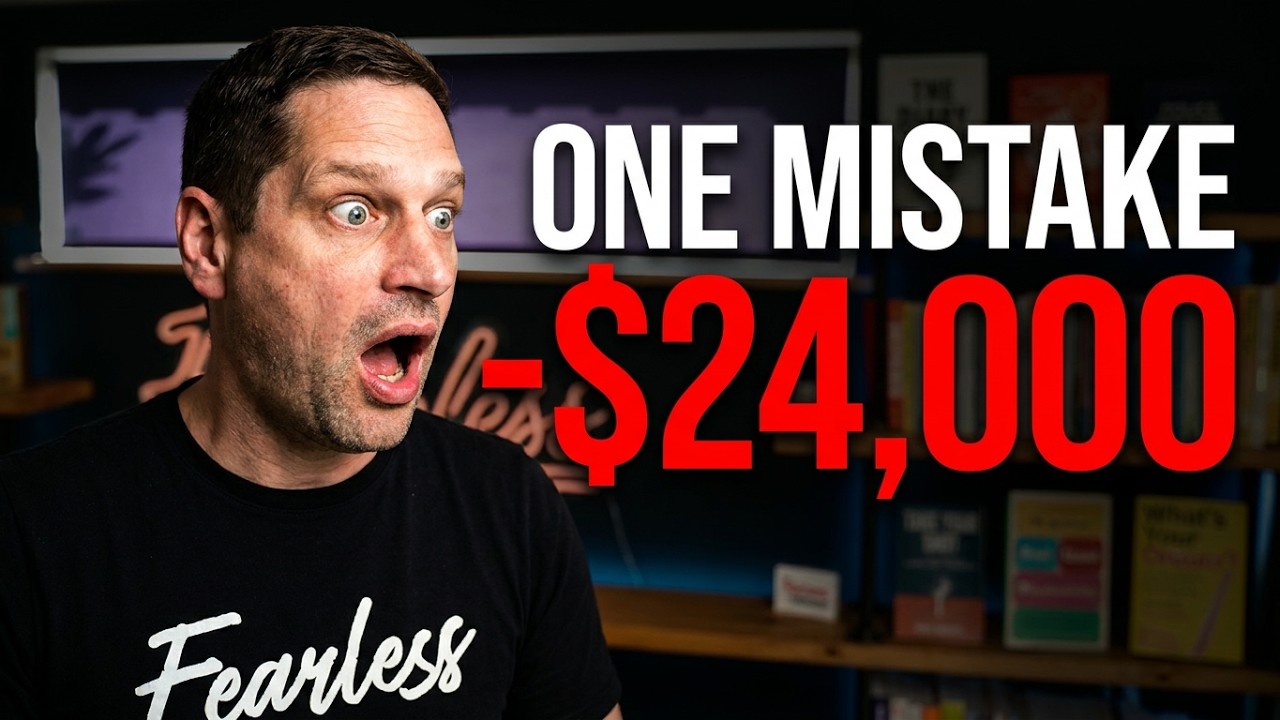
Robin Waite lost £24,000 in a year because he didn't use contracts and clients quit after 4.2 months instead of finishing their 6-month programs. He switched to a written agreement framing coaching as a product, not a subscription, with a larger upfront payment and smaller monthly installments to stop the bleeding.
Chapters
When I first started my coaching practice nearly 10 years ago, I made one silly mistake that cost me in most months as much as £2K per month. And in essence, that mistake that I was making was just being too nice. Obviously now, being a more experienced coach running a practice, what I don't wanna see is you as a new coach just starting out making some of the silly mistakes I was making. But I didn't know better back then, and so ultimately I suppose I was maybe a bit naive. And when I say that I was being too nice to clients, I took it as a given when they signed up to one of my coaching programs, that on a handshake, that they would see out that coaching program for 3 or 6 months or however long the process took in order to get results for them. However, what happened, I used to get to the end of the month having delivered all of this work, and I worked really hard during that first year. I get to the end of the month sort of scratching my head going, well, where's all the money? Because I would look at my cash flow forecast where I had this as very organized and I had this spreadsheet written out, the names of all the clients in there. And how much they were paying me on a monthly basis. But every month I got to the end of the month and I was like, there's not as much money as I'd estimated there would be on my cash flow forecast. And simply what happened was, well, there probably wasn't one mistake, there was probably a combination of several mistakes which were happening here. The first one was that I didn't have any legal contracts written up with my clients which I would get them to sign. Now you probably think as a business coach this would be one of the first things which I would do, and obviously now I recommend all my clients do this. However, naively, when I first switched from doing web design into I just thought that people would see out their coaching programs and pay me the money which we had agreed. However, that didn't always happen, and it wasn't necessarily anybody's fault. But ultimately what would happen is that a client would maybe have a good month and they would decide that they didn't need my support or help anymore. Sometimes they would even have a bad month and then decide they didn't need my help or support anymore. But when I went through and looked at on average how long clients were sticking around for when we worked together, it ended up being about 4.2 months out of the 6-month coaching program. which I was selling to my clients. And what I realised was that when they would get to month 4, month 5, and say, actually, Rob, I think I probably had everything which I need from my coaching now, I would say, yep, no problem. I'd cancel their direct debit and off they would go. But of course, what I then came to the conclusion was, the realisation was, that ultimately I was making— I was losing money. And when I totted it up over that first year, I think I probably worked out that I lost close to £24,000 in total over the course of that year through being too kind and allowing clients to leave their contracts early. So I came up with a very simple coaching agreement. It's evolved since then over the last 10 years as I've worked with more clients, but now when a client agrees to work with me, one of the first things I do is I send them the coaching agreement via DocuSign, get them to sign it and return it, and then we start coaching together. Now it's very rare actually that clients will decide that they're going to leave their coaching early because It's not really about creating a legally binding document, although there is a part of that, and I have had to enforce the contracts several times. Not many times, you know, I've worked with hundreds of clients now, so probably I could count it on one hand where I've actually had to go through and enforce the contract. I, you know, take somebody to small claims court to get back their fees that they've reneged on paying. But what's actually happening is rather than them signing a legal agreement, what they're doing is they're signing a contract with themselves that they are signing up for a 6-month coaching program or a 3-month program or whatever it is they're signing up to, and that they agree to the payment terms, that they're treating their coaching not on a session-by-session or a month-by-month basis, but what they're buying is a program, a product. And the goal is that out of them buying that coaching product program, that they're going to get some kind of result or outcome from it. But the clear— the thing is that they clearly have to go all the way through the 6 months in order to achieve that outcome, because on average, that's how long it might take for somebody to see a result or outcome. What you also need to do during the sales process is to essentially train your clients they're buying a product, a package, not just one-off sessions or monthly sessions or things like that, that they're buying a whole coaching experience which they're gonna go through. So it's not just about the sessions, coaching sessions which they get from you, it's also about the wraparound support which they get, or maybe the extra accountability they're gonna get, access to courses or turbo calls or various other things within that package. So it's a whole host of wraparound support for a period of X number of months— 3 months, 6 months, 12 months, however long your coaching process is— that they're going to get when they sign up to work with you. The other thing around selling coaching packages is that when you sell it over the course of 6 months, one of the biggest mistakes people make— and this is what I used to do as well— is let's say your coaching program is £3K. You would then take £3K, divide it by 6 if you're doing a 6-month program, And you would come to the conclusion that it'd be $500 a month for the duration of that 6-month coaching program. However, again, there you've just trained your client that they're paying for like a monthly subscription. They're kind of gonna treat it a little bit like a Netflix subscription if you're not careful. So one of the things I normally recommend to clients is that you create payment installment plans where the client pays a little bit more upfront and then they split the rest out over monthly installments. So let's say we were selling our coaching package for $3K. What you might choose to do, for example, is say that it's $1,500 upfront and then it's 5 installments at $300 a month. And then the client, if they want to continue into month 7, month 8, month 9, you've anchored them into then paying $300 a month. So they just go into a continuation ad infinitum for as long as they then want to work with you after the 6-month period. Now, if you want to anchor them into a higher monthly installment, you're probably gonna have to raise your prices. So let's say in that example, if actually you wanted to anchor your clients into a $500 a month program from month 7 onwards, well then what you might want to do is sell your coaching for say $3,600 where they maybe pay $1,100 upfront and then 5 installments at $500. Now they're anchored into $500 a month. So eventually then if you wanted to get to a coaching program where you've got 20 clients all paying $500 a month because they've gone through your initial coaching and then gone into continuation Now you've got a 6-figure coaching business where you're earning, you know, $10K per month. My final point on this is that this is a business, and I wouldn't say those clients took advantage of me. I think I was just naive in thinking that if I didn't have a contract, they would still carry on paying me. And ultimately, yes, a contract could be an email confirmation of a fee that they were going to pay for X number of months, or however you want to wrap it up. But what I realized was that if there is a contract in place and it's in black and white, One, the clients tend to be far more committed anyway because they have signed that document, that contract for you. But also, you have to be prepared to chase the client up for payments. So if a client is late with payments, it's ultimately down to you to make sure that you're chasing them up, making sure that their direct debit or payment system is set up accordingly to, to take the money each and every month on the same day, that you're not waiting on payments. And if the client does fall behind, you have to be prepared ultimately to make a decision as to whether you're going to chase them up for the balance on their program fees or if you're just going to let them go. And yes, there are times when it is appropriate just to let a client off. You know, for example, there are times when genuinely you can see that you've taken on a client and the coaching process isn't working. The client might still have got some value out of it initially, but it might be really just not working, and therefore you may just choose mutually that you'll, you know, tear the contract up, you know, decide on whether they're gonna make any further payments or not, or if you're gonna refund them, and away you go, you go your separate ways. And again, I've had to do that because you can see clearly that the client process isn't necessarily working. Equally, sometimes clients don't follow the process, and there are people out there, and I hate to say this, who will go from coach to coach to coach, just grabbing as much as they can as quickly as they can, and then not completing payments and moving on to the next coach and doing exactly the same. I've seen this time and time again. Thankfully, it's few and far between. It doesn't happen, but it does happen. So really, as a coach, it's your responsibility to protect yourself with contracts, make sure that you're delivering maximum value to your clients, chase payments if payments become overdue, and then manage that contract accordingly so that you can make sure that you're not losing money, especially if you know that you've done a great job for that client. And I have had clients in the past Again, very few and far between, but sometimes people do just try it on. They, they try and get out of payment plans because, you know, even down to silly little things like, you know, I've had people say that they're struggling to pay my coaching fees, but then, you know, a couple of months later they're off on this expensive holiday or they've just bought a new car. I've had that before as well. And you're kind of looking at this going, well, what are your priorities here? My belief is that if you've agreed to pay for something, then you see it through. That is just the right thing to do. Not everybody thinks the same as me, so therefore we have to have these protections in place. I just don't like to see coaches losing money or not making the money which they deserve when they work so hard. And if that's you, then perhaps you just want to reach out and have a conversation. I've also got a coaching agreement which I'd be happy to share with you, a template which I use and which a number of my clients have also used because a majority of my clients are coaches these days. I'd be happy to share that with you if you just want to, you know, reach out and email me and just ask for that coaching agreement. I'll send you the template over for you to use.
More from Robin


Surviving Entrepreneur Burnout - Why I Nearly Quit My Business (And How I Got Through It)

Freelancer vs Business Coach: How to Build a Profitable 6-Figure Creative Business



How Timothy Armoo Finds A-Players Nobody Else Can #recruiting #scaling #business

