How I Make $20k A Month as a Business Coach: 6 Income Streams
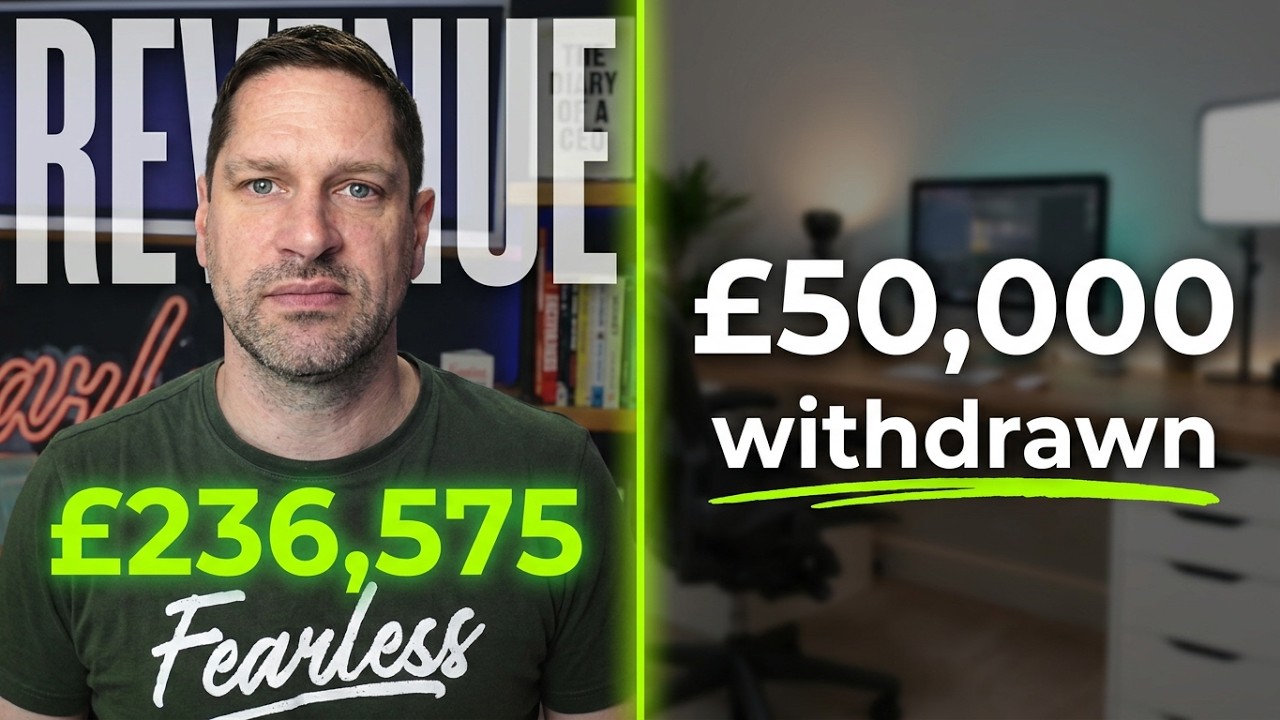
Robin Waite, a UK business coach, made £236,575 in revenue over a year, roughly £20k monthly, across eight income streams including group coaching (£125k), one-to-one coaching (£50k), and book royalties. After £116k in operating costs, his pre-tax profit was £101k, though he deferred £50k to the next year to stay below the corporation-tax threshold.
Chapters
Pretty much every month I get asked by somebody how much money you can make as a business coach. So in this video, I'm going to be breaking down exactly how much money I make, where I spend my money, what my different income streams are, and various things like that. So I'm Robin Waite. I'm a business coach based in the UK. I've been coaching now for 8 years, and prior to that I ran a marketing agency doing web design and branding for the best part of 12 years. In pretty much every year that I've worked as a business coach, bar one, I've done at least 6 figures. And for this exercise though, I'm going to break down how much money I earned during the financial year for me, which runs from August to July. So I'm going to break down my income now that I've reached my year end, running from the 1st of August 2023 through to the 31st of July 2024. And I'm going to talk through literally exactly line by line how much money I earn, where the money comes from, what I expect it maybe to, to do next year, whether I'll be expecting to get similar results or not. And then also where I'm spending my money, because as they say, turnover is vanity, profit is sanity, but cash is king. So I'm gonna try and explain to you how the money flows through my business and how much of that I actually get to keep versus how much of that I spend. So first of all, we're gonna dig into the different income streams which I've got within my business. And I've got, currently I've got about 8 different income streams in the business, albeit some of them are slightly similar. So the first one which I've got is Very simple, small one, but it's interest income. So one of the things I like to do at the end of every year is I'll save up all of my corporation tax which is due. And on the moment my accountant tells me how much corporation tax I owe, I send that straight through to HMRC. And HMRC, albeit it's very small, but they do pay an interest on any cash which they keep if you pay your corporation tax early. This year I've done it slightly differently. Interest rates have gone back up, so there are business savings accounts now. And I'm anticipating for the next financial year ahead, I should earn significantly more on interest income, or at least that's my goal. But this year I earned £88.15 on interest income on the corporation tax, which I'd saved and paid as quickly as I possibly could do. I'm anticipating the interest that I'll earn on my rainy day fund, which I keep, and also my corporation tax will be probably 10 times that given the way that interest rates are right now. So maybe I'll report back in a year's time and let you know how that's going. But that's the first income stream is interest. The next income stream I've actually got written down in my profit and loss, and I'm going to share some screenshots of this as well so you can see its actual data, is I've listed it as other revenue, and I had to go and click into it to see exactly what it is. It was actually a majority of this is for a client event which I put on down in London where I charged them a small fee to cover off the hire for the room, food, and sundries and things like that. That income was £2,028.43. So a small amount of, you know, but that covered costs. That wasn't really all profit, and I'll break that down a bit later on in this video. The next line of income I've got, as many of you know, I'm an author, so I have several books out across Kindle, paperback, and audiobook. So I've got 2 separate lines in my income streams for books which I sell. It's really rare that authors make money from the books which they sell. I'm quite fortunate that my books do very well in author terms, albeit the monetary side of things doesn't feel like it's that great when I actually look at these income streams. One of the things I like to do though is I reinvest the income which I make from book royalties and sales back into sending out free and signed copies of the book. And you're welcome to reach out to me if you'd like a copy of Take Your Shot. But it means that overall my book sales end up being cost neutral, but I treat it— I reinvest it so that as a form of marketing back into my business. So I have a goal which I set, which is to send out 3,000 copies of my books a year. And that might mean either people apply for them, I pop them in the post and send them out, or perhaps I sponsor some events and send out boxes of books. But any money I make from royalties, I reinvest back into getting more copies of my books printed out and sent out into the universe so that people can get some hopefully good quality business advice at a minimal or negligible cost to them. And I know that I'm doing a bit of good as well by sending those books out. But income-wise, my— the audiobook version of Online Business Startup and Take Your Shot in the last financial year generated £776.87. And the Kindle and paperback versions of it, which believe it or not, the audiobook actually outsold them in terms of quantity. But the books tend to do better in terms of revenue and royalties. So from book sales, um, I made £3,464.76. And like I said, combined, what's that, about, um, £4,250. A lot of authors don't make any money from their books. I'm quite fortunate I've been able to monetize my books and, and have that money then to reinvest. And effectively, my marketing book-wise ends up being cost neutral. Now here's the big one. This is where we, we look at the coaching side of my business. So this is what I do every day with my clients. I have 2 separate programs which I run. I have a group coaching program and I also have some one-to-one clients as well. Very limited spaces on one-to-one, and I'll break down— I've got these in as a single line, but I'll give you a breakdown of how much I made from one-to-one coaching versus how much I made from my group coaching program. To give you an idea of how much I charge for each of those, currently the fees for my group program are £4,500, and then for one-to-one coaching I charge £10K. I won't go into all of the ins and outs of what's included for each of those. That's not really important for this video, but I wanted to give you a context of how many clients I bring in to generate this amount of revenue. So the big one for me is my group coaching program, which generates in the order of £125,000 worth of revenue for me last year. We enrolled— I don't know the exact number, I probably should— but we enrolled somewhere in the order of about 35 to 40 clients through that. So you can, you can do the maths on that. At that £4.5K price point, you can work out how many clients enrolled. And then I worked with just 5 one-to-one clients last year. Sometimes those clients pay in full in advance, and there's a slight benefit to doing that, but, uh, on average they will have paid somewhere between £7.5K and £10K, the full £10K, for their, their opportunity, um, for us to work together. So in, in total, my coaching revenues— a bit random actually, I've just seen there's some numbers at the end of this— but in total, for the business coaching side of things, it was £175,000 and £66.66. So it's a little bit random. I don't know where the £66.66 has come from, but I'll have to investigate that later. But roughly £175,000 from coaching alone in the last 12 months, which I'm super hyped about. It's taken me, you know, 8 years to get to this point where I've got this substantial revenue coming in from doing what I love doing the most, which is coaching. So I'm really pleased with that, and I hope that, that I can also sustain that moving forward into the next financial year as well. Got some really cool stuff happening, um, with with clients moving forward. The next line is speaking engagements. Now this is actually, again, this, this is split out into 2 different revenue streams, but I, I've bundled them both together. Speaking engagements, I have a number of associate coaching roles. Associate coaching roles are where I'm a coach on somebody else's group coaching program, and they essentially pay me a small retainer or a per-session fee to deliver coaching within their group or organization. I also do have some professional speaking engagements as well where I get paid to stand on stage and speak, or might be a virtual event or something like that where I get paid to speak. But in total for both of those, the majority of this will be my associate coaching roles, there are a couple of small speaking gigs in there as well, but in total for speaking, £14,570. Again, when I first started coaching, it was really important to me that I had these multiple streams of income, one of those being professional and paid speaking engagements. Now I know you could argue that the associate coaching is really coaching work, but for me I don't have to do any marketing for that. I don't have to do any sales calls for that. I just have to show up and do what I do best, which is coach clients. So that's why I kind of put it under speaking engagements as opposed to business coaching. It's the nuances of it, I suppose you could argue, but it means that there's no overhead to my business for that. I just have to show up and deliver and talk, um, essentially. The next 2 lines are quite interesting ones again, because, um, over the past year I've also started to get some sponsorships on board. And these are people— so Because of my personal brand, guesting on lots of podcast interviews, getting my name out there, I have a lot of inbound links coming back into my website, which has raised my domain authority. That makes it quite attractive for other people to want to partner up with me and to— for me to have affiliate deals and sponsorships within my website, which I think is pretty cool. It's a relatively passive form of income for me now because I have an assistant, a guy called Tate, who I took on a couple of months ago to run this side of the business for me because I got to a point now where it's earning me enough income that it kind of washes its own back and it can afford to pay a salary, a full-time salary to somebody to manage and run it, and then also make a significant amount of sort of profit on top of that. So this is broken down into 2 lines, and this is just for tax or VAT reasons. We have over sponsorships which come in from overseas clients, and then we have sponsors which come in from UK-based clients. So obviously UK clients I have to charge VAT on because I'm VAT registered. Overseas clients I don't. So in total for the overseas sponsorships, that came to £32, £369.25, and then for my UK sponsor partnerships, £8,211.78. So in total, for the whole of the 12 months, uh, in the run-up to the end of July 2024, in total I brought in £236,575.90, which I think is pretty cool. I set a goal for myself to have an average over the course of the year of £20,000 pounds per month income or revenue from the business. I'm not that far off it, and I'm certainly not going to be disappointed with myself. £236,500 for the work which I get to do, um, which I thoroughly love, I think is, um, more than commensurate. It would be wonderful if I could again match that in the coming year. There's a couple of nuances to this as well which I'll explain as I go down through the profit and loss. But now we're going into sort of the outgoings. So my biggest, um, initial outgoing is what I call cost of goods sold. So I have some associate coaches on my own program, and then also when I enroll a client, I send out these welcome packs, which actually are quite expensive. They're up there, probably about £250 worth of things go into the box when I send it out to a new client when they join. Um, so my total cost of sales was £19,127, brings my total gross profit down to £217,448, again, which is a really solid, healthy gross profit margin for a business like mine. Because I'm a service client business, it means that a lot of my money gets spent out in the overhead section, which I'm going to run down through now. From a marketing perspective, I spent £23,692 last year. Spending 10% of your income is what I normally recommend to my clients in terms of reinvesting that income back into marketing activities. A majority of that marketing spend went on, uh, book costs, so printing my books out. There was a couple of events which I sponsored as well, which were kind quite expensive. I've also reinvested some of that money back into getting my next book published. So those activities I'm reinvesting back into things which I know well— so speaking engagements, partnerships, and then also my books— I know that that's money well spent. I will get that money back in, in the next financial year because it's all about getting my brand out there, my name out there, and also helping to add value and educate people. So giving a lot of the— you know, a lot of that is actually the cost of books and sending those back out. The next one is my accounting fees, currently stands at £2,100. Again, for a business of my size, spending 1% of your income on an accountant is actually a really good investment. My accountant's very good, he's very on the money, he's very good at finding ways that we can reduce tax liability and things like that, all obviously legitimately. So that's a really good investment because I probably get 10 times that back in terms of understanding the finances within my business and better leveraging it. The next one's a bit surprising. I spent £2,259 on bank fees. That's normally things like Stripe and PayPal, like card processing fees when clients make their regular payments to me. Feels like it's quite high, but equally again, 1% on transaction fees in my business is not unusual in this day and age. I've got clients in 22 countries. We're dealing in dollars and pounds and euros and lots of different currencies. So those bank fees are fairly typical of a business of my size. I made a few charity donations last year. I always think about giving money back. When I'm growing my business. So last year I donated £1,250 to various sort of charities and organizations. Part of that was through partnerships. Quite often I'll do a partnership with somebody and they'll say, we don't want paying for this partnership, but could you make a charitable donation? So that just again is a nice way of giving back. The next, um, outgoing was consulting fees, £2,792. This is probably either some associate work or maybe I was getting some help on understanding SEO on my website a bit better. Or various things like that. For the first time in a while, I was able to put a significant chunk of money into my pension. The nice thing about investing into a pension is that it reduces your net profit, which means actually you end up— which sounds like a bad thing, but it means that you end up spending less on corporation tax. It reduces your liability. Because of the structure of my business, I also get pension relief, tax relief from the government. So I saved £2,500 on corporation tax. But I also got £2,500 back in tax relief through investing directly into my pension. So that £10,000 is actually probably worth £15,000 in real money because of the savings which I've made, but £10,000 directly went into my pension. Probably the one you're most interested in is how much money do I actually get to take home at the end of the financial year? So I pay myself a fair and reasonable salary. It does mean I pay a little bit more tax, yes, but I believe that I'm worth more. So I set my notional salary which I pay myself on a monthly basis, which means I pay into my PAYE and tax on a monthly basis at £35,000. What I also then do is because I've made enough profit, I can then also pay myself and top up with dividends. So what I like to do is I draw as much as I need really in the business. I don't necessarily— I don't like to overdraw. I like to keep money in the business because I can then reinvest it. I can make— get interest from any savings and things like that as well, which goes back into the business to be reinvested. So last year I paid myself £15,000 worth of dividends, which you'll see doesn't show on the profit and loss account. That's something which shows up on the balance sheet. And obviously when I do my tax returns and that's paid purely on profit, the reason I didn't go— I didn't want to go above £50K in total is because the moment you go over £50K in dividends, you spend— the tax on that jumps from 8.75% up to 33.5% or something ridiculous. Like that, so it just means that my my own personal tax liability is kept at a reasonable sort of level. But I will have to pay a bit of tax on those dividends as they've gone out. National insurance three thousand four hundred and ten pounds. I've obviously got insurance within my business as well, which is professional indemnity insurance just in case and employers liability. That's currently one thousand one hundred and sixty five pounds. Obviously, any software and consumables and things like that, Office 365, any bits and pieces. Pieces, cables that I buy for my PC, camera equipment and stuff like that. £2,539. Some legal expenses in there, I can't remember what that's for, but £419. Postage is quite a big one on mine because I post my books to pretty much anywhere in the world, and actually I've recently shipped a book to Mongolia, which is pretty cool but also quite expensive postage-wise, but that came out at £3,167. Bit on printing, bit on repairs and maintenance for my office office, my studio here. Now that I've got Tate working for me, these are now employee salaries, so £4,347, and that's roughly about £2,150 a month now that I've got Tate working for me. But don't forget, the money that I spend out on his salary is directly revenue generating and bringing those sponsorships in, which is pretty cool. Subscriptions— I put pretty much any— anything and everything in which is like software-based, so anything I pay for on a regular basis. So that could be— I've got to think of the things now— um, Jotform, which I use for my, my application forms. Score app, which is like a quiz funnel. Basically, people give me their information and we give them a— answer a load of questions and we give them a score. Office 365. Pretty much any software which I buy, which is £8,508. And a big chunk of that is actually, um, website hosting and also my Zoom fees as well, which is about probably about a sixth of that fee there. Because I'm a virtual business coach, a lot of my work is done online, so I rely very heavily on software solutions, in particular Zoom, to make sure that I can reach people in the world all around, you know, 4 corners of the globe. Telephone and internet, well, that's just my mobile phone and also my wife's phone, so that's £1,950. And then a bit towards travel, so that's going off to events which I speak at and various things like that. So overall, my operating overheads were £116,106, leaving me a net profit— this is all before tax and various things like that and depreciation, a net profit of £101,341.72. Now that sounds pretty cool. It like— don't get me wrong, it definitely is pretty amazing. But because of the way that I structure installment plans with clients when they join my programs, we're going to be carrying probably about £50,000 across into the next financial year. So that will be reduced actually off my, my income, my revenue, when we actually submit our accounts And it will be put straight into August's revenue so that it then contributes towards the income next year. So effectively my net profit gets reduced down below £50K. There's a quirky thing with corporation tax in the UK that you pay 19% up to £50K worth of net profit, but then between £50K and £250,000 worth of revenue, you end up paying 26.5% corporation tax. So it's actually worked out quite well in terms of my, my salary, my dividends, and then feeding that into the net profit. By the time we've moved the installment plans into August, that will bring our net profit down below £50K. Now I know this is kind of moving the figures around to kind of make it work so it works better from a tax perspective, and it means that I, I will still obviously pay, um, corporation tax on that income. It's being moved into the next financial year, but because those clients are on installment plans, we're not— we've still got that money to collect and we're still delivering work to clients into the coming financial year. So from an accounting perspective, it's a logical thing to do to shift some of that income and net profit across into the next financial year. It also means that it starts the next financial year off with a nice boost as well, on paper, and obviously cash flow-wise too. So there you go. So in terms of actual money which I've been able to pull out of the business, we had £236,000 worth of bills invoicing sent out. I've personally withdrawn £50,000 from the business, and then we have this net profit which is in there. And that actually roughly what's left in my bank account, about £40,000 to £50,000, obviously once tax and everything else has been paid out. I keep that cash in the business because that acts as my rainy day fund and it gives me a bit of extra security. And that's really important to me. It's one of those— if, if you're constantly running your accounts and finances really close to the line, you essentially then all you're thinking about is where's my next client coming from, how can I pay my bills. I don't like having that feeling. I like a sense of security within my business, which means that I have to have some money in a rainy day fund so that I'm not, you know, when I speak to a client, I'm not coming at it from a position of I'm desperate to enroll you because I need the money. I know I've got money so I can take them on knowing that they're going to be a great client, I can get great results for them, and And if that's not the case, that actually I can say no to them and refer them across to one of my other associate coaches if I don't feel they're a good fit for Fearless Business. So there you go. So that's how much money you can potentially make as a business coach here in the UK. And I have, you know, a small team. I've kept it that way intentionally. I don't want to scale and grow to 7 figures. I like the fact that I've got here relatively organically without having to force the issue. And I know that through consistency, I've done 6 figures every year, and I know now the mechanisms to continue to do that each and every year afterwards. And it's really cool knowing that things like my sponsorship income is going to continue to grow as well. What you saw there was probably only about 6 months worth of income, so we should probably do double that, maybe £70-80K over the course of the next, um, 12 months, which again, it just adds us another layer of security so that if maybe we don't enroll as many coaching clients, we've got the sponsorships income that we can fall back on. If maybe the sponsorship income dips, well, hopefully the coaching income is doing really well. So we've, you know, bringing multiple streams of income and revenue into your business is massively important in terms of creating that long-term security within your business. And like I said, I've tried to be really transparent here. If you've got any questions, if you want to poke holes in it, if you want to tell me that I'm not making enough money and I'm not a good enough business coach, I should be doing 10x that and whatever. Fine, drop it in the comments. I'm all ears. I know that people have different degrees of what success is and what your expectations are as a business coach. And I know that sometimes when I share these figures, I only really tend to share them with my clients. Now it's gonna be out there in the open. But it does surprise some people. Some people think I should be earning more. Some people think I should be earning less. But what it comes down to is success is determined by what's going on inside you. I'm really happy with these figures. Like, I think what I've been able to achieve and what I've been able to earned through this business and the security I've created for my family is exceptional. And part of that is because this is by design. I set my business up to generate these kinds of numbers and I've been able to follow through with it. The business I've created also gives me an incredible amount of freedom and fulfillment because I get to work with amazing people. I get to go to cool events. I get to send my books out all around the world. All of those things really excite me. The money is kind of like a natural byproduct to get him to do all of those amazing things. You know, granted, if I wasn't earning any money, it would be a big disappointment and I'd probably have to rethink my life choices. But things are going well and I'm really happy with that. And just because it's not £1 million a year revenue or £500,000 worth of net profit doesn't necessarily mean that I'm some kind of failure or anything like that. This is what is important to me. This is what matters to me. So I'm really happy with those results. But by all means, probe away, ask questions, drop them in the comments below. And if you want me to go through your accounts at this sort of forensic level as well and figure out how we can make you a bit more money, just reach out. The link's in the description below to my website. You can go and book a free call with me. We can take a bit more of a deep dive into your business and see where you end up.
More from Robin


Surviving Entrepreneur Burnout - Why I Nearly Quit My Business (And How I Got Through It)

Freelancer vs Business Coach: How to Build a Profitable 6-Figure Creative Business



How Timothy Armoo Finds A-Players Nobody Else Can #recruiting #scaling #business

