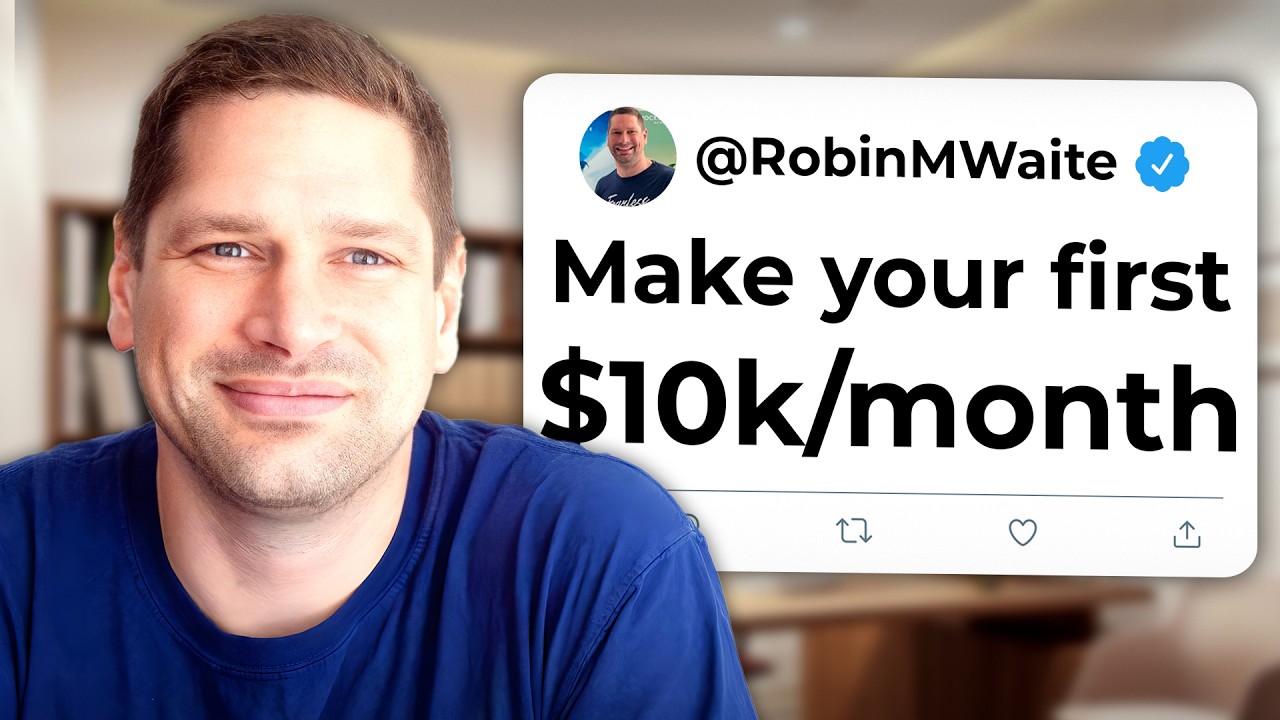
Robin Waite breaks down how he built a $10K/month coaching practice. He did 125 free consultations in year one, raised prices from £1,200 to £3,000+, and leveraged podcast interviews and speaking gigs to fill his calendar. He caps concurrent clients and builds multiple income streams for sustainable growth.
Chapters
I think in this day and age, it's really fair to say that it's not that hard to get to $10K per month. And it really doesn't matter what you do now as a business owner, from your products or services, whatever it is that you're planning on selling. I believe every business can get to $10K per month. However, I do have a bit of an unfair advantage. I've got 20 years in business. I've run 3 separate businesses, all of which, which have gone to $10K plus. In fact, this year in my coaching practice alone, I'm gonna do over $300,000. And that's just with me. on my own, with a small team of associate coaches, one admin person, and one person running the content side of my business. First of all though, it's worthwhile digging into why a lot of coaches find it really hard to hit £10K per month. I think a lot of it has to come down to both mindset and then the practical business skills. From a mindset perspective, a lot of coaches that come into my world are typically going through some kind of career transition. So that means they might be coming out of gainful employment, say for example having a job, or maybe another career, another business which they've been running, and all of their previous knowledge around how much they're worth is gonna be attached to that prior thing which they were doing before they decided to take up something like coaching. Therefore, when they step out into the marketplace and try and get coaching clients, they're gonna immediately come up against not the other person's values, but their own internal value system, which is gonna be making it hard for them to tell those prospective clients about how much it is that they're worth. And what I would love to do in this video is try and break down if I, knowing the knowledge which I've got now around the coaching industry and marketing and how to grow a business in 2024, how I would grow my business to $10K per month if I was starting from scratch. First of all, you have to understand why $10K per month is potentially the wrong goal to have. $10K per month is this number, you know, hitting that 6-figure income is this number which a lot of gurus and experts bandy around out there on the internet. And the reality is that means different things to different people. Here in the UK, $10,000 doesn't actually get you that much in real terms. If you're looking to sort of settle down and buy houses and feed your family and various things like that and run a business and pay people to work within your business, $10K doesn't actually get you that far. Whereas actually $10K to somebody in a different country might actually mean a lot. So $10K needs to be this goal which is relative to you within your own circumstances. But for the sake of this, we'll focus on what $10K means to somebody maybe setting up a coaching practice in Europe or America or somewhere like that, and then you can build your own assumptions around that. What the $10K goal means though to a lot of people is surpassing that magical 6-figure income, and there's lots of different ways that you can achieve that. Um, you know, and if you actually break it down, you know, you could go out and find a single client that's willing to spend $100,000 with you, and there you go, you've broken through the 6-figure income goal with no trouble, no hassle, just one client and away you go. The reality though of you being able to get out there and find a single client worth $100,000 though, it's probably going to be very hard work. We could start to break it down though. What may be more realistic is maybe 10 clients paying $10,000, or maybe 100 clients paying $1,000. Actually, that's where it probably starts to tip the balance, because I know as a coach, getting to a point whereby you're enrolling 100 clients in a year requires an awful lot of work, not least from a client fulfillment and delivery perspective. But from a marketing perspective, to find and attract 100 clients from the word go is really, really quite difficult. So what you wanna focus on is, what is your natural capacity to be able to deliver coaching to your clients? In my case, I found that typically when you're delivering one-to-one coaching, you max out roundabout having 20 concurrent clients. That's the absolute maximum. And when I had 20 clients in my first year of coaching, I was run ragged. I was so exhausted. And this is in amongst all of the other activities that I was doing to grow my business. So realistically, 20 clients is manageable, but it is a lot. You will end up getting potentially quite tired from that. I'll tell you a little story actually. So I had somebody come into my coaching practice about 18 months after I'd started the practice up, and this is after I'd already achieved my first $100K year. And that person said to me, oh Rob, I think I'm a better coach than you. That was a little bit of a red flag, I should add. I think I'm a better coach than you, but I don't understand why you're so much more successful than me. And I started to rattle off all of the activity which I'd undertaken during the first 12 months of running my coaching practice. I'd set goals around building my personal brand. I was fortunate I already had a book, so that was a bit of an unfair advantage. But perhaps what I would look to do if I was a new coach into an industry, I would look to position myself as an expert authority figure and potentially write a book, albeit that would probably take you 8 to 12 months in total anyway. So that's not going to get you your first $10K month, but it will contribute to those more regular, consistent $10K months further down the line. But in answer to her question, what I said was— or I asked her a question actually. I said, just out of curiosity, how many consultations have you booked recently? And she started counting on one hand. She started, 1, 2, 3, 4, I don't know, 4 or 5. And I was like, oh, 4 or 5 in the last week, that's not bad. And she said, oh no, no, Rob, this is in the last 12 months. So it transpired she just had this massive lack of activity. She'd just not really done a great deal in order to try and attract and enroll the right clients, but also the right number of clients. And I started to explain to her, well, listen, I did 125 consultations in my first year of coaching. I set this ridiculous goal around essentially giving away as much free coaching as I possibly could do to people who would be willing to sit there and listen to me in order to start to build those relationships and trust. And also, they call it a coaching practice for a reason. Delivering those free consultations, 125 of them in that first year, is a way to practice the art of coaching and become a better coach. So it was, you know, one you could argue, should I be paid or do those consultations for free? My view is, in your first year coaching, do as many free consultations as you can possibly get booked into your diary— online, in person, don't care. Just aim to get as many as you possibly can do. But breaking down those 125 consultations, actually you're only talking 2 to 3 a week potentially, which when you think about it isn't that many. So if you can find creative ways to maybe get 5 or 10 or 15 of free consultations booked each and every week, that's gonna definitely swing the odds in your favor in terms of having your first $10K months. Second to that, I then said to her, I've done 28 podcast interviews this year, how many have you done? And of course the answer was a big fat zero. I realized very early on that trying to build my own audiences from ground zero, from zero, literally was gonna be a virtually impossible task. It would pay off eventually, but in order to get clients immediately, I had to come up with something better. And I realized that podcasts actually have much greater leverage because somebody's already gone to the trouble of building an audience. And if that audience aligns with your potential audience of the types of clients you want to work with, well, that's going to accelerate your ability to be able to reach more people. So I booked nearly 30 podcast interviews in my first 12 months. I also got on the stage and started speaking despite the fact my previous career as a web designer, I was, um, pretty rubbish. I'm not gonna lie at speaking. Maybe you think I still am, I don't know. Uh, very introverted. I found it very quite intimidating standing up on a stage in front of sort of 50 or 100+ people. But I set out on this, um, I set my big hairy audacious goal to speak at as many events as I possibly can do and challenge myself. Could I get one speaking gig each and every week throughout my first year in order to sharpen my sword when it came to speaking in front of large audiences or small audiences? It didn't matter. And I spoke on stage from anyone from like sort of 5-person audiences right the way up to audiences of 250 people or more. And It really helped me to find my message. I started to build frameworks around, you know, from, from a coaching perspective that I was able to share with those audiences and try them out. And I liked the interactions and the questions which I got from those, from members of the audience. But of course as well, those were other people's audiences at events, and I was able to leverage that, and that helped again to get people booked onto those consultation slots which I was offering. Another thing which I did is that I recognized that as a coach, you want to be an expert authority figure and to be in front of other people's, you know, as well as other people's audiences, you want to start being able to build your own. So one of the things which I did, and bearing in mind this was several years before COVID and lockdown, so people's attitudes towards live events has shifted, you know, a little bit, but there are ways to also make this work online. So in the virtual world, doing webinars and things like that. What I chose to do though was set up a local networking group. We had 12 events during my first year, and I was able to invite anywhere between 50 and 80 people along to each of those events. And again, they were all prospective customers. And as I got to know them and build relationships with them and they saw me as this authority figure in the business community, I was able to invite them onto consultations and then potentially turn them into clients. Now, this is all well and good, I'm talking here, you know, there's, there's lots of different levers which you need to pull in business. The main 2 are supply and demand. So in terms of supply, do I have the capacity to work with X number of clients? So you've got to figure out what your natural capacity is, and I found that enrolling 2 to 3 clients per month during those first 12 months as a coach was about my natural limit in terms of energetically how much coaching I could deliver to them. And this was very much in the one-to-one space. On the other side of that is the demand side of things. So you can have unlimited supply, but if you're not able to stimulate demand, then you're not going to be able to grow a successful coaching practice and, and start to create your first $10K months. Equally alongside that, as part of that demand side of it, you've got price elasticity, which is going to impact your ability to be able to convert clients. You might be able to get loads and loads of interest from people and get lots of people booked onto those free consultation slots or paid consultation slots even. But then if your prices are either too high, you might find that that creates a lot of friction and you end up with fewer people buying. Or maybe your prices are too low, so you're able to enroll clients, but then you can't hit your $10K target. Now the reality is, I think my first client which I took on was round about the £1,200 mark, so about $1,500. So in order to consistently hit $10K months, I'd have to enroll like so many clients, know, probably what, 6, 7, 8 clients a month in order to consistently hit $10K months. And at the time, I didn't have any other sources of revenue coming in. Coaching one-to-one was my only source of revenue as well. So very quickly, within the first sort of 2 or 3 years— well, even in that first year— I realized that if you price yourself too low, you're making a rod for your own back, and you're not going to be able to achieve those financial goals that you set out for yourself. So one of the first things which I did was I started to increment my prices. So I went from £1,200 to £1,500 to £1,800. And again, remember, this is all for one-to-one coaching. I now run a group coaching program, obviously Fearless Business, which you can see behind me. However, this was all for one-to-one. So the challenge was if I enrolled too many clients, I was just going to reach my, my natural capacity relatively quickly. And so that then prevented me from being able to enroll any more clients until more capacity freed up. So gradually what I did is I incrementally increased my prices. And then I got to a point, round about the £3,000 mark, so what's that, about $3,600, where I hit this natural point of equilibrium where through all of the marketing which I was doing on the podcast interviews, the events I put on, the speaking engagements, and also through people buying my book, I was able to marry that up with being able to enrol the right number of clients for me, which enrolling 2 to 3 clients a month at that stage was around about the right sort of mark. Then I had some months where I was starting to do 4 or 5 clients. When you start to extrapolate out, you know, $3,500 program out to sort of 3+ clients, I'm starting to hit those $10K months. And I was doing that with some certain degree of consistency. Now the thing is though as well, like, I think a lot of people underestimate, one, what it takes to get to consistent months, especially when you get into the order of sort of 6 figures, so $10K, $20K per month. So what I found was that I could have these $10K months, but then I would have months sort of following that where I might only enroll 1 or 2 clients, so I'd slip back down again. So I think hitting— that's why I said that having a £10K per month goal is good to a point, but you can also be left feeling quite deflated if you don't hit those £10K months with some certain degree of consistency each and every month. So when I realized this, I knew that £10K wasn't really the goal. Actually, for me, a goal which would work better would probably be £12K to £15K Because it meant that on the months where maybe things went really well, it would balance out the months where it didn't go so well. So it was more important for me not just to hit £10K months, but I wanted £10K as an average over the course of 12 months, because what that signaled to me was that at that point I had a good set of clients coming through the practice and I was able to consistently attract and enroll enough clients each and every month to do on average £10K per month. And then off the back end of that, I was getting a lot of referrals. Because, well, hopefully the coaching was good that they were experiencing and they were getting great results from it. And so that started to stimulate further demand in my practice. One of the other things which I would recommend that you look at would actually be partnerships. So where I was talking about getting— guesting on podcasts and getting speaking engagements, it's not just a matter of sort of, you know, spotting a local event and rocking up and saying, hey, would you have me as a speaker? There is a process which you've got to go through in order to kind of connect with the right people and establish which partnerships are going to be fruitful for you and also how you can benefit those partnerships as well. If you're interested in learning more about partnerships, I recently did a video to this which we'll link to in the description below. One of the other things which I would say, not just about, um, getting to those $10K months but also in regards to things like partnerships, it is a long game. This isn't about just getting out there and making a $10K month happen and then that's it. I think a lot of people forget that when you get into something like coaching, you should be getting into it not for the money. You should be doing it because you want to be able to help people and do that in a sustainable way in the long term. So one of the areas where I see a lot of coaches start to fall down is that if they have a dip in their income, if they have a poor month, or if maybe they're not able to stimulate demand, i.e., the marketing starts to become too hard, mindset-wise they don't seem to have a lot of resilience. And so very quickly, when the chips are down, they'll just give up and basically go and find something else to do. If you want to get consistent $10K months, you have to have a very resilient mindset, a mindset which is, I'm in this for the long haul. Every morning, I— when I wake up, I ask myself the same question: can I see myself doing this for the next 10 years? And if the answer is no, I start to question why that is. Now, I've been coaching now for 8 years. And there's probably only been a handful of mornings, maybe 2 or 3 mornings, where I've woken up and felt like, oh gosh, I'm not sure I can do this for, for another 10 years. Okay, I'm in this for the long haul, but it's an— asking that question is a good way just to check in with yourself to make sure that energetically you're not overstretching yourself, you're not doing too much, you're not working with too many clients, you're not having to work too hard on your marketing. Coaching is about building that sustainable income, this stable base for yourself. And being able to help those people that you really want to help. And I know sometimes as coaches we desperately want to help as many people as we possibly can do, and if you set out to go and help 100, 200, 500, 1,000 people a year from a standing start, you are going to find it very difficult. Having a 10K target is one goal to have. I would actually set a target to be realistic in the first instance of sharpening your sword, coaching a handful of people, and doing it to the best of your possible abilities. And that may only mean working with 10 to 20 clients during the first year that you're actually coaching. Beyond that, what you choose to do as your business starts to grow and you start to find creative ways to bring in other income streams into your business— I think I'm up to about 5 or 6 different income streams now— then that gives you choices, it gives you flexibility, and it gives you a bit more freedom to decide on where you're going to put your time and how many people you're able to help. during that process. One of the things I've noticed is I've started to increase my earnings capacity within my business, and the monkey stops jumping around saying, hey, you know, how are we going to pay our mortgage this month? I've actually found a much deeper, more authentic way of coaching my clients. I found a creative way to get better and more long-lasting results for my clients because I'm not so focused on like what I'm doing for me and for my practice. I can be 100% focused on my clients. And then what's interesting about that is when you're solely focused on everything that's going on out there, it means that the world starts to get a little bit more abundant, a little bit bigger, and I've been able to develop some really great partnerships where I'm able to impact thousands, if not tens of thousands of people at a broader level. But yeah, I think when you're first starting out, to kind of summarize, you've got to get active. You've got to put yourself out there, find audience, find other people's audiences and leverage those instead of trying to build your own. And that will easily set you up for your first $10K months, especially if you get your pricing right. If you price yourself too low, you're going to have an uphill struggle each and every month trying to attract enough clients. So I'd suggest when you're starting out, skip a couple of steps. Maybe think about charging $3K to $5K for your coaching program initially. And if you're worried about whether you can deliver that amount of value, I'd be thinking more, what can I do in order to add enough value into this coaching journey for my clients that that's worth $3K to $5K, and you might start to design your products or services ever so slightly different. If you're interested to know more about Fearless Business, do just hit the link in the description below. I offer a free coaching session. I'd be more than happy to have a conversation. It's an application-only process. And then do look out for the next video.
More from Robin


Surviving Entrepreneur Burnout - Why I Nearly Quit My Business (And How I Got Through It)

Freelancer vs Business Coach: How to Build a Profitable 6-Figure Creative Business



How Timothy Armoo Finds A-Players Nobody Else Can #recruiting #scaling #business

