This content was created by Robin Waite. This content was uploaded by Robin Waite. This is a YouTube video titled "Most Coaches Don't Know They're Wasting This Much Time" (created 2025-09-26). It is a solo coaching/advice talk in which the presenter (a coach) recounts personal burnout, then gives practical time-management strategies for coaches: audit and color-code your diary, move initial consultations online to eliminate driving time, batch similar activities and dedicate days to specific work types, perform a weekly "diary detox," introduce seasonality and non-working days (e.g., no Fridays), transition from one-to-one to group coaching to leverage time and increase fees, and monitor appointments that cause anxiety. The speaker also offers a call-to-action to apply for coaching help. Metadata: contenttype=YOUTUBE, thumbnail=https://i.ytimg.com/vi/DLrAWTGFgQ/maxresdefault.jpg, created_time=2025-09-26T15:00:22Z.
Chapters
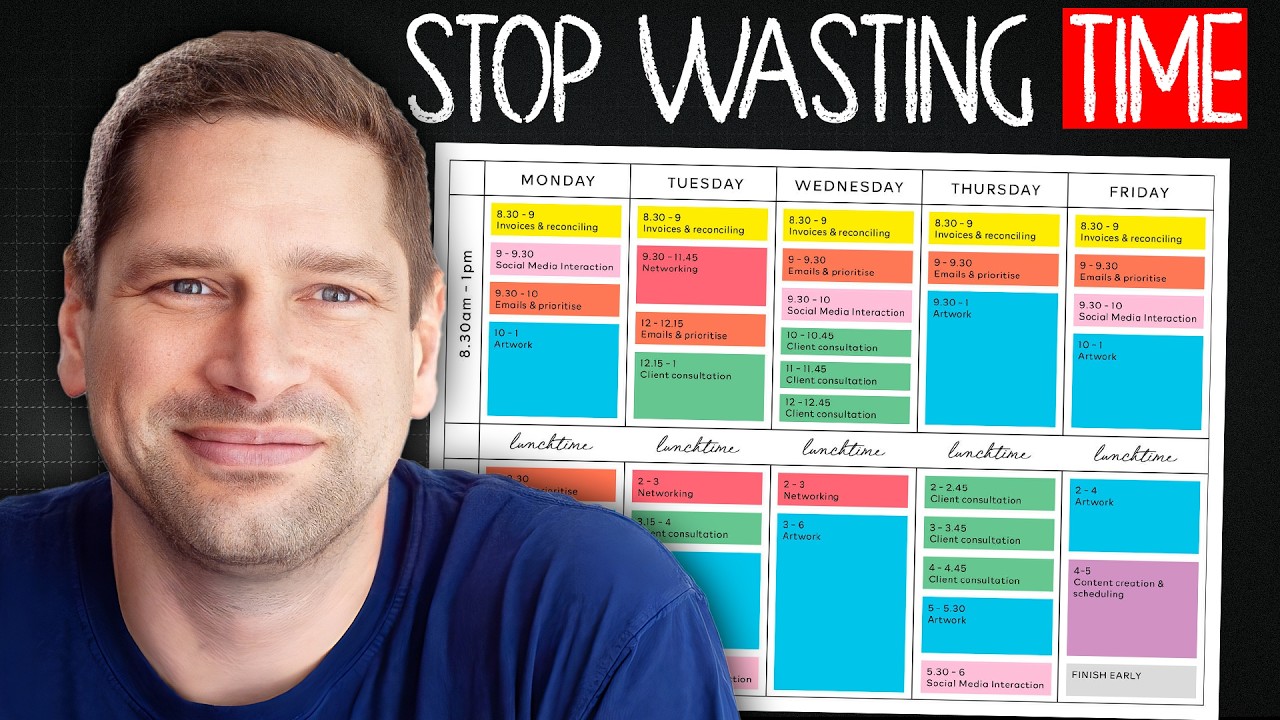
Running a coaching practice can be really quite busy and very frenetic at times, and knowing where best to spend your time can be quite challenging in a busy coaching practice. So what I've done is I've prepared some very simple time management tips for coaches in this video, which I'm going to share with you now. So I learned about time management the hard way because I ended up getting incredibly burnt out about 2 years into me running my coaching practice. I ended up booking a retreat out in Cyprus and spending a week with a group of coaching friends of mine And several mentors and very quickly discovered just one very simple thing which I was doing wrong in my coaching practice that was leading to my burnout. One of my mentors asked me just to share my diary with him so that he could have a look and see how I was spending my time, because I was saying— they were telling me to do all of these things, and I was like, I don't have time, I don't have time. And at that particular time— I'm going to say time loads of times in this video, obviously, because it's about time management— but at that particular time, my kids were still quite young. I was learning about how to run a successful business alongside, you know, having a family and the responsibilities which come with that. And so time is, let's face it, as a parentpreneur, one of the most challenging things which you probably have to face. But that mentor had a look at my diary and he was like, what are all these purple bits in it? So I color-coded my diary and I had red for my coaching sessions, I had amber for my sales calls, I had green for my podcast interviews, but I had this purple time, which essentially was my like wait time wasted. It was my time when I was driving. And he said, what are you doing during all this time? I was like, well, I'm either driving out to see a client or driving out to see a prospect for a consultation. And he was like, this is bearing in mind this is like pre-COVID, it's 2018, you know, the internet's been around for a while. And he's like, oh, you have heard of this thing called the internet? You can actually do all of your consultations online. And I was like, and we had to go through a bit of a sort of a mindset reset around that, like a reframe, because I always thought that the coaching was about me, and it was about me having that interaction with the client, and it had to be in person, and that's where the value was. Turns out that it's not about me at all, it's actually about the results of the coaching experience with me, which you can also deliver online these days. Back then in sort of, I guess, mid-2010s, it was less of a thing, but now obviously everybody's online. So what he said was, stop driving out to see clients, run all of your consultations, initial consultations at least, You know, virtually, that's gonna save you X number of hours. And why are you driving out all of these, like, you know, for 2 hours to go and visit a client instead of getting the client to come to you? Actually, surely getting them to step out of their natural environment of their office is gonna be really beneficial for them to get out, maybe listen to some podcasts, come and have a coaching session with you, and then drive home afterwards. So we completely rejigged my diary, and all of a sudden I had about 20 hours a week which was freed up. And up until this point, you have to Recognize the volume of activity that I was doing, because I thought this is what you should be doing to have a successful coaching practice. You know, I was running probably 2, 3, 4, 5 consultations each and every week, driving out an hour to go and see them, an hour back, do the consultation, sometimes for an hour and a half, 2 hours, which looking back on it now is just utterly ludicrous. I can now successfully run a consultation with a client within about 25 to 40 minutes-ish. Depends on kind of how it's going and how many challenges and problems they're experiencing, but generally about sort of 25 30 minutes is the sweet spot really when you're doing an initial consultation. And there's a very specific process which I teach people around that. But yeah, back then I was doing all of these consultations. I was obviously coaching my clients. In that first year of coaching, I think I had 44 clients, you know, some on monthly plans, some on quarterly plans, going out and seeing all of those different people. I was speaking at lots of events. I was going and doing a ton of networking. So my diary was just constantly full of all of this driving time. Probably within 30 days of me just, you know, getting rid of all that driving time and shifting my business entirely online, just all of that burnout and stress dissipated. And then I had more time to focus on growing my practice. Of course, then what happened is, as I then get more consultations booked online, the one thing that I'm left to do is to kind of elevate my prices because I'd learned how to stimulate more demand for my, my coaching practice because I wasn't spending 20 hours a week driving. It's really important to make sure that you are regularly auditing how you are spelling your time. And the simplest way that I found to do that, and hopefully we'll share an example of how to organize, structure your default diary so that you can color code each of your appointments which you have. So like I said, for me, I do for growth activities like podcasts and things like that, going to events, I'll put those down as green time. For sales calls, I put those down as, as amber. When I'm managing my team now, that's yellow time. And then when I'm doing my coaching work, that's red time because that's the doing time. And then I have me time, which is like a blue color. And then I have my sort of driving and other time, which is purple. So we'll share an example of it on the screen so you can have a quick look. But I would really recommend you go and audit your diary, whether using Google Calendar or Outlook, and color code each one of your appointments so that you can be really hyper-aware of how you're allocating and using your time throughout the week. It's also helpful to see that you're not jumping from different types of activities. So I have specific days dedicated to coaching, so I have like a red day. I'll have days which are more dedicated, or afternoons or mornings which are more dedicated to green time or amber time, so that I'm batching my stuff so that I'm not jumping from a coaching session to a sales call to a piece of marketing to a podcast interview, because Each of those use different aspects of the brain, and that can be quite tiring. I know when I've had a tiring day because— or when I'm tired because I'll have had one of those days where I've switched around too much and not just focused on doing one thing really well. I also introduced seasonality into my business, so I'll have like a busy coaching week and then almost a week off, and a busy coaching week and a week off. And now of course I don't work Fridays either, so those are reserved for me to do with as I see fit. Go to the gym or up to the spa to have a massage or get my hair cut. But if I choose to work, I can work on a Friday, but I try and avoid work where I can now, particularly coaching work or any sales calls or even podcast interviews. So I leave it more as like a creative fun day for myself. Occasionally I'll slip in with a coaching session, but that's if a client is really struggling to find a time. What I recommend, color code your diary. Then once a week, for me it works, I do it. That's one of the activities actually I do on a Friday afternoon about 1 o'clock before I go and pick up my girls from school. I'll go and have a— do something called— I call a diary detox, where I will go back and look at the week that's just happened, re— you know, make sure everything is color-coded, make sure all the time's been allocated, even if it's just for wasted time. Um, that, that I'll just jig my diary around. Then I look ahead to the week that's coming up, make sure I color-code the week ahead. So again, I'll— if I look at a week and there's too much red time in there, or too much green time, too much amber time, I know that I might have to shuffle a couple of appointments around just to make that week work a little bit better for me so that I come out of that week energized and, you know, ready to spend time with my family at the weekend. So, you know, choose a time. I do mine on Friday afternoon, but some people I know choose to do it on a Sunday evening, or some people a Monday morning, or maybe a Wednesday, whatever. But you should go through and set a reminder to do your diary detox each and every week. Color code all of your appointments, and, you know, pay attention if there's stuff in there where you have an appointment which pops up where you kind of get your gut instinct is like, oh God, I don't really want to do that. You're kind of like a bit anxious about about, you know, whatever that call is or appointment that you've got to do, that's quite telling. You should listen to that. And if you end up with lots of those in your diary, I found that that's where a lot of the stress is created. So actually, I don't do a lot these days. It's quite nice. Coaching-wise, probably I'm spending about 6 hours on average a week, uh, just purely on coaching activities. So that's actually coaching clients, but there's some wraparound support which I do with my clients as well— turbo calls and, and bits and pieces of support in WhatsApp and reviewing people's documents as well. So that's probably like maybe another 2 to 4 hours a week. The rest of the time then I spend on sales calls or podcast interviews generally. You know, next week for example, I'm not really doing a lot of work over the summer, but next week I'm off down to London for a couple of events which are happening, which is quite exciting. One's a podcast interview, one's a mastermind which I'm going to. So there's some really cool stuff which you can do when you start to structure your time better, but whatever is taking up the most amount of time, you probably want to do something about that first and see if you can find a way to leverage that time better. One of the biggest shifts which happened for me was going from doing one-to-one coaching into a group structure. I mean, that, that probably cut down my coaching hours in half pretty much overnight. I do still have a limited number of one-to-one clients, but again, if you're looking to make the transition from doing predominantly one-to-one coaching into group coaching, we should probably have a conversation because I've got a framework which I've helped a number of coaches shift from one-to-one to group. It's far more leveraged. You can actually charge more money for it. Interestingly, when I went from one-to-one to group, my results got better, believe it or not, especially particularly for the smaller businesses, because they don't just benefit from the coaching, they benefit from that whole sort of group mastermind effect which is going on as well, and extra accountability and learning from other people. So yeah, so I can certainly help you out with that if that's something which you're doing. Hit a link below which is to fill out a very brief application form, and then we can have a conversation, talk about your goals for your coaching practice.