Picking the Wrong Business Idea? Here's What to Do Instead
Robin Waite breaks down three criteria for picking a business idea that lasts: you must love the work, clients need clear ROI, and they must afford your prices. Before spending on marketing, test demand with a waitlist. Only 5% of businesses survive ten years.
Chapters
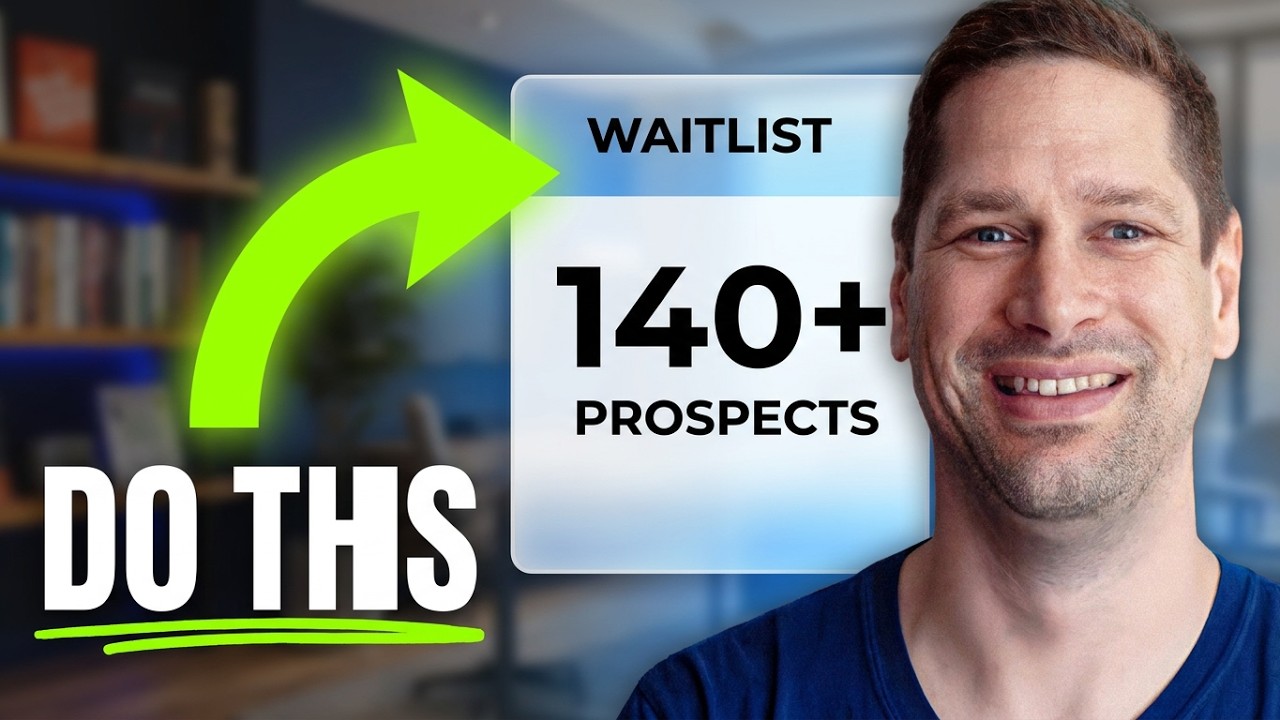
If you're anything like me, you probably get distracted about every 5 seconds by a really nice shiny new idea for a business or product or service that you would love to launch. And you think that that's going to be the idea which catapults you into millionairedom and is going to make you money overnight. The challenge though is that you've got to do a tiny bit of planning. And one of the things which I'm going to be sharing with you today is what you should consider when starting a business, especially in 2024. So one little-known fact The truth is that about 5% of businesses make it to the 10-year mark, which means that 95% of businesses fail. Now, I don't like using the F-word. However, it's true. They're out of business within 10 years. And so one of the things you need to be making sure you're doing when you're considering a new idea for a business is to make sure that it has longevity. So that's what we're going to be going through today. And here are the 3 initial criteria that I use to weigh up any new business idea which comes across my desk. So the first thing is, who do you love working with the most, or what do you enjoy Ultimately, what this comes down to is that business shouldn't be about just making more money. I get it, the ultimate goal is to create a profitable, sustainable business that does pay your mortgage or your rent and puts food on the table and those sorts of things. But there are going to be times when it gets really tough and the revenue starts to dip, and maybe you don't make the money which you want to make. It could be through the economic climate, or maybe you just struggle to get clients, or any number of different reasons. Growing pains, for example, is another one. However, there is something which you need In order to keep on going through those tough times, and that is essentially passion. You have got to enjoy the thing which you're doing and the people that you do that thing with. So, the first thing you wanna consider is, how much do I love doing this thing that I'm thinking about starting up? And the second thing is, who do I actually love working with? Because, again, you might love doing the thing, but you might not like the clients which you're doing it for. So, again, the moment life gets a little bit tough and things become a bit of a struggle, you're gonna stop doing the work, or your motivation to want to do those things is going to start to wane. And that will be one of the first criteria where you throw your hands up in the air and think, screw this, I'm going to give it up and go back to getting a job again. The second thing which you want to consider is around return on investment. Now, this isn't for you. It's actually for the people that you're doing the work with. You can have a great idea for a product or a service which you want to deliver for somebody, but ultimately, when you do that work for them, is it actually going to generate a return on investment for that business? A lot of people, when they're marketing a new product or service, they very much focus on the thing which they do, but they don't talk about the results which they get for their clients. This is really, really important because ultimately one of the things which creates a sustainable business is where you can generate recurring revenue from the clients, which means that they want to come back time and time and time again. If they're not getting value, if they're not getting a return on investment from the work you're doing for them, then they're not going to come back. A good example of this is social media marketing agencies are absolutely rife at the moment all across the internet. There are hundreds of them starting up literally every day, and the challenge with that is that you can do tons of posting on social media as a social media marketing agency, but the reality is likes, comments, and shares don't pay the bills. So ultimately, those SMMA agencies should be focused on how are we gonna use this content to leverage generating inquiries and consultations and ultimately clients and money for the clients that we work with. So you wanna choose a business where you can fundamentally get a return on investment for your clients, So that one, they're gonna pay you some money upfront for the service or product which you're offering, and two, they will keep on coming back for repeat purchases from you, which builds up customer lifetime value. The third criteria which I recommend you look at is, can the clients that we want to work with actually afford to work with us? Quite often, again, you can come up with a premium service or product which, and you've got your ideal client which you know you can get a return on investment for, but if they're too early in the market in terms of their own lifecycle of business, Maybe their revenues are too low. You might have a great service or product, but you're trying to market it to an audience of people who don't have the money to buy it. That's not a good product market fit. And therefore you really want to figure out where you can find premium clients who can pay high fees. Again, this adds to your profit margins. It means that your revenue is going to grow and it means that those business owners are going to come back time and time again. So for example, if you were selling a marketing service for $5,000, for example, but that business owner is maybe only doing $25,000, $30,000 revenue at this particular point, that is a large chunk of their revenue to put down on your services into your business without any clear idea about what return they're going to get back for that. So you've got to pick premium clients where you know you can get that return on investment and that they can then afford to pay for your service, not just initially, but also on an ongoing basis as well, to justify them buying your services on a regular basis. This is how we build a sustainable business. The next thing that you want to consider as well, this is just a little bonus and something which I go through regularly with my clients. Is around just doing some basic maths. Just do some really basic planning in advance to figure out— you don't need like a 40-page, all-singing, all-dancing business plan that you're gonna send to some kind of venture capitalist or investor or a bank. No, you just need a 1-page plan to figure out how much money your business needs to bring in, again, so that it is sustainable. So, just as an example for this, let's say you set out a goal for the next 12 months to earn $100,000 from your business. And the thing, the product or service that you were thinking about selling may be $1,000. So we do some basic maths and we take $100K divided by $1K, and that means we have to deliver 100 of those units of capacity or product or service in order to achieve our financial goal. Now, for whatever business idea you've got, and you should have a rough idea about how much you might sell that product or service for, if at that point when you do that basic calculation, your eyes pop out of your head because you're like, crikey, how do I actually produce 100 units or deliver 100 units of this product or service? It means that your pricing or your goal are a little bit out of whack, so we've got to readjust that. If you then go through and do a basic calculation of, right, well, actually I can deliver probably 20 units of this product or service over the course of 12 months realistically, well, there's a big difference there between what your price you were thinking of charging for it and where it actually needs to be. So in this example, you'd need to find creative ways to increase the value of your product or service from $1,000 to $5,000. This is to stand you in a better chance of achieving your financial goal, because if you don't have the capacity to deliver that number of widgets, you're never gonna— you've limited your earnings capacity and you're never gonna hit that financial goal. So it's super important just to do some basic maths up front just to make sure that your financial goal that you set for your business tallies up with both your capacity, the price which you're thinking about charging, and then finally, when I was talking about finding those premium clients, are you able to stimulate enough demand to then sell those 20 widgets, units of whatever your product or service is. Again, a lot of the time when you're starting out from scratch, people don't have— they're not able to stimulate enough demand out in the market to be able to get enough clients, despite the fact they might have the capacity. They can't fill up all those units of capacity. And again, this limits your ability to be able to achieve your financial goals. So just be really clear. Just create a one-page plan outlining those 4 criteria, and then you're pretty much ready to go. The final thing which I would recommend doing before you spend any money, and I mean any money on a website or branding, or any kind of marketing collateral, or anything like that, I would set up something called a waitlist. The idea behind a waitlist is really just to test the market out. So, by this point, you should have an idea about who your ideal client is, whether you feel you can get a return on investment for them, whether you feel they can afford your product or service, and roughly what price point you're gonna sell your product or service at. And then what you can do is you can go out to the market, whether it be on LinkedIn, or at networking events, or on other forms of social media, maybe reaching out to other people's networks as well and test the market. One of the tools which I recommend you look to use when you're building a waitlist is a tool called ScoreApp. We'll make sure we share a link to that in the description, but ScoreApp is a really fantastic tool of not only taking registrations of interest from people who might be interested in your product or service. You can collect name, email address, and telephone number, but then what you can do is ask them just several pointy questions related to your product or service, whether they need it or not, what price point maybe they might think about buying it, what sort of return on investment they might get if if they bought into your product or service. So you can create this short quiz or scorecard, which also gives you extra information about those inquiries or leads as they come in through your Score app. Now, what I suggest is that you want to get oversubscribed. There's a fantastic book by a friend of mine called Daniel Priestley. It's called Oversubscribed. And the idea behind this is if you want to sell 20 widgets, units of whatever it is, your product or service that you want to sell, so you probably want to get oversubscribed by a factor of about 7 to 1. So if you have 20 spots available for your product or service, you want to build up a waitlist of maybe 140 prospective clients or buyers for that product or service. This stands you in good stead so when you actually do a product launch, you've got plenty of people in there. You know, remember what I was saying about stimulating enough demand for your product or service that it's more— it swings the odds in your favor that you're probably going to sell out those 20 units of capacity. Effectively, what you're signaling to the market is that you're a scarce resource, you're exclusive. I've only got 20 spots, 140 people are interested in it, you're gonna have to get in really fast if you want one of those 20 spots. And it just helps to stimulate demand, it creates a bit of a fervor, a bit of energy about your product launch when it comes to market. And all of this you can do relatively inexpensively. ScoreApp's only about £30 a month, so about $35 a month for the cheapest option. In fact, I think you can even set up a scorecard for free. You get 30 days free trial with the link which I'm going to share with you. So it means you can go and set up your scorecard, send it, blast out to a load of people, make— do some direct outreach, for example, on LinkedIn, and ask people to complete your scorecard. And you can start to get a feeling for whether your business idea is a good idea or not. And quite frankly, if the feedback comes back and it's a bit flat, you might want to rethink your business model and the business plan and the idea itself. And you can, at that point, you can adapt it, Go back out to your waitlist again, maybe update them and say, oh well, if it had this feature in it, do you think that might make it more attractive? Or if we, as far as the value proposition is concerned, if we created this result for you, do you think that would work better and you might be more interested in buying this product or service? One of the things which I've also created for you— so remember those 3 criteria which I said at the start around doing what you love the most, can you get a return on investment for your prospects, and also can they afford to buy your product or service. I've created a free worksheet which you'll be able to download. I've linked to it in the description below. There's no need to sign up for it. You can go and download it off our Google Drive, and it just takes you on a bit of a journey to go through however many business ideas you've got and then weigh up those 3 criteria and then use that to figure out which one of those ideas stands the best chance of working for you. So go and click on the link, go and grab that worksheet. You're welcome to also email it into me. I'd love to give you some feedback on that and And if you get stuck or have any questions with it, either drop them in the comments or email me. I'll be happy to help out.
More from Robin


Surviving Entrepreneur Burnout - Why I Nearly Quit My Business (And How I Got Through It)

Freelancer vs Business Coach: How to Build a Profitable 6-Figure Creative Business



How Timothy Armoo Finds A-Players Nobody Else Can #recruiting #scaling #business

