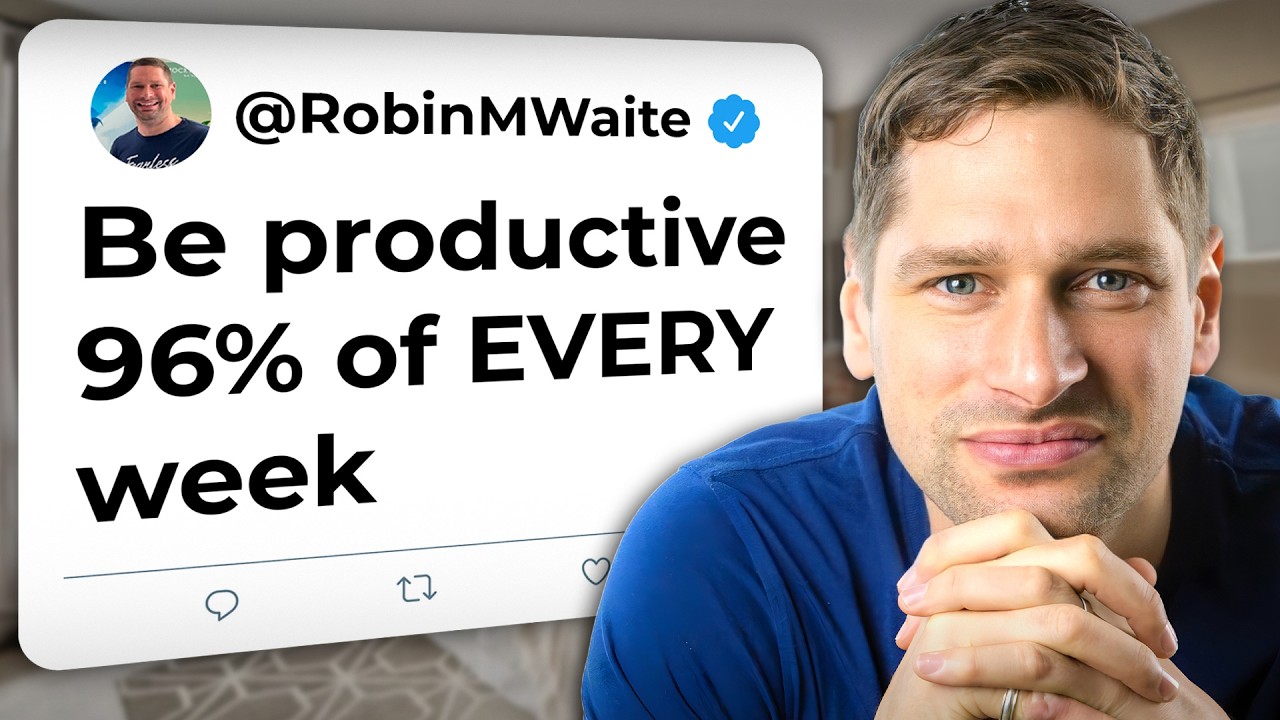
Robin Waite shares a productivity system built on three pillars: Freedom, Fulfillment, and Finance. He uses 6-week sprints alternating three productive weeks with three creative weeks, and applies the 96% rule (the 20% of the 20%) to identify which 4% of activities drive most results. Focus your marketing on high-impact channels like podcasts and speaking, not shiny tactics.
Chapters
You may have clicked on this video because you have a never-ending to-do list as long as your arm where you're struggling to tick anything off that list. Or perhaps your business has just left you feeling a little bit frazzled and exhausted, and you're wondering about whether there's a way that you can either get through that to-do list or perhaps just rethink how you go about running your business so that you can remain ultra productive and also get some enjoyment out of running your business in the process. I'm going to be sharing with you 3 really simple tips to focus on when you want to become more productive within your business. And they come from a really good friend of mine, a guy called Matt Essam, who is one of the best coaches in this world. He's written a book called Create and Prosper, which I thoroughly recommend jumping onto Amazon and getting hold of a copy of yourself. But there's 3 very simple Fs which I'm going to go through, which Matt teaches all of his clients on his coaching program, which I know will help you to become much more productive on your day-to-day work within your business. Now, just like you, over various points in my business, my career, I've been going now for 20 years, I've struggled at various points in terms of productivity and energy levels and having a bit of fun within my business. And sometimes it can get to feel really grindy, like every day you're just like, oh, I've got to go through these same steps over and over and over again. Now, part of the reason why a lot of business owners really struggle with this is because there's this expectation that business growth looks like this, that it's this nice straight upward trajectory with no peaks or troughs. It's very predictable. and we end up with great results at the end of it. But as you know, business is very squiggly, lots of ups and downs and pitfalls and steps backwards and forwards, big leaps up, and it can be very draining if you don't understand this. One of the things which I've noticed about the businesses which I've run is there's this seasonality to it. And I've noticed that the cycle which I go through with my businesses is typically about 2 to 3 years in length, where you have this period of consolidation, a short period where you're wondering, God, when are things gonna start to go wrong? And inevitably then they do go wrong. Yeah. Go into the dip. Then you, as a result of that, you have some massive breakthroughs and your business takes a huge leap forward, and then you go back into the consolidation phase. And that cycle, those 4 steps, typically takes about 2 to 3 years. Every business goes through it. All of my clients' businesses have been through it. In my agency days over 12 years, we went through it 3 times. In my coaching practice over the last 8 years, I've been through this dip twice. So I would like to think I'm pretty much an expert of navigating the dip and the breakthroughs. And how to engineer them. And the thing is, ultimately you want to make sure that you get through the dip as quickly and painlessly as you possibly can do, so that you get to enjoy the massive breakthrough which comes at the end of it. But one of the things which I've learned through Matt is, through his 3-step methodology, is that there is a much more enjoyable way to run your business. So they're the 3 Fs, as I said. The first F which I want to focus on is freedom. One of the reasons why you probably started your business in the first place is because you wanted Freedom to roam. You wanted to be able to pick up your kids and drop them off at school, and you wanted to be able to run meetings when you wanted to run meetings. You didn't want to have to commute into work and grind out a 9-to-5 job which you didn't necessarily enjoy that much. You wanted to be able to go and see your friends when you wanted to. You want to be able to take holiday when you want to, and all of those good things. The challenge though is that most people come from a job into running a business, and ultimately they end up creating yet another job for themselves, with the constraints which come with it. So they end up working a 9 to 5, only taking maybe 4 to 6 weeks worth of holiday each year, struggling to juggle kids and life and sickness and health and all of the good things that come with running a business and having a, having a life. So ultimately what we want to do is we want to figure out what is my tolerance to this whole business thing? How much work can I actually tolerate within my business? And what freedom do I want to So for me, it's become very apparent that things like school holidays are really important. I need to make sure that I'm available during school holidays, even if ultimately I end up still working. I'm still around for my girls because they're gonna be off, and I want them to see me at home. That's really important. And the second thing as well is to make sure that because my wife works very hard, that I'm also available to be able to pick up the slack as a dad, as a family member, you know, when it's needed. I also recognized as I've got older— I mean, I'm not that old, I'm only 42 now— but as I've got older, I also need to put a little bit more time time into self-care, your body starts to struggle a little bit physically, mentally. I get a bit tired a bit more easily now, and there's other health issues and things like that. So I've got to make sure I'm fueling my body well, that I'm taking time out to do exercise and just a bit of R&R for myself. So about a year and a half ago, I decided that I would lock, stock, change my working hours entirely. And as a part of that, I wanted to ensure that Fridays were Robin's day. They were my day, guilt-free time off to spend exactly as how I wanted to. I could drift into work if I wanted to on those Fridays, although now, because I've practiced this muscle memory around guilt-free time off. My Fridays, I can really lean into them and enjoy them. So things which I get a kick out of— I love my cycling, so Fridays is quite often the day when I get on my bike and go out for a ride on my own in the Cotswolds countryside. Might go and get my hair cut, or I might go and have a massage, for example. And the goal is to take off each and every Friday. Also means I can pick my girls up on a Friday as well from school, so again, I'm always present for them. So having that freedom is massively important. Now what that means is I've got to be ultra productive with the 4 days that I do work, and obviously if I'm not working school holidays, my hours are generally vastly reduced as well. What I typically tend to find is I work in these short 6-week sprints, so they're the length of the half terms typically. So I have 6 weeks whilst the girls are at school, a week off for a half term, 6 weeks now, 2 weeks for Christmas, 6 weeks half term, 6 weeks Easter, you get the picture. So I'm working in these short sprints, which means I can put in these periods where I work 4 days a week, flat out for 6 weeks. I work really hard. I book all of my sales calls within that. I do as much coaching as I can. I get out and I speak to, you know, to as many people as I can. I book my speaking engagements during that time, and I get onto as many podcasts during that time as I possibly can do. And then I take a breath, and I breathe, and I've got my time back, my freedom. And it also— another thing which I've done to remain as productive as I can as a coach is that I, I have within those 6 weeks, I have 3 ultra-productive weeks and 3 slower weeks. So the 3 ultra-productive weeks typically tend to go into revenue-generating activities like coaching and paid speaking engagements and partnerships. And then my 3 weeks off, and I alternate them, so I go heavily productive week, week, quieter week, productive week, quieter week. And the quieter weeks generally I tend to put into much more creative activities— writing books, doing videos, my own podcast, blogging, and various things like that. Also putting time into making sure I'm training my team and various other more holistic things. So that means I have incredibly productive, from a finance perspective, productive weeks. And then from a business growth perspective, I also have productive weeks as well. And that means that each and every week I'm doing stuff to kind of grow my business and advance it and take it further forward. So freedom is important, but businesses do need fueling. So you do have to put time and energy into them, which means you're going to work. But I structure it in a way that when I am working, I'm ultra productive, and then I reward my myself with the time off, whether it be on a Friday or during the holidays, the school holidays, so I can spend time with family. So the first F is freedom, just to recap. The second F is fulfillment. And Matt Esson talks about what's the point in running a business if it's not fun, if it's not filling you up, if it's not fulfilling you and fulfilling a purpose, a bigger purpose than you? What is the point in running it? I see a lot of business owners that are driven solely by money, and the statistics don't lie. You know, within the first 5 years, 50% of businesses have gone out of business. By year 10, there's only, only 5% of businesses are still going. So very few businesses stay in business for the long haul, and it's probably because they're chasing the wrong thing. They're probably chasing money. They probably have a couple of tough months and then that puts them out of business. And because they don't have much passion for it, their work isn't actually fulfilling to them and it's not generating, giving them the freedom, well, they end up giving up. Because what's the point in carrying on if it's not paying the bills? For example. So fulfillment is massively important because that's where your sense of purpose comes from. Now for me, I know the work I do as a coach generally is really helping the business owners that I get to work with in terms of creating the life and creating the freedom and fulfillment which they want to generate, as well as the money also that they want to earn in order to have a successful, prosperous small business. So directly through the work I'm helping people— when I, I give away 3,000 copies of my book Take Your Shot, and if you're interested Jump into the description. We'll share a link to the book there. Fearless.biz/TYS. If you go there, you can pop in your details. I'll even cover postage if you don't want to help out with that. So you can get a free copy of the book and you can learn about the basic principles of fearless business. But I get a huge amount of fulfillment— believe it or not, this is so dull, isn't it? I get a lot of fulfillment out of signing a copy of Take Your Shot, popping it into a brown envelope, printing off the shipping label, taking it down to Pauline at the local post office, and off it goes. And I send out 3,000 books a year, or at least that's my goal, to send out 3,000 books a year. And I know that whilst I mainly work with 20, 30, 40 clients every year, there's 2,960 people that are going to benefit from reading that book because it's an inspiring story. It's got 5 basic business principles in there that I believe every business needs, and they get a lot of value from it. And through that, that fulfills me. I feel like I'm serving a higher purpose because Whilst directly I only work with a tiny proportion of, you know, people who come into my world, I'm also helping a much broader audience through some of the free resources which I give away, like the books. So getting some fulfillment out of the work which you do is massively important. And one of the things which I've noticed is if I spend too much time coaching, my fulfillment levels drop because my business isn't growing and I'm not helping that broader audience. I'm not serving that purpose of building this bigger business community, which is one of the goals and ambitions I've got for Fearless Business. So I've got to be— in order to remain productive and get fulfillment out of the work which I do, I need to make sure that my coaching hours are limited. So it might surprise you that on a typical week, my average coaching hours are maybe 6 to 8 hours a week, and I'm able to grow a coaching practice that generates nearly £250,000 a year on just 6 to 8 hours of productive revenue-generating work each and every week. Some weeks there's no coaching in it. Some weeks there might only be an hour or 2. Some weeks it might get a little bit busier. There might be 10 to 16 hours worth of coaching in there. It just depends how I structure those busy coaching weeks. But yeah, the bulk of my work— and whilst I find coaching very fulfilling, energetically it can be quite draining. And what I've noticed is when I do too much coaching, I'm quite tired. My creative work tends to stop at that point. I do fewer YouTube videos. I record fewer podcasts and I do far less writing just because intellectually my brain is overstimulated. I'm too tired and I don't have the energy to put into those like more creative jobs. So to remain productive in the creative work, I have to make sure that I limit the amount of revenue-generating work which I'm doing. And getting that balance right is massively important. And that's where a lot of the fulfillment comes from, is just serve enough people over here so that I can serve 10 or 100 times the amount of people over here. That's hugely, hugely important. So we've got freedom, we've got fulfillment, and then the final and third F is finance. It's last for a reason. If you get freedom right, if you do work which fulfills you, the money will take care of itself. Now, I know a lot of people don't want to rely on that woo-woo stuff because I'm, I'm actually more of a fan of woo— less woo and more do, personally, because the more risk you take, the more things you do, the more luck you have. And the greater chance you've got of your business growing. But finances last, but finance does need to have a sense of purpose as well. So I'm very clear on what my financial objectives are for my business. So at the start of last year, I made it very clear that my Mighty Small coaching practice was going to generate £250K, and I would do everything within my power to ensure that that happened. But I had to design the business that would get me there. And so I divided up multiple streams of revenue that I needed to— where I was going to pull all my money from, whether it be from my group coaching program, one-to-one associate coaching roles, our content sponsorships and partnerships which we've got, my books, and several other sources of income. In fact, I did a video where I broke down all of my different revenue streams that I've got in my business and how I generated $250K worth of revenue in my last financial year. But finance-wise, you've got to design that. You've got to figure out what your financial goal is for your business and how you're going to get there. Otherwise, this bit like just getting into your car and not bothering with the sat-nav, just kind of setting off and driving, and you could end up anywhere. And in financial terms, that means you could far exceed your goal if you'd had one and generate $1 million worth of revenue, or in many cases you end up driving off a cliff and only doing $53,742 worth of revenue, and you're left a little bit disappointed by that, which erodes the freedom, it erodes the fulfillment side of things certainly. So finance, you have to design that. Now here's an interesting principle. Pareto's principle applies very much to the finances within your business, okay? For those who don't know, the Pareto principle— you may also know it as the 80/20 principle. So in business terms, 80% of your income is probably derived from 20% of your clients. 80% of the revenue in your business will come from just 20% of the revenue streams within your business. 80% of the products contribute towards 20% of the profit within your business, or 20% of the clients within your business contribute towards 80% of the problems and queries and support requests within your business. So 80/20 is prevalent throughout your entire business, and especially when it comes to finances. So some of you may be new to business, which is fine. You may not have the data yet to be able to apply Pareto's principle to your business, but you can at least start paying attention to it. But those of you who've maybe got a year or two under your belt and you've earned some money last year, go back and look at last year's profit and loss account and look at where the money came from. Look at where most of your time was taken up. Look at where the greatest contributions towards your overall revenue came from, and I can guarantee it will only be in a fraction of whatever the inputs were that you put into your business last year. The goal really is to find the 20% of the things that contribute towards the, the greater output, the 80%. I also like to take it a step further and think about the 4 4% rule, the 20% of the 20%, because you can guarantee there are 4% of the things which you do which contribute towards 96% of the outputs. And that's where you can become ultra productive. I must get 50 to 100 cold DMs and emails daily from people who are selling me all sorts of shiny marketing shit. Basically every man, woman, and their dog has a, has a shiny marketing thing to sell you. The LinkedIn expert sells you LinkedIn, the Instagram expert thinks Instagram is the best thing since sliced bread. Facebook ad guy wants to sell you Facebook ads. And if I bought all of these things, I would be bankrupt about a gazillion times over. And the thing is, you can't do all of those marketing activities. And one of the things which I've noticed is that most business owners in 2024 are spending the vast majority of their time doing marketing activities and only a tiny fraction of their time actually revenue generating, doing the thing which they love. It's the same for me. So I shared earlier on, I probably only do about 6 to 8 hours worth of client fulfillment work each week, which is what I get paid for, which is where 80% of my income came from. So how I stay productive is to maximize the time that I'm spending doing the ultra revenue-generating activities like the coaching. Same from a marketing perspective. I don't want to then spend the other 3, 4 days a week that I'm working doing tons of shiny marketing stuff that I don't know whether it's going to work or not. So marketing is hard. In fact, I'll probably have to do an entirely other video on how to market yourself as a coach or consultant, because it is really bloody hard to get it— get the mix right in 2024. But my advice would be to look at the, the 4% of your marketing activities which generate the vast majority of your leads and inquiries. If you're a great networker and all of your inquiries generally— 96% of your inquiries tend to come from networking— go and spend more time networking. And, and really maximize it. Go in there intentionally to enroll clients, okay? You can ditch your blog and your email marketing and your Facebook ads, and you can ditch all of your social media and short-form video and stuff like that if 96% of your leads come from networking. Go and do more of that, you know? And that might be a day or two out of your business each week or month or something like that, you know, but that might be a really good use, an optimal use of your time. So it's really important to apply Pareto's principle for, but do the 20% of the 20%. For me, for example, things which I found that really helped to grow my coaching practice over the last 8 years: my books, which I bang on about. You can get a free copy of Take Your Shot. In fact, I think I've already plugged it in this video. So my books, I know if I give away books, for every 100 books I give away, I'll get 8 to 10 calls booked and maybe 1 or 2 clients. I know that if I go and speak on the stage in front of 250 people, that again I'll bring another 20, 30, 40 people into my communities, into my world, some of whom will eventually become clients. Doesn't matter whether it's now or 2 years into the future, but as long as I'm growing my community, I know that some of those will rationalize into clients further down the line. I know that guesting on podcasts is a huge one for me now, especially video-based podcasts. As an example, I guested on the Ali Abdaal podcast last year. That one podcast has generated over 3,000 leads for my coaching practice, and I still continue to get inquiries coming through off the back of that one single podcast interview on YouTube. Now it's hard to get those tier 1 podcasts like that, but is it any wonder— you might be surprised or not surprised— that I've now made it part of my marketing strategy? I ditched everything else that I do pretty much aside from the books, aside from the speaking engagements, and now I just double down on trying to find tier 1, tier 2 podcasts to get on to be a guest on where I know that they've got large numbers of my audiences already created. I think too many people are on this one-person mission to grow their own audiences, whether that's YouTube subscribers or Instagram followers or email list subscribers or whatever it might be. And they're doing it like Noah's Ark style, one by one by one by one, and they're wondering why it's such hard work. Well, there are people out there who already have vast numbers of your audiences already pre-built. Whether they lucked out and managed to build them, whether they intentionally built them, it doesn't matter. It's neither here nor there. But if you focus on building these high-value partnerships where people have 100,000 or 1 million subscribers, that they're willing to do some kind of pod swap or Skillshare or something like that and get you onto— in front of their audience, then do 1 or 2 of those things per year, and I can guarantee it will be absolutely transformational for your business. That's the 4%. That's how you remain productive with the other 96% of your time. Is finding those hyper-productive, the tiny 4% of things which create the biggest impact within your business. And it doesn't matter whether it's on the finance side of things, whether it's on the lead gen and marketing side of things, whether it's in terms of creating your freedom, what fulfillment you get from your business. And I, I've also decided as well, the people I want to hang out with and the work I want to do is fun. I got that from Ali Abdaal's book Feel Good Productivity, which is a fantastic read. Everything which he talks about there is like, as long as you're living a life on purpose and it's fun, then you'll get everything that you need out of that off the back of it. But doing it just for the money is, in my eyes, a really poor excuse for setting up a business. It's one of the reasons you do it, yeah, we've got— there is a means to an end. Not all of us have a trust fund or born with a silver spoon in our mouth, so we do need to earn a living from our businesses. But make the finance side of things a natural byproduct of doing the other 2 things really well. On your freedom and the fulfillment and the purpose of your business, you'll naturally make money from that. You— it will come as a natural byproduct, and I, I can't overemphasize that. And making sure that everything is fun and you have the freedom to roam, it's fulfilling, and also it generates you some money, and there's a plan behind how you generate money. I can guarantee that you will be able to remain productive in your business and enjoy the process. I want you to be in a situation whereby you're still around in 10 years, 15 years, 20 years' time, still doing the same business because you absolutely love it and you get a huge amount of joy from it. Otherwise, you'll be one of the statistics. Your business will just gradually decline, and, you know, maybe in 2, 3, 5 years you won't be running it anymore. Maybe you'll be doing something different. Part of the process as well, I think, to, to look at this in it from a more introspective way, part of this is also about trying to figure out what it is that you do enjoy, what does give you that sense of fulfillment and purpose, what— how can you make money? And sometimes there are businesses which is just really hard to make money and it's really hard to make a success of it. So part of this process might be about building a business to fail so that the next business you set up, you learn from your past experiences and then that sets you on the pathway to success.
More from Robin


Surviving Entrepreneur Burnout - Why I Nearly Quit My Business (And How I Got Through It)

Freelancer vs Business Coach: How to Build a Profitable 6-Figure Creative Business



How Timothy Armoo Finds A-Players Nobody Else Can #recruiting #scaling #business

