9 Ways to Use AI to Differentiate Your Product or Service Offering
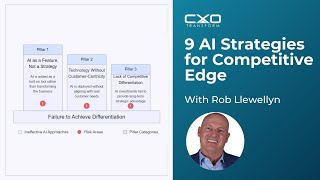
Adding AI as a feature won't cut it. Companies need to embed it across their entire business model. The video covers four core strategies: hyper-personalization, AI-augmented decision making, autonomous operations, and AI-powered business models, plus how to measure what actually works.
Generative AI is becoming a fundamental part of business strategy, but simply having AI capabilities doesn't set a company apart. A lot of businesses are integrating AI without a clear plan of differentiation, leading to generic AI applications that fail to provide a real competitive edge. One of the biggest mistakes companies make is treating AI as a bolt on feature rather than a transformational tool. Adding an AI chatbot to customer service or using AI to generate marketing content may enhance efficiency, but these tactics alone don't create differentiation. They are table stakes, not strategic advantages. Another pitfall is investing in AI without aligning it to customer needs. Companies often adopt AI for the sake of technology rather than focusing on how it can truly add value. If AI driven features don't solve a customer problem, improve decision making or create new business opportunities, they remain underutilized and fail to generate meaningful impact. So to avoid these common traps, organizations must think strategically about how AI can reshape their value proposition and and help them stand out in the market. True AI differentiation doesn't come from a single feature. It emerges when AI is embedded across the entire business model. Rather than focusing on isolated applications, companies must explore how AI can enhance the entire value chain from product development through the customer experience. Now, AI can be leveraged at various stages such as research and development, where AI accelerates innovation by predicting market trends, analyzing vast data sets and simulating different product variations before launch. This allows businesses to create products that are more aligned with customer needs. It's also valuable in production and operations where AI driven automation streamlines workflows, reduces errors and optimizes resource allocation. Predictive maintenance and manufacturing and AI powered supply chain forecasting are examples of how AI improves efficiency within marketing and sales. AI refines targeting strategies, generates personalized campaigns and optimizes pricing models to attract and retain customers more effectively. Finally, AI plays a crucial role in customer engagement and service by by enabling AI powered virtual assistants, personalized recommendations and predictive customer support, which improves satisfaction and loyalty. By applying AI across multiple touch points, businesses ensure that they embed AI deeply into their operations rather than relying on fragmented or surface level solutions. One of the key decisions leaders must make is whether to use AI as a tactical enhancement or as a strategic driver of competitive advantage. When AI is treated as a feature, it tends to focus on improving existing functions rather than reinventing them. For example, adding AI powered search to an E commerce website can enhance the user experience, but it doesn't fundamentally change the business model. On the other hand, when AI is positioned as a differentiator, it reshapes how a company Delivers value. AI can enable entirely new services, revenue streams or customer experiences that competitors can't easily replicate. So organizations that use AI to redefine how they operate will lead their industries. While those who treat AI as just another tool risk blending into the background. Now, there are four key ways AI can be used to create true differentiation in the market. And each of these strategies allows businesses to go beyond efficiency and automation, unlocking new sources of competitive advantage. The first strategy is hyper personalization where AI analyzes vast amounts of customer data in real time to deliver truly personalized experiences. Whether in E commerce, financial services or healthcare, AI can provide recommendation services and interactions that feel tailor made for each individual. Another key approach is AI augmented decision making which goes beyond automation. By enhancing human decision making through real time insights and predictive analytics, leaders who leverage AI powered forecasting and scenario modeling gain a significant competitive edge. Now, a third differentiation strategy involves autonomous operations where AI can go beyond traditional automation by enabling self optimizing systems. From logistics to risk management, AI continuously learns and adjusts to improve efficiency and without human intervention. Finally, some of the most transformative uses of AI come from AI powered business models. AI driven services on demand, AI consulting and AI generated product customization can create revenue streams that were previously impossible. By adopting one or more of these strategies, businesses can ensure that AI becomes a source of sustained differentiation rather than just a short term enhancement. One of the most immediate and powerful ways AI can set a company apart is through customer experience transformation. AI allows companies to move from reactive customer service to proactive engagement. Instead of responding to customer inquiries after they arise, AI can predict potential issues and provide solutions before the customer even realizes there's a problem. And this applies across multiple areas including AI chatbots and virtual assistants, which improve response times and customer satisfaction by handling routine queries while freeing up human agents for more complex issues. Another application is sentiment analysis, which helps brands understand how customers feel about their products and services, allowing for faster adjustments to improve experiences. AI also enhances accessibility through voice and image recognition, creating new engagement opportunities for diverse customer segments. A company that uses AI to create seamless, intelligent and proactive interactions will always outperform competitors relying on traditional customer service models. AI isn't just about improving existing products. It can redefine entire industries by enabling entirely new services and business models. Businesses must rethink how AI can unlock automated content generation where AI produces personalized reports, legal documents or creative assets at scale, providing new value to clients. Another area of opportunity is on demand AI services, where companies can build AI as a service offerings that allow customers to access AI powered capabilities without requiring technical expertise. AI generated product design is also becoming a game changer with AI driven simulations and predictive modeling accelerating innovation cycles and reducing time to market for new products. The companies that use AI to drive product reinvention will be the ones that lead their industries forward. To ensure AI is successfully integrated into a business strategy, leaders must follow a structured approach. AI implementation fails when it's not aligned with clear business objectives. A successful roadmap includes identifying customer pain points before deciding on an AI solution. AI should solve real problems, not just add unnecessary complexity. It's also important to prioritize AI for high impact areas where differentiation is most needed. Leaders need to focus AI efforts on strategic growth opportunities rather than spreading AI adoption too thin. Finally, businesses should scale AI solutions in stages to test effectiveness before full deployment. Rapid experimentation allows companies to refine AI models before committing to larger rollouts. A clear implementation roadmap ensures that AI is used strategically and effectively rather than becoming a costly experiment with limited returns. To maintain AI differentiation companies companies must continuously measure and refine their AI initiatives. Without proper metrics, it's impossible to know whether AI is truly adding value. Key performance indicators include customer engagement levels, where AI should enhance the customer journey, leading to higher retention and satisfaction rates. Another important metric is operational efficiency gains, ensuring that AI drives measurable improvements in cost savings, speed and and accuracy. Revenue impact is also crucial where AI should contribute directly to revenue streams or improved sales conversion rates. By tracking these metrics, businesses can ensure that AI remains a strategic enabler rather than a technological investment. AI is really evolving quickly and companies that fail to stay ahead of emerging AI trends will struggle to maintain differentiation. In the coming years. Self learning AI models, AI powered decision engines and advanced autonomous systems will define the next wave of competitive advantage. Companies that continuously innovate with AI integrated deeply into their business models and measure its impact rigorously will be the ones that dominate their industries. By taking a strategic approach to AI differentiation, leaders can ensure that they remain ahead of the curve, turning AI into a lasting source of competitive advantage. If you're ready to take your capabilities to the next level, check out the links below. Thanks for watching and I'll see you in another video.










