Why Meta-Leadership Is the Missing Link in Enterprise AI Success

A single speaker explains why enterprises struggle to scale AI and argues that meta-leadership, a discipline focused on organizational alignment and breaking silos, is essential for successful AI transformation.
Across industries, we're seeing the same troubling pattern in enterprise AI. Big ambitions, bold pilots, then nothing. Adoption stalls, ownership blurs, and momentum fades away. And despite the dashboards and the slide decks, transformation just doesn't stick. What's most striking is that the core issue isn't technical. BCG's 2024 survey found that 74% of firms struggle to scale AI. And in 70% of those cases, it's not the algorithms or infrastructure. It's leadership, process and people. Marketing rolls out one tool, finance another. HR builds its own tools proliferate, efforts fragment, and the enterprise ends up with AI on app islands. But this isn't a matter of negligence. Leaders are doing what they've always done, just in a world that now demands something fundamentally different. And that's where meta leadership steps in to lead. In the AI era, we need to shift from how we define leadership itself. Meta leadership is not about adding another steering committee. It's about a structural reorientation. Traditional leadership moves vertically through the org chart within departments focused on functional outcomes. But meta leadership moves horizontally. It operates across units, systems, and change portfolios. It brings cohesion where fragmentation usually wins. So instead of asking, how is my team performing? Meta leaders ask, where is the system getting stuck? They lead with a panoramic view, not just of their remit, but of how change actually flows across the enterprise. And they practice seven disciplines that make that shift real in daily operations. So let's explore the first. If you're still relying on quarterly steering meetings, you're already behind transformation, especially AI driven transformation moves much faster than that. By the time issues surface in a status pack, the cost of inaction has already multiplied. That's why the first discipline is real time oversight. Meta leaders don't wait for reports. They build weekly cross functional review rhythms that connect delivery to value while it's still in motion. At a global healthcare firm, the CIO implemented weekly synchronizations across data, risk, and business unit leads. Within a month, they'd uncovered six critical misalignments that traditional governance had missed entirely. And that's the power of proximity. But for oversight to really matter, it must be paired with another capability. The ability to understand and guide AI itself, not just manage around it. Oversight without fluency quickly becomes passive. To shape the AI agenda, leaders really need to do more than approve budgets. They need to understand the strategic implications of technologies being deployed. Fluency isn't about coding. It's about critical thinking. Can you interrogate assumptions in a model? Can you spot when a vendor is over promising? And can you weigh the risk of data drift or regulatory exposure? The COO of a major UK retailer saved over 1.2 million by challenging contractual lockings proposed by an AI vendor. She wasn't technical, but she was fluent enough to to spot the strategic flaws. And this fluency enables the next discipline staying close to execution without falling into micromanagement. Fluency allows you to ask better questions, but what happens next is equally important. Many AI initiatives falter because the vision is there, but the execution clarity isn't. Timelines stretch, accountability blurs, and the definition of success shifts. Meta leaders address this by engaging early on not to run delivery, but to shape the conditions under which delivery thrives. They work with teams to define what good looks like, anticipate blockers, and clarify interdependencies. For example, in a logistics firm, one early intervention from the Chief digital officer aligned AI development with compliance and governance requirements, cutting rework by 70% and reducing deployment time by half. And that alignment only works when supported by the right technical foundation. Your enterprise Architecture here's the thing I Architecture decisions aren't just technical, they're strategic. Your data flows, system integrations and cloud configurations determine how fast you can move, how safely you can scale, and how flexibly you can adapt. Yet architecture is often treated as an afterthought, a back office concern rather than a boardroom topic. Meta leaders change that. They bring their CTOs and architects into early stage planning. They understand that infrastructure choices either enable transformation or silently sabotage it. One global insurer redesigned their integration layer in partnership with business leaders and the outcome model deployment time dropped by 62%, code reuse tripled across regions, and risk scoring was standardized across five different countries. But even the best architecture will be underused if the organization is fragmented. That brings us to the next and often the most entrenched barrier to AI success. Which is functional silos. Strong architecture means little if your organization keeps defaulting to my function. My solution silos. They slow everything down. Finance optimizes for savings, marketing for engagement, risk for safety. Each one builds AI tools in isolation, none of which align at scale. Meta leaders dismantle this reflex. They build shared KPIs, they align incentives. They create forums where interdependencies is the default, not the exception. And a European manufacturer, the chief transformation officer discovered 11 AI pilots running in parallel. She introduced a cross functional AI alignment board with quarterly integration reviews and unified KPIs. And within six months, redundant pilots were reduced by 40%. A third of the AI budget was reallocated to shared services and time to scale dropped by nine months to just three. And even that level of cohesion requires strong integration with the transformation office. And here's a mistake many executives still make treating the PMO as an administrative hub. But in meta leadership, the transformation office becomes a performance enabler. It doesn't just track delivery, it aligns portfolios, surfaces conflicts, and resolves trade offs. At a major telecoms provider, the CIO embedded a shared delivery dashboard into the transformation office, linking Project health to strategic Value Stream. And the result? Underperforming initiatives were restructured early and high impact AI programs accelerated by 35% in under six months. Execution integration isn't optional. It's what prevents wasted energy from becoming wasted budget. Which brings us to the final shift, the mindset that makes all the others work. Everything we've discussed leads to this Meta leaders don't just lead people, they lead systems. They understand how change travels across portfolios, functions, geographies, governance, and time. They shape how transformation is designed, delivered and sustained. They don't just ask, are we on track? They ask, is this system set up to succeed? And that means influencing architecture, risk frameworks, talent development, and investment strategy all as part of one integrated operating model. In short, they lead beyond the team. They lead how the system itself performs. If you're starting to recognize these patterns in your organization, if you've seen strategies stall, silos slow progress, or AI fade into PowerPoint, then this might be your next step. Meta leadership isn't theory. It's how the most effective transformation leaders already operate. And if you want to take your transformation capabilities to the next level, check out the links in the description below. Thanks for watching and I'll see you in another video.
More from Rob










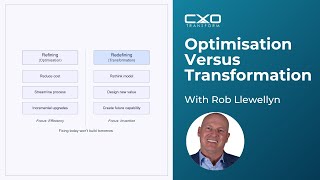
Why Optimisation is Not Transformation — And What That Means for Your Strategy