A guide for CFOs on using AI for financial forecasting, risk management, and cost optimization. The talk covers practical steps for AI adoption and how the CFO role is changing as AI becomes central to financial strategy and decision-making.
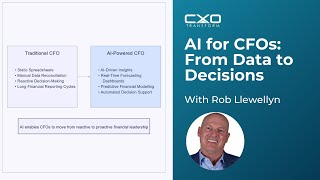
For years, CFOs have relied on traditional financial models, static reports, and manual forecasting methods to guide their businesses. But in today's fast moving economic landscape, these conventional approaches are no longer enough. The reality is finance leaders are under increasing pressure to deliver accurate forecasts, optimize costs and manage risk in an unpredictable world. Market volatility, inflation, supply chain disruptions, and ever changing regulations all demand faster, smarter decision making. AI has already transformed industries like marketing and supply chain, yet finance has been slower to adapt. Why? Well, because many CFOs still view AI as a technical tool rather than a strategic enabler. The truth is, AI isn't here to replace finance teams. Instead, it provides real time insights that enable CFOs to make more informed and confident financial decisions. In this session, we'll explore exactly how AI is reshaping financial strategy and decision making. We'll come at key AI capabilities that finance leaders can leverage, real world applications and a structured roadmap for integrating AI into your finance function without the need for a team of data scientists. By the end, you'll have a clear understanding of how AI can help you stay ahead of financial risks, improve forecasting accuracy, and optimize capital allocation. For decades, CFOs have relied on historical data, spreadsheets and static models that assume the future will look like the past. But today's business environment is far too unpredictable for that approach to remain effective. At least. Traditional financial forecasting and decision making have three major weaknesses. They rely on fixed assumptions that quickly become outdated, markets shift rapidly, and static financial models struggle to keep up with external changes. They lack real time adaptability, making it very difficult to factor in external data like market fluctuations, supply chain disruption, and economic trends. And they require significant manual input, meaning finance teams spend more time compiling and adjusting reports than analyzing insights for strategic decisions. As a result, finance leaders often make critical decisions based on outdated or incomplete information, putting the organization at greater risk. Meanwhile, companies that are using AI are already gaining a competitive edge. They're optimizing cash flow, predicting market trends with greater accuracy, and automating financial processes to reduce costs. So how can CFOs bridge this gap between traditional finance and AI powered decision making? AI isn't just another tool in the finance department. It's a strategic enabler that enhances financial intelligence, automation, and risk management. So here's how AI is revolutionizing financial strategy. AI powered forecasting continuously analyzes internal and external data to generate more accurate revenue, expense and cash flow prediction. Real time risk detection helps CFOs anticipate financial risks before they escalate, allowing for proactive rather than reactive decision making. Process automation reduces manual financial tasks such as reconciliation, invoice processing and compliance checks. This frees up finance teams for higher value work and scenario based planning enables finance leaders to test multiple financial projections, helping them prepare for different business outcomes and mitigate risks more effectively. By leveraging AI, CFOs can shift from reactive decision making to proactive data driven financial leadership, ensuring their organizations remain competitive and resilient. Now, AI isn't a single technology. It consists of multiple capabilities that finance leaders can integrate into their workforce. The most impactful AI applications for CFOs include predictive analytics which analyzes historical and real time financial data to create more accurate forward looking forecasts Machine learning for financial insights, which detects complex patterns and relationships in financial data that human analysts might overlook Natural language processing for compliance, which automates regulatory reporting and ensures alignment with evolving financial regulations AI driven cost optimization, which continuously monitors expenses and identifies areas where costs can be reduced or or optimized and AI powered investment and capital allocation which helps CFOs assess risk adjusted returns and make more strategic investment decisions. By integrating these AI capabilities, CFOs can gain faster, deeper and more actionable financial intelligence. For CFOs looking to get started with AI, the key is not to overhaul the entire finance function of instead, a structured phased approach is really essential. First, assess AI readiness by identifying gaps in your current forecasting, risk management and financial reporting processes. This will help you determine where AI can add the most value. Next, select the right AI tools that integrate with your existing finance systems and align with your strategic objectives. Then pilot AI in a specific finance function such as cash flow forecasting, risk detection or investment analysis to test its impact before a broader rollout. Next, train finance teams to work with AI, ensuring they really understand how to interpret AI generated financial insights and use them effectively in decision making. And finally, scale AI across the finance function by expanding AI adoption into budgeting, investment planning, compliance and automation. By taking a step by step approach, CFOs can ensure AI adoption is controlled, strategic and aligned with business goals. AI in finance is really evolving very rapidly and the role of the CFO is changing with it. In the near future, AI will become a standard part of financial decision making, enabling real time financial forecasting that adapts dynamically to market conditions AI driven investment and capital allocation that enhances risk adjusted returns, automated financial compliance and governance, reducing regulatory risks and AI powered ESG reporting and sustainable finance initiatives. Ensuring financial strategies align with sustainability goals now. The CFOs who take action today will position themselves as the leaders in the AI driven finance function of tomorrow. AI is no longer a nice to have for CFOs, it's becoming a competitive necessity. The finance leaders who understand and implement AI now will be the ones driving smarter financial strategies, reducing risks and optimizing costs before their competitors do. If you're serious about leveraging AI for financial strategy and decision making, I've included additional resources in the description below. Thanks for watching and I'll see you in another video.