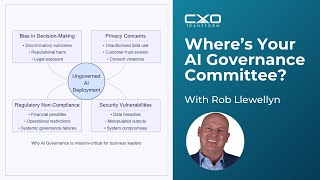
This is a YouTube video titled "AI Governance Committee: Why Your Organisation Needs One" created in May 2025. The content is a detailed monologue explaining the importance of establishing an AI governance committee within medium to large organizations. It covers the risks of AI such as bias, privacy, compliance, and security, outlines the ideal committee composition, operational practices, responsibilities, and ways to measure success. The video also provides real-world examples and practical advice for integrating AI governance into existing organizational structures. The format is a single-speaker educational presentation focused on AI governance best practices.
What if I told you your organization's next AI project could either revolutionize your business or completely destroy your reputation overnight? As AI transforms how we work, it's bringing serious risks that many organizations are completely unprepared for. I'm talking about biased algorithms making discriminatory decisions, privacy breaches that violate regulations, and AI systems that are vulnerable to to manipulation. These aren't hypothetical scenarios. They're happening right across industries right now. That's why today I'm breaking down the one essential safeguard every medium to large organization really needs. And that's an AI governance committee. By the end of this video, you'll understand exactly why you need one, who should be on it, and how to make it work effectively. If your organization is using AI or planning tool, you really can't afford to miss this. So let's start with why an AI governance committee is so crucial. Without proper oversight, AI can quickly turn from a competitive advantage into your biggest liability. Here are four major risks that make governance essential. First, we've got bias in decision making. AI systems inherit biases from their training data, which can lead to discriminatory outcomes. Imagine a hiring algorithm that consistently favors certain demographics because it was trained on biased historical data. Not only is this ethically problematic, but it could also expose your organizations to some serious legal consequences. Second, we've got privacy concerns. AI often relies on vast amounts of personal data. Think about the sensitive customer information that your systems process every day. And without proper governance, you'll risk violating privacy laws and losing customer trust. Third, we've got regulatory compliance. Regulations like the eu, AI act and CCPA are getting stricter by the day. And non compliance can result in penalties up to millions. Just last year we saw several major organizations face significant fines for AI related compliance failures. And fourth, we've got security vulnerabilities. AI models can be targeted by adversarial attacks. These attackers can manipulate inputs to produce incorrect results, potentially compromising critical systems or or sensitive data. An AI Governance committee addresses these risks head on. Ensuring your AI initiatives align with your values, comply with regulations and avoid unintended consequences. Now let's look at who should make up this really vital committee. You need a diverse team with complementary expertise. Your ideal committee includes a chief AI officer leading your AI strategy and ensuring governance alignment. A Chief Technology officer providing technical guidance. A chief Data officer overseeing data quality and privacy. The head of legal or compliance monitoring regulatory requirements. An ethics officer focusing on fairness and accountability. Business unit representatives bringing practical insights from different departments. And you need external experts offering independent perspectives and specialized Knowledge. Keep your committee between, let's say, six and 10 members. Any larger and decision making can become quite inefficient and any smaller and you might miss critical perspectives. Your committee members should have expertise in their fields and receive specific training on AI governance. And to maintain a fresh perspective, you should consider setting term limits of two to three years for your members. With the right team in place, let's now examine how the committee actually operates on a day to day basis. Most committees meet quarterly, with additional meetings for any urgent issues or high priority project approvals. And this regular cadence allows for consistent oversight while remaining practical for very busy executives. Budgets vary widely, depending on organizational size, of course, and AI maturity. For medium to large organizations, you should expect to allocate anywhere from 40,000 to several hundred thousand pounds annually to your AI governance committee. And this covers training, expert consultations and essential assessment tools. Ideally, the committee reports directly to the board or senior executives, ensuring AI governance aligns with overall strategy and receives appropriate attention. Effective committees use frameworks like Fair Fairness, Accountability and Interpretability and custom checklists to assess different projects. They also leverage specialized tools for models, monitoring data quality and detecting bias. When ethical disagreements arise. And they will, you need to have a clear escalation process. Consider creating a separate ethics review board for particularly complex issues that require deeper analysis. Now that we understand how the committee works, let's explore its key responsibilities in more detail. First, policy development. The committee creates and enforces policies on ethical AI use, data usage standards, model transparency requirements and clear accountability across the AI lifecycle. Second, we've got risk assessment and mitigation, and this involves proactive bias detection systems, privacy protection protocols and security measures against adversarial attacks. Third, we've got compliance monitoring. The committee ensures AI initiatives, meets regulatory standards through regular audits against internal policies and external regulations, comprehensive documentation for transparency and fourth, strategic alignment. This means reviewing AI projects to ensure they contribute to key business objectives, reflect your organization's core values and finally, stakeholder engagement. The committee builds trust by providing internal education on AI ethics and governance, communicating standards clearly to customers and investors, and these responsibilities really form the foundation of effective AI governance. To see how they work in practice, let's look at some real world examples. Consider the case of GE Healthcare. The organization has proactively integrated its Chief Privacy and Data Trust Officer into the AI development process, ensuring that privacy and ethical considerations are addressed right from the outset. This collaborative approach between privacy and AI leadership exemplifies how embedding governance into AI initiatives can enhance compliance and and build trust. Conversely the 2018 SingHealth data breach in Singapore serves as a cautionary tale. This incident, which compromised the personal data of approximately one and a half million patients, really highlighted significant lapses in data security and governance. The breach led to substantial fines and and a comprehensive overhaul of cybersecurity measures within the organization. Now these examples really underscore the critical role of AI governance in safeguarding sensitive data and maintaining public trust. For smaller organizations, establishing a streamlined committee with cross functional roles or engaging external experts might be an effective way to implement robust governance without overextending your resources. It's really essential to recognize that an AI governance committee shouldn't function in isolation. Integrating this committee with existing governance structures ensures a cohesive approach to risk management and compliance. Your AI governance committee doesn't exist in isolation. It needs to work with existing oversight bodies for maximum effectiveness. The committee should collaborate with risk and compliance teams to assess share risks. Audit committees to provide data for compliance reporting. AI development teams to implement feedback and monitoring standards. This integrated approach creates a comprehensive view of organizational risk and compliance, preventing silos that could lead to overlooked issues. With the committee properly integrated, how do you now know if it's actually making any difference? Well, let's look at how to measure success. You need clear metrics, so track these key indicators. Compliance rate, which is the percentage of AI projects meeting regulatory standards. Bias reduction, which is a measurable decrease in algorithmic bias over time. Incident rate, which is the frequency of AI related compliance or security issues. Stakeholder satisfaction surveys gauging trust in AI initiatives and return on investment, which is financial value generated by well governed AI. These metrics will help you demonstrate the committee's impact and prove the value of responsible AI governance to senior leadership and and other stakeholders. An AI governance committee isn't just another corporate body. It's essential infrastructure for the AI era. And this committee ensures your AI initiatives are ethically sound, legally compliant and strategically aligned, providing the foundation for responsible innovation. If your organization is really serious about AI, you need to be equally serious about governing it properly. And an AI governance committee isn't just a safeguard, it's an investment in sustainable, trustworthy AI that delivers real business value. So is your organization prepared for the AI risks ahead? Consider what steps you might take now to establish proper governance. Now, if you're ready to take your AI leadership capabilities to the next level, take check out the links in the description below. Thanks for watching and I'll see you in another video.