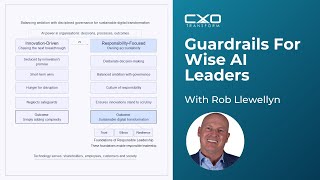
Rob Llewellyn argues that companies deploying AI need governance structures that balance innovation with accountability. He covers risk-based approaches, regulatory compliance, and ethical considerations leaders must navigate when rolling out AI at scale.
Lets begin with a truth that distinguishes respected leaders from the rest. In today's AI powered enterprise, real leadership means owning responsibility, not just chasing the next breakthrough. Far too often leaders are seduced by innovation's promise, pushing ahead at speed, but neglecting accountability. And this approach may create short term wins, but it undermines the foundations of trust, ethics and resilience that great organizations depend upon. I'm Rob Llewellyn and today I'll show you why sustainable transformation relies on leaders who balance ambition with disciplined governance. Proving that the most visionary enterprises are the ones that are built on a culture of responsibility, not just a hunger for disruption. When we talk about AI in large organizations, we're really talking about power. Power to make decisions, to change processes and to shape outcomes at a scale that we've never seen before. But with that power also comes a duty to ensure that technology serves not just shareholders, but employees, customers and society at large. Responsible leadership means asking the hard questions, putting safeguards in place and ensuring every innovation stands up to scrutiny, not just today, but for years to come. It's this deliberate approach that ensures AI drives real value instead of simply adding complexity. As the pace of AI accelerates, the risks grow just as quickly. Many organizations are really eager to unlock AI's value, yet deploy it without proper safeguards. The absence of governance creates a gap where unintended bias, privacy breaches and regulatory non compliance can thrive. External scandals make the headlines, but it's the internal erosion of trust and alignment that truly threatens progress. Robust governance frameworks are not defensive and red tape. They're proactive enablers of sustainable innovation. By putting the right guardrails in place, you're protecting your organization's reputation, response relationships and license to operate in the digital economy. Guardrails also promote collaboration across departments, ensuring that legal compliance and business leaders are all aligned. Without this cross functional engagement, even the most sophisticated AI systems can falter, producing unintended consequences that could have easily have been avoided. Of course, not all AI systems present the same level of risk. Treating every application the same stifles innovation and leaves dangerous gaps where scrutiny is most needed. The solution is a risk based approach inspired by frameworks such as the EU AI Act. Leading organizations focus governance resources where the stakes are at their highest, streamlining controls for low risk AI and applying rigorous oversight to systems that affect health, finance and employment. This targeted model ensures regulatory compliance and public trust, while still encouraging creativity where it's safe to do so. Once high risk AI systems are identified, responsible organizations embed risk management into every phase of their development and and deployment. And this means ensuring data quality, enforcing transparency, maintaining human oversight and conducting regular audits. The goal is not to stifle progress, but to ensure that powerful technologies serve the interests of everyone they touch. When risk management is taken seriously, enterprises are not only protected from disaster, they earn the confidence of regulators, employees and the public. And they're able to innovate with integrity and speed. As AI systems become more autonomous, clarity around accountability is really critical. It's not enough to build a technology. You also need to define who's responsible when things go wrong. That's why successful enterprises establish clear oversight roles, embed human in the loop processes and create escalation protocols. At the same time, they uphold the highest standards in data management. Poor data leads to unfair outcomes and reputational damage. So organizations really need to invest in data quality, privacy protection and bias auditing. These practices ensure outcomes that are not only accurate, but but they're also justifiable and defensible. As the regulatory environment evolves, enterprises really should embed compliance checks throughout every stage of AI's life cycle. Proactive organizations don't just react to new laws, they anticipate them conducting assessments and collaborating with third party auditors where necessary. But true governance is more than compliance alone. By uniting risk assessment, accountability, data integrity and regulatory diligence into a single framework, organizations eliminate gaps and silos and ensure every stakeholder, technical and non technical alike, operates with a shared understanding of standards values. Governance isn't static, it's a continuous journey and organizations dedicated to excellence, they regularly assess their practices, they measure maturity and they set milestones for improvement. AI governance maturity models and strategic roadmaps really help pinpoint the gaps, guide learning and keep the enterprise agile in the face of change. This culture of reflection and growth transforms governance from a compliance exercise into a living source of strategic advantage and resilience. When all these elements are brought together, it becomes clear governance isn't a brake on progress, but the mechanism that makes sustainable innovation possible. The most forward thinking enterprises treat governance as as a strategic differentiator. Embedding ethical guidelines into every decision, engaging with regulators and fostering trust inside and out. There's a deeper insight here. For leaders, the systems we build ultimately build us in return. The quality of our governance not only shapes the effectiveness of our AI, but also defines the character of our organizations and the legacies we leave behind. When we govern wisely, we help shape a future where technology serves humanity with integrity. Remember that effective AI governance is the key to true digital liberty. It ensures that AI serves humanity, not the other way around. And by embedding ethical guidelines, transparency, and accountability, you're not just controlling technology, you're shaping its impact on your organization and on society as a whole. If you're ready to elevate your own capabilities and take your organization's AI leadership to the next level, I really encourage you to explore the Certified AI Governance and Ethics Program. You'll find a practical consulting grade curriculum that goes way beyond theory and empowers you to lead with confidence, credibility, and purpose in the age of intelligent enterprise. Thanks for watching, and I'll see you in another video.