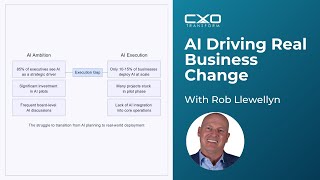
A breakdown of how AI is reshaping eight industries: financial services, healthcare, retail, manufacturing, energy, telecommunications, transportation, and media. The video explains the AI innovation flywheel concept and offers strategic guidance for businesses integrating AI into core operations, plus the main obstacles companies face during adoption.
AI is no longer a buzzword, it's a strategic imperative. And 85% of executives now see AI as a driver of business model and product innovation, not just efficiency. Yet despite this widespread enthusiasm, AI adoption remains fragmented. A lot of organizations are stuck in pilot mode, running isolated AI experiments, but failing to integrate AI into their core operations. The gap between AI ambition and execution has become what we call the AI adoption paradox, where businesses recognize AI's potential but really struggle to implement it at scale. So which industries are moving beyond the AI hype and achieving real transformation? Let's explore eight industries that are making AI work and more importantly, what they're doing differently. The industries successfully adopting AI are not just automating processes. They're redefining how their businesses operate, compete and grow. AI is allowing them to unlock new revenue streams, create new innovative business models and gain a competitive edge over slower moving rivals. For these organizations, AI isn't just a tool, it's a strategic asset embedded in their decision making, operations and customer experiences. So let's break it down. How exactly is AI transforming industries today? Well, of course, AI is not a one size fits all solution. The most successful companies, they tailor AI implementation to their specific industry challenges. So let's take a closer look at how AI is reshaping eight key industries. And the first one is financial services. The financial sector has been at the forefront of AI adoption, particularly in fraud detection and risk assessment. AI powered algorithms are analyzing massive amounts of transactional data in real time, flagging suspicious activities that human analysts would struggle to detect. Banks are also using AI for automated trading, customer service chatbots and predictive analytics to personalize financial products. And the result? Faster, safer and more profitable financial services. Next is healthcare. AI is revolutionizing healthcare through diagnostic imaging, drug discovery and personal treatment plans. For example, AI can now analyze medical scans with far greater accuracy than human radiologists, identifying diseases like cancer at much earlier stages in pharmaceuticals. AI driven models accelerate drug discovery, reducing the time and cost of developing new medicines. Next, we've got the retail sector and this is where AI is really transforming retail by enhancing customer experiences and optimizing inventory management. This is where retailers are using AI driven recommendation engines similar to those used by Amazon and Netflix to personalize shopping experiences. Predictive inventory systems powered by AI, reducing waste and ensuring that shelves are stocked with the right products at the right time. Now let's move on to manufacturing, where we are seeing factories that are becoming more intelligent thanks to AI powered predictive maintenance, automated quality control and smart production lines. Instead of waiting for machines to Break down. AI predicts work when equipment is likely to fail and that allows manufacturers to conduct maintenance before costly disruptions occur. And this minimizes downtime and increases operational efficiency. Next, we've got the energy sector. AI is playing a crucial role in optimizing energy grids, reducing waste and improving sustainability efforts. By analyzing consumption patterns, AI helps utilities predict energy demand, prevent blackouts and integrate renewable energy sources like solar and wind into the grid more effectively. Now we move on to telecommunications. AI is transforming telecoms through automated network management, predictive maintenance and AI powered customer service. Telecom providers, they use AI to optimize network performance, predict outages before they happen and offer real time troubleshooting solutions through AI driven chatbots. Now let's move to transportation and logistics. AI is streamlining supply chains, improving route optimization and really enhancing fleet management. For example, logistics companies like ups, they use AI to predict the fastest, most fuel efficient delivery routes and that reduces costs and environmental impact. AI powered autonomous vehicles and drones are also making inroads in last mile delivery services. Now let's move to media and entertainment. AI is reshaping the media industry through content creation, audience analytics and personalized recommendations. Streaming platforms like Netflix and Spotify, they use AI algorithms to predict what users will enjoy. And that of course keeps engagement high. AI generated content, including automated news articles and deepfake technology is also changing how media is produced and consumed. Now I really like IBM's term AI innovation flywheel. It perfectly captures how AI adoption isn't just a one time event, but a self reinforcing cycle that gains momentum over time. It suggests that AI adoption follows a reinforcing cycle across industries which consists of efficiency gains where AI reduces costs, speeds up workflows and and improves accuracy. Workflow transformation Because AI streamlines operations, businesses reimagine their processes. New revenue streams where AI enables new business models, products and services and continuous innovation where AI driven insights fuel ongoing improvements and competitive advantages. The companies that scale AI successfully aren't just deploying AI tools. They're embedding AI into core business strategies and driving long term transformation. Yet many organizations are still struggling to implement AI at scale. The biggest roadblocks include no execution strategy where AI projects they start strong but lack any clear roadmaps, no performance metrics because without measurable impact, AI remains just a nice to have fear and resistance because some see AI as a threat rather than an opportunity. And compliance roadblocks where security and regulatory concerns slow down adoption. For AI to truly transform industries, businesses must have a structured approach. First, integrate AI into your core business operations because AI must go beyond experimental projects, then track measurable business impact. Define cost savings, efficiency gains and revenue growth. Upskill your teams for AI adoption. This is because businesses must train employees to work alongside AI and develop AI governance frameworks because strong compliance and ethical guidelines are absolutely crucial. Now the industries leading AI adoption are doing exactly this. They're turning AI from an experiment into a competitive advantage. AI is no longer just about automation or cutting some costs. It's becoming the foundation of of business transformation. And the next wave of AI adoption will move beyond efficiency improvements to full scale business model reinvention. Companies that really embrace AI today will shape the future of their industries while those that hesitate risk falling behind in an AI driven economy. So the question is, where does your company stand? Are you still in in the AI hype cycle or are you driving real transformation? If you want to move beyond discussion and start implementing AI where it truly creates value, check out the links in the description below. Thanks for watching and I'll see you in another video.