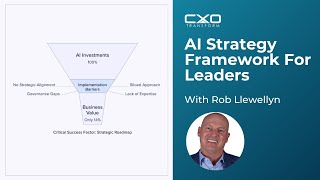
This is a YouTube video titled "AI Strategy for Enterprise Leaders: The Roadmap to Responsible Scale" created in April 2025. The content features Rob Llewellyn delivering a detailed presentation aimed at leaders and consultants in medium to large organizations. He discusses the importance of having a strategic AI roadmap to move AI initiatives beyond pilot phases into scalable business value, covering topics such as governance, alignment with business objectives, infrastructure, investment planning, change management, and continuous improvement. The video also promotes a Certified AI Strategy and Implementation Program offered by Rob Llewellyn.
Across industries today, organizations are investing millions in AI initiatives that never make it beyond the pilot phase. They start with real enthusiasm, but end up as expensive experiments that fail to deliver real business value. And what separates successful AI implementations from the rest? One critical factor a strategic roadmap. Hi, I'm Rob Llewellyn and if you're a leader or consultant in a medium to large organization, this video is for you. Today we're exploring why an AI strategy roadmap is absolutely critical for any organization that's serious about leveraging AI. This roadmap isn't just another corporate document. It's the blueprint that transforms AI from a technology experiment to a business value driver. Now, most organizations approach AI without strategic alignment. Marketing experiments with a chatbot, perhaps finance tests, predictive analytics, and operations tries process automation. These siloed projects lack coordination, proper governance and executive sponsorship. They're technology first rather than business first, which means they remain isolated experiments rather than components of a cohesive strategy. What's more, they often compete for the same limited resources, creating internal friction and inconsistent outcomes. Without clear prioritization criteria, organizations end up chasing the newest AI trends rather than focusing on capabilities that deliver sustainable business value. The financial impact of this fragmented approach is enormous wasted investments, budget overruns and minimal returns. Meanwhile, your competitors are building cohesive AI capabilities that really drive real transformation. The talent implications are equally concerning. How do you attract AI specialists when you can't articulate a direction? The cost isn't just money wasted, it's opportunities missed. The AI Strategy roadmap provides a standardized approach to planning, implementing and scaling AI initiatives. It consists of five key vision and strategic alignment, governance and ethics, capabilities and infrastructure implementation, planning and performance measurement. Together, these create a framework ensuring your AI initiatives are strategically aligned, properly governed and technically feasible and continuously improved. Your AI vision must connect directly to strategic objectives. Instead of implementing cutting edge AI, think leveraging AI to reduce customer churn by 15% while increasing operational efficiency. The roadmap should include specific measurable objectives linked to your organizational priorities and map AI applications across business functions, ensuring cross functional alignment rather than departmental silos. Now, a compelling vision serves as both a North star for your AI initiatives and a communication tool that really helps stakeholders and understand the business outcomes you're targeting. Remember, the most successful AI strategies start with business challenges, not technology solutions. So by grounding your AI roadmap in clear business priorities, you ensure that every investment moves you towards meaningful transformation rather than isolated innovation. Establish clear governance policies, compliance frameworks and ethical AI principles. Ask yourselves who oversees AI initiatives? How are investment decisions being made? What ethical guidelines will govern our AI development without this governance structure, AI initiatives can create unexpected risks, from biased algorithms to privacy violations, and that can damage your brand and create legal exposure. You need to benchmark your AI capabilities against industry leaders to identify the gaps and opportunities. Develop an AI differentiation strategy that leverages technology for unique competitive advantage. This analysis becomes the foundation for prioritizing investments and potentially identifying strategic partnerships or or acquisitions that accelerate your capabilities. Assess your current data architecture, your cloud strategy and technical skills. Now, a lot of organizations invest in AI models without ensuring they have the data quality, infrastructure, scalability and expertise to support them. Your roadmap should include a plan for building these foundational capabilities alongside your AI initiatives. You should rank potential AI investments based on business impact, feasibility and strategic alignment. Create a multi year budget covering infrastructure, security, talent and other critical components. Develop a risk adjusted investment plan that really acknowledges uncertainties while demonstrating a thoughtful approach to managing them. This business case is essential for securing ongoing financial support. You should outline a phased approach to AI deployment, proof of concept, pilot scaling and enterprise wide adoption. Each phase should have a clear success criteria and timelines. This methodical approach allows you to learn and adjust the before committing significant resources, reducing risk of costly failures. Now, AI transformation is 20% technology and 80% change management, so you should develop strategies for securing executive sponsorship, engaging middle management and addressing workforce concerns. Your roadmap should detail how you'll communicate with key stakeholders and manage the organizational change required for successful AI adoption. You need to define clear success metrics that connect technical outputs to business outcomes. Now many organizations focus exclusively on technical metrics like model accuracy while neglecting business impact measures. So establish a continuous improvement framework to refine your AI models and implementation strategies based on real world performance. The question isn't whether you need an AI strategy roadmap, it's whether you can afford not to have one. Without this roadmap, AI initiatives remain fragmented experiments that fail to scale and deliver inconsistent results. Now, organizations that approach AI strategically will build sustainable competitive advantages, while others will will struggle with pilot purgatory. In my experience working with dozens of organizations across industries, the difference between AI success and failure rarely comes down to the technology itself. Rather, it's the strategic framework surrounding that technology that determines the outcomes. Those with clear roadmaps move confidently from experimentation to transformation, making purposeful investments that compound over time. Those without them continue the cycle of excited pilots followed by disappointing results. So which path will your organization take now? If you found this valuable and you want to develop these capabilities within your organization. Consider our Certified AI Strategy and Implementation Program. You'll receive the complete Strategic Roadmap along with a series of intelliprompts and data set templates to help you tailor it specifically to your organization, plus nine additional Executive Grade AI documents. All the details are in the description below this video. Thanks for watching and I'll see you in another video.