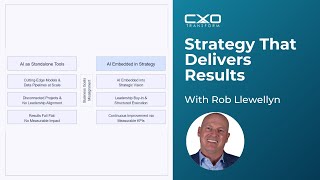
A framework for building AI strategy that connects AI initiatives to business goals through vision, leadership buy-in, roadmap, and KPIs. The approach ensures sustainable and scalable AI adoption across your organization.
Imagine an organization that invests heavily in AI, cutting edge models, sophisticated data pipelines and automation at scale. Yet after months, the results fall flat. Adoption rates are low, return on investment is unclear, and AI initiatives feel disconnected from the business strategy. Now compare that to an organization that approaches AI very differently. Instead of treating AI as a standalone tool, it embeds AI into its strategic vision, leadership priorities, execution roadmap and measurable KPIs. It creates a feedback loop where every insight refines its AI strategy, continuously driving value and and innovation. Now the difference is a structured AI strategy framework. One that ensures AI aligns with business goals, gains leadership buy in and continuously improves through measurable outcomes. So let's break down the AI strategy framework. A structured approach for ensuring AI delivers business value, not just hype. Now, a lot of organizations really struggle with AI adoption because they focus on the technology rather than the strategy. They invest in machine learning models, hire data scientists and deploy AI tools. But they don't align AI initiatives with business objectives. They lack clear leadership buy in, they have no structured execution roadmap and they fail to measure AI's real impact. Without a structured framework, AI projects stall in pilot mode. They fail to scale or become expensive experiments with no real business value. So to solve this, organizations must take a more strategic approach. One that follows a structured framework with four key components. Vision, which provides the foundation for AI strategy and ensures alignment with long term business objectives. Leadership buy in, which secures executive commitment and drives AI adoption across the organization. A roadmap, which ensures AI initiatives are executed in a structured and scalable manner and KPIs, which measure impact and create a continuous cycle of refinement and improvement. More importantly, these four areas must be connected in a continuous feedback loop where KPIs refine strategy, leadership buy in drives AI adoption and execution informs future adjustments. Now, this framework isn't just a checklist. It's a dynamic system. Every part feeds into the next. Ensuring AI initiatives are sustainable, scalable and results driven. AI strategy starts with a clear vision, but not just any vision. It needs to be business aligned, meaning AI initiatives must be directly supporting strategic business goals rather than operating as siloed projects needs to be innovation focused. Ensuring AI solutions drive competitive advantage and meaningful transformation within the organization and scalability orientated, meaning AI solutions should be designed for long term growth rather than short term experimentation. Now let's talk about how vision connects to the rest of the framework. Vision guides the roadmap, ensuring that execution remains aligned with strategic goals. Vision also measures impact and tracks progress through KPIs. So if adoption rates or business impact are low, adjustments can be made to keep AI initiatives relevant and valuable. AI success deployments.