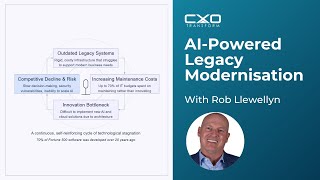
Legacy systems slow down innovation and drain budgets. Generative AI and autonomous agents can accelerate modernization, but success requires reskilling talent, breaking down silos between teams, and getting leadership aligned behind the shift.
Imagine your organization as a powerful ocean going vessel cutting through waves, built for speed and agility. But beneath the surface, a massive rusted anchor is dragging, slowing you down with every mile. That anchor is your legacy technology. And here's a number that puts this into perspective. 75% of Fortune 500 software was developed over 20 years ago. Now let that sink in. It means that core systems running some of the world's largest businesses were built before the smartphone revolution, social media, cloud computing, or AI. These aren't just aging systems. They're active obstacles holding businesses back, making them slower, less innovative and and more expensive to run. And every year they remain in place, competitors who've embraced modern technology pull further ahead. The problem with legacy systems isn't just that they're old, it's what they cost. Firstly, they kill innovation. Because if your core systems are outdated and rigid, launching new digital services is like trying to build a skyscraper on a crumbling foundation. Second, they drain IT budgets. Some companies spend up to 70% of their IT budget just keeping old systems running, leaving almost nothing for actual innovation. And then there's compliance and security. Every year, regulations evolve and legacy systems struggle to keep up. What starts as a manageable challenge turns into a very high stakes liability. A global financial institution faced exactly this issue. Their core banking platform, a patchwork of systems built over decades, was consuming 60% of their IT budget just for maintenance and compliance. They were running a modern digital first business on technology that were designed in the 1980s. But when they introduced AI powered modernization, things changed. Operational costs dropped by 35%, new digital banking products launched 50% faster and security risks were significantly reduced. Now this isn't just about efficiency, it's about survival. This is where generative AI changes everything. For decades, modernization has been slow, expensive and disruptive. But generative AI has rewritten the playbook, making large scale transformation faster, more affordable and and more intelligent than ever before. With AI, modernization costs can drop by 50%, making large scale upgrades financially viable. Transformation timelines shrink by 40%. What used to take years can now be done in months. And systems become self optimizing, adapting and improving in real time without manual intervention. Now this isn't just a small upgrade, it's a complete shift in how your technology is built, maintained and improved. AI doesn't just accelerate modernization. It changes who or what does the work. Autonomous AI agents. They're not just tools, they're intelligent digital specialists that can handle tasks that that would take human teams weeks or months. Imagine AI agents that can analyze vast amount of data in minutes, run compliance checks with near perfect accuracy and rewrite and optimize legacy code without breaking critical systems. A telecom system faced what seemed an impossible challenge, migrating millions of lines of legacy code from a 30 year old mainframe. The project was projected to take 12 months with a traditional approach. With AI powered automation. It was done in just four months, saving $8 million in the process. Now this isn't just about making it more efficient. It's about fundamentally rethinking how technology evolves. So how do you actually put AI to work in a modernization strategy? Well, the strategic modernization roadmap provides a very clear framework. First, forget traditional multi year transformation projects. AI allows for rapid incremental change. Focus on high impact areas first. Not everything needs to be modernized at once. Use automation wherever possible because AI can rewrite, optimize and test code at scale. Track every improvement, tie your AI investments to business outcomes and prepare for a shift in operational models. This isn't just about technology, it's about how people, processes and systems interact with one another. Now, organizations that take this approach don't just reduce costs, they gain a competitive edge that keeps them ahead long term. Now, to make AI powered modernization a success, technology alone isn't enough. Organizations must have the right talent and operating model models. AI powered platforms that accelerate system modernization, scalable modular AI solutions to reduce vendor lock in, robust AI governance to ensure compliance and security, and upscaling programs to prepare IT teams for an AI driven future. Now, one of the biggest roadblocks to AI adoption is a lack of talent. And the solution? Well, instead of hiring entirely new teams leading organizations, they reskill their existing workforce to work alongside AI. And companies that align people and AI are around 40% more likely to succeed in transformation. AI transformation isn't just about technology upgrades. It's about organizational changes. And some of the biggest challenges organizations face are leadership resistance because many executives are hesitant to invest in AI siloed departments because AI modernization requires IT finance and operations to work together. And budget restraints because organizations are stuck spending on maintenance instead of innovation. Now here's how to overcome these barriers. First, you build a business case for AI investment and demonstrate the impact on costs and revenue. Create cross functional AI teams, break down silos between IT finance and operations and shift budget priorities so you can free up resources by reducing legacy system maintenance. Companies that do this don't just adapt, they set the pace for the future of their industry. Now, the most successful organizations don't just replace legacy systems, they build adaptive AI driven technology ecosystems. So what should CIOs focus on over the next 12 months. Well, they need to deliver quick wins to prove AI's business value. They need to transition to AI enabled decision making and build self improving technology systems. This isn't just about keeping up with change, it's about leading transformation. Look at it this legacy systems are anchors and AI is your propulsion. The choice isn't whether to modernize, it's how fast you do it. If you want to take your transformation and AI capabilities to the next level, check out the links in the description below. Thanks for watching and I'll see you in another video.