Business Model Transformation: How to Move Beyond Incremental Change
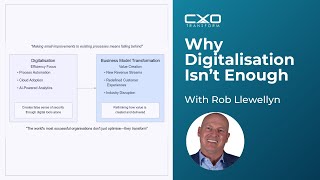
A guide to transforming your business model beyond small improvements. Using Kodak, Netflix, Microsoft, and Tesla as examples, the speaker walks through rethinking value propositions, redesigning revenue models, leveraging AI, and restructuring for agility.
If your company is only making small improvements to existing processes, you may already be falling behind. The world's most successful organizations don't just optimize, they transform. Many organizations believe that they're transforming when they upgrade their technology, automate workflows or move to the cloud. But digitalization alone is isn't business model transformation. And this creates a false sense of security where organizations assume that digital tools will save them, when in reality they're only making existing business models more efficient, not rethinking how they create and deliver value. Now the biggest risk is not failing to digitalize, it's failing to rethink your business model. History is full of once great companies that went digital but still failed because they didn't evolve their value proposition. Kodak. They pioneered digital photography, but they stuck to a film based business model. Instagram and smartphone cameras changed the industry while Kodak faded into irrelevance. Toys R Us. Instead of building its own E commerce, Toys R Us outsourced online sales to Amazon, allowing Amazon to dominate the market while they fell behind. And Blockbuster? Well, they had the opportunity to buy Netflix, but they refused because they focused on optimizing physical stores in instead of embracing a new entertainment model. Now, all three failed to adapt their business models and they paid the price. Some companies did more than just digitalize though. They transformed. Netflix evolved from a DVD rental business to an on demand streaming giant and later a content powerhouse, ensuring they stayed ahead of disruption. And Microsoft was struggling in the early 2000 and tens when under Satya Naidala's leadership, they transformed into a cloud first enterprise. And they shifted from software licensing to subscriptions. With Office365, they built Azure, making it a dominant cloud computing player. And they expanded into AI driven business solutions, moving way beyond simple software. The result? Well, Microsoft regained its position as one of the world's most valuable companies by rethinking how they deliver, create and capture value. Now, for years, businesses have relied on incremental improvements, efficiency gains, cost reductions and process automation to remain competitive. But in today's market, these small adjustments are no longer enough. While digitalization has helped optimize existing processes, it rarely leads to genuine transformation. Industries are being disrupted by companies that completely rethink how value is created and delivered. The question is, how can you ensure your business doesn't make the same mistake as others have made? Well, step one is to rethink your value proposition. Business model transformation starts with a fundamental reassessment of the value you provide to customers. This isn't about making Incremental product improvements. It's about redefining how you create delivery and capture value. So to challenge conventional thinking, consider these questions with your leadership team. First, are we solving the right problem or just improving an outdated solution? Can we shift from selling products to offering outcomes and experiences? And what customer needs or pain points remain unaddressed in our industry? Now, companies that successfully transform don't just refine their offerings, they rethink their entire customer experience. For example, Apple didn't just build better phones. They created an ecosystem where hardware, software and services like iCloud, the App Store and Apple Pay work seamlessly together, making it very difficult for customers to leave. Now, this integration of value really creates long term loyalty and differentiation. Now step two is to redesign your revenue model. Even the most innovative businesses fail when they rely on outdated revenue models. A transformed business model must include sustainable and scalable business monetization strategies. So consider these key questions. Can we transition from one time purchase models to a recurring revenue stream? Subscription memberships? Are there data driven monetization opportunities such as licensing, AI driven insights or marketplaces? And can we create tiered pricing models that capture different levels of of customer value? Now one of the best examples of revenue model transformation is Adobe. They shifted from selling expensive one time software licenses to a subscription based model with Adobe Creative Cloud. And this allowed them to create predictable recurring revenue, lower the barrier to entry for customers and continuously add value rather than releasing a new version every few years. And this shift completely changed the way that they capture value and it strengthened customer retention. Step three is to leverage AI and emerging technologies. Technology should be more than just an efficiency tool. It should fundamentally reshape how value is created. AI, automation and digital platforms are not just cost saving tools, they're enablers of entirely new business models. For example, AI powered personalization can create unique customer experiences, increasing engagement and retention. Predictive analytics can forecast customer demand, enabling proactive decision making rather than reactive responses. And AI driven platforms such as recommendation engines, chatbots and autonomous operations allow companies to provide services at scale that were previously impossible. Now, a company that's done this really well is Amazon. They use AI for personalized recommendations, warehouse automation and even demand forecasting, giving them an unparalleled competitive edge. Step four is restructuring for agility and innovation. Traditional corporate structures are too rigid to support transformation. Companies that fail to restructure often find themselves unable to act on new opportunities. Successful transformation requires cross functional project based teams rather than rigid hierarchies. A culture of experimentation where failure is treated as part of learning and real time decision making rather than slow bureaucratic processes. Now a great example of organizational agility is Spotify's squad model. Instead of siloed departments, Spotify organizes employees into small autonomous teams called squads, which focus on specific initiatives. And these squads operate within a broader network of tribes and chapters, allowing the company to innovate rapidly. Step five is to measure success beyond short term KPIs a lot of companies track the wrong metrics, focusing too much on short term financials instead of long term transformation outcomes. To assess true transformation success, you need to measure innovation velocity, which is how quickly ideas move from concept to to execution. You need to measure customer impact, how will new business models solve real problems, and business model adaptability how effectively the company pivots in response to change. For example, Tesla doesn't just track car sales, it measures the rate of technological advancements, expansion of charging networks and and software improvements. And this allows them to stay ahead of traditional car manufacturers who only track units sold. The most disruptive and successful companies are those that go way beyond incremental change and completely rethink their business models. Business model transformation isn't just about efficiency. It's about redefining value creation, building resilient revenue streams, leveraging AI and technology as enablers of new business models, and structuring organizations for agility and continuous innovation. Companies that fail to evolve will find themselves left behind. The question is, will your business be one of them now? If you're ready to master business model transformation, check out the links in the description below. Thanks for watching and I'll see you in another video.










