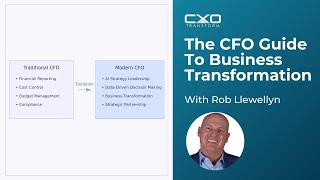
This is a YouTube video titled "CFO Playbook–Leading Business Transformation" created in March 2025. The content is a detailed presentation focused on the evolving role of CFOs, emphasizing their leadership in business transformation through AI adoption, data integration, and building future-ready finance teams. It covers strategic priorities for finance leaders, the impact of AI in finance, and the importance of digital upskilling and cross-functional talent. The video is a monologue-style presentation without multiple speakers.
The role of the CFO has changed. It's no longer just about managing numbers, it's about leading transformation. Finance leaders are now expected to shape business strategy, drive AI adoption and use data as a competitive advantage. And the pressure to get this right is only increasing. But what does that actually mean? What do CFOs need to focus on to stay ahead? So in this video we'll break down the key priorities for finance leaders. More importantly, how you can use them to drive real business impact. Now, for decades, the CFO's role was clear. Finance management, cost control and reporting, of course. But today, CFOs are not just overseeing financials, they're co leading enterprise wide transformation. And we can see this shift happening in real numbers because According to Gartner, 76% of CFOs now play a direct role in enterprise data strategy, making finance leaders some of the most influential decision makers in business. So what's behind this shift? Well, three major forces are redefining the CFO role. First, finance is no longer an isolated function. It's now integrated across the entire business. CFOs are expected to work alongside CIOs and COOs to ensure financial data isn't just tracked, but that it's used to drive strategy. Second, technology, particularly AI and automation, is shaping how finance teams operate, making traditional reporting and forecasting methods obsolete. And third, the demand for real time Decision making means CFOs can't afford to be reactive. They need to build an organization that's agile and forward thinking. So how do finance leaders make this shift successfully? Well, it starts by building a finance function that goes way beyond transactional work. This means focusing on three key ensuring financial data is fully integrated into strategic decision making, leading the adoption of AI driven analytics, and developing the finance team's digital capabilities to match the evolving business landscape. The ability to make real time data driven decisions is becoming the difference between thriving and falling behind. The problem is most organizations are still relying on outdated financial reporting that tells them what happened last quarter instead of what's likely to happen next. That's where AI powered finance comes in. Companies using AI driven analytics are 20% more profitable on average, simply because they're making decisions based on forward looking insights rather than historical reports. And yet, many finance teams still struggle to integrate financial data with operational and customer data, leaving valuable insights untapped. So to overcome this, CFOs need to move away from static financial reports and tools. A real time AI driven financial strategy. That means breaking down data silos, creating integrated dashboards that Bring together financial, operational and market insights and using predictive analytics to guide strategy rather than just track performance. CFOs who build this kind of data driven culture will see faster, smarter decision making and at every level of the business. Now, AI is everywhere in finance right now, but the real question is how much of it is actually used. A lot of companies are experimenting with AI, but few are seeing meaningful results. That's because AI isn't a magic fix, it's a tool. And like any tool, its value depends on how well it's used. So where does AI actually add value in finance? Well, there are three areas where we're seeing real impact. First, automation, reducing manual reporting, speeding up reconciliation and eliminating repetitive tasks. This frees up finance teams to focus on higher value work. Second, risk management. AI is transforming fraud detection and financial risk analysis and this helps CFOs predict and prevent problems before they happen. And third, predictive insights. AI is enabling finance leaders to model different business scenarios, forecast trends more accurately and make proactive decisions. The companies that are seeing success with AI aren't just plugging in new tools. They're embedding AI into their finance strategy. And that means choosing specific high value AI use cases, making sure teams are trained to work with AI models, and ensuring that there's a clear link between AI adoption and business outcomes. AI works, but only if it's used in the right way. A CFO is only as strong as their team. And right now, the biggest challenge finance leaders face isn't technology, it's skills. The reality is most finance teams aren't yet equipped to fully leverage AI, automation and advanced analytics. And without the right talent, even the best finance strategy will fall flat. So what can CFOs do to build a future ready finance team? Well, there are three critical areas to focus on. First, digital upskilling, investing in AI training, data literacy programs and analytics certification so finance professionals can use modern tools effectively. Second, hiring cross functional talent, bringing in specialists like data scientists and AI experts to complement traditional finance roles. And third, creating a culture of continuous learning where finance teams are encouraged to experiment with new technologies and integrate innovation into their daily workflows. The companies that win won't just have the best technology, they'll have the best trained teams. And for CFO's future, proofing the workforce is just as important as financial strategy itself. The CFO rule is evolving really fast. And the most successful finance leaders won't just be number crunchers, they'll be transformation leaders. Those who embrace AI, predictive analytics and digital first finance strategies will will shape the future of business, but those who stick to traditional models really risk being left behind. So if you're serious about leading transformation in your organization, start by focusing on three things. First, integrating financial data into real time decision making, embedding AI strategically into finance workflows, and building a future ready finance team. Because in the end, it's not just about managing money, it's about leading the future of business. So if you're ready to take the next step in business transformation as a cfo, check out the links below for more insights on enterprise transformation in AI. Thanks for watching and I'll see you in another video. Thanks.