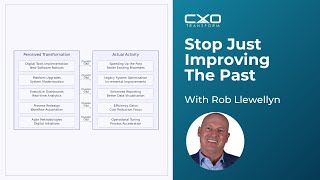
This is a YouTube video titled "Change vs. Transformation: Why Fast Caterpillars Won’t Save Your Company" created in June 2025. It features Rob Llewellyn delivering a monologue or presentation discussing the critical difference between organizational change and true transformation, emphasizing the need for strategic reinvention rather than just speeding up existing processes.
Hi, I'm Rob Llewellyn, and let's start with something very uncomfortable. Most companies that claim they're transforming are just changing faster. And that's really the truth. They're launching digital projects, updating platforms, maybe redesigning processes and calling it transformation. But what they're really doing is speeding up what already exists. And speeding up the past is, isn't the same as creating the future. And this misunderstanding is more than a semantic. It's strategic. And it's costing organizations time, relevance and competitive edge. So let's unpack why the difference matters and what happens when it's ignored. So change is essential, right? Every enterprise needs it. But change fundamentally is past orientated. It's about making what we already do more efficient, more streamlined, more scalable. And this is where frameworks like Lean, Itil and Agile come in. These are tools for optimization, for tuning the machine. The question change asks is, how do we do what we do, but better? And that's a real valid question. But it only matters if what you do is still strategically relevant. If the market has moved, if your customer expectations have shifted, if your business model is no longer fit for purpose, then change is a short term patch, not a long term answer. That's where transformation comes in. Transformation doesn't begin with process. It begins with purpose, with vision. It doesn't ask, how do we improve this? It asks, what should we become? Transformation starts from a blank page. It's not constrained by legacy systems or existing capabilities. It's driven by ambition and imagination. And when it's done well, transformation allows an organization to operate in fundamentally new ways. Change builds on the past, while transformation builds from the future. Where change asks, how do we get better at what we do? Transformation asks, what new thing do we want to bring into existence that doesn't yet exist? It's a completely different mindset. And the people behind these efforts matter a lot. Change is often driven by managers, highly capable professionals focused on process efficiency and delivery. They analyze, they plan, and they implement. They follow established pathways and they drive discipline and predictability, competitive decline, talent attribution, and strategic confusion. And this is how companies become irrelevant. Not because they fail to improve, but because they failed to transform. To transform, you must release legacy thinking. Let it go. This means more than sunsetting old systems. It means challenging the assumptions that are baked into your culture, your metrics, your operating model. You can't create a butterfly by upgrading a caterpillar. You have to let go of being a caterpillar. Transformation is uncomfortable. It's unpredictable too. And it often breaks things before it builds something. But that's the work. That's the edge. Transformation touches every part of your organization. It creates new behaviors, new mindsets, and new systems. It redefines how value is created, how work is done, and how customers get served. Transformation isn't a tech deployment. It's a strategic reinvention. You're redesigning from the inside out. You're not just doing digital, you're becoming digital. So here's the key question. Are you changing or are you really transforming? It's not a trick question. It's a strategic one.