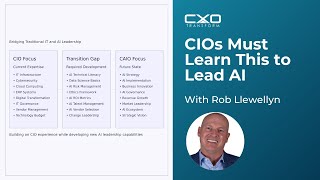
This is a YouTube video titled "From CIO to CAIO – The Skills You Need to Lead AI in Your Enterprise" created in March 2025. The content is a detailed monologue or presentation aimed at CIOs transitioning to Chief AI Officers, outlining the necessary skills, leadership qualities, and strategic approaches required to lead AI-driven enterprise transformation. It covers AI fundamentals, execution strategies, governance, ethical considerations, and the business impact of AI leadership. The video serves as a guide for IT leaders to expand their expertise and drive AI adoption at scale within their organizations.
If you're a cio, you've already mastered traditional IT leadership. But the skills that brought you here won't be enough for what's coming next. The next wave of business transformation requires a new kind of leader. The Chief AI officer. The transition from CIO to Chief AI officer is your opportunity to lead AI driven enterprise transformation. Companies need leaders who can bridge traditional IT and AI strategy. Your CIO experience is your secret weapon. You've already understood the complex organizational dynamics, you've led large scale implementations and you've aligned technology with business goals. But AI is a different game and to succeed, you need to expand your expertise beyond it. To lead AI transformation, you don't need to become a data scientist, but you do need a strong foundation in AI fundamentals that includes AI architecture, data literacy and advanced AI integration. Critical technical skills required for a chief AI officer. Start by understanding AI fundamentals, machine learning basics, neural networks and the role of AI in decision making. You don't need to code, but you do need to be able to evaluate AI solutions, lead strategic discussions and communicate effectively with data scientists and engineers. AI literacy is no longer optional. It's the foundation that enables meaningful conversations and informed decisions. Knowing the fundamentals is really just the first step. To be an effective chief AI officer, you need a focus on AI execution, delivering real results at scale. Execution starts with identifying the right AI projects. Focus on AI driven automation, data driven decision making and operational optimization. Start with small AI pilot projects and demonstrate quick wins and measurable return on investment. Then transition to scalable AI deployment across multiple business units. Your goal is enterprise wide AI scaling, ensuring AI doesn't remain in silos but becomes embedded across operations. Now, a strong chief AI officer doesn't just experiment with AI, they drive systematic deployment and and continuous optimization. AI transformation doesn't happen in isolation. It needs executive buy in and clear strategic direction. So as a chief AI officer, you need to shape the AI governance framework for your organization. And that includes defining AI ethics policies, mitigating risks and ensuring AI aligns with corporate priorities. This isn't just about avoiding compliance issues. Ethical AI leadership protects your organization from reputational damage, regulatory fines and internal resistance to AI adoption. AI leadership also means setting a strategic vision for AI's role in business transformation. That means integrating AI into the company's long term goals, defining metrics for AI success and positioning AI as a competitive advantage, not just a back office function. A chief AI officer with strong leadership capabilities earns trust at the board level and drives AI as a core component of the business strategy. AI is no longer just about efficiency gains. It's about market leadership, business model innovation and competitive AI advantage. So a Chief AI Officer needs to go beyond operational improvements and explore AI driven revenue growth. AI can really drive hyper personalized customer experiences, predictive analytics and entirely new business models. Look at companies that have successfully commercialized AI, whether through AI powered recommendation engines, automated decision making or advanced forecasting. Your role is to ensure AI isn't just a support function. It's a key driver of business strategy, revenue growth and long term growth. Becoming a Chief AI Officer isn't just a title change. It's a transformation journey. Most CIOs start with IT leadership and digital infrastructure. But to reach Chief AI Officer mastery they need to develop AI implementation expertise, innovation leadership and enterprise wide AI scaling. It's a gradual process, so start by embedding AI awareness into your current role. Then take ownership of AI strategy within your organization. Your success will be measured not just by technology adoption, but by business impact, AI maturity levels, revenue growth and process optimization. These are the success metrics that will define the Chief AI Officer's role. And your ability to commercialize AI, scale its impact across departments and enter integrated into strategic decision making will determine how effectively you lead AI transformation. The financial rewards for chief AI officers are really significant. Competitive salaries, influence at the executive level and the opportunity to really lead one of the most important transformations of this era. But this role can comes with great responsibility. You need to balance innovation with accountability. AI governance, ethical deployment and risk mitigation will be key parts of your role. If you're ready to develop your AI skills, gain practical experience and position yourself as the AI leader your organization needs, take a look at the resources below this video. Thanks for watching and I'll see you in another video.