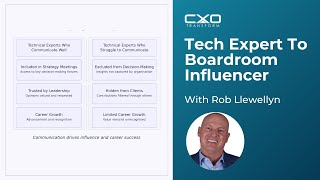
This is a YouTube video titled "From Tech Expert to Boardroom Influencer: Communicate for Impact" created in April 2025. The content is a detailed presentation or talk focused on how technical professionals, especially in AI and IT, can effectively communicate complex topics to executives by framing their work in terms of business impact such as revenue growth, cost efficiency, and competitive advantage. It provides practical advice, examples, and exercises to help bridge the communication gap between technical experts and business leaders. The video aims to help viewers become influential in executive decision-making by mastering executive-friendly communication.
Your technical brilliance is one thing, but communicating complex topics in a way that resonates with executives is an entirely different skill. Executives, they don't need to understand every line of code or every data set or algorithm. They need to know how it impacts business outcomes. Now, many AI, IT and process experts eventually get sidelined. Not because they lack expertise, but because they struggle to translate it into executive language. They get excluded from high level meetings, hidden from clients and even overlooked for leadership roles. But technical professionals aren't the only ones who fall into this trap. Even business leaders sometimes overuse jargon. Some do it because they think they'll impress people, while others use it out of habit because it's the language they speak internally with their teams. But when this same language is used with executives who are focused on high level decision making, it creates barriers instead of clarity. If you can't communicate business impact in clear, executive friendly terms, you won't be included in business decisions. Take the case of an AI researcher at a global healthcare company. They built a deep learning model that detects rare diseases with 95% accuracy. But when presenting it to executives, they focused on the technical intricacies, neural networks, training data sets and precision recall curves. The result? Leadership couldn't see how it aligned with cost reduction, patient outcomes or regulatory approvals. Months later, the company bought an AI powered diagnostics tool from a competitor. One that was marketed as reducing diagnosis times by 40% and cutting costs by 25% per patient. Now this researcher had developed a world class AI model. Yet their failure to communicate its strategic value meant it never really gained traction. Internally, executives make decisions based on business priorities, not technical complexity. So instead of talking about model accuracy, talk about faster diagnosis times, reduced operational costs and regulatory compliance. Here's what executives care Revenue growth. How will this AI solution drive sales or monetization? Cost efficiency? Will it reduce operational expenses or increase profitability, risk and compliance? Does it help meet regulatory requirements and mitigate risk competitive advantage? How does it help the business stay ahead in the market? And scalability? Can this be applied company wide without major disruption? Now, if your message doesn't speak directly to one or more of these priorities, it's probably not going to land. Because at the executive level, it's not about how impressive your technology is. It's about whether it moves the business forward. Now to bridge this gap, use this four step framework when communicating with executives. Start with impact. Frame the business problem in terms of financial or strategic value. Next, connect to strategy. Align your insights with existing company goals. Quantify the benefit. This is where you need to use clear executive friendly numbers, for example percentage cost savings, revenue projections or efficiency gains. And simplify without oversimplifying. Use analogies, structured messaging and clear data visualization. And here's how the AI researcher could have positioned their work differently. Instead of saying our model uses deep convolutional networks to classify disease patterns in real time, they could have said this. This AI solution can detect diseases 40% faster, reducing hospital costs by 25% per patient and allowing doctors to focus on treatment rather than diagnosis. Same insight, different impact. Now an AI engineer at a financial services firm, they built a fraud detection system that cut investigation time by 60%. But when presenting it to leadership, they focused on the technical models, precision and feature engineering techniques instead of the financial and and compliance benefits. And of course, the CFO wasn't convinced. Without a clear cost benefit case, budget approval was delayed. Three months later, an external consulting firm repackaged the same project, framing it as a 40% reduction in fraud related losses and secured full funding. Now, if you don't control the narrative, someone else will. Every executive speaks a different language of impact. Of course, CEOs, they're interested in competitive positioning, revenue growth and market leadership. A chief financial officer loves to hear about roi, cost efficiency, financial risk. Chief operating officers are focused on operational improvements, scalability and workforce impact. And a CIO or a CTO spent their time thinking about IT integration, innovation, feasibility and security risks. So if you're speaking to a cfo, lead with cost savings and ROI models. If you're talking to a coo, focus on operational efficiencies and scalability. Know your audience before crafting your message. Executives will of course challenge all your assumptions, so be ready to address their concerns. Common objections will include how do we measure success? And you can respond by providing clear KPIs and financial projections. Another objection is what's the risk if we invest in this AI project? Which is your cue to to discuss regulatory, financial and operational risks plus mitigation strategies. And one more is how will this impact the workforce? Which gives you the opportunity to position AI as a productivity enhancer rather than a job replacement tool. Now, the more prepared you are, the more credible you become. And of course, how will you know if your new approach is working? Well, you can use these three indicators. Firstly, inclusion in key discussions. If you've been invited to more high level meetings, you know that your communication is resonating. Stakeholder buy in. If executives are actively asking your input, well, you're making an impact and decision acceleration. If your AI or IT proposals are moving through faster approvals. It means leadership understands and values your insights. Now, if you're still struggling to gain traction, ask yourself, am I presenting this in a way that speaks to executive priorities? And here are two quick exercises to improve your executive communication. The first One is the 32nd AI pitch. Take a technical concept that you work on and summarize it for a CEO, a CFO, and a COO in 30 seconds each. Now, for the CEO, you need to emphasize competitive advantage. For the CFO you, you should be highlighting cost savings and return on investment. And for the coo, you should be focusing on operational improvements. Exercise number two is the financial impact test. For any AI or IT project you're involved in, write down cost savings, revenue growth, and efficiency gains. And if you can't quantify these, your message isn't yet ready for an executive audience. Executives. They don't reject AI or any other technical topic because it's complex. They often reject it because it isn't framed in a way that impacts business growth, cost efficiency, or competitive positioning. Your technical knowledge is powerful, but your ability to communicate that knowledge in executive terms is what will determine your influence. Master this skill and you won't just be another technical expert, you'll be someone who can significantly influence executive decisions. Now, if you want to master the vocabulary used by senior managers, leaders and consultants, check out the links in the description below. Thanks for watching and I'll see you in another video.