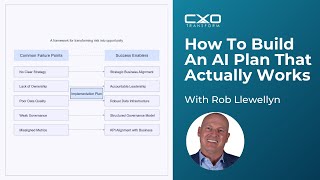
A framework for actually executing AI projects in organizations. The video covers strategic planning, governance, risk management, change management, metrics, and sustainability. It's a step-by-step guide to ensure AI initiatives deliver real business value instead of stalling.
Let's face it, most AI initiatives don't deliver what they promise. They start with hype and end in frustration. And the problem? Well, organizations jump into AI without a clear, actionable implementation plan. And that's exactly what we're fixing today. In this video, I'll walk you through a complete AI implementation plan structure, a proven framework used by enterprise leaders to deliver AI with strategy, structure and success. If you're tired of theoretical models and are ready to execute, this is for you. So let's get into it, and this is what you could consider your document template. First, there's the Executive Introduction, which is about grounding AI in in strategic intent. Because you must start with clarity and in this section you'll explain why the organization is implementing A.I. not just technically, but strategically. This is your opportunity to ground the initiative in real business value, link the implementation to transformation goals, regulatory shifts, or competitive imperatives. A good executive introduction doesn't just describe what's happening, it justifies why it matters. Next is strategic context. Why now? And what's at stake. This is where you articulate the environment. What's changing inside and outside the organization that makes AI implementation urgent valuable. This section positions AI within broader strategic drivers, whether it's improving efficiency, unlocking new revenue, or meeting regulatory expectations. Without this context, implementation risks being seen as an isolated tech project instead of a strategic business leverage. Next, you need to spell out the implementation objectives, clarifying what success actually looks like. Here, you need to define your objectives very clearly and measurably. You're answering the question what are we actually trying to achieve? Is it increased automation? Faster customer response times? Improved forecasting? Don't be vague here. Objectives should be precise, trackable and tied directly to enterprise value. Then there's scope and prioritization, focusing effort where it counts because not everything can be done all at the same time. Nor should it be. This section outlines which business areas or use cases are in scope for AI implementation. You need to be clear about what's included and what's not. You should also note any prioritization logic, e.g. tackling quick wins first or focusing on high impact low risk domains. This is how you keep your AI grounded in real business relevance. Next up is governance and accountability. Who owns what? Because AI without governance is a liability. And in this section of the document, you'll define the governance structures that will oversee implementation, including steering committees, project leads and escalation paths. You'll also clarify individual and team level responsibilities. Accountability must be embedded from day one, otherwise AI initiatives will drift or worse, they Breach trust. Then there's the implementation roadmap, where we shift from vision to execution. And this is where you get into the sequencing. Your roadmap lays out the major phases and milestones of implementation, and typically this includes activities like solution design, data readiness, model development, testing, deployment and post launch optimization. You don't need to detail every task, just enough to show a structured, intentional progression from planning to value delivery. Next are dependencies and enablers. What really must be in place because AI doesn't operate in isolation. This section of the document highlights the technical, organizational and cultural enablers that are needed to support implementation. Think data infrastructure, change readiness, security frameworks, executive sponsorship, even workforce alignment. You're surfacing what must be true for implementation to succeed and calling out risks early. Then there's risk management, addressing what could go wrong. Every implementation has risk, but that's not the issue. The issue is whether you've anticipated it or not. This section outlines your approach to identifying, managing and mitigating risks. You might include risks around data quality, model drift, compliance, stakeholder resistance, or integration failure. Risk doesn't need to be a blocker, but it does need to be visible and actively managed. Next is change management and communication, which is about bringing people with you. Because AI isn't just a technology shift, it's a behavior shift. And in this section you need to detail how you'll engage stakeholders, manage adoption and communicate the change. You should consider including internal campaigns, training, executive updates and and team engagement strategies. You want AI to be welcomed, not resisted. And that starts with how you communicate. Then you need to cover metrics and monitoring, because what gets measured gets momentum and of course gets managed. Too many AI projects are declared successful without ever proving their impact. And here you'll define your measurement model. What KPIs will you track? What does success look like at each phase? How will progress be reported and to whom? You should include delivery KPIs like milestone adherence, operational KPIs like automation rates and strategic KPIs like cost savings or customer satisfaction improvements. Measurement isn't an afterthought, it's part of of your governance. Next is sustainability and iteration, which is all about making success last. AI isn't a one off project, it's a new way of working. And this section explains how the organization will sustain, update and evolve AI systems post deployment. And that includes performance monitoring, retraining cycles, model versioning and feedback loops. You're building not just an implementation, but a system for continuous improvement. And finally, you should be considering your appendix and supporting assets, extending the plan essentially, and this is where you'll list all your assets, templates or references that could support your plan. Now these might include solution architecture diagrams, risk registers, technical documentation, or change management plans, and you should use this to anchor your plan in real, executable material. When it comes to implementation, your strategy document is only one part of the system. Execution lives and dies by the quality of the materials that support it. That's why we reinforce this plan with structured enterprise ready execution assets that extend far beyond templates. And these include guided prompts, stakeholder workshop designs, and data set frameworks, all engineered to help leaders move from intention to action with credibility. Now, rather than asking teams to start from scratch or interpret strategy loosely, these assets operationalize your intent. They clarify expectations, they standardize quality and provide a repeatable system for delivery and scale. They also ensure that every section of your AI implementation plan can be backed by data and validated through stakeholder engagement, eliminating ambiguity and building trust from the boardroom down. This structured foundation doesn't just reduce execution risk, it makes it possible to manage complexity around across multiple work streams without losing alignment. Now, if you're serious about execution, then your strategy must come with a scaffolding to support it, and that's what the AI strategy and implementation leader program delivers across the program. You'll be guided step by step to build this complete plan using our structured IntelliPrompts executive templates and and data sets. And you'll produce nine more documents of equal quality, each designed to withstand real world scrutiny. To learn more, visit cxo, FMA or see the links in the description below. Thanks for watching and I'll see you in another video.