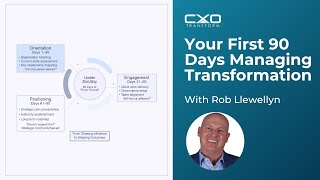
Rob Llewellyn outlines what transformation managers should do in their first 90 days to build credibility and establish control. He covers establishing governance, gaining influence, and the specific moves that matter most when stepping into a new enterprise role.
Hi, I'm Rob Llewellyn, and in this video, I'm going to walk you through exactly what every transformation manager must master in their first 90 days. Because here's the truth. The clock starts ticking on your influence. The moment you accept the role, you get a new title, perhaps a warm welcome message, and maybe a copy of the strategy deck. But beneath the surface, you're already under scrutiny. People are quietly wondering, can this person actually deliver? Will this be any different from the last transformation? And should I support this or wait for it to collapse? Now, the first 90 days aren't a buffer. They're your credibility Runway. If you waste them, you'll find yourself chasing influence instead of shaping outcomes. But if you use them well, you lay the groundwork for strategic control, meaningful impact, and trusted leadership. So let's get into it now. The biggest mistake I see is leaders who jump straight into action without decoding the organization first. In the first 10 days, your primary role is to observe, not to act. Why? Well, because every enterprise has two versions of itself. The one on the org chart and the one that actually operates behind the scenes. And your job is to map both of them, understand who really holds influence. Where are the informal alliances and tensions, what past efforts failed, and why. You're not just managing a program. You're navigating a political and operational ecosystem. And that means your first priority is learning how the game is actually played in this particular organization. Now that you've read the terrain, it's time to identify players. Not a stakeholder list, a stakeholder map. You want to capture formal authority versus informal influence, active supporters versus passive resistors, and those who nod in meetings versus those who move the dial behind the scenes. This isn't soft stuff. This is survival. Because transformation doesn't rise or fall on the strength of your Gantt chart. It rises or falls on the alignment and engagement of the people around you. So build a map, then build relationship strategies. Who needs frequent updates, who should be brought in early for alignment, and who's likely to derail momentum if they're left out. Map it, track it, and engage it deliberately. By now, someone's probably handed you a deck. It'll have mission statements, strategic pillars, and transformation principles. Maybe, but that's not enough. You need the real executive intent. What do I mean by that? Well, it's the truth that lives behind the bullet points. What are the outcomes they'll defend at the board level? What are the risks they're unwilling to tolerate, even if not spoken aloud? And what are the reputational, financial or political stakes they're managing. Run one on one alignment sessions with your key executives and ask them what will make this transformation credible in your eyes? What does success really look like by year end? And what would cause you to lose confidence in this effort? Because clarity here saves you from misalignment later. Now let's turn to governance. If you don't create governance, chaos will create itself. So don't wait for permission. Don't assume someone else is handling it. Establish your governance rhythm within the first month. Define how decisions are made, how escalations flow, and what cadence is keeps things on track. This isn't about control for control's sake. It's about tools, velocity and ownership. Governance doesn't slow you down. It makes sure the right problems are solved by the right people at the right time and that everyone knows the score. Next, you need to build your credibility calendar. This is one of the most overlooked levers in the first 90 days. It's your strategic communication schedule, not for reporting, but for demonstrating control and real progress. You're aiming for consistent, visible touch points that build trust. Think a stakeholder update in week two showing orientation progress, an early win announced in week four, pilot results shared by week six, and an executive pack circulated by week eight. Why? Well, because in transformation, perception is progress. People need to see traction, not promises, not pitch decks. Proof. Your calendar becomes your credibility engine. Now let's talk about quick wins. And let's be clear. You do need quick wins, but they must be strategic. A lot of managers fall into one of two traps. First, they deliver something fast but meaningless. Or they delay wins in pursuit of something big but quite distant. You need something in between. And the criteria? Well, first it needs to solve a real business friction. It needs to be visible to key stakeholders. And it needs to demonstrate a new way of operating, not just fixing the old. Avoid busy work wins. You need to deliver symbolic value things that signal change has really arrived. By now you've got stakeholders, activities and expectations multiplying. And now you need structure. Not for the sake of compliance, but for the sake of execution visibility. So set up your transformation intelligence system. This doesn't require a massive tool. A well structured Excel or smartsheet can get you 80% there. You need a live initiative tracker, risk and issue logs, a dependency map, milestone tracking and value delivery metrics. Think of this as your cockpit. It keeps you proactive instead of reactive. And when an executive asks you where are we on X? You'll have the answer before they finish the sentence. Now here's what no one tells you if you don't control the story, someone else will. And once that story spreads, it's really hard to unseat. So shape your own narrative. And that means regular sharp stakeholder updates, executive brief packs that tell a value story, not just activities and departmental communications that explain what's coming, why it matters, and how to engage. Narrative isn't fluff, it's influence infrastructure. And done well, it shapes how your program is perceived, which directly affects how it's supported, funded, and protected. Eventually, you need to shift from listening to, to leading, and then it's time to present your position. But don't just build another deck. Build your transformation operating model. Present what's in scope, how decisions will be made, who's accountable for what, what success looks like, and how it'll be measured. This becomes your North Star, a visible, structured signal that this transformation isn't just theoretical, it's only operational and you're running it. Listen, I've worked with transformation leaders across industries, continents, and crisis points, and one thing is always clear. You don't earn trust through activity. You earn it through clarity, rhythm, and credibility, especially in your first 90 days. So if you're stepping into a transformation role, or you're already in one and need to reset, this is your roadmap. And if you're ready to take your transformation capabilities to the next level, check out the links below. Thanks for watching and I'll see you in another video.