The 10-Step Framework for Enterprise-Scale Digital Transformation
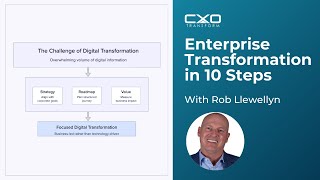
This single-speaker YouTube presentation outlines a ten-step, business-focused approach to enterprise-scale digital transformation. It emphasizes assessing six digital capabilities via a maturity model (Innovation capability, Transformation capability, IT Excellence, Effective Knowledge Worker, Customer Centricity, Operational Excellence), mapping and classifying digital use cases, prioritizing them with a benefits-versus-cost matrix, and turning top candidates into a flexible roadmap and persuasive business cases. The talk ties these activities to a broader Digital Capability Framework and an integrated Business Transformation Management Methodology (BTM²: Envision, Engage, Transform, Optimize) that organizes discipline-specific practices across strategy, value, risk, process, IT, program/project, organizational change, and competence management.
Today, I'm going to walk you through a structured approach to transformation. Now, with digital transformation conversation at an all time high, for anyone charged with their organization's digital transformation journey, it can feel like drinking from a fire hose. This ten step approach that I'm going to tell you about can help you develop a business orientated digital transformation roadmap while demonstrating measurable value to your stakeholders. Now, before we dive in, let's acknowledge a hard truth. 70% of transformations struggle or fail. They result in extended timelines, massive reductions in return on investment, poor relationships between the business and IT, and an experience that most people would happily avoid. Now, these unfortunate results often stem from a lack of transformation management capabilities which are very different from operational capabilities. Now, the ten step approach I'm going to walk you through can help you address this capability issue. Because regardless of company type or technologies, your capability maturity levels will determine how how successful your transformation will be and the value it will add to your organization. Now, with digital capabilities defining the success or failure of any digital transformation, it's really important to gain a good understanding of how your company already leverages digital technology. So, using a digital capability maturity model, a set of six digital capabilities are individually assessed to enable you and your stakeholders from IT and the business to determine the current level of digital maturity. And these are Innovation, capability, transformation capability, IT Excellence, the effective knowledge Worker, Customer centricity and Operational excellence. These six capabilities are made up of transformation enablers and and business goals, providing the perfect opportunity for IT and the business to collaborate from the outset. Now, a simple heat map can be used to capture, communicate and analyze the as is state of each of your six digital capabilities. And this will result in six separate heat maps which can be transferred into radar charts to visualize your current digital maturity and you can plan for higher levels. So, in the context of digital transformation, digital use cases are practical scenarios that describe how to reach a particular goal, namely the goal of maturing a particular digital capability. They help you close the gap between where your digital capabilities are now and where you need them to be now. Because technology has a unique place in each of the six digital capabilities, multiple digital use cases can help companies improve each of them. So, using the results of the digital maturity analysis in step one, you should facilitate the creation of appropriate digital use cases with a team made up of both IT and business leaders. Digital use cases should consist of at least the following characteristics. First a description, then the current situation, then the value proposition and your benefits. And you might also consider adding risks too. Once you've defined Your digital use cases the impact of the transformation needs to be analyzed and each digital use case will help you do this by illustrating why your organization needs to change and why it needs to change now. Understanding what can happen if the organization doesn't change now is also a key component of this step. Your digital use cases need to be classified according to their impact and the nature of their business and organizational changes. Some potential changes will solve problems and others will provide innovative ways of leveraging new capabilities or opportunities. Now, your digital use cases can be strategic or operational or a combination of both. Strategic use cases need your attention to be focused on innovation to gain competitive advantage, and your operational use cases need your attention to be focused on solving problems such as reducing inefficiencies to remain competitive. Now, every digital use case will provide different benefits to your organization. Some will have enormous impact and some will help you solve minor issues. These all need to be prioritized by your team in order to define the priorities for your digital transformation. So you should define your priorities by assessing the business benefits and implementation costs of each use case and plot them onto a matrix. You've got quick wins these are digital use cases that require little effort but deliver significant business benefits, and these should be seen as quick wins that can be realized very rapidly. Then you've got the must haves which are digital use cases requiring significant implementation effort but also provide significant business benefits. And these are key use cases that require extra special attention and transformation effort. Then we've got the low hanging fruit. These are digital use cases that are easy to implement but don't provide significant business benefits, and these should only be realized if the resources are available and not required for a transformation initiative of a higher priority. And then you've got the don't touch use cases. These are digital use cases requiring significant implementation effort but with minimal business benefits and these should be sidelined, at least for now. After establishing a clear understanding of the benefits of your individual use cases, it's time to define your digital transformation roadmap which needs to be agile enough to cope with future digital change. So consider a strategic time frame to establish your roadmap duration. Then map the digital use cases that are candidates to develop into business cases and then projects or programs in your transformation. Depending on the outcomes of the previous steps, your roadmap could well be made up of digital use cases that will deliver value towards achieving improvements in customer centricity, effective knowledge workers, operational excellence, and IT excellence. Designing your roadmap will require input from a broad set of stakeholders, so be sure to invite them all to your workshops. Remember that you're plotting digital use cases onto the roadmap, each of which eventually requires a business value. Now, if you're wondering why technology projects are not being mapped, remember the transformation is about the business. So you should map the digital use cases which provide the business outcomes you want. Don't get tempted into creating a technology solution focused roadmap. Now, you need to develop a persuasive business case if you want each of your ideas to go anywhere and your primary goal is to help people decide whether to invest resources or not. Business cases need to be developed for every digital use case that you would like to realize, and they should capture and describe the value of the planned investment and how the initiative will provide a convincing return on investment. It's really important that the benefits described in the business case should then be tracked and managed through to actual realization. And this will provide your stakeholders at every step of the transformation journey with the confidence in the decision they made to support your business case. Now, your business case is the vehicle that clearly demonstrates the value that you're able to provide. Faced with the inevitable stakeholder dynamics, your business case also needs to be watertight and so convincing that it would be very difficult for anyone to stand in its way. Components of your business case should include an executive summary, business needs statement and analysis, project overview and options, a schedule impact risk financials such as costs and return on investments, and a summary of options and recommendations. Now, it's really essential that you use a structured approach towards your digital transformation and leverage a strategic management tool that's designed specifically for transformation. In this video, we're drawing upon the Digital Capability Framework, which is a strategic management tool set that enables transformation executives to obtain clarity about what maturity level their organization has in terms of the six digital capabilities, what maturity level they want to achieve, and how how they plan to do it. Now, the Digital Capability Framework consists of these four building digital capabilities, Digital capability maturity models, Digital use cases, and a digital transformation roadmap. Each building block consists of its own tools and body of knowledge, which, particularly in the case of Building Block 1, is very extensive. Now, while considering the latest digital technologies, it's important to keep in mind that these technologies are enablers of business transformation. So when you've drafted a transformation roadmap and business cases, a business transformation management approach is really important to ensure your transformation is approached in a holistic and integrated manner. The Business Transformation Management Methodology, or BTM squared for short, integrates very closely with the Digital Capability Framework and it provides an integrated and holistic approach to orchestrating the entire transformation effort. Now, BTM Squared is comprised of four phases which are Envision, Engage, Transform and Optimize. The methodology integrates discipline specific technical and business expertise from transformation relevant subject areas. It's a very extensive body of knowledge, over 300 pages that addresses the following nine business transformation management disciplines. We start with Meta Management Strategy Management, Value Management, Risk Management. Then we've got Business Process Management, IT Transformation Management, Project and Program Management, Organizational Change Management and finally Competence and Training Management. Although not detailed in this video because that would be too much, this step involves executing your transformation plan using the methodologies selected in the previous steps. Now, to deepen your understanding of what we've looked at today, I recommend some additional reading. Firstly, there's the Digital Enterprise Transformation book. This is a really solid reference for anyone involved in digital transformation and is ideal for C suite executives and senior managers and that covers the Digital Capability Framework. And then we've got the Handbook of Business Transformation Management Methodology. And this book provides the body of knowledge for the holistic and integrative business Transformation management methodology known as BTM Squared and that's of course integrated into the Digital Capability Framework. So let's recap on the 10 steps. We've got Digital Capabilities Assessment, the Digital Use Case Mapping, Benefit Analysis, Business Priority Assessment, your Digital Transformation Roadmap, Business Case Development, Strategic Management Tool Selection, the Business Transformation Management Methodology, Orchestrating the transformation and acquiring the knowledge you need to do all of this. Now, by following these steps, you'll create a business focused digital transformation roadmap that delivers real value to your organization. Now, if you're ready to take your transformation capabilities to the next level, check out the links in the description below. Thanks for watching and I'll see you in another video.










