The Future of Learning & Development: Driving Business Transformation with AI
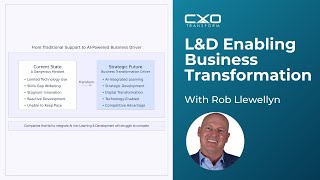
A presentation on how AI is reshaping corporate learning and development. It covers strategic priorities for L&D leaders, AI-powered learning models, and practical steps to embed AI in workforce training for better agility and competitiveness.
What if I told you that in the next five years, companies that fail to integrate AI into learning and development will really struggle to compete? The reality is business transformation isn't just about adopting technology. It's about ensuring your workforce has the skills to leverage that technology effectively. Yet most organizations still treat L and D as a support function rather than a strategic driver of business success. This is a dangerous mindset in an AI driven world. Companies that fail to rethink L and D will face widening skill gaps, stagnant innovation and a workforce that's ill equipped to handle the pace of transformation. Now in today's video, we're going to explore the top strategic priorities for L and D leaders and how they can accelerate business transformation through AI powered learning strategies. Now we know that organizations invest billions in training every year. But here's the problem. Most L and D programs fail to create real business impact. Why? Well, because traditional corporate learning is slow, static and disconnected from from real world business transformation. Most L and D programs still focus on generic one size fits all training content, heavy engagement like learning methods and compliance based learning rather than skills based growth. Meanwhile, business leaders are demanding real time AI powered learning that adapts to to employees needs training programs that directly improve productivity and business performance and workforce agility to keep pace with constant digital disruption. Now the disconnect is very clear. Traditional L and D is falling short because it was designed for a slower moving business environment. To remain competitive, companies must embed AI and data driven strategies into their workforce development. AI is transforming industries at an unprecedented rate and L and D teams still rely on outdated learning platforms that don't adapt in real time. If companies want to build AI ready workforces, they need to leverage AI drone learning models that personalize development, predict skill gaps and accelerate training. Now here's how AI is redefining workforce Adaptive learning models where AI powered learning platforms adjust training content based on an individual's progress, ensuring employees receive targeted relevant instruction rather rather than generic courses. Predictive skill analytics where AI can analyze workforce data to predict skill gaps before they impact business performance. L and D leaders can use this to proactively reskill employees and AI powered coaching and mentoring where AI chatbots and virtual assistants provide employees with instant coaching, feedback and and personalized learning recommendations. A leading technology firm implemented AI powered learning recommendations and saw a 35% increase in training efficiency reducing the time required for skill development while boosting employee engagement. So to embed AI into L and D, organizations must shift from from passive learning to continuous real time skill development that aligns directly with their business goals. One of the biggest mistakes organizations make is treating L and D as a support function rather than a growth enabler. But of course, in the age of AI driven transformation, L and D must evolve from training employees to accelerating business innovation. Here's how L and D leaders can reposition workforce development as a business growth engine. First, align learning with business KPIs. Every L& D initiative should be tied to measurable business outcomes, whether it's increased efficiency, higher revenue or improved customer satisfaction. Next, from content to capability building. Instead of just providing learning materials, organizations must focus on real world skill application, ensuring employees can immediately implement what they learn. And third, cross functional collaboration. L and D shouldn't operate in isolation. Instead, learning teams need to collaborate with it, HR and leadership to create training programs that align with transformation initiatives. For example, a global financial services firm integrated AI powered reskilling programs into their transformation strategy. And the result? A 40% increase in workforce agility, allowing employees to adapt to new technologies much faster. By positioning L and D as a core pillar of business transformation, companies can turn workforce development into a competitive advantage. Leadership development is one of the most critical, yet overlooked aspects of transformation. Many organizations assume that leadership skills remain static. But in today's AI driven world, executives must continuously develop their capabilities to lead in a very fast changing landscape. The problem is that most leadership development programs focus on outdated management theories. They lack real world AI and transformation integration or are delivered in one off workshops with little ongoing learning. What's needed instead? Well, first is AI literacy for leaders. Business leaders must understand AI not from a technical standpoint, but in terms of its strategic implications. Second is real time leadership coaching. AI powered coaching tools can provide instant feedback to help leaders refine decision making and leadership strategies. And third, continuous data driven learning AI analytics should guide leadership training, ensuring that it's tailored to individual strengths and weaknesses. A leading multinational used AI powered leadership training to enhance executive decision making and that led to 25% faster strategy execution and it improved adaptability in disruptive markets. Now, if companies want to remain competitive, leadership development can't be static. AI must be embedded into executive training to ensure leaders are prepared for challenges ahead. Now, there's a lot of hype around AI in learning and development, but what's real and what's just? Marketing buzz? Well, here are three real applications of AI in L and D that are driving measurable impact. First is AI powered content curation. Instead of employees sifting through endless resources, AI curates hyper relevant learning materials based on their roles, skills and and objectives. Next are automated skill assessments. AI can evaluate skill proficiency in real time, providing insights into areas where employees need further development and third, predictive workforce planning. AI driven L and D platforms can forecast future skill gaps, allowing companies to proactively train employees before critical shortages emerge. Organizations that adopt these AI driven strategies will future proof their workforce while those that ignore them will struggle to adapt to changing market demands. Now we've covered the key priorities, so now let's turn insight into action. Here's how L and D leaders can drive real transformation with AI powered learning. First, integrate AI into learning programs, shift from static to adaptive learning models and use AI to personalize training and accelerate skill acquisition. Second, make L& D a business transformation enabler, align L and D with business KPIs and ensure learning is tied to real world skill application. And third, develop AI ready leadership teams, provide executives with AI literacy training and use AI powered coaching and decision making support. And fourth, build a culture of continuous learning, move beyond one time training sessions and leverage AI to deliver ongoing data driven learning experiences. The future of business transformation belongs to those who learn and adapt and evolve much faster than their competition. Companies that really embrace AI driven L and D will gain a competitive edge while those that rely on outdated training models of the past will fall behind. The question is, is your organization ready? If you're serious about building your organization's transformation capabilities, check out the resources linked below. Thanks for watching and I'll see you in another video.










