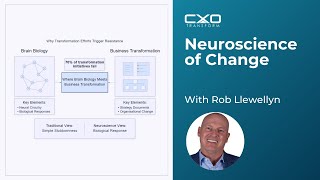
This is a YouTube video titled "The Neuroscience of Organisational Change: Why Transformation Efforts Trigger Resistance" created in May 2025. It features Rob Llewellyn delivering a detailed monologue explaining the neurological reasons behind resistance to organizational change and providing strategies to align transformation efforts with brain biology to improve adoption and reduce resistance. The content is a single-speaker presentation focused on neuroscience and change management.
Have you ever wondered why 70% of transformation initiatives fail despite rock solid business cases? I'm Rob Llewellyn, and today I'm going to reveal what's happening in your team's brains when you announce a major change. The resistance you face isn't just stubbornness. It's neuroscience in action. So let's dive into the fascinating world where brain biology meets business transformation. So imagine this. You've crafted the perfect transformation strategy, but your team seems oddly resistant, despite the clear benefits. This disconnect happens because our brains have evolved with one primary mission to keep us safe, not to embrace change. So when you announce a transformation initiative, your team's own amygdala, the brain's alarm system, lights up, flooding their systems with stress hormones that actually impair rational thinking. To overcome this biological response, you need to frame your transformation in terms of safety and opportunity rather than disruption. Create a narrative that positions change as an extension of what's already working, not a replacement for it. A lot of transformation leaders are baffled when seemingly positive changes meet fierce resistance. And this happens because transformation threatens five core neurological status, certainty, autonomy, relatedness, and fairness. The SCARF model. When these needs are threatened simultaneously, you've created the perfect storm for transformation failure. So you need to address each element specifically in your change strategy. Clarify how people's status will be maintained or enhanced. Provide certainty wherever possible, and offer choices to preserve autonomy. You need to try and maintain team connections and ensure transparent fairness in how change impacts different groups. And map your transformation plan against these five needs to identify and mitigate potential resistance hotspots. Your meticulously designed transformation still faces resistance. Despite addressing obvious concerns. The culprits are often hidden cognitive biases, status quo bias, loss aversion, confirmation bias, sunk cost, fallacy, and effective forecasting errors that silently sabotage even perfectly planned changes. Now these biases affect everyone, including your executive team, creating blind spots in your transformation strategy. So you can counter these biases by explicitly acknowledging potential losses alongside gains, creating low risk experiments that challenge the status quo, and using diverse teams to identify confirmation bias. Make a point of documenting and celebrating the early wins to create evidence that counters any negative forecasting and helps teams let go of sunk costs. So your team completed the training, but they're still reverting to old processes, leaving you frustrated and confused. This happens because habits are physically encoded in neural pathways through the basal ganglia, making familiar routines the path of least resistance for the brain. During periods of change, when cognitive resources are already stretched thin, the brain automatically defaults to established patterns. So you need to design your transformation to include sufficient practice time for new behaviors to become encoded. Create environmental cues that trigger responses and remove triggers for old habits, while recognizing that habit formation requires approximately 60 days of consistent practice. So you've noticed declining quality and creativity during your transformation despite having very talented teams. This performance dip happens because transformation induced stress really does hijack the prefrontal cortex, the brain region responsible for planning, creativity, correct, and rational thinking. The biological reality is that your team isn't functioning at full capacity precisely when you need their best thinking. So you need to build deliberate cognitive recovery periods into your transformation timeline to allow for this neural reset. Use stress reduction techniques before key decision making sessions, and consider adjusting your expectations for innovation during high stress phases of transformation. Your transformation was progressing well, perhaps until resistance suddenly spread throughout the organization. And this happens because mirror neurons in our brains help us match others emotional states, especially from influential peers. One vocal resistor can trigger a domino effect that creates resistance networks more powerful than your change coalition. So identify and engage informal influencers early in your transformation process. Create visible communities of change advocates and address resistance hotspots as quick as you can before they spread through your organization's social network. Traditional change management approaches often trigger the very resistance they aim to overcome, and this happens because many change methods unintentionally activate threat responses in the brain, creating biological barriers to adoption. When people's brains perceive threat, they physically can't engage with your transformation vision. Design change that works with the brain by creating psychological safety, breaking changes into manageable chunks, and using strategic rewards to trigger dopamine. You need to craft stories that connect change to existing values and pace your transformation to respect neurological adaptation timeframes. Some leaders believe that veteran employees can't adapt to new ways of working, and this can create, of course, transformation blind spots. This misconception ignores the brain's remarkable neuroplasticity, its lifelong ability to rewire itself and create new neural pathways. With the right conditions, even the most experienced employees can embrace transformational change. You need to leverage neuroplasticity by creating repeated, multisensory exposure to new processes and mindsets. You need to design learning experiences that accommodate different adaptation speeds and celebrate adaptation milestones to reinforce neural rewiring. A lot of transformation efforts fail because they track implementation milestones, but they miss the vital signs of true adaptation. When you focus solely on project metrics, you miss the neurological indicators that reveal whether change is taking root or facing subterranean resistance. Without measuring adaptation, your transformation may appear successful on paper, while it's failing in reality. So look for decreased stress responses, team level synchronization in new behaviors and cultural indicators that new patterns are becoming the norm. Create feedback mechanisms that specifically track adaptation alongside implementation and be prepared to provide targeted support when resistance persists while your competitors are still battling change resistance with outdated approaches you have an opportunity to gain significant advantage. Most organizations are trying to overcome biology rather than working with it and this leads to transformation, fatigue, burnout and ultimately failure. This knowledge gap creates a strategic opportunity for leaders who apply neuroscience to transformation so aim to integrate brain aware approaches to reduce resistance, accelerate adoption and create sustainable change. Position your organization at the forefront of effective transformation by respecting and and leveraging the brain's natural responses to change. If you're ready to transform your organization using these neuroscience insights, check out the links below for resources that will help you lead change in alignment with how the brain actually works. Thanks for watching and I'll see you in another video.