A structured guide to adopting AI in large organizations, covering strategy development, readiness assessment, implementation, data strategy, and scaling. The presentation walks through key deliverables and frameworks needed for successful enterprise AI integration.
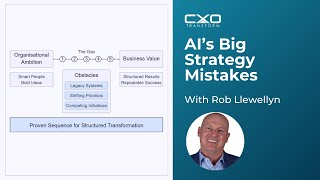
When we talk about enterprise AI, the challenge isn't a lack of ambition. In fact, most large organizations are full of really smart people and bold ideas. The real difficulty is turning those ambitions into structured, repeatable and measurable business value, especially in complex environments with legacy systems, shifting priorities, and no shortage of competing initiatives. So how do leading organizations overcome this gap? Well, there's a proven sequence, one that I've seen work across different industries and continents, and I'll walk you through it now, step by step, highlighting not only the logic, but the practical outputs, the critical deliverables that keep everyone aligned and on track. So let's begin at the foundation. We start with AI strategy development. Now, the first stumbling block for many is diving into AI without a real strategy, one that actually aligns with business objectives. That's why the first deliverable you need is an AI strategy roadmap. Now, this isn't just a presentation for the board. It's a living document that maps every AI initiative to your wider transformation goals, sets priorities, and clarifies governance. With that, you avoid the trap of random experimentation, and you ensure that every AI investment ladders up to something that really matters. And once you have a strategy mapped out, the natural question, of course, is, well, can we actually execute on this? Are we really prepared? And that brings us straight into AI readiness and maturity assessments. You'd be surprised how often organizations leap ahead without pausing to even assess their actual readiness. Here, your key deliverable is the AI Readiness Checklist. It's a diagnostic tool, a way to step back and evaluate whether your leadership, culture, infrastructure and workforce are genuinely prepared for what's ahead. It surfaces strengths and more importantly, uncovers the gaps that might derail your ambitions. With this clarity, you can build a targeted action plan rather than hoping for the best and risking costly setbacks. But knowing where you stand still isn't enough. You need to understand who's going to deliver all of this. So the next logical piece is roles and responsibilities in AI initiatives. Now, in large enterprises, ambiguity around who owns what can quietly sabotage even the best strategies. That's why this deliverable is so important, the AI roles and responsibilities matrix. It's so valuable. This document clarifies precisely who is accountable, who governs and who executes, and how collaboration happens across business and technology teams. It eliminates duplication, reduces friction, and ensure every initiative has the right leadership and and expertise behind it. Once you have the right people aligned, the conversation naturally turns to how you'll actually make things happen. That's where building the framework for AI implementation comes in this is not about operational discipline. Here your central deliverable is the AI Implementation Plan. It's a comprehensive document that takes you from high level vision to the nuts and bolts. Objectives, milestones, governance, resources and risk controls. By structuring implementation in this way, you move from sporadic pilots to a scalable engine for delivery. Where lessons are learned, results are measured and improvement is ongoing. And underpinning all of this, of course, is data. So let's talk about data strategy and infrastructure. If your data house isn't in order, your AI won't scale or even work as intended. That's why the AI Data Strategy and Infrastructure framework is the next must have deliverable. It lays out how you'll source, govern, secure and integrate your data for trustworthy, compliant and and scalable AI. This framework doesn't just support your current projects, it provides the backbone for every future initiative, ensuring your data assets truly become strategic advantages. Now, with your strategy, people and data all aligned, it's time to get into execution mode. And that leads us into execution. AI Project Planning and Management. The most elegant strategies will still fail if projects are poorly planned or managed. So here the AI Project Planning and Management framework is indispensable. It offers a structured methodology covering everything from setting up project objectives and timelines to managing dependencies and tracking performance. This isn't just about control, it's about transparency, risk mitigation and ensuring every project stays aligned with the bigger picture. And then with planning in place, it's time to actually build and deploy real solutions. So building and deploying AI solutions becomes the next critical phase. The deliverable. Here is the AI Solution Development and Deployment framework. And this guides your teams through designing, testing, deploying and maintaining your models. It addresses both technical and business realities, ensuring solutions are robust, scalable and truly aligned with operational needs. This approach reduces deployment risk and ensures your AI delivers sustainable business value, not just technical outputs. But building one or two solutions isn't the end goal of course, is it? We need to embed AI scale across the enterprise. And that's where operationalizing and scaling AI takes center stage. Here your go to deliverable is is the operationalizing and scaling AI Strategy framework. This is what moves you beyond pilots and into enterprise wide adoption. It details how to embed AI into core processes, integrate with IT and business systems and set up the infrastructure for monitoring, retraining and continuous improvement. With this in place, AI stops being a side project and becomes a true engine of value across different functions. Of course, the more you scale, the greater your exposure to new risks and challenges which means AI risk management and challenges can't be ignored here. The AI Risk Management and Compliance Framework is essential and this document systematically addresses the unique risks of AI bias, security compliance and operational reliability. By building these safeguards in from the start, you ensure your AI operates safely, ethically, and in line with both legal and stakeholder expectations. And finally, the most successful organizations know they have to keep learning and and evolving. That's why case studies and best practices round out the journey. Your deliverable at this point is the AI Case Studies and Best Practices Framework and it serves as a repository and methodology for capturing lessons learned by studying real world successes and failures. You institutionalize learning and you refine your approach and you create a culture where AI execution gets sharper with every project. Now bringing all of this together, what truly distinguishes leading organizations is not just ambition, but disciplined execution, using structured deliverables at every step to drive clarity, accountability and real business outcomes. If you're interested in learning about a complete step by step system you can use to generate all these deliverables we've covered and learn how to validate them with stakeholders, secure executive sign off and most importantly, implement them to achieve tangible results. Feel free to check out the link below this video or visit CxO FMAI for more information. The journey to enterprise AI leadership is demanding, but with the right frameworks and a culture of continual improvement, it's absolutely achievable. Thanks for watching and I'll see you in another video.