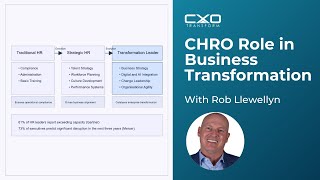
This is a YouTube video titled "The Role of Chief HR Officers in Business Transformation" created in March 2025. The content is a detailed monologue or presentation discussing how chief HR officers are evolving from traditional talent managers to strategic leaders driving business transformation. It covers topics such as AI integration, workforce agility, leadership development, change management, and cross-functional collaboration within organizations. The video emphasizes the strategic importance of HR in aligning workforce strategy with business goals and leveraging data-driven decision making to build future-ready organizations.
HR leaders are no longer just managing talent. They're central to driving business transformation. The shift from traditional HR functions to strategic workforce leadership has accelerated with 61% of HR leaders reporting their responsibilities now exceed their capacity, according to gartner. Similarly, Mercer's 2024 Global Talent Trends study highlights that 73% of executives predict significant disruption in the next three years, demanding a much more proactive HR function. Now, to remain effective, chief HR officers must embed workforce transformation into business strategy, leveraging AI, data analytics and leadership development to build adaptable future ready teams. The HR function is no longer a cost center. It's a catalyst for organizational resilience and competitive advantage. For HR to lead transformation, its strategy must be fully aligned with business objectives. However, only 1% of CEOs see the chief HR officer as their primary partner in AI driven business transformation. And this really highlights a significant gap that HR leaders need to close to elevate HR's strategic role. Chief HR officers need to forge much stronger alliances with the C suite to ensure HR initiatives really drive business outcomes, develop data driven workforce planning to anticipate talent needs and reduce disruption and implement agile HR structures that allow for continuous adaptation rather than rigid outdated processes. Now, Mercer reports that 52% of Chief HR officers cite leadership development as their top priority, reinforcing the need for HR to play a pivotal role in shaping future business leaders. Gartner estimates that 23% of global jobs will undergo significant changes within the next five years due to AI and transformation. This means HR must take a more proactive approach to upskilling and workforce transformation. So some of the key actions for chief HR officers include identifying critical skills gaps and creating tailored reskilling programs investing in AI driven learning platforms to personalise employee development and promote a culture of continuous learning, ensuring employees stay ahead of technological advancements. Now, according to Mercer, 60% of companies are accelerating automation efforts, making it crucial for HR to ensure that employees are are empowered with the right skills to work alongside AI rather than be displaced by it. Resistance to change is one of the most significant barriers to transformation. 80% of HR leaders have stated that change management is much harder now than before the pandemic. According to Gartner. Now, to foster adaptability, HR needs to equip leaders at all levels with change management training, develop transformation ready cultures where agility and innovation are rewarded and use real time employee sentiment analysis to address concerns before resistance escalates. Mercer's research shows that two in five employees believe the traditional work model is broken and this really underscores the need for HR to lead change management efforts with empathy and and strategic foresight. AI and automation are really defining HR's role. However, 50% of HR leaders report that managing AI driven workforce changes is a lot more complex than previous transformation efforts. So to ensure AI augments the workforce effectively, chief HR officers need to use AI driven HR analytics to enhance talent acquisition and workforce planning. They need to automate repetitive HR processes, freeing HR professionals to focus on more strategic initiatives and balance automation with human oversight. Ensuring AI deployment aligns with ethical considerations. Mercer's findings indicate that over 60% of Chief HR officers believe that they need deeper technical expertise to successfully navigate the integration of AI into HR functions. The future of work is employee centric with flexibility, well being and engagement at the core. Yet Gartner reports that only 31% of HR leaders feel they have an effective employee experience strategy. HR can really enhance employee experience by personalizing career development paths using AI driven learning recommendations. Create flexible work models that align with hybrid and remote work expectations and focusing on employee well being ensuring that mental health and work life balance are prioritized. Mercer's research finds that employees in companies with strong well being initiatives are 35% more likely to stay long term, reinforcing the link between employee experience and retention. HR can no longer operate in isolation. It really needs to collaborate across departments to drive holistic business transformation. Did you know only 20% of HR leaders say they effectively partner with other business functions? That's according to Gartner. So to enhance HR's role as a business partner, chief HR officers should really integrate HR insights with finance, IT and operations, ensuring HR data informs broader decision making. They need to facilitate leadership alignment between business unit heads to ensure workforce strategy aligns with transformation goals and also champion cross functional problem solving initiatives, breaking down silos and promoting innovation. Mercer highlights that companies where HR and business units are aligned are twice as likely to meet their transformation objectives. And this really showcases the the strategic importance of HR business integration. HR needs to move beyond qualitative assessments and provide tangible metrics that demonstrate its impact on business transformation. But only 27% of CEOs currently rank workforce transformation as a top business priority, meaning HR must really strengthen its ability to showcase return on investment. Key transformation metrics can include workforce agility index, measuring adaptability and learning engagement, talent retention rates, particularly for transformation, critical roles and efficiency gains from AI driven HR processes. Mercer's findings suggest that 84% of Chief HR officers expect HR to become more tech driven and data focused. And this really reinforces the need for HR leaders to leverage analytics and decision making. HR is no longer a support function, it's a strategic enabler of business transformation. From aligning HR strategy with business objectives to integrating AI and leading cultural change, chief HR officers play a pivotal role in ensuring organizations remain agile, resistant and competitive. By embracing workforce transformation, embedding AI strategically, and fostering cross functional collaboration, HR leaders can position themselves not just as talent managers, but as architects of future ready organizations. The path forward requires bold leadership and data driven decision making and a relentless focus on building adaptive workforces. The question is no longer whether HR should be involved in business transformation, but rather how effectively HR can lead it. If you're serious about leading business transformation, check out the resources linked below. Thank you for watching and I'll see you in another video.