In this YouTube monologue, the speaker argues that traders with small accounts—especially those with only $1,000—should limit risk to about 1% per trade. He critiques the high‑risk “challenge” style where traders risk large portions of tiny accounts to achieve rapid gains, noting that such behavior sets a poor example and can quickly wipe out a trader’s capital. The speaker frames trading as "calculated gambling" rather than a conventional job, emphasizing that success depends on risk‑to‑reward assessment, market understanding, and disciplined risk management rather than the number of hours spent trading. He warns that losing a large portion of a small account can force a trader into a desperate mindset to recoup losses, which further undermines long‑term profitability. The core lesson he delivers is that proper risk management—specifically risking only 1% of the account per trade and learning to read charts—is essential for sustainable trading.
Chapters
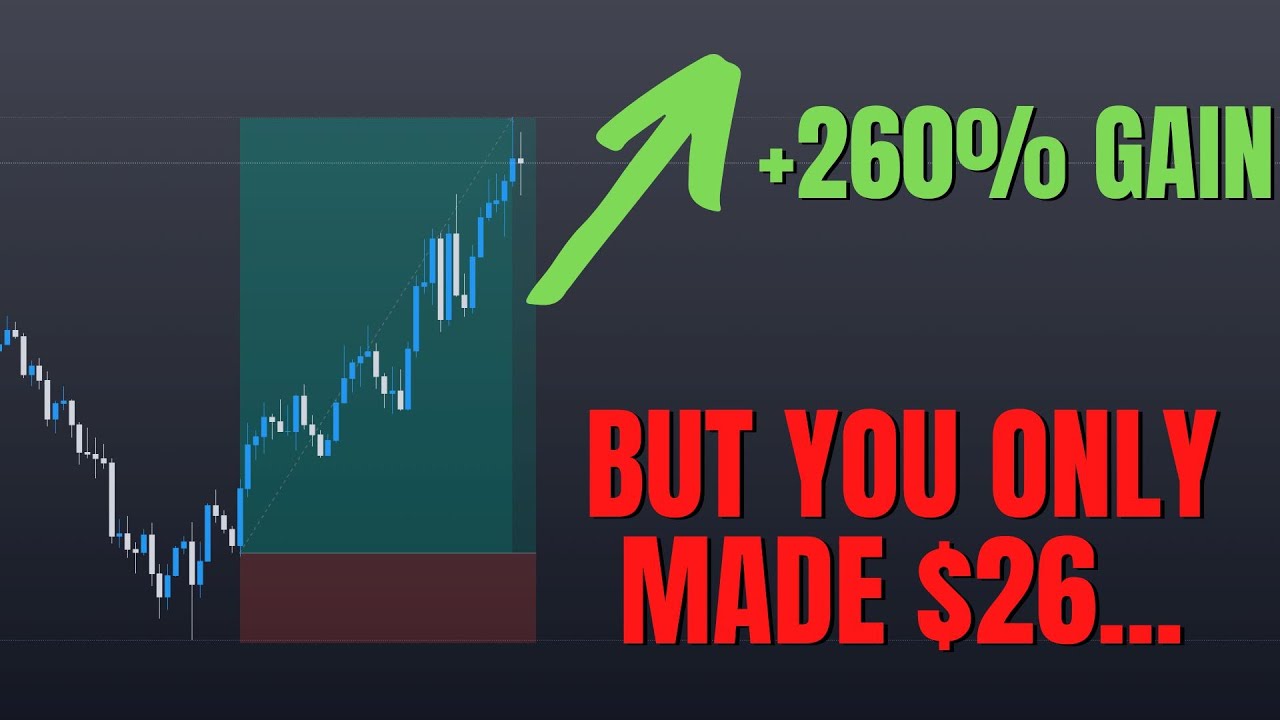
Does it make sense to risk 1% on a $1,000 account? Why not? Why wouldn't it make sense to risk 1% of that on a $1,000 account? If $1,000 is all you have, it would be a stupid— it would be an absolutely stupid idea to risk like 10% or like whatever on a trade because $1,000 is all you have. When you— whenever you see traders, like established traders trade, and let's say they start like a $100 to a $1,000 You know, challenge, and they do it in like 3 days. It's not that they are god-tier traders. Yeah, they might be. They're good at trading, that's for sure, because otherwise you're not going to make money, period. But they are also at the same time taking on immense amounts of risk. Like on a $100 account, if they were to lose one trade, they might lose like $10 or like $50 or, or more. And why do these traders do that? It doesn't set a good example. Like, sure, you make money really quickly. That's something to brag about, but it doesn't just set a good example for the rest of you. Because if you only have $1,000, you're not like, it's not going to be in your best interest to risk so much because one, you probably don't know what you're doing yet. Yet. And secondly, what if you do lose all that money because you risk so much trying to make quick money? Then you're out, you're out of the game. You can't go back into the game because that was all the money you had left. If the only way you're gonna get back into the game is if you make some money from your job so that you can jump back into the markets again, which at that point you're gonna have that kind of a mindset where, oh, I lost $1,000 last time. So now that I'm coming back in with a fresh $1,000, I have to make that money back quick because, you know, I lost money. And which brings me on to another point, which is most people do not understand that trading is professional gambling, right? It's like calculated gambling. It's gambling. It's still gambling in its purest form. And if like most people look at trading as a job, right? What do I mean by that? Most people, like we are all accustomed to, if I work 40 hours a week, I'm going to make more money. Sorry, if I work 40 hours a week, I'm going to make less money than if I work 60 hours a week because 20 more hours of work equals more money, you know, paid to me, right? And so they bring that mentality into trading and they think, if I trade more, if I trade with like— if I trade 50 hours a week, I should make more than the guy who's trading only 1 hour a week. But you'd be surprised to find that the guy trading 1 hour a week can make the same amount of money as the guy trading 50 hours a week because this is not a job, it's gambling. It's calculated gambling. It depends on who understands the markets more, who can take the more calculated trade. It's all about risk to reward in these markets. So on a $1,000 account, you should still risk 1% because this is gambling. And the only thing that separates trading from gambling is the fact that it is calculated. It is the fact that you are managing a risk. When it comes to a gambler, you're very likely not managing a risk. If you lose like 5 gambles in a row, you're probably out. But you don't want that in trading because, well, it's different. At least with gambling, it's fun. You know, you're just leaving it all up to chance. With trading, it's like you could leave it all up to chance, but arguably it's much— it's a smart, much smarter decision to actually learn how to read these charts to make proper solid trades than leaving it all up to chance. Lesson number 1, risk management. Yes, or as AOC would say, proper risk management is key. Yes, proper. You need proper risk management, boy.