Flexport CEO Ryan Petersen on Scaling a Startup from Zero to $8B

Ryan Petersen built Flexport from zero to $8 billion by turning logistics into software. The company now moves $19 billion of goods across 112 countries and recently launched Flexport Capital, a trade-finance product that works like buy-now-pay-later for global commerce.
Chapters
Prices are going insane. Everything from food to fuel is more expensive now, and we're feeling it. Why? The supply chain is in bad shape. Over the last few months, container ships have been stuck at US ports for an average of 7 days, 21% higher than at the start of the pandemic. It can take up to 20 different companies to move just one shipment because the system mostly still only uses paper and pencil until now, until Flexport. Founded in 2013, Flexport turns that paper and pencil system into a modern marketplace driven by great software. We were lucky to invest at the beginning. This is a huge business. They help nearly 10,000 companies from tiny startups all the way up to Fortune 500s to move nearly $19 billion of goods across 112 countries. Today, we're in San Francisco talking with Ryan Petersen, CEO and founder of Flexport. Ryan, thanks for joining us today. You come from a family of entrepreneurs and software engineers. Tell me about that.
My mom's an entrepreneur. My dad is an entrepreneur too. My mom is probably the world's leading expert on food safety. So she has this company, she's a biochemist. And if you are a food company and you need to get something approved by FDA, USDA, California, EPA, all these different, there's so many different regulatory bodies. My mom is the world's leading expert on how to do that. I see. She probably employed like 100 PhDs When I was in high school, she was running this business. She would work about 18 hours a day.
Oh my God.
And yet still find time to be an amazing mom. So she was really my role model growing up. Also, I didn't know, I didn't realize any of this was happening. I'm not, we've never really talked about it, but I kind of think she trained me to be an entrepreneur from a young age. So—
That makes sense.
I used to, my brother and I both, we used to earn our allowance by doing work for her business and then her business would pay us. I think it was like also a tax advantage so she could, make our allowance tax deductible.
That's awesome.
So we would go and pick up sodas and stock the snack cabinet at her fridge and we'd sell them. We'd buy it at the grocery store and then sell it to her company. And then my dad was a computer programmer, so he taught us to write code to invoice her. In fact, he wrote his first software in 1970 for the Department of Defense that was analyzing Soviet defense spending and trying to smooth it out.
Oh, wow. A lot of people are watching this channel wanting to start a company. Through YC, we know so many founders who like have both made it and not made it. Do you feel like that was a formative moment where you learned a bunch of things that now you actually sort of led to learning that Flexport was a need?
I mean, YC is an amazing opportunity to like go fast, meet, build a network, turn like venture capital from like an outbound sale, begging people to give you money, to more of an inbound sale where they kind of come to Demo Day and come to you. There's a lot of benefits to that, but the downside of it is it's sort of like a really time-bound pressure cooking situation. You got 90 days and then if you don't raise money, you're kind of like, I don't know, you might die or you fail. And even if you do raise money, there's an expectation that's put on you that you're going to go hire a bunch of people and have 18 months of runway. And then if you don't— achieve it in 18 months, you're dead. I never really liked that approach that much for me. I always like, I kind of like Paul Graham's original teaching, which is like, be a cockroach, stay alive, nobody can kill you. Like on some timeframe you'll succeed.
Totally.
But the timeframe is super uncertain. So how do you set your life up in a way that you can't fail?
I mean, you had to grow as much as possible before you ever started your company and—
Yeah, and like I started businesses and ran companies for 11 years and my brother for even longer than that, 11 years before I ever raised any venture capital and started some successful businesses that generate millions of free cash flow every year. It's like, how do you design your life in a way where you're— it's kind of like be ramen profitable but in life instead of in your company. So for example, the company that I started that is called importgenius.com, this is what I did right before Flexport and right before I joined Y Combinator. I was running this business that is one of the biggest, if not the biggest provider of data to the import-export industry and global logistics industry. We sell data on shipping manifests. And when we were starting that business, I didn't know if it was going to be successful. I had never really heard of venture capital or been involved in that world. It was very much like, well, we figured out how to get this data. We wrote software to create an interface where we could sell the data. I didn't know if it was gonna work, if anyone would buy it. So I found ways to make money. I wrote business school case studies for Columbia Business School.
Really?
In fact, yeah, I wrote the first ever business school case study about an African business. I went to Nigeria and like, I was getting, you know, I was making like $40 an hour or something, but like I had income.
What year was that?
Oh, it was in 2008.
Oh wow, yeah.
So that was like a job that I got, but it was part-time, it was flexible, so I could do that while working on my startup. And what was the other one I had? Teaching the GMAT, which is the business school entry class. I had like a very high GMAT score, so that qualified me to teach that class. It's just like find— oh, and I had a third one doing consulting to help people with their website generate more traffic from Google. And so I had 3 different flexible, I could work any time of day on those jobs.
You were ahead of the curve then.
And then that gave me like freedom to on any time horizon I wanted be successful because I couldn't die, my expenses were low, I was paying down my debt. My number one advice for people who wanna be entrepreneurs is to get rid of your student debt. And then yeah, it took me a number of years before we found success, but success was certain because like we didn't have this like time horizon that it had to happen in 18 months or else we were all gonna go bankrupt and everyone's gonna be mad at us. We never had investors. Actually, it had success pretty quickly, so I didn't do those things for very long. I kind of prefer that setup than the pressure of like, you've raised money, now everybody— you have to succeed in 18 months or it's over. Even if you are raising venture capital, I don't like the 18-month time horizon. It's pretty short. I'm like, raise more money, last 3 years, give up more of your company, it's fine.
I mean, that's one of the reasons why we are totally cool with seat extensions. We actually like to do them because that actually gives the founders more time to develop. So it's not an 18-month, it might be 36 months, it might be 40 months. And if you're thinking long-term, actually trying to help people, you will actually help people get to product-market fit on a longer timeframe. It's fine. I mean, VC probably should do it that way because people have a 10-year horizon anyway.
Yeah, exactly. And the amount of money that's getting thrown around is like, great, raise a lot of money if it's there, but don't go spend it. But it's almost impossible. The money wants to get spent. I remember we raised our first big round at that time, was pretty big. We raised a $20 million Series A round and immediately, the next day I was like, all right, we're getting a shipping container and we're gonna convert it into a booth for a trade show and we're gonna make it like a party container with a go up on top and party. And we went to CES and got a booth. It was like $100,000 the next day that I committed. The money just kind of—
The mindset changes, right?
Yeah, and I don't know how to avoid that. And we saw it, that was true at smaller dollar amounts all the way up to when we raised a billion-dollar Series D round and immediately lost discipline, started overspending. Everybody could hire as many people as they wanted, didn't have budgetary control. Our burn went crazy and we then spent another 2 years paying the consequences of needing to tighten belts, having hiring freezes. It's a really bad instinct to just go in, but I don't know how to overcome it. And we just raised a Series E round, $985 million.
Congratulations.
We're profitable now. We were profitable, yeah, thanks. But we were profitable when we raised this round. And how do we avoid that happening again? Having really tight capital allocation, accounting controls, budgetary process. I hope it's good enough, but it's my big fear right now is it happens to us all over again. We've done it before.
It just happens at a different scale, I guess. But the tools sound like they're the same. It's have an operating model, give yourself enough runway. Of the cohort of startups that raised at a billion, for you to be profitable with the growth rate you have is sort of unheard of, isn't it?
I don't know that it helped us, by the way, being profitable. And I think it raised some red flags that people were like, well, why are you raising money if you're profitable? Don't you have anything good to invest in? Why are you profitable? And those are both reasonable questions. So it's kind of funny.
For just startups, period, but even, you know, huge startups like yours, it is still about return on invested capital. But the question is, on what timeframe?
Yeah.
If you want monthly or quarterly, you're doing it wrong. In order to actually take over an entire, you know, sort of section of the— or sector of the economy, that might take years or 10 years, you know?
Yeah.
At that point, can you have leadership like your leadership that is long-term enough that can actually think strategically about it and actually take big bets and sort of survive being wrong about things?
Yeah, it is pretty rare. You need real job security. And frankly, most hired CEOs haven't earned the job security to be able to do whatever they want. It's sort of something that comes with being the founder that people are like, yeah, well, he started the thing so he can do what he wants. It actually gives you then permission to go, do the stuff. So I'm not sure that there's a simple answer like, oh, every CEO should be allowed to go spend as much as they want. They'll probably waste the money. That's why Wall Street has that. It's why Wall Street likes software companies, by the way, because there's not a lot of assets that they could buy.
Yeah.
In our space, the people who own ships, planes, trucks, historically Wall Street hasn't loved these businesses. They tend to be family-owned because it's capital intensive. And what do you When they do make a lot of money, what do they do? They go buy more ships. And Wall Street—
It's an asset business.
Yeah. And it's— the return on those assets are not what Wall Street tends to look for. It's like 5% a year maybe or something, right? So you leverage it up, you get it to 8%. It's not— Wall Street's— you know, you'd rather invest in a tech company where not only is the growth rate there, but there's nothing you could waste the money on in a typical tech company. That's been why they're popular.
I mean, in your case, you're bringing Basically, structured data to an area that just never really had it before. And so you can actually just deliver things that are better, faster, cheaper in that way. How do you think the Street should look at this? Sometimes when you're creating a new category, you actually become the comp. And that might be happening here.
Yeah, well, I mean, fundamentally, at the end of the day, in the long run— and I don't know what long run needs to mean, 5 to 10 years, let's say. Really, I think longer term than that, but okay, let's say 10 years. It's very hard to predict beyond that. We're going to be valued on the amount of cash that we generate, sort of similar metrics to any other business. OpEx, the amount of headcount that you need to generate that cash, which is a sign of scalability. How big can you make the thing? What's the transaction volume that's moving through this thing? And what percentage of those transactions do you end up capturing? for yourself. So I don't think that it has to be fundamentally different. I'm not looking to have a different price-to-earnings ratio in the long run than anybody else. For example, let's say we want to be a $100 billion company. That's our current goal. We had an $8 billion valuation. I think actually the $8 billion valuation is not really real. Within that is some probability that we're worth $80 billion and another probability that we're worth $800 billion. and another probability that we're worth zero. And like, you have to wait these things out and they get to 8. I'm not sure they actually did that math, but that's the mental model. Our job is to dramatically improve the probability that you're worth 80 and then 800 billion. Well, if you want to be, just to make the math easy, if you want to be worth $100 billion and you have a price-to-earnings ratio of 20, you need to make $5 billion a year in profit. And you could be like, oh, but we're a tech company, we should have a price-to-earnings of 40 or something. But guess what? Apple's price to earnings is 30. Facebook's is 20, was 20, it's probably lower right now. You're not like that much better than these companies. Even when you're a great company, at some point you're gonna have a price to earnings of 20.
Yeah, that makes sense.
And a price to earnings of 20 means it's a 5% return per year. It's not like that great. Unless there's growth. You only get 20 if you're growing. So I need to be able to make $5 billion a year in free cash flow and be growing pretty fast. That's pretty daunting where we sit right now. It's a lot to do. We try to frame it back to reality. It's like, okay, what are the big buckets of businesses, investments, and things that we have to achieve to generate $5 billion in free cash flow? Because we're not going to be valued on hype in the long term. You're not going to be able to pull things off like that. And I think we try to ground it in reality and make sure everyone can see like, okay, here are the things that have to get done to be worth $100 billion. And what does each team do And how does your work contribute to that? So every single person in the company can know that.
Yeah, I was going to ask, even going from a billion-dollar valuation to $8 billion and surviving and thriving, not merely surviving and getting to break even, but becoming profitable with the top-line growth that you've had, there must have been a transformation in the org around thinking about different initiatives, right? When you're a tiny startup, you do basically one thing. And then now coming into this next phase, what are some of the things that are top of mind for Flexport? This is the core business, and then this is the thing that we're investing very deeply into the next couple of years.
Yeah. I mean, number one is always customer experience. We want to be the best way to move products anywhere in the world. And what that means is we onboard importers, and then for every importer we get, for every brand that that is importing product from another country, we're getting 18 of their factories to come on board on average within the first 3 years. And in fact, within 6 years, it goes to 36 factories. So you've got this great network effect. Those importers place orders to their factories through our system, and the factory becomes a user, places bookings to coordinate, okay, the cargo's ready, come and pick it up, and we'll dispatch a truck now in 112 different countries, dispatch trucks, who go and bring it to the port. We clear it out of customs, put it on a ship, clear it into customs in the destination country, again, anywhere in the world, and then deliver it to a warehouse. So it's that loop that you're trying to run. And that's the core of what we're doing. So you're trying to— that doesn't change that much. We need to do that better, more efficiently, dramatically improve the efficiency, meaning removing the number of human interactions that take place in that chain. It's not all tech. There's some old school companies out there that are really good at some leg of it, customs in Nairobi or something, and we don't always have it fully integrated. So if a human is there, what is that human doing? How do we get them to be either way more efficient or remove the need for them to do anything? And that's probably like 80% of all the effort at Flexport right now is like, how do I just run that core loop for customers in a way that's easier and cheaper and make our teams more efficient? But there's some real venture bets that come along the way. And where the strategy gets really interesting is what we want to do then is upsell them to other services. What else do you need? Well, I mentioned customs clearance. You need cargo insurance. We've got a financing group that grew 10x last year making inventory loans to the companies so they don't need to think about that.
Flexport Capital.
Flexport Capital is a beautiful business. And I think we'll find more. We do have some tricks up our sleeve that, like, new things that you can offer. But that's that core transaction of global trade. And our vision is really, look, you're a brand, you've created amazing, beautiful products. You have basically 2 jobs. Make something people want is the YC slogan. So it's really hard to make cool, awesome products at scale that stand out, that there's something actually interesting about the thing, with high quality. That's very hard. Number 2 is find customers for this product. Make a brand, connect. It's like supply and demand, the 2 things And our vision is basically companies should be really good at those 2 things. That's all they should spend their time on. And everything in between that sort of infrastructure layer to get the goods picked up and delivered, optimize how many units to order, when to order them, where to position them to be able to hit customer demand. So you want to be able to do 2-hour delivery? Okay, here's what that looks like. Here's how many units you need to order. Here's when to order them, where to ship them. And then finance it, insure it, do the compliance to get them across international borders, et cetera. We want to be able to offer all of that stuff as automatic. You don't have to think about it. My analogy here is kind of like the electrical utility. When you flip a light switch in your house, you're actually controlling a power plant somewhere. It's probably coal-powered in most of America, but somewhere that power plant's actually getting a little bit hotter just for you. It's actually generating more electricity just for you on demand. And like people kind of assume that that must be how the economy works when you buy a product. But actually, no, it's like there's—
Picking up the phone.
Phone calls, emails, Excel file attachments, PDFs getting emailed all over the place. And we want to make it much more like the electrical grid where like you buy something and like this whole trigger, it triggers this whole series of events to take place and make that all seamless. It's like a really hard, ambitious, multi-decade journey that we're on. But we've made a lot of progress so far.
I mean, to me, what you're doing, sort of taking paper and pencil process and turning into structured data, It actually unlocks all of these other markets and marketplaces. I mean, we touched on Flexport Capital very briefly, but in fintech and fintech startups broadly, the buzzword of the day is buy now, pay later. And you know what the best buy now, pay later is? It's actually things like Flexport because you have many years and in the future, decades of data on absolutely every shipper, every buyer, every seller, in the world, you're going to have way more data to do way better lending and actually lower the cost of capital and grease the wheels of international commerce, actually.
And we've proven this already. So Flexport Capital is almost like a buy now, pay later button for global trade.
Totally.
Global trade is 47% of global GDP. So all you need is a couple basis points off that, and it's a massive business. We have a few advantages. So like any lending business, you basically need to have 4 things. One is customer acquisition. Usually a good lending business has one of these 4, and there's some advantage in customer acquisition. What's your model? How do you attract users? Underwriting. So how do you decide who to lend to and who's creditworthy? Collections. What happens when it goes wrong? Do you have an advantage of how do you secure a collection? And then 4th is cost of capital. Can you get cheap money?
Yeah.
Well, Flexport Capital has huge advantages in the first Cost of capital, not really. Our investors want to make 30% per year IRR even at this scale. We dream big together. But the first 3, we already have the customer here. They're already placing orders to their factory. So it can literally— we haven't actually integrated into the core platform yet, but it can easily be pay late. You're placing the order, now pay and pay later are obvious things to do. Underwriting means deciding who to lend to. Well, If you want to clear a product across international borders, you need to be able to show US Customs what you paid for that product. You have to pay duties on that product, so you have to show the invoice. So if we know your wholesale price, we know your retail price just by checking your website and seeing what you're selling, I know your margins. I know your growth rate. How many units are you selling? I know, do you pay your freight forwarder on time? Do you pay your factory on time historically? And I get to meet the people and underwrite, is this a good business? Are these good people? Do you want to lend to them? So we have a real underwriting advantage. And then the third thing is collections. If they were to go bankrupt or fail, what happens? How do you get paid? What happens? Well, under ancient maritime law, which is older than the US Constitution, maritime law is some of the oldest law existing, is the freight provider has first lien. If a company goes bankrupt, we get paid back first. So if I have your cargo, I can just take it. And if you don't pay me back, we'll sell it on Amazon or eBay. And that's actually how I started my career, was selling stuff on eBay. So it's a credible threat. Like, I get the band back together, launch the Flexport eBay site, and sell stuff. We haven't had to because we lend at the wholesale rate. We lend it on your China price or wherever you're buying stuff from. So even if you fail and I have your stuff, you'd rather pay me back and sell the stuff. And so we've had bankruptcies in the portfolio that still pay us back. So Flexport Capital is something I'm extremely proud of. extremely bullish on. When I say, okay, I got to figure out how do I make $5 billion in free cash flow in 10 years or 5 years, hopefully sooner than later, I got Flexport Capital earmarked for one of those 5. I need to be able to— it could be a massive, massive business.
Yeah. To me, that's why it sort of starts with the software where it's just literally having engineers and product people and designers in there being able to make software that is as awesome as you going to lunch and taking a photo of your lunch, right? And you can post that on Instagram. It's like that level of super ease of use, but applied to something that is the world's commerce, actually. It just wasn't available before.
And it's like, I don't think that it's because we're so much smarter. There's actually a ton of really smart people in our industry, and we've hired a lot of them, and they're like super smart. There's a real problem that we're the companies that we compete with, the traditional, what are called freight forwarders, of the top 100 of them in the world, Flexport's the only one that was founded after Netscape in 1994. And that's when the browser came out. They're not built for today.
And your return on investment could be years or decades and not monthly or quarterly.
Well, that is part of their problem now is that Basically, the founders of these companies have retired and it's now hired CEOs.
It's an asset. Just run it out. Don't make it go down.
Don't go out on mandate from Wall Street to go and invest. In fact, most of them are paying 100% of their cash flow back to investors as dividends and buybacks, which is like, okay, clearly a sign you don't have great things to invest in or don't have a mandate to do so. And that's Netscape, by the way. That's to say nothing of cloud computing, right?
This is just being able to put it on the web.
Yeah. And so, that's the problem. And again, I don't think that they're stupid. It's just, like, a hard problem. Tech debt, like, you've got old systems. Like, it's very hard to take a mainframe. A lot of them still run AS/400 IBM—
That's wild.
Mainframe software. It's very hard to take that and, like, create, you can't really do it, to create APIs in a modern technology stack. So, starting from scratch is easier. And I'm actually paranoid about this because we've got tech debt, and how do I make sure that we're not someone else come along and create something that moves way faster. And it's pretty interesting to watch a company kind of slow down. And it's— I shouldn't say interesting, it's horrifying when it's your company and you see that. And one of my lessons that I don't know what to do with yet, but I've certainly learned it, is hatred of bureaucracy is not enough to keep bureaucracy away. You also need good process, good systems, great people, and clear strategies to keep the company moving fast and being agile. I think that's one of our great challenges that I'm obsessed with learning about at Flexport now because I don't want to end up like these other companies where they're kind of stuck in molasses and you can't execute. And I've seen it. We're definitely moving slower than we were 6 years ago when it comes to product development and new things. You keep adding complexity to the mix and slow down. So I'm super focused on what can we do to make people run faster, What do we need to learn? What is the skillset? What's the tech debt that we need to pay down to make it happen?
I mean, it sounds like that is sort of the moment for you in terms of as CEO, as founder, really the leadership end. How do you actually continue to hire and then manage people on all of these different things? How are you thinking about that now?
I think org design really matters. I think architecture matters from a technology standpoint, like getting to a service-oriented architecture where it's systems can talk to each other via API, and not everybody needs to talk to each other. And you can't write code that goes directly to the database, as annoying as that is, and everyone wants to be scrappy and just do that. But at scale, if you do that, then as soon as they change the schema, then everybody's stuff breaks. And you just, it's annoying because you do go slower, but you go slower to go fast.
Yeah.
The Marine Corps says this, like, slow is smooth, and smooth is fast.
Yeah, it makes sense.
There's an element of that that's needed. That's on the architects, the tech side, but similar things need to exist in the org structure of the people side. It's like, how do I get it so someone can be really single-threaded on a problem and not have to coordinate with everybody else and end up in these endless bureaucracy of meetings, right? A meeting is very similar to, like, an architecture where everybody can talk directly to the database. It's like, Yeah, meetings are okay when you're small. You just make a decision. But when you're big and you need everybody's approval and you've got big leaders with big titles and they want to get their way, it can be very bureaucratic.
It's fiefdoms. Yeah.
So there's a lot to be done with what are the most important metrics in the company? How do we know? Let's back out from that $100 billion valuation that we want to have and the $5 billion in free cash flow. We're like, okay, what needs to be true to make that happen? What are the leading indicators? And how do I get someone who can really be single-threaded on a metric and responsible for it and actually control all the things, as many of the things as possible. And so like a good example of this would be net revenue or gross margin. In our business, what are the components of that? I gotta go buy freight from somebody, then I have to mark the freight up and sell it. I got kind of 3 things.
That's marketing.
But if you wanted to put one person in charge of net revenue, Well, they would have to both buy it, do the pricing, and sell it. And that probably is more than one person's skill set. So you want to go, okay, let's create a team that just focuses on buying freight. And that's all they're focused on. How do I get the best relationship with the people who own the ships and the planes? Make them love us, like be their best customer, help them make more money by working with us. 2, on the sales side, someone who just fully focuses on sales, they don't think about what it's priced at. They're given a price by a system of algorithmic pricing. And so if you can take that net revenue figure, that gross profit figure, and decompose it into 3 teams that can just fully focus, you can actually break down bureaucracy and move fast. Whereas if all of the people wanna own all the things, it's more fun to own all the things, by the way.
Yeah, that's right.
But you'll go faster and you build a machine and you're like, Hey, I know you wanna own all the things, it is more fun, but I need you to just focus on this thing and execute.
Yeah.
And that's like kind of a muscle that has to be built as you build a big company. Small companies are like, yeah, I get to own all the things. That's what's kind of fun about working in a small company. But I think it's also fun to work in a big company and show like, dude, we're making this machine.
Yeah.
And it's excellent, like the way it's operating. So that's kind of a transition that we're going through now and learning about and I'm obsessed with. You can't figure all these things out from scratch and you shouldn't. It's like people have traveled these roads before. Find people who have worked at Amazon, who've worked at Uber, who've worked at great companies that have had to solve these things.
I mean, it sounds like it's, to borrow a crypto term, it's like decentralized autonomy.
Yeah.
If you do it the right way, you don't have to be involved in absolutely every single decision. So it's decentralized in that way, but it's also that people can sort of run in their lanes and there's rules of engagement between them, really?
You wanna get to a world where ideally we're a team of teams and everybody's their own little startup within the enterprise. And if you can set the architecture up the right way, tech architecture and organizational architecture up, that they can still own something and move fast. Maybe they don't own everything, but the thing they own, they really own, and they don't have to talk to a million people and get permission. They can execute. That's the dream. And I think it's really interesting. You think of the law of large numbers where, oh, the bigger you are, the harder it is to grow. But there is a wrinkle in the law of large numbers, which is if all you are is a team of teams in groups of small teams and you're in, well, each of those is a small team, why couldn't it grow super fast?
Yeah, totally.
Then actually, if everybody's just, if you're organized that way, then you should be able to grow really fast and break the law of large numbers and continue to grow really fast.
I sort of wonder if we're at this moment in history because of the power of software that the natural size of firms might actually change? There's this professor named Coase and his ideas like companies grow to a certain size and then the internal costs of communication become too great and then that's how big companies end up being. That sort of butts up against what you're describing or what our friend Parker Conrad at Rippling talks about where it's like, hey, we can have comp compound startups. If we can decentralize and give the right type of autonomy and then have the right rules between those units, it's a team of teams.
Yeah. But if you talk to Parker, he'll tell you how important it is to get the data model right and allow teams to work so that they don't— because you do, at the end of the day, if you're not coordinated and the teams aren't connected at all, it's like, well, why have a company? You might as well spin it out and have 26 separate companies. So you do need to have an architecture that allows them to still communicate to each other. And probably the most important document in the technology industry history is Jeff Bezos's API memo where he said, like, every team must communicate with each other via APIs.
Yeah.
And it seems like overkill for a small startup. And it's funny, you'll go through this resistance period where people just don't wanna do it 'cause a small company, it does slow you down. You have to set it up and not go to the database, but build a service in between. And yet, if you don't do that, you become a bureaucracy where no one can do anything.
Yeah.
And it's not just on the tech side, on the business side too. It's like, give people clear ownership, let them run fast, set clear goals, have a process. And I used to say there's no good word in the English language for bureaucracy. It's like bureaucracy's just a bad word, right? And yet, the good word is probably process. like, yeah, okay, there's gotta be some set of standards. And when I was starting out, like, I'm a pure entrepreneur, never did venture capital. Like I said before, for my first 11 years, I thought process was really corporate and I didn't want anything to do with any of that stuff. That's why I'm an entrepreneur. I don't wanna work for a corporation that has all these policies and processes and stuff.
Yeah.
But as I've gotten to scale, I realized, oh, the The reason that those exist is to enable you to move fast. You'll actually get more bureaucracy from not having any process and policies and standards than you will from having too much. It's like there's a line in between. It's a paradox. The edge between order and chaos, right? And you wanna be right on that line. And that, because your company's always changing as it grows, staying on that line is incredibly challenging.
Yeah.
tip over into too many services and too many policies and processes just as easily as you can of having none of these. And it actually makes it really fun to be, like, obsessed with, like, how do I stay on that? Where is that line at any moment? You're never on the line, right? You're, like, always figuring out that you're on one side or the other.
Well, so, one of the things you mentioned earlier was, like, having a team of teams, but then that's also driven by, like, sort of the same vision. Has Has the Flexport vision changed at all, or has it been very consistent, sort of a straight line from your mother's work in public safety to here? How do you think about the vision, and how do you get people to run in the same direction like that?
One of the things I love about Flexport is that the vision does keep expanding and getting more— we keep learning constantly and getting more inspired and realizing, whoa, actually we could do something even bigger than we thought of. So I'd be lying if I said, oh, I dreamed all of this from day one that you would have this utility-scale infrastructure where everybody can just place orders and it all just flows and kind of what we're trying to do today. In the beginning, honestly, our vision when I applied to Y Combinator was I want to be TurboTax for customs and make it super simple to clear a product through US customs. And I didn't have time to think about all this stuff. In fact, I used to think planning that far in the future was a sign that you're going to fail. Just focus on what can you do for the next 6 to 9 weeks or something like that.
Do one thing really well, I guess.
Yeah. And try to do it. We had a clear product market fit almost from the start 'cause I knew what the problem was. So I knew that there would be demand if I could start to solve it. But the more you learn and the more customers you talk to and the more vendors you talk to, the more you realize how screwed up the world is in this space. Then you're like, oh, actually we can do bigger and bigger. And it keeps expanding. I hope that becomes true for the next— if you talk to me 5 years, you're like, oh, you know what? I figured out this whole other thing that we could do that we haven't dreamed of yet. I think I have more than 5 years worth of vision outlined for our team today, probably 10. And planning beyond that's a little crazy given that we're all going to be connected directly to our brain with AI or something by then. But yeah, it's one of the fun things about Flexport. You just keep expanding the vision.
I think that's really common. I mean, there's a misconception that you sort of wake up from a haze and you're like, this is it and this is the vision. And then generally the story is actually, oh, well, here's this thing that I know that I can solve. And then once you solve it and people really like it, it sort of expands and expands.
Yeah. And probably if a founder is too certain of exactly what the vision is and what the product's going to look like and how it's all going to work, they're probably wrong. The world is super messy. And you've got to get out there and iterate. I think, and this is, I used to have a real challenge with this, is like, I don't know exactly what the vision is when I was first starting out. And you will hear it, like Y Combinator, an eminent guest speaker will come and tell you, hey, you need to have a vision, you need a mission statement, you need to have clear company values, you need all these things. And like, first off, I heard all that and I'm like, that sounds like really corporate. Like, we're just gonna hack, we're We're gonna execute, we're gonna iterate, be agile, change, pivot, whatever you wanna call it. It was only as you start to realize, like, okay, here's the product-market fit. You've talked to enough users. It's very clear what you need to do. They've given you feedback. A lot of if this, then that statements, like, if you had this, then I would buy.
Yeah.
To where you go, okay, we now have, like, 5 to 10 years worth of roadmap. Okay, now you really actually do need these things, especially as you get to scale, and you can't do it via osmosis. Not everybody can talk to me and my core team of leaders to know exactly what the strategy is. You need to write it down. You need to start having values that people can commit to, even if they haven't spent a lot of time with me to understand my personal values. I mean, thankfully we did it before we got that big. I did get enough people teaching me these lessons. But once you have, I would say, like, once you have a layer of managers between you and all the employees and you're not directly, you need to start writing these things down to clarify for people what they're doing 'cause it doesn't happen through force of personality at scale. Like, you need to have clear codified set of standards. Now, the downside risk is if everything in your culture is codified and written down, then it's kind of like you might become a culture of rule followers.
Yeah, totally.
And you don't want that either. So it's It's always a balance in how do you— where do you end up on that line?
Yeah, I think from Series A to Series B, people die on the not being willing to do enough process because it was corporate. And then maybe at the B to the C or the C to the D, that's when you die for the other thing of only rule followers and you can't add new things.
I never knew— I knew what the problem was. I didn't know how to solve it. Customs is just pretty complicated. Like, I didn't know how to do all the different forms and rules and regs and everything. And freight forwarding is still like, there's no one on planet Earth who knows all of freight forwarding.
Yeah.
It's one of the fun parts. Like, you're constantly peeling layers of the onion. Every country's a little different, all these nested relationships and things. So because I had never been a freight forwarder or a customs broker, I'd only experienced the problem on the customer side. then I could not, when I was starting Flexport, tell everyone what to do. I didn't know what they should do. I was like, hey, I know that there's a problem here. I kind of have an outline of what the solution would feel like if it existed, but how to make it work, I didn't know. And so we built, we went very slow. Like, I actually worked on Flexport for 4 years before I ever raised venture capital for it.
Oh, wow.
Before I ever went to Y Combinator. I was the only employee for 4 years. Whereas, like, if I had known all those things and had all the licenses myself, I'd have, like, hired a team, told everyone what to do. We would've gotten much further in the years 1 through 3, much further than years 1 through 4. We didn't get any revenue till year 5 or something. But then it would be dependent on me and my own knowledge and my ability to tell everyone what to do.
Yeah.
Which I never did. Like, we really, from day 1, because I couldn't do that, I didn't know what we should do. I still kind of don't. I'm like, we got— but I do know what the problem is. I know what the vision is. I can get really smart people on the team.
You know how to know, which is possibly more important than just knowing.
And also how to empower people, right? Like, how do we get awesome people on the team who can then say, okay, yeah, go run and solve the problem, please. Like, I'm not gonna tell you how to do it. I'll tell you what the problem is, why it matters, how it fits into the bigger picture vision. And that, I think, has been a key to our scaling is that early days, because I couldn't tell everyone, I'm not licensed as a customs broker. I actually failed the customs brokerage exam. I am by one question. So I don't know how to do all this stuff, but I can tell you why it matters and why it matters that we're compliant, why it matters that we do know how to do these things. So then other people who are more qualified than me can solve each of the problems. And that's, I think, a trap that a lot of entrepreneurs fall into where they can't let go. And I'll tell you an example. I consider myself kind of good at marketing. You could see I get PR and Twitter, This is kind of like, if I had to get a job somewhere, it'd probably be in the marketing department somewhere of some company. Yet I think because of that, we've never really properly built a proper enterprise marketing muscle. I don't want to offend anyone at Flexport on the marketing team, but they probably agree. I meddle too much. I kind of know too much about that and it becomes the least developed part of the company. I think that you see that a lot of companies—
Because you have to let go in order for it to truly be—
You have to let go and empower people and let them run. And I probably, in the area that I think I'm good at, I probably hold Flexport back. And I think a lot of founders do that in their company. And yet, if you're good at something, your company, you need to go do it. So it's not an easy answer to say, hey, stop.
I mean, it sounds like on the product development side, knowing how to know and then having a process and having a culture that makes that happen, that's One of the key innovations for sort of this stage of Flexport going from here to $80 or $800 billion, really.
Yeah. And what is the process for how do you allocate resources in the company? How do you set priorities? You can do anything you want, but you can't do everything. So what are you going to do, not do? How do you do budget assignment? Budget used to be like this terrible word to me. It sounds so corporate, right? Capital allocation sounds cooler.
I mean, I can say as someone who funds a lot of very, very early-stage people, A lot of people are like, how do I learn how to do this? And actually, that's part of the reason why we really like to fund people who work for you in the past because that's where you learn. So I mean, Flexport is hiring.
Flexport's always hiring. I think we've built a great talent engine that people are poaching our people. At least 8 companies have come out of Flexport. Flexport employees have gone and become venture-backed done venture-backed startups, some of which we funded ourselves. It's hard though because the people who know how to do these things have a lot— they're well-paid, equity. A lot of them are not just at Flexport, like take Amazon, like the great people at Amazon make like millions of dollars a year. Even Walmart, a VP at Walmart makes over $1 million a year. I wish more kids knew that. They all want to be professional basketball players, which is like impossible, but like being a VP at Walmart is probably doable for a lot And this wasn't totally true 5 years ago, 6 years.
I feel like it's a much more recent thing that tech companies, because they have so much more gross margin and they always had this insane half a mil to several million dollars in earnings per employee sort of thing going on, they could have always given people this much money. And then the war for talent in the last 5 years has actually made it such that It's great, actually. I think it's great.
I think it's all good. Yeah. But it's very hard for an early-stage startup and one that's going through Series A, Series B to actually attract the talent that knows how to do at scale. And they may not need that talent upfront. And yet, if you had it, someone who could tell you the processes and the systems and avoid the tech debt and the organizational debt by just getting things right in the beginning, you'd be so much better. I think about this a lot. Our CTO now, if I would've hired him 5 years ago, it would be so much better. Well, 5 years ago I couldn't hire him. He came from Amazon where he ran global logistics technology.
Yeah.
He wasn't gonna join an early-stage unproven company. So you have to constantly be upgrading team, adding new talent, and then finding ways. One thing I don't think we're that good at yet, but finding ways that like, look, you might have to bring in outside talent, but how do you make sure that the existing people stay? still feel like, cool, I can still own something. I still have an important role even if you hire a boss for me. It's been sad to watch people who can't get there and like, look, I gotta hire your boss. I love you. Some of them still feel like the human ego is a real thing.
Yeah, leveling is a very hard thing.
Super hard. And it's very sad for everybody because if all the great people who have left Flexport over the years had never left, guess what? Our company would be worth twice as much right now. And then they would've made a lot more money probably than whatever they've gone on to do. I think about that a lot.
Yeah, it's a never-ending effort, but I think you should take a moment and just sort of look back. I mean, when we first met, it was really that much earlier moment, which is like just getting the first— I mean, granted, you'd been around and you'd learned a lot about the market, but it was such an early day. And then here we are. Real percentage of global GDP.
Yeah, well, I think we're 1% of US trade now. Containerized trade. Ocean freight. It doesn't count oil and all these other things, which are pretty big. But 1% of all the containers coming in, which means every single ship that enters the United States, a container ship, will have Flexport cargo on it. When I joined YC, I was the only— I was one person in YC, solo founder. I think I had 3 engineers in the Philippines that I'd been paying for myself. Yeah, that's when I met you, was way back in YC. So yeah, it's definitely been a ride.
Well, thank you for sharing this story. And I think we're just going to continue to see Flexport grow into that $800 billion juggernaut.
That's the goal, man. Thanks for supporting us over the years too. Initialize has been a great investor.
More from Ryan
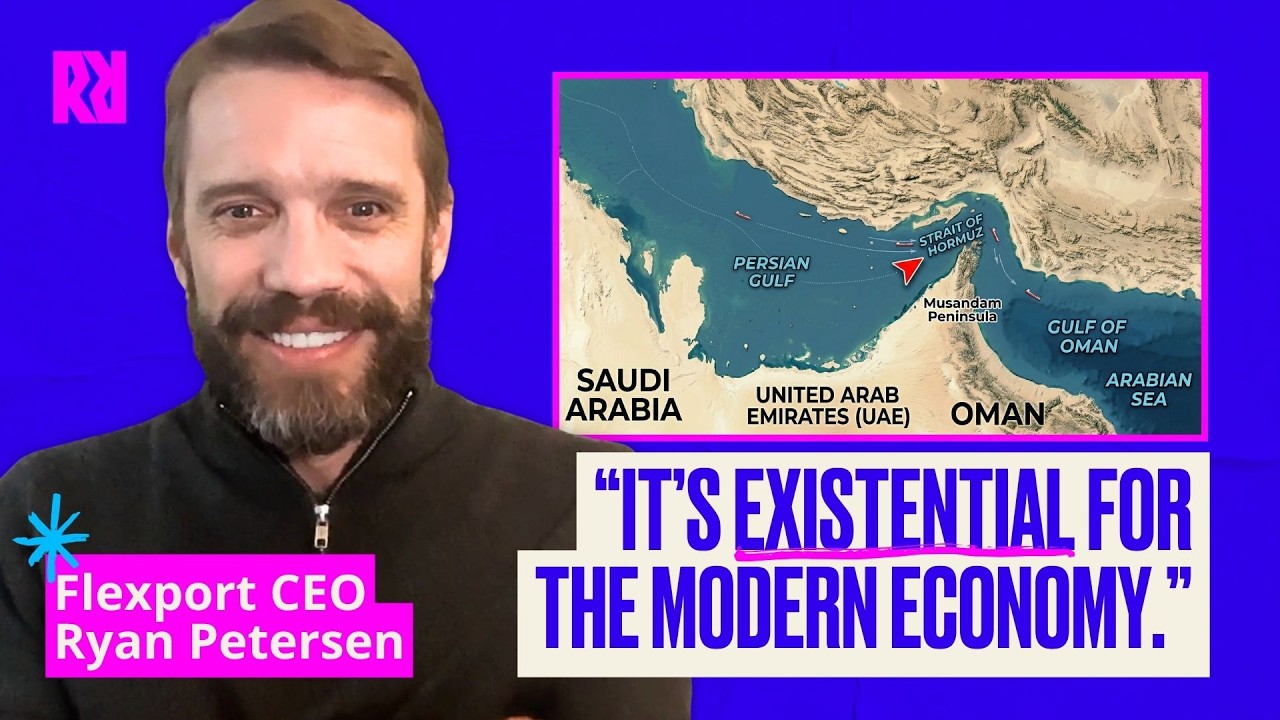
Flexport CEO Ryan Petersen on the crisis at the Strait of Hormuz | Rapid Response

Flexport's Ryan Petersen: Debunking myths about global trade & tariffs | Masters of Scale Summit
How business leaders are reacting to tariffs (with Flexport's Ryan Petersen) | Rapid Response