Flexport CEO Ryan Petersen on the crisis at the Strait of Hormuz | Rapid Response
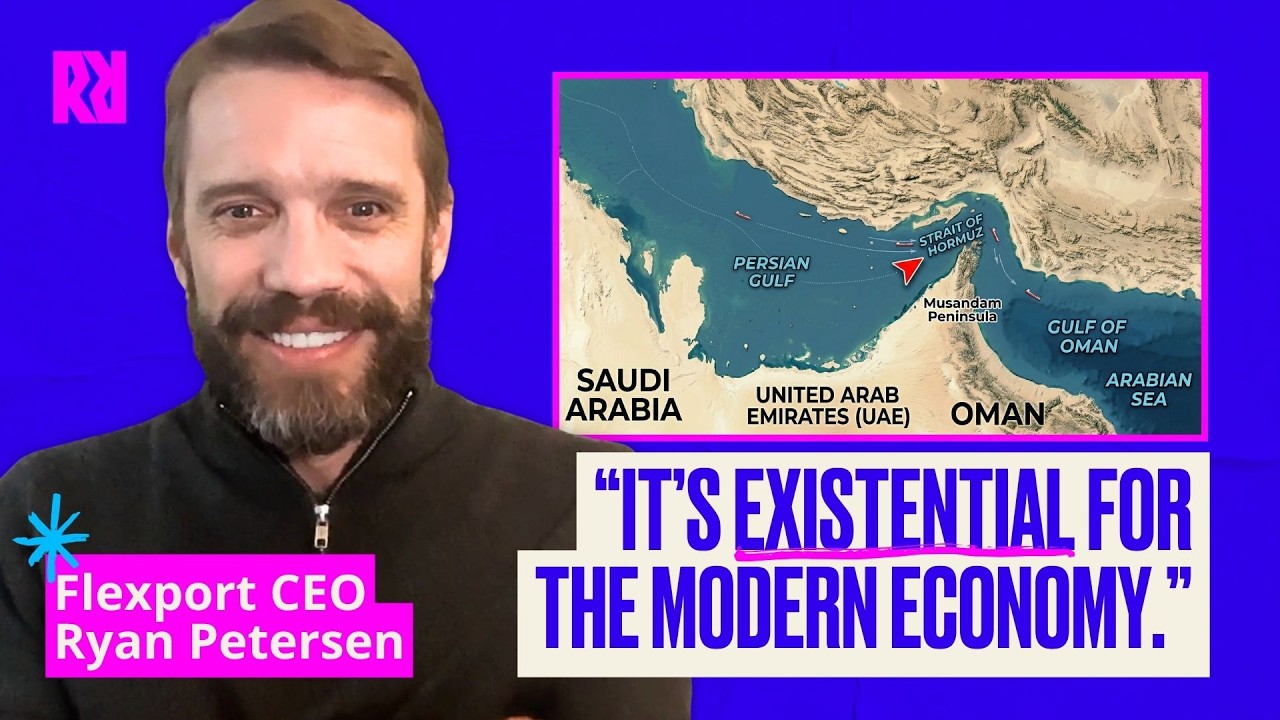
Flexport CEO Ryan Petersen explains how the Strait of Hormuz closure disrupts global trade, from air-freight costs to stranded containers. He details a $166 billion pool of tariff refunds that importers barely claim, and Flexport's new services: an ocean-express route and an AI customs system that cut errors from 1.8% to 0.2%.
Chapters
The US post-World War II kind of established this order that said, hey, everybody can trade with everybody and you can just send a ship wherever you want and the US Navy will provide freedom of navigation. Maybe the US Navy can't provide that guarantee anymore. Oil is not just about pumping your gas in your car. That's what you're used to because that's where you see it in your life. But it's part of so many different products. 30% of the world's helium comes from Qatar. You can't make semiconductors without it. You can't launch SpaceX rockets without helium. How all of the economy functions now is like every company is interconnected with everybody else. And if you stop that, you end up in a much darker place.
That's Ryan Petersen, CEO of global trade platform Flexport and a repeat guest on this show. Ryan's been dubbed tech's hurricane reporter for global trade. And with the Strait of Hormuz essentially blocked and the price of oil soaring, I wanted to get his real-time view of the on-the-ground and on-the-water impacts. We also talk about the prospect of tariff refunds after the Supreme Court's ruling against the Trump administration and more. It's serious stuff, but Ryan's sense of humor keeps it fresh. So let's get to it. I'm Bob Safian, and this is Rapid Response. I'm Bob Safian. I'm here with Ryan Petersen, founder and CEO of Flexport. Ryan, good to see you. Welcome back to the show.
Great to be here.
Do you have to check your— like you get up on Monday morning, you're like, what happened today in the trade? Or is it, do you don't even have to wait? You're getting woken up in the middle of the night with all the changes.
I, I do tend to wake up in the middle of the night and check, but that's, that's just like my, my insomnia. It does not because of work, but it, Does seem to be like every single day, multiple times a day, there's new news. And by the time this airs, everything may change.
The attacks on Iran have, they've effectively closed the Strait of Hormuz, the world's most critical sort of oil choke point. Oil prices up, ships stranded, global shipping kind of in limbo. So I know this is changing as we speak, but from your vantage point, from what you can see at Flexport, like what does the traffic jam look like? So how fast are ripple effects spreading? Like, what's the snapshot of right now?
The big story, of course, here is oil and energy generally, natural gas, which is all of that. I think that's pretty well covered out there in the media that the prices have been spiking and shortages starting to appear. Places like Australia, which is very energy rich but doesn't produce a lot of oil, is running out of diesel and moving towards a world where they're just not going to have enough fuel to operate. There's other things that are less well covered, which are maybe even more impactful around fertilizer. That's actually probably a more important story here. It's planting season, and if those don't come to market, you're going to have big, big, big problems in the food production of the world. Container shipping is not that impacted actually, just because the Persian Gulf is a cul-de-sac. You don't really need to go in there. Air freight's a bigger deal. The Middle Eastern airlines own somewhere between 15% and 20% of all the cargo airline capacity, depending on what source you look at.
Okay.
And Dubai is the biggest cargo airport in the world. Huge amounts of planes that go from Asia to Europe make stopover there to refuel, and kind of it's a hub for transshipment of cargo. So there you've seen the price of air freight double in the last— since the war started, even. And it's even up 50 to 60% on trades that would seemingly have nothing to do with that, like Vietnam to the US across the Pacific. Air freight prices have gone up 50%. I saw the United Airlines CEO said that They're modeling that this is going to cost $11 billion of fuel expense.
So these costs are going up because the fuel prices are going up, or also because it's disrupting routes or forcing people to change their direction? Or is it hard to know right now?
It's both. Fuel price is the big one, but it's going up also because of supply and demand. It's sort of a global market. And if you pull off all that Emirates and Etihad and Qatar Airways are Big airlines. Um, and if you pull that out, they start moving planes around. You just like— it's kind of fungible. Like, a plane that's flying across the Pacific could instead fly somewhere else. And, and so they're— and it's just like, it's a very mercenary market, freight. Like, they get away with what they can get away with, you know? So, um, on the container shipping side, it— the, the actual big impact here is that in February, the The container shipping lines for the first time had started to return to the Red Sea. We haven't had container shipping through the Red Sea and through the Suez Canal since December of 2023 because of the Houthi terrorist attacks in the Red Sea. And they just started to return in February following the ceasefire in Gaza. And then now they've all just immediately returned to going back around Africa. So that's actually the bigger impact for container shipping because Again, the Persian Gulf's a cul-de-sac, whereas the Red Sea is just massively important for container shipping.
I mean, are container ships stranded? Are they stuck?
Yeah, a small percentage. I saw someone who had gone and counted them all, and he said there are 57 ships, container ships inside the Strait of Hormuz. Now, many, many more are on ships that would have called in the Strait of Hormuz and have had their routes disrupted and are dropping containers at random ports that You know, if you had a container that was meant to go to Dubai, they're just leaving it wherever. And now it's your problem as a business to go, you've got a container stuck in some random port that you didn't plan for.
Oh, really? They're just like, I'm letting it off here?
Yeah. Like, let's say you were going from Argentina to Dubai. What they've been doing is saying, all right, just drop it at the next port of call. And so now you have a container stuck in Morocco or Brazil or France or somewhere, and you're only given 7 days of free storage at that port before you start paying big fees. So yeah, there's like definitely some cases where people are living kind of business nightmares right now.
Listen, we've had a lot of disruption in trade over the last few years. Lord knows. Is this like, where does this rate on that sort of how this ripple effect is feeling compared to some of those other things we've been going through?
From a container shipping view, it's like pretty insignificant. COVID, all the congestion we had at the ports, let's say that's That's like an 8. There's no 10, right? We haven't lived a 10 yet. We always have to be ready for something bigger. Let's say that was an 8. The Red Sea disruption is probably like a 6 or a 5, and then this is like a 2 or a 3 for container shipping. Now, for air freight, this is probably a much bigger deal than those things were for the world economy. I mean, this is like one of the worst things you could imagine. Because the price of oil is just upstream of everything else. The bigger impact here again is oil price, oil shortages, frankly. The US will be mostly fine on this. We're going to see high prices, but there's going to be oil shortages in a lot of markets across Asia. I was just looking at the Philippines, 96% of their oil comes from the Strait of Hormuz. And I mean, the poor Philippines, right? First AI decimates their call center jobs, data entries wiped out, and now they, they don't have any oil. It's just like a country that's going to be, um, struggling. And that's one of many allies in the U— of the US in the Pacific that's going to have these problems.
As you talk about this, that sort of America, the United States, is a little bit, um, more insulated from some of this than places in Europe and Asia, like, is there, is there a scenario where sort of American companies, like, gain competitive advantage from this? Like, it's good? Or, or is that, uh, is that a misread of the situation?
Well, certainly our oil companies are. I mean, I mean, Texas is going to boom. The price of oil's gone way up. Texas college football's probably going to have some great NIL team. No, sorry, it's not appropriate. It's a joke. Yeah, certain segments of the US are going to do very well. We're the biggest oil producer in the world, so it's going to be very good for them. But net-net on the economic basis, most of America's— yeah, we might be better off than other countries because we have oil and energy and food. But it's not a zero-sum game, the economy, right? It's like if others do worse, it doesn't mean that we do better. We actually also do worse.
When you're interacting with the shipping customers that you deal with, is there a breakdown yet about who's feeling it most? You know, big global organizations, small businesses?
Right now, the people who are feeling this the worst are air freight shippers and especially air freight from Asia to Europe. Um, and who, who ships air? It's high-value stuff or it's new product launches. Um, so one of our customers makes fashion accessories, I guess you would call it, and they have a very successful product launch right now in Europe and it's running out of stock and they need to air freight the stuff over there and they like can't, you know, the rates are so expensive that the economics don't make sense for their product. Uh, and so we've been getting creative. So we created a, a service where we actually, um, do a fast ocean express service to Los Angeles. across the Pacific and then hotshot transfer it from the port to LAX and fly it to Europe same day. And that's a lot faster than going around the tip of Africa and a lot cheaper than flying it to Europe. So it's like kind of a hybrid. They're fine. They have a hot product launch, like good for them. You know, for the most part in air freight, it's things like the iPhone, you know, like really computers, really high-value stuff that you fly by air.
My iPhone prices are gonna, are gonna be going up.
I did the math on this once. It's a, the, the price of freight on your iPhone's probably like a, a buck or something out of the $1,000, maybe $3. I forget.
We're not gonna notice it compared to all the other things. It's, it's one, it's one gallon of gas for my car.
And yeah, again, you know, I think California is going to see some problems here. They closed down a lot of the refineries for kind of green climate change reasons, but now we import the oil from South Korea and they get their oil from the Middle East. So we're gonna have some problems there. That's why Trump suspended the Jones Act for oil. You know who's going to benefit actually is Hawaii. The Jones Act says you have to— for to transport between 2 US ports, it has to be a US-made ship with a US crew. And there's not a lot of those, so the price is way, way higher. And Hawaii and Alaska are the big sufferers of the Jones Act, and Puerto Rico. And so Trump suspended that, like an emergency suspension. So now all of a sudden Hawaii can get oil from American ports on non-US ships, and it's going to be much, much cheaper.
For folks listening to this, like, what do you feel like is at stake for global trade right now in this moment?
It goes beyond trade. I mean, you're just starting to realize how tied to globalization, how tied our economies are to each other, how interconnected everything is. You know, I had someone last night tell me, ah, we'll just be— we should just close the Strait of Hormuz forever and just get on with it and just like the naivete to not realize how it's not just oil. And oil is not just about pumping your gas in your car. That's what you're used to because that's where you see it in your life. But it's part of so many different products that it's a precursor to so much in the chemicals industry. It goes into all sorts of all the plastics, these glasses that I'm holding. 30% of the world's helium comes from Qatar. It's not just for your clowns, your children's parties. It is used to make semiconductors. You can't You can't make semiconductors without it. You can't launch SpaceX rockets without helium. There's just a huge percentage of the— we just don't understand this stuff. The US post-World War II kind of established this order that said, hey, everybody can trade with everybody and you can just send a ship wherever you want and the US Navy will provide freedom of navigation. And that worked until really this is— we're now seeing with the Houthis and now the Iranians that if maybe the US Navy can't provide that guarantee anymore, and so much of our civilization depends on it, that it's a really, really important question of is there an off-ramp here that if the Trump administration backs off, does that mean Iran backs off? If they don't, then what? It is existential, I think, for the modern— And we say, oh, for the economy, people look at the stock market or the price of fuel or something. It's just like, this is much more than the the price of some commodity or equities or bonds or something. It's like how all of the economy functions now is like every company is interconnected with, with everybody else. And if you stop that, you end up in a much darker place. So let's all pray. Civilization depends on peace and we often just take it for granted. So pray for those who are trying to bring back this peaceful world.
You and I could have been having this conversation today even if there were no activity going on in the Middle East because we've had other things going on in the world of trade and tariffs, the Supreme Court reversing Trump's initial tariffs, new tariffs under a different statute. Can importers count on getting a refund in this situation? I mean, I know you've built tools to help businesses sort of calculate their claims.
Our take is yes. I think that, um, my strong view bordering on certainty is that the The government will pay these tariff refunds. It's a question of timing and what the process is and how, how much, how arduous the paperwork is. And like, do they reject a lot of the claims and force you to go back and refile and stuff like that? But our take is that it's pretty clear that the refunds are owed and the court has compelled them to do so. And there is a sec— a very active secondary market now where you can sell your refund and just get— take away the risk. So the fact that there's sophisticated buyers on the other side of that paying You know, we're hearing rumors and depends on the size of your claim, but the bigger claims are going for above 70 cents on the dollar. And these are hedge fund buyers who, you know, they're, they have a high expectation of return. So 30, what is it? 30 cents is like a 40% return or something like that. That only works if you're going to get paid within 2 years. After that, that, that's not enough of a return for a hedge fund to want to be interested. So they're betting that you'll get paid, but it's unclear when.
Right.
It's a huge question though. $166 billion. And Customs and Border Protection said 330,000 companies that are owed a refund, only 6% of them have gone and entered their bank account info to get the refund. Most companies are asleep at the wheel on this.
I mean, is it hard to do? You just go on a website and put it in, or do you have to do this like manually?
Like, we have a guide. If you go to tariffs.stopflexport.com, there's a free guide there to show you how to do it.
But, uh, I don't know.
I think a lot of people, we, we forget that big companies, like no one's job is to collect the tariff refund and people are just used to doing their job, not like figuring out what their job should be.
And, and the, the, this, this sort of financing option for like basically securitizing, getting paid today for whatever you might get tomorrow. Is that something that like, that you see bigger companies getting into or is it something that smaller companies do? Like, I need the cash now. Up until now, it's really only been an option for companies with claims above $10 million.
I'm actually working right now at Flexport to try to create the option for people below $10 million to get paid now. We hope to be able to announce that soon. But we haven't seen a lot of activity below that. And frankly, people don't know what to do. I'm getting texts daily from importers with claims of all sizes, including some big claims over $20 million, who are just looking— they don't know. It's very difficult to operate in uncertainty. And there's $20 million at stake for the company that texted me this morning. And my advice is like, well, I don't know what I would do. My take is that there will be refunds soon, but—
But you might take the 70 cents on the dollar from a hedge fund to get your money today and not have to worry about it.
Yeah, it's tough. You'll feel stupid if there's refunds in 90 days and you left 30% of your money on the table.
At the same time that this is happening, the Trump administration has not backed away from tariffs. They have these new levies. Does that restart the legal fight?
They've put in Section 122, it's called, and that's going to get challenged. They've also rolled out their over 80 different investigations, either from Commerce Department or the US Trade Representative, to add tariffs on either country-specific tariffs or sector, product, commodity-specific tariffs. And these are under different statutes because the current tariff, the 10%, Trump said it was 15%. Nobody should remind him that they only did 10. They haven't rolled out the 15 yet.
He keeps talking the 15%, but they haven't done any.
I don't know why CBP hasn't done 15. Don't tell anybody. I hope they're not listening. But that has a limit of 150 days. And so they're trying to get these other tariffs Implemented by that was July 24th is the deadline for when that rolls off, and yes, it may get challenged, and those might get refunded too. We'll see. There's two other types of tariffs, and those require investigations by either the Commerce Department or USTR, U.S. Trade Representative. Investigations that can take months, so they're not as easy as AIPA, the one that got overturned by Supreme Court, allowed the president just kind of wake up in a bad mood and say, you know, F you Canada. So he's a little bit more restrained, but likely you end up in a very similar place. He has a lot of tools in his tool belt.
And these reviews have to take months, or can they like, you know, accelerate them and shorten them?
It is a great question. I feel like with AI, you could probably do the, you know, 2 months of research with one prompt, like, hey, write me a Section 301 investigation, Claude. Don't make any mistakes. Like, it might just work. So—
Is all this turmoil Oddly, like, good for Flexport? I mean, you're here talking about the crisis, you know, you do it on social media and elsewhere. It must help your brand awareness for Flexport. It helps the case for your tools. Or, or is there risk of all that kind of backfiring on you?
I, I, you know, nothing that's bad for trade and bad for our customers should be really good for Flexport in the long run. Um, that said, I think it's a good principle in business that if you're better at operating in conditions of uncertainty and disorder than your competition, then you can benefit from uncertainty. And we've proven that over and over again. We move faster, we make decisions, we just take action. And part of it is being a younger company. Our competitors are really good companies, but they've been around for, in some cases, 125 years. It's just harder for that. Like, it's managers all the way up and down the top. They don't have that same, like, take some risks, make a decision, launch some stuff. We expect to launch a fund to buy people's refunds at a discount and help these small businesses that haven't been served by the hedge fund market. That started with a phone call from a hedge fund guy that I know. You know, 24 hours, we had a term sheet. You know, within a week, we had multiple term sheets. Like, we just, we're going to go live with it. There's no one whose job is to do that at a big company. And so it's just like harder for them to kind of execute like that.
How much do you think that sort of these, um, opportunities, turmoil, whatever, can sort of distract you from, from longer-term strategy, whether it's things like AI advancement or other things? Like, how much do you worry about that, that sort of urgencies get in the way of priorities?
For sure. In October of last year, we rolled out this AI agent that does customs compliance audits. And we still do the exact same audit process we did before for our customs brokerage. which is human experts reviewing some small percentage, like 4 to 5% of all the customs entries we file. We review them and do them a second time, a sort of standard compliance procedure. In October, we built this AI agent. So we audit 100% of our customs entries before we transmit them to the government. And it reduced our error rate from 1.8%, which was, given the turmoil of last year, was already industry leading in terms of error rates. It reduced it to 0.2% in that same compliance review. And that was the thing. We had that data around November of last year where we saw, oh wow, this is not just cheaper, but it's way better. It's letting us audit everything. Like, it's way better than humans could ever be. And we set the whole company on fire for all of November through February, applying AI agents to everything that we do. That's all I want to work on right now. And I was pumped. I was doing a lot of coding myself and just building this stuff. And like, then—
Yeah.
tariff refunds hit, and then 10 days after that, the Iran war started. So yeah, it's super distracting and trying to kind of make sure that it doesn't— the vast majority of our team is still staying the course and just applying AI to everything we do.
I'm curious because you say you're in there coding yourself, and I know you have that background, but I just find it's hard to keep up with all of the new things that are coming out. How do you try to do that?
Um, you know, actually, I really like what X did recently, Twitter. They, they, on the mobile app, they created this For You dropdown menu and there's a choice in there for artificial intelligence and you just block out. I wish, for some reason it's not persistent. It only stays for one session and you have to return it on because, but it blocks out all the other news that's out there in the world because there's so much stuff. And I just, part of me, I just want to see what's new on AI. So that's been the best way to stay. And there are, there's like 4 or 5 new breakthroughs every single day.
Yeah.
That I go deep on, read, read about, and try. So that's, that's the number one thing. And 2 is just trying it yourself, leading, leading from the front, like going out and using these apps. Claude Code being my favorite right now, and Claude Cowork as a close second. Codex from OpenAI is just as good as far as I can tell. So all these things are just, yeah, you want to be all over everything. I really think every company is going to get replaced by people who are good at using AI. And you either do it yourself and replace yourself and your processes, or someone else is gonna come along. And I'm paranoid 'cause we are in such a good position to be that company for logistics. But if we don't do it, and there's no guarantees that it doesn't just happen, like it has to happen through force of us wanting to make it happen, and someone else will do it if we don't.
Well, I mean, and there is a lot of, you know, whatever conversation that sort of software businesses are great beneficiaries, but also what are most at risk.
Yeah, for sure. I mean, I, I feel vindicated because for a decade, all the smart investors and many smart employees told me we should just be a SaaS company and sell access to software. And I always felt like the service business that we're in of shipping things is a much bigger market that's way more defensible and hard to get into. And, you know, AI is not going to build your relationships that you need with all of the ocean carriers and trucking companies and ports and governments. And when it's not When the AI doesn't work, it's not that, oh, my AI didn't work. Oh well, I just won't ship the thing. Like, you know, you know, it still has to ship. It's a little bit like Tesla self-driving approach. Like, I've had a Tesla for 10 years and the self-driving is finally really, really good. But for years I was holding the wheel and making sure, you know, it didn't screw up. And now I don't have to do that. Well, that's, that's kind of how we're trying to make it come to life in supply chain.
I was talking to someone who works for a, a SaaS company and, you know, Google had just came out with a new sort of product iteration that like the market was like, oh, this company's going away, you know, and the stock price went down. And then they went and they used it and they were like, yeah, it doesn't really quite— like, how often are you finding that you find these tools and you get in, you try them and you're like, yeah, I see there's something there, but it's not really doing what I need it to do yet?
For sure. Yeah. Especially if you're trying to replace a whole software company. You know, with OneShot or like Google doing some, I don't know, they launched some new design tools. I think Figma's still miles ahead of them, for example. And, and there's a lot of that. Um, but, and a lot of what we see in our, in our particular applications of AI is like, it can do really interesting, important point solutions, like automate some job. There's not a whole company in that, and yet it's important. that you do it. And so it's actually much better to apply it within a company than it is to build a new AI-focused software company around it. And if you are building an AI-focused software company, you have to go into these industries, into these companies, convince them to give you their data, to teach you their workflow, to like allow you to figure out what's going on here. And I— most of these companies are resistant to that, including Flexport. Like, we've been approached by all the foundational model companies. They want to come in and automate our business for us. And I just am like, don't really want to teach them how freight forwarding works. It's like this dark art that we spent 10 years figuring out, and I'm not really eager to like teach others how it works. So we'd rather be the ones that apply it to ourselves rather than let these other guys come in and forward deploy onto our, onto our teams.
We've seen this sort of nonstop series of trade crises— COVID, the Suez Canal blockage, the Houthi attacks in the Red Sea. Tariff war, Supreme Court involvement. Now, now the war closing Hormuz. Like, do you think things are ever going to get predictable again in supply chain?
No, I don't think so. I, you know, and there's, there's, we've now learned that these choke points are, are just super important. We had also, you didn't mention, but the Panama Canal was not operating properly 2 years ago. That's right.
Yes.
Yeah. Not enough water. There's always rumors about Taiwan and China and Taiwan. So I don't think anything's gonna be normal, maybe ever. I think you should operate with that assumption is you have to figure out how to operate under uncertainty.
Well, Ryan, thanks as always for, for, for coming on and, and, and sharing with us.
Yeah, my pleasure. Thanks for having me, Bob.
Listening to Ryan, I'm struck by where he's confident and where he sees uncertainty. He's pretty sure that tariff refunds will be coming. He's also pretty sure that AI is a game changer, but he's uneasy about the economic impacts from Iran, and he doesn't see much stability ahead for supply chains. In such chaotic moments, I'm reminded what an expert in chaos theory once told me, that the key insight with chaos is understanding where things are truly unpredictable and where they aren't, and then acting accordingly. With a war going on, It can feel trite to say focus on what you can control, but sometimes that's all we have. By taking action, we can start to influence the conditions around us. And if we're deliberate and thoughtful about it, well, that's progress. I'm Bob Safian. Thanks for listening.
More from Ryan

Flexport's Ryan Petersen: Debunking myths about global trade & tariffs | Masters of Scale Summit
How business leaders are reacting to tariffs (with Flexport's Ryan Petersen) | Rapid Response