Flexport's Ryan Petersen: Debunking myths about global trade & tariffs | Masters of Scale Summit

Flexport CEO Ryan Petersen debunks five myths about tariffs and global trade, from the false belief that companies should rush to respond to tariff announcements to the idea that the US has a coherent trade plan. He warns that foreign firms exploit a loophole to import without legal presence, causing massive customs fraud, and notes that tariffs have existed for millennia while trade has grown roughly 4% annually for a thousand years.
Chapters
The United States is the only country in the world, the only major country in the world that allows foreign companies to import goods into the country without any kind of legal entity, physical presence, employees, bank account, nothing. You just, as a foreign company, fill out this form and you just get approved and you can start importing from overseas. Well, then you just don't— you just misdeclare. You say the products are worth $10,000 when they're worth $100,000. You just reduce your duty rate by 90%. You are committing fraud. And I only have one rule in life is I'm never going to jail. I don't have the personality for it, you know.
If you don't come away with anything from this event, remember that.
Don't. It's not worth it.
Don't go to jail. So, Ryan, I have created 5 myths for us. These are, these are things that are based on sort of what I'm hearing from different folks in the business community. I'm going to go through them. I'd love your perspective on them. Are you ready?
I'm ready.
So myth number 1 is don't act on tariff announcements too quickly. Policy could shift again. I remember you telling me about Customs Border Protection finding out about changes like on Truth Social, like things just keep changing.
We have a Supreme Court case that's coming down the pipeline and it may actually— all the tariffs might just get refunded and we'll find that out in the next couple of months. And then, by the way, for sure, the administration will claim that as a victory because the stock market's going to go way up and they'll go, look, we did it.
We did it again. We just keep driving the stock market up. When you're talking to clients, do they like, yeah, we gotta do things, we don't have to do things? Like—
I think sometimes the best thing is to do nothing. That might, you might say that's actually an action. It could be a radical action to just say, hey, we're gonna stay calm. Some changes in supply chain take many years to play out. Like if you're gonna move your production to a new country, we've seen this where people said, oh, okay, China doesn't work, we're gonna set up production in India. And then, well, it turns out the tariffs on India are just as high as on China right now. So it is, it's very difficult to make long-term decisions in a policy environment that changes so quickly.
Are they looking over their shoulder at each other and saying like, what's that one doing? Should I be doing that? What, like, what can I do differently?
Yeah, there's a lot of that. So we're a customs brokerage. We help companies figure out what duties they owe and pay them. And it's a really complex world, as you can imagine. There's every variety of product out there. And I'm used to being the expert when I talk to my customers. But now, you know, the CEOs, they have to know their product at a level that I probably— I don't know every single product and every rule. And then I'm just like, smile and nod, like, yeah, yeah, that's— I mean, so it's been really tough for us to be at that forefront, trying to monitor what's happening, you know, and interpret it for our customers and figure out, give them advice, what decisions should you make?
Let's move to myth number 2. The government has a plan. Don't worry, they know what they're doing. Everything's gonna turn out great.
You know, it's difficult to say. I think there's maybe a plan. I don't know if it's a good plan. The reality is there's actually some pretty good reasons for us to be concerned about the lack of industrial production in the United States. And one of the problems in life, though, is you get a bunch of people in a room and say, hey, we got this problem, we got to do something. They're going to do something.
Uh-huh.
And it doesn't always mean they're going to do the right thing. Or like, you know, yes, tariffs may actually be an effective way to stimulate manufacturing. The way they've been done so far, actually, I've met more companies that are shifting shifting production offshore as a result of the tariffs, because you have to pay duties on the components that are coming in and on the machinery that you use.
So these unintended consequences, second-order impacts, maybe.
Typical. Economies aren't meant to be centrally planned is maybe the—
All right, let's move to number 3. Myth number 3, China is in a better position to adapt to trade volatility than the US. I'll have to say that I've heard this exactly the opposite way too. I almost wrote this the other way, that the US is in a better position to adapt to trade volatility than China is.
Which is actually very illustrative that you could have written it both ways. And it does illustrate, yeah, trade is a positive-sum scenario. Both parties do trade because they're both made better off by doing it. And this idea that you can win a trade war inherently is wrong. I mean, you win a trade war by just not having one and doing trade. And both parties— So that said, the United States does depend on global trade less than China does. We produce, we're self-sufficient in food and energy, and they're not. And that's a big deal. They import, I think, 80% of their energy. They import a lot of food from around the world. If you're talking about like subsistence level, who's going to survive in a terrible situation, like we do depend less on trade. But that said, yeah, I think both parties, definitely both parties are going to lose.
You have a lot of communications, as you say, with CEOs here. Is there communication or information that you're getting from contacts in China about how the trade war is impacting things there that maybe we're not seeing as much?
The thing that we're seeing actually, and it's not just China-related, you see this on a global basis, is when you jack up duty rates the way we have, you just create this huge incentive for fraud.
For fraud?
Yeah, for cheating. It's quite simple what's happening, and it's happening en masse. We've seen— we're actually spending a lot of time in DC trying to help them understand how this happens. The United States is the only country in the world, the only major country in the world that allows foreign companies to import goods into the country without any kind of legal entity, physical presence, employees, bank account, nothing. You just, as a foreign company, fill out this form and you just get approved and you can start importing from overseas. Well, then you just don't, you just misdeclare. You say the products are worth $10,000 when they're worth $100,000. You just reduce your duty rate by 90%. And it's very difficult for customs. We don't have enforcement agents in other countries. for trade compliance. We do for terrorism, for drugs, but not for trade compliance.
Because it hasn't been a measurable—
it hasn't been worth it. Exactly. And now the incentive is there. So I suspect there's probably going to be some kind of— there's a bill in the Senate that's being talked about and maybe executive order, we'll see, to make it much more difficult for this type of fraud. But it's not China-specific. I think this is like anyone in the world. If you're in a foreign country, you can take advantage of this loophole. Don't do that, by the way. And if you're an American company that's buying from those people on those terms, And they're importing for you, you are committing fraud. And I only have one rule in life is I'm never going to jail. I don't have the personality for it.
You know, if you don't come away with anything from this event, remember that. Don't go to jail. All right, let's go to myth number four. The trade industry itself is struggling to keep up with the times.
The trade industry. is a, uh, it's an old industry. They sometimes call it the, the world's second oldest profession. And we, we all want to be data-driven in this world. But the problem with data is all, it all comes from the same place, which is the past.
Uh-huh.
And when the future looks different from the past, all that expertise and experience actually might serve you wrong. You might, you might be bad at responding to these circumstances. Um, and I, I push my team a lot because when a new rule comes out, People turn to the experts to understand what it means. I'm like, well, they're just gonna read the thing. You could also read the thing yourself and get in there.
Right.
And I think some of that bad habits that form is people just rely on experts instead of going to do it yourself and go learn. And so you see a lot of cases like this. So for one really interesting example, maybe it's too nerdy for you guys or too industry deep dive, but we have these new duties that are on steel and aluminum, and it's based on the percent of the value of the product that's made up of steel and aluminum. which is the first time, I think in my knowledge, the first time that duties have been done this way. Duties in the past have always been done based on the classification of the product. And so each product gets a tariff code based on what its classification is. Now it's that plus based on a percent of steel and aluminum composition. And it, this is a simple thing, by the way. You could do the, we could do the math at the whiteboard and like figure this out in 30 seconds.
But the industry doesn't have—
It has totally broken down big parts of our industry. They can't calculate, well, first of all, you have to track this stuff. data, that's kind of hard. What is the percent of steel and aluminum? Nobody knows. They didn't track that before.
Right.
That part's kind of hard. But once you have that, you just stack it on top and you do the math. Well, our software engineers built this in 3 days, built this calculator. The entire industry is using our calculator and acting like it's God's gift. You're like, this is— 3 engineers built this in 3 days. Like, it shouldn't be that hard.
Well, sometimes the older an industry is, the harder it is to adapt to technology that makes things easier. Not that a calculator maybe may not be the most— The key to success is dumb competition, and sometimes Another thing to remember, choose an industry and opportunity where you're going to be patient.
And the key to failure is, the number one cause of failure is arrogance, so I gotta be careful.
Let's do myth number 5 here. This I hear constantly. Buckle up, we've entered a new era of trade, never before seen. This is a whole different game.
That I do think is a myth, although this is my opinion. You know, a lot of people believe this and it could be true, but I love history. I'm a history buff. I read like a history book every single week, basically. If you look at the long run of global trade, first off, tariffs have been here forever. Some of the oldest, basically numbers were invented to calculate tariffs. Like, that's why we have math, is so you can figure out how much you owe the Lord. And so this has been around for a long, long time. It's like the primary form, governments were funded off tariffs for most of human history. Some of the big progress that we made was breaking down these barriers to trade, like national unification in Europe, France, they used to have a tariff every time you crossed to the next count or whatever, to the next property over, you had to pay tariffs, and they got rid of that and created countries. But the borders of countries have almost always had tariffs. We're in a relatively unique era that we've had for the last, since World War II or so, since Bretton Woods, that you've had low tariff barriers, but they'll go up and down. I don't think that's dramatically different. But one thing you do see in the long run of history, talk about 1,000 years of history, really since the Mongol invasions, you've had 4% annual growth of trade. And 4% growth doesn't sound like much for those of us here in Silicon Valley, but when you put it on a 1,000-year trajectory, it looks like a hockey stick. In fact, I plotted this and it looks like a hockey stick curve of exponential growth on a logarithmic graph. And so it's very rare you see a hockey stick on a— that's a hyper-exponential function. It looks like a straight line up. And we've had all kinds of disruptions in that period. If you may not be aware of things like the Black Death and the 30 Years' War and World War II, but—
And it's still globalization. Trade keeps moving.
Kept growing. And all of those things are way worse than like, you know, a couple of presidents not getting along with each other. So I think you'll see my prediction 10 years from now, there'll be more trade, not less, but we'll see.
And that means for those of us who are running businesses that are engaged in trade, don't Don't rush too fast to reweigh the way you're thinking about things.
Yeah, I mean, hopefully you'll get a big refund in 2 months and we're having a party.
Ryan, this has been great. Thank you so much.
Thank you.
More from Ryan
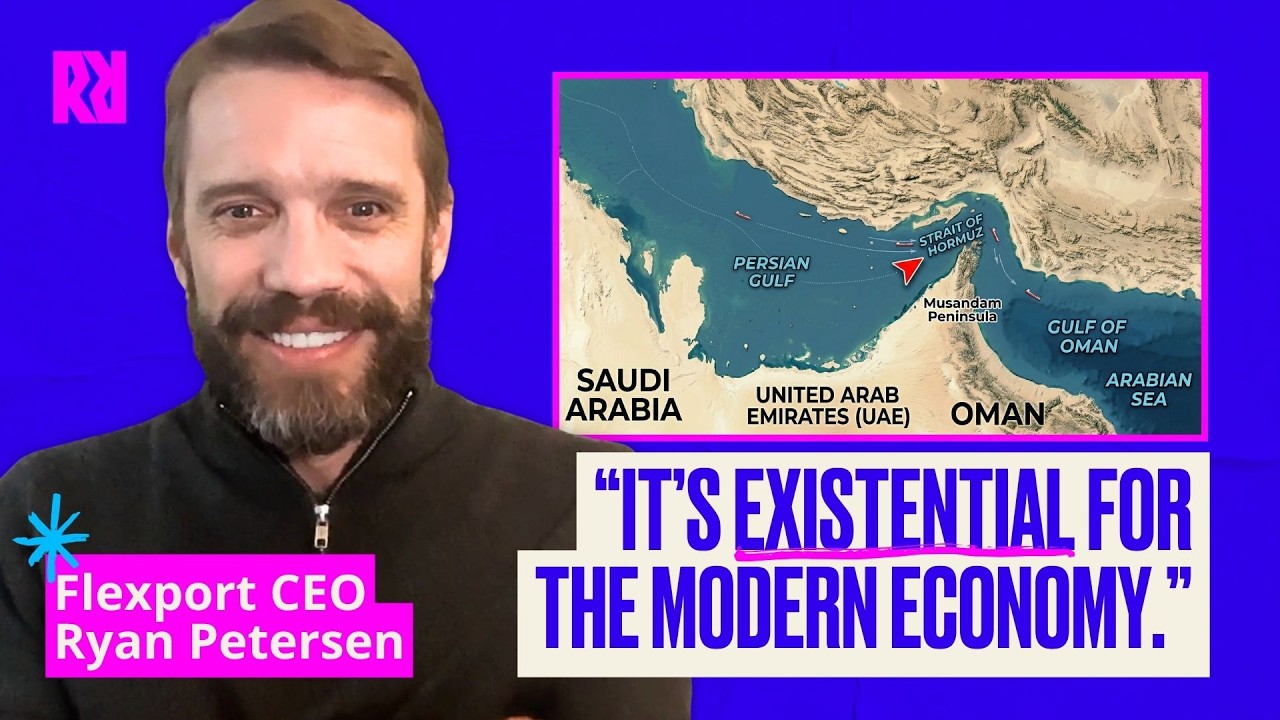
Flexport CEO Ryan Petersen on the crisis at the Strait of Hormuz | Rapid Response
How business leaders are reacting to tariffs (with Flexport's Ryan Petersen) | Rapid Response