Here's Why Karen De Amat Helps Her Clients Find Their Why Before Launching Any Campaign
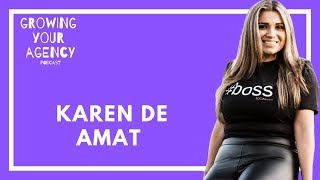
Karen DiAmato founded Social Behavior five years ago managing Facebook pages for restaurants and franchises. She charges $800 to $2,500 monthly for social media management, or $50k to $100k for full campaigns, but won't start work until clients define their "why" first. The agency uses Hootsuite and Sprout Social to track geo targeting, demographics, and conversion data.
Chapters
What's up guys, thank you for coming back to another episode of Growing Your Agency. I'm the host Ryan Shank. Today, super excited, we have Karen DiAmato with Social Behavior. Karen, thank you so much for joining us.
Thank you.
So Karen, tell us about Social Behavior. It's a really interesting company. You know, a lot of, a lot of agencies that, you know, I've worked with have social media as a small component. Seems like you're doubling, tripling down on social. So would love to hear a little bit of background about the company and also, you know, why you decided to go after this space and to particularly start the company.
Oh yeah, sure. Absolutely. I'd love to share on that. So we are a social media forward agency. That means we are turnkey with all things social media, starting from the management portion of it all the way down to influencer campaigns. And even as far as social media training if somebody has their in-house team. So those are just 3 of the, the main services that we offer. I started the agency 5 years ago after having a lot of success with me as a marketing professional leveraging the brands and businesses that I was working with on social media. So basically at the cusp of the social media evolution, I was having a lot of success success and growth with Facebook and LinkedIn, and I really impressed my superiors, my bosses, my colleagues, my peers were saying that, you know, I had a great social media presence and I was able to encompass the brands and clients that I was working with and present them well on a very, very native platform, which was at the time social media. After leaving my marketing career, I kind of was at a turning point and I decided that I would charge people to manage their Facebook profiles. This is about 5 and a half years ago, 6 years ago. And when I told people that I was doing this, they just looked at me and told me I was nuts, that nobody was going to pay for this.
And businesses in particular though, right?
In particular, like who would even have the budget to have someone manage just a non-important Facebook page. It just wasn't received as well as I thought it would be in the beginning stages of me launching my agency. There was a lot of education involved with me educating my prospects or clients on as to why it was so important, but now there are clients that have been with me for the last 5 years and have grown with us as an agency that thank me because they were 5 years ahead of the cusp. Yeah, and that by the end of this year, social media will be the number one advertising spend. That's against the combined traditional efforts of TV, print, other types of advertising. People are really, like you said, doubling down, tripling down on social.
Yeah, that's so, so, so incredible. And just one thing that comes to mind, and obviously we can talk tactics and everything later. Just the power of social media, I think, has been— you've seen it sort of grow over the years, whereas now people with incredibly small, what would be small, you know, businesses in terms of like human capital, like creating, you know, billion-dollar companies or creating, you know, self-made billionaires. Kylie Jenner, for example, of just the power of the reach and the audience that these people can kind of amass through social media. And I think that's where like brands are starting to like fast follow. And say like, oh wow, like there's, you know, all the eyeballs are here, all the attention is here, like I need to be here as well. So when you were getting started, how did you get clients? Like how did you get your first clients to sort of jump into, to jump into and hire you?
I'm gonna give you a crazy answer, but this is how I built my brand and my business, and I got them on social media. But that shouldn't take away from the fact that I cultivated a lot of relationships in my professional career history. I have over 10 years of working in marketing and startup launches, and so I cultivated a lot of relationships along the way. So people believed in me. They had a genuine you know, trust. And so once I started this, I put myself out there on social media. But today it's a mix of the lead generation, it's a mix of me personally, me being present, me using different tactics on digital marketing and using social media, of course, to bring leads in.
Absolutely. Does it ever scare you how dependent the business is on you?
Oh yeah, yeah, yeah.
I've talked to a bunch of people and, you know, I think the whole— the holy grail is really making yourself replaceable. And I think, you know, in the beginning it's incredibly hard because you are the business, you are the brand, you're the face, you're kind of doing everything. People are hiring, you know, they're hiring the brand, but they're really hiring you because they know you're behind the brand, right? And I think, like, you know, how do you— how do you foresee yourself, uh, transitioning to make yourself replaceable in your own business?
Oh yeah, so that's actually something that I'm working on 5 years into my business. I'm trying to kind of exit stage left without getting noticed because there's, there is a lot of clients that—
the Irish exit.
Yes, yes, yes, yes. And so I've actually, in the last year, I kind of slowed down on taking clients. I mean, we're self-sustainable, so I slowed down on accepting new clients because I needed to transfer the knowledge and I needed to transfer everything to my employees. So I've broken up my agency into 3 departments, which is content, engagement, and ads. And having that division makes it great because, you know, one person is never in charge of one total account. But the execution of that training has been quite painful, to be honest, as an entrepreneur, just distancing yourself from the business in that capacity where now I am making myself available to land larger accounts, to land restaurant chains, to land the type of clients that we really want to go after. But I could only do that with the ability of having my team take everything on. And so I feel like we just got there after about maybe 6 to 8 months of intensive training.
Got it. Yeah, and that kind of goes back to just the importance of documentation and training across the organization so that you can scale, scale those things. Um, when you see a client, like you were just saying, you know, a franchise or a restaurant group, um, what is your strategy? How do you go after them? Let's say you want to go after, you know, Applebee's as a, as a franchise or, or something else. Doesn't have to be Applebee's, uh, you know, whatever it is, Sweetgreen. What do you do first?
Yeah, so they just opened up in Houston. I have yet to go.
Sweetgreen did?
Yeah.
They're so good.
They're so good. I can't wait. They just opened up this week. So what we recently did was we did our first trade show and expo, which was the Texas Restaurant Association Expo, or they call it the Marketplace. And it was, um, visited by 6,000 Texas restaurant owners. And at that event, we did get to meet with Whataburger and Salata. We got to meet with James Coney Island, some of the big franchises and food names that you may not recognize out in New York. Whataburger just got bought out by a venture capital firm in Chicago, so you'll hear about them soon enough. But, you know, it was just getting in front of them. So being visible to those clients as a social media agency really gave us, really put us right in front of them because we exhibited at this event and it really legitimized the agency. So I think there's agencies popping up every single day and I encourage anyone to start their own business, right? It's definitely the road less traveled. It's a very difficult, challenging road. Yeah. But definitely go for it. I think You just have to pace yourself. Like, we didn't come out of the gate 5 years ago and say, "All right, we're gonna go exhibit at this." Everything that we've been learning over the last 5 years has been, you know, constant growth, constant application. And in social media, the landscape changes almost every single day. So to get in front of those clients, you just gotta, you You gotta be where they're at, where their marketing people are at. So wherever you need to plug yourself in.
Absolutely. So what, so nowadays, how do you guys, you know, what does the process look like? You get to them, how do you, you know, do you put together a comprehensive, you know, audit overview and then say, hey, here's how, here's areas of improvement. You know, what does I guess proposal process look like? And then kind of tying that into pricing. How do you guys price? Is it, Monthly fees, ad spend, if they're doing ad spend, like curious about all of that.
It is. So we work in ad spend to every client, but I guess I'm going to give you the answer that everyone gives. And we do have some cookie-cutter packages. They all include the posting, they all include engagement, they all include an ad budget. And those are cookie-cutter bundles. So we have about 4 packages. They range anywhere from $800 to $2,500 a month. But we typically like to speak with a customer and learn about their goals. Because if you're telling me that you have the budget to come out of the gate swinging and be a big brand and you do want to get lined up with influencers, then you could be looking at $50,000 to $100,000 a month in just your social spend. And/or upwards of that. So it's all about your goals and what you want to do. We got creatives on the team and we have people that are ready to do the content and ready to do the engagement. But, you know, it's all about what that customer, what their goals are as a brand on social. And they also need to answer a question, and it's the why and the conversion. Because if you don't really have a reason, sometimes we've turned people away when they think they need to be on social and really they don't.
Right. They're just doing it just to check the box, whereas it might not, might not be like aligned with their business goals.
Correct. Correct. Yeah. Yeah. They don't necessarily need to be present on there or need to be paying an agency thousands of dollars a month to do it. Right.
Right. Yeah. Get Hootsuite, get some tool. Well, by the way, speaking of tools, what tools do you guys use?
Oh, okay, cool. So there are different tools that we use. A lot of the, the softwares now are very scheduling friendly with all platforms. Hootsuite is one of the ones that we like to use. We also use Sprout for analytics, which is great just to monitor that. A lot of these companies that offer social media management, they always forget the analytics. And so you want to make sure that you're always trending upwards and that you're able to show your clients that you're performing well and you're hitting all those targets that you, you told them you would.
Awesome. And then in terms of reporting, what, what, what metrics are you reporting back to your clients and what reporting tools are you using?
We report on geo, geo targets, age demographics, gender specifics. We also report on what campaigns work the most. We report on the paid ads, you know, what converted for the least amount and what worked. Then we can double down on that in the following months.
What do you consider a conversion? Is that when someone clicks through an ad and goes to a site and fills out a form? Is it a phone call? Like what?
Different conversions for different things, right? So if we're doing a giveaway, and we needed to get people to follow all the way through and leave us an email, that we would consider that conversion. If somebody is requesting more information on a product or something and it was a click-through form, anytime we got that click-through is one conversion. That's one metric, but anytime somebody completed the form, that's another completion, you know. So we measure all of those.
Awesome. Awesome. So, uh, this has been, this has been great. Uh, final question, actually final 2 questions. What is your, what's driving you? Like, why are you doing this? What's your why? Why, you know, why spend arguably 95% of my time? Yeah. Why spend like, you know, the majority of your waking hours doing this?
Yeah. Um, honestly, I think every entrepreneur has a different story. For me, I knew that I was very labor-intensive in all my jobs. I did my jobs real well. I had really amazing bosses when I worked under people, and I was really passionate about what I did. And I never saw that within my colleagues. And both my parents are entrepreneurs, but they had a lot of challenges and winding roads along the way. It's crazy. But that was never the part that appealed to me. The part that appealed to me was that they dictated their own life and they set their own schedule and they made their own rules and called their own shots. And so just when I decided to embark on this journey, I thought, if I put this much energy into working for someone else, imagine the possibilities of what would happen if I applied it to my own business, to my own thing. Truth be told, you know, some days I wake up with an abundance of gratitude, like today, and I'm ready to take on the day and I'm ready to kill it. And some days I gotta check myself in the morning, like, look, this is, you know, I gotta activate my right mindset and I gotta plug myself in, literally, because it's not every single day that you wake up with that, you know, surge of energy, but But it is that the driver for me is the passion. The thing that keeps me going is that we still have so much ground to cover. We're just getting started even 5 years in.
Love it, love it. Awesome, Karen, thank you so much for, uh, for being on the podcast. And, uh, where can everyone check you out? Where can everyone find you?
Check us out at www.socialmediahouston.com. Or on Instagram @socialbehavior, and I hope to see you guys there.
All right, Karen D. I'm Matt, Social Behavior. Thank you so much for being on Growing Your Agency. We will check you out later.
Thank you. Bye.
Bye.
More from Ryan

We Analyzed 500+ Contractors. Here's What the Most Profitable Companies Do Differently.

Employee Incentive Programs That Drive Team Performance and Profitability with Ryan Shank


Stop Losing Money! Ryan Shank of ShareWillow on Using KPIs to Reward Field Teams






