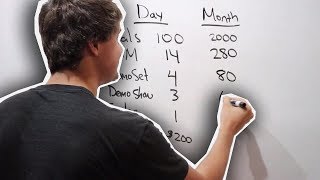
Ryan Shank breaks down a SaaS sales funnel: 100 cold dials per SDR per day yield 14 decision-maker contacts, 4 demos set, and 1 closed sale at 30-35%. That scales to 20 sales and $4,000 MRR monthly. With two reps costing $12,500 per month, payback is 3.2 months.
Chapters
So what I'm going to do is I'm going to show you exactly what our metrics look like for our outbound sales process. And what I'm going to show you is what ours looks like, but you probably have something similar. You're going to have some type of sales funnel where you're going to get leads, you're going to try to do a consultation or a demo or something like that, and then you're ultimately going to make a sale. Okay, so what ours looks like is first we start off with outbound cold calls. Okay, so I'm going to show you a first column on a daily basis, and then I'm monthly basis and show you exactly what it looks like. So first off, to feed our sales funnel, we have to make, uh, 100 dials a day. Okay, so on a daily basis, on our day, right, we're gonna make dials, 100. Okay, of those 100 dials, we're gonna get in touch with about 14 decision makers of those 100 dials. There's gonna be a lot of voicemails, a lot of gatekeepers, that sort of thing. So DMs on those 100 dials is going to be 14. Okay? Of the 14, we're gonna pitch and we're gonna try to build value around our product, around our service, and we're gonna ask them to set up a demo. Of the 14, we're gonna be able to set about 4 demos, okay? So demo set is 4. Now, obviously, of the 4 that get set, not all are gonna show up. There's gonna be some no-shows, that sort of thing. But of the 4, about 75% will show up. So shows, demo show, is 3, okay? So we are gonna be able to perform 3 demos from those 100 dials initially. 14 decision makers, 4 that got set, we're gonna be able to do 3 demos. Right now, our close rate is about 30, 35%. So of those 3 demos, we're gonna make 1 sale, okay? So sale, 1. Okay, so we're gonna make 1 sale. Our average revenue per sale right now is about $200. So, and it's MRR by the way. MRR is monthly recurring revenue. It's the value of the sale each month. So MRR is gonna be $200, okay? So $200 per month from these 100 dials. Now I'm gonna show you what this looks like on a monthly basis. There's 20 working days on average in a month, and I'm just gonna show you what this looks like on a monthly basis and then show our costs to acquire that, those number of sales. So literally, if I just go 1 and times everything by 20, okay, so this is gonna be 2,000 dials. Uh, 14 times 20 is going to be— I'm just kidding, it's 280. Okay, uh, and then we're gonna demo set. So demo set, so if we do 4 a day, we're gonna set 80 demos. Uh, we're going to then show 60 demos, and of the 60 that we show, we're going to make 20 sales. Okay, 20 sales times $200 average MRR, we're gonna bring in $4,000 in monthly recurring revenue from, from this model right here. So it's gonna— we're gonna bring in $4,000 in MRR each month from one SDR making 100 calls a day. So this requires two different salespeople to bring in this amount of money, okay? And the next thing that you're gonna want to look at is how much does it cost you to acquire this $4,000, and how long does it take to pay back those costs to acquire the $4,000 $4,000 in monthly recurring revenue. So we'll do another video where I'll show the exact cost that we have to pay to acquire this. But if you just assume fully baked, we're paying out, call it, $150,000 in salary to both of the sales reps to acquire this. So what you can do is $150,000 in salary divided by 12. So basically we pay, like, let's call it $12,500. So we pay cost $12,500 to acquire $4,000 in revenue. So how long does it take us to pay that back? Okay, so you just do $12,500 divided by $4,000. We're gonna pay this back in 3, in about 3 months. Payback period, okay? Payback period is about like 3.2 months, okay? So we're in the negatives for 3.2 months, but then we're gonna be cash flow positive, and this is ROI positive after that. So we pay $12,500 one time, in acquisition costs to acquire a recurring $4,000. Okay, so it takes us about 3 months to pay it back. That's a really good payback period for a subscription model. Uh, some of the content out there says that if you can pay it back within 6 months, 12 months, you're really good. So our current payback period is around 3.2 months, uh, give or take, you know. And again, some levers in here, by the way, are going to be what is the average MRR per sale, what is your close rate. If I could get our close rate from 30% to 60%, we're gonna get 2 sales here which this would make this 40 sales, and you can see how the numbers, you know, will really jump. So you're gonna wanna always optimize each different part of this sales funnel. You're gonna wanna optimize right here, you know, this is only 14% right now to get from 100 to 4, and then to get 4 set on 14, you know, that's around 30%, right? So you're gonna wanna optimize each different place in this sales funnel so that ultimately at the bottom of your funnel, your number of sales and your revenue, it shakes out even higher, which is gonna make your payback period go even lower. This is the way we look at our sales funnel right now. We're always optimizing each part of it, but you guys can take a look at yours and see what works, what doesn't work, and then try to just keep optimizing those different levers. So hope you guys got some value out of this. This is what we're doing with our business. Let us know in the comments what you guys are doing and what your sales funnel looks like.