80 outbound sales calls per day? Does it work?
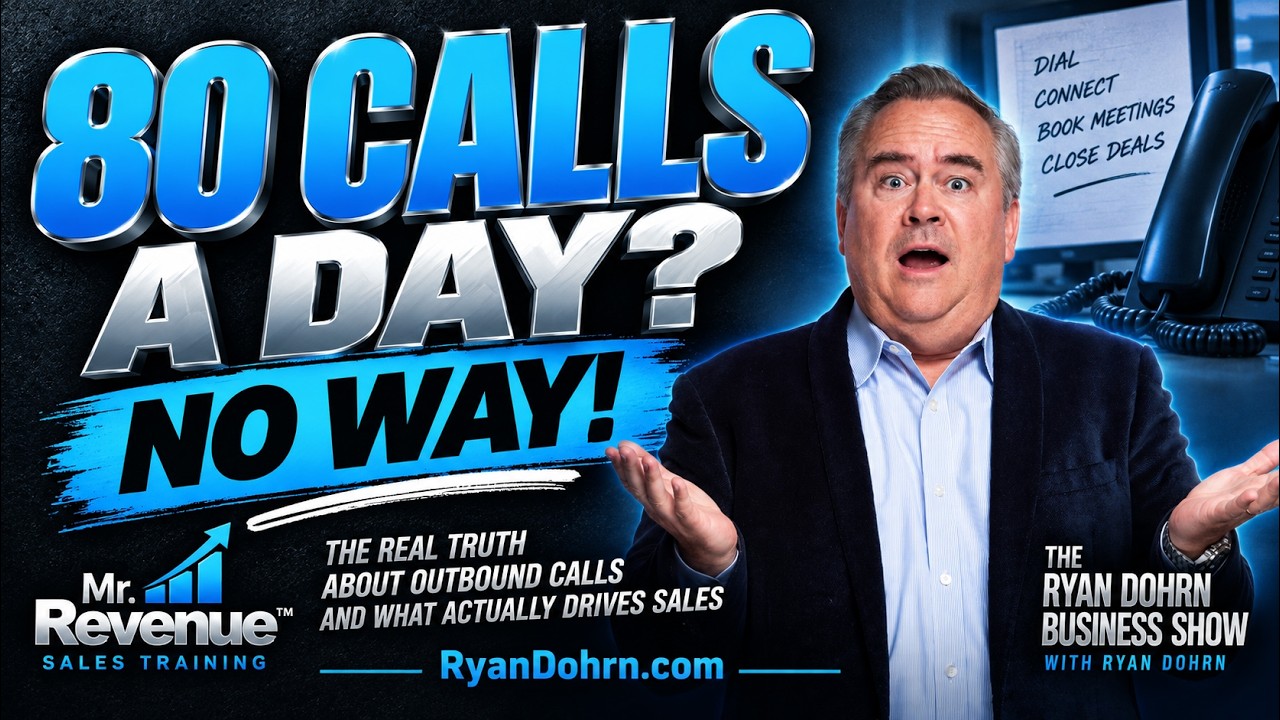
Sales coach Ryan Dohrn breaks down whether 80 outbound calls a day works using sales math: your booking rate (calls to meetings) and close rate (meetings to deals) determine if the target is realistic. He shows how to use AI tools like ChatGPT to build personality profiles for more relevant outreach, and recommends the book Giftology as a retention strategy.
Chapters
Hey, what's going on, friends and fans? Welcome to this week's edition of the Mr. Revenue Show. My name is Ryan Dohrn, your billion-dollar sales coach. Let's get started. Here comes your quick sales tip of the week. This tip is really about 80 phone calls, and it was sent in from Linda who lives in Utah. And Linda asked this question. Ryan, I think my boss, my sales manager, is crazy. That's very possible, Linda. They are wanting me to make 80 outbound calls a day, and that just seems ridiculous. I don't understand where this number came from, and I don't understand why or how they think this might work. So good question that was sent in. I'm going to make a guess here that this is basic sales math, and people are using sales math to give you an advantage. Your supervisor is using sales math to give you an advantage. We've talked about it on the show on several occasions. I love sales math. I don't love math, but I love sales math. So there's 2 kind of closing rates that you want to know. You want to know your rate of close on booking meetings. So how many calls does it take to get to one meeting? And then another close rate is once you get to a meeting, what is your close rate on those meetings? Okay. So typically, and this is an average, it's not terribly scientific, but I observe it across various companies. Typically, your booking rate is going to be about 20% to 25%. So if you make 10 calls, you should be able to book 1 or 2 meetings out of that. Now, your closing rate, when you get to a sales call, that now is completely different. Your closing rate is probably, for good sellers, going to be 30%, 35%. Now, it might be higher if you're doing a discount, a flash sale, selling something at, say, 50% off or something like that. But it's very common for me to see closing rates 3 in 10, 2 in 10. It's super common, especially in the SaaS business and the marketing solutions business where I live. Your circumstance may be different, and that's why you adjust the numbers accordingly. Now, Linda, if you're making 10 phone calls and you're booking 2 meetings, and the goal is to book 1 meeting out of 10, Then I would suggest you don't go to your boss and say, well, I don't need 80, I need 40 outbound calls. I wouldn't do that. If you're discovering you can book 1 or 2 in 10, that's 8 meetings. I would make those 80 outbound phone calls. I'm going to bet though, it's not as simple as that. Normally there's going to be a cadence of emails, of voicemails, text messages, and marketing outreach. If all of those things are in play, then perhaps you don't necessarily need 80. Recognize though, friends, a lot of you, what you're doing is you're solely basing everything that you do on relationship-based selling. The problem with relationship selling— I love it, by the way, love my customers— is that relationships take a while to form. And so a lot of times as a sales manager, I don't have time to wait for you to form a relationship. I don't have time for you to date that person to, you know, get married to them. So what I want you to do is think about it as, Okay, what does the 80 mean? What's the benefit that could come from that 80? And not look at the number as being ridiculous. Now, because I don't know what you sell, because I don't know your close rate of booking meetings, it would be hard for me to adjust off of that 80. But I think the bigger lesson in all of this is, what are your sales math numbers? What do they look like? What do those numbers look like? Everyone's numbers really should be different. So if you're brand new to the job and the boss says 80, There's probably a reason for that. After I book and hold a bunch of business, I might only need 20, 30, or 40. So you may want to ask for some clarification as to, is this a number for everybody? Is it for me? If I book more meetings, is it less outbound calls? Or you might just be working for somebody that's very rigid. In that particular case, embrace the rigidity. Is that a word? Embrace the rigid nature, make the 80 calls, and do it successfully for 2 or 3 weeks. Prove to the supervisor that perhaps you You don't need to make as many because you're booking more than what they expected. But more than likely, they're going to say— they're going to say, if you're booking 2 in 10, do all 80 because let's get 8, 10, 15 calls on the books. So don't just throw the proverbial baby out with the bathwater. Ask yourself this question: could there be some magic in those 80 outbound calls? Now, I do know though the general kind of reluctance, like, I want to make quality calls. I'm not a telemarketer. I don't just want to make a bunch of outbound calls. Normally there's some logic behind that, and usually it's sales math. Now recognize though, friends, there's a gentle blend between sales math, okay, and relationships. So what can you do in your outreaches to be really, really successful? And that is going to lead us to our prospecting tip of the week. Now if you're making those outbound calls, Linda, what you also might want to do is be using AI to look up more information on people so that you can make those calls more impactful. One of the things that I'd like to share this week as a prospecting tip is that I'm using AI to build personality profiles on each of the prospects that's on my list. Now, maybe I probably don't have time to do the 80 that Linda in Utah is talking about, but I could be asking myself this question. If I am going to be making 40 a day, what could I leave on the voicemail? What could I send in the email that would actually create a really nice point of relevancy to increase my chances of getting a callback, an email back, or potentially booking a meeting? So when I'm in ChatGPT or Copilot or Perplexity or whatever, I love the prompt of build me a profile, build me a personality profile. Now, you know, I'm a big person and advocate of building rules for AI. So what you might want to consider is building a prompt and a rule set around personality profiling. My rule set says, find me this person. Here's their LinkedIn profile. Find me 3 or 4 things that you think I could connect with them about based on what you know about me. So in advance, I've loaded up things that I like— colleges, alumni, football, sports, horses, coffee, travel, you name it. And then I want AI to go out and see what type of things might I have in common with the prospect that I'm reaching out to. When you can use AI to increase your prospecting effectiveness and you're making those 80 outbound calls, I think, Linda, others, you're going to be crazy effective. And I think it makes a lot of sense. That's going to lead us to our sales tech tip of the week. I'm looking for repeatable AI prompts that I can use over and over again. So whenever you're doing things in a repeated way, one of the things you might consider is creating projects within Claude or ChatGPT, whatever, creating projects where you can really define what it is that you want the bot to do. Now, in the marketing business where I live, I'm always creating spec ads, banner ads, print ads, webinars, e-newsletters. I'm always looking to create spec ads so I can show the client what their marketing solution might look like. So what I did is in Microsoft Word, I actually wrote up the prompt of all the information I want the bot to have so I don't forget. And then I feel like I'm giving the bot enough information that they can actually do that repeatable task for me on a regular basis. Now, to give you another example of an AI repeatable task, I record this show that you're watching. I record it for YouTube. Then what I do is I use AI to watch and listen to the show. Then it's going to create a blog from that. It's going to create a podcast. It's going to create the thumbnails that you see, the descriptions that are used. I've created a repeatable prompt workflow and saved that in a project inside of ChatGPT. You could do the exact same thing if you're prospecting people and you're doing company research. You would write out what you want, put that into a project inside of your AI model, so that way when you put in a company name in that project, it will know what it is that you want them to— the bot, it'll know what you want to do with it. Friends, I feel like AI can very much enhance all of our sales lives if we spend some time creating rules and workflows that are really going to help us better connect with all of our customers. All right, friends, it's time for our retention idea of the week. I don't know if you've ever had the opportunity. It's not a brand new book, but it's certainly a good book. And the book that I'd love to recommend to you is Giftology. And the reason I like the book is it really explains the psychology and the thought process behind gifting and what you can do from a gifting perspective as it relates to retaining your customers for a lifetime. Some of the things that I took away from the book are the small things really do matter if the gift is super meaningful. Generic gifts are, are fine, But if you take just a couple of minutes and really think about the person you're sending it to and find something specific for them, it's gonna be deeply meaningful. It's a lot more motivational. It's a lot more emotional. Now, that's just one of the many things that's talked about in the Giftology book. But friends, I'd encourage you to think about your retention budgeting. This time of year, we're creating budgets for next year. Are you budgeting for retention? What is your retention plan? What are you doing to keep your clients for a lifetime? So one of the things besides just reading that book, it's a mindset thing. Retention is a mindset. What are you doing to figure out ways to retain these customers for a lifetime? Because if you don't figure it out, guess what? Your competitor will. See, when push comes to shove at the end, I feel that a lot of customers, when it comes time to renewal, they think, you know, How much love has Ryan Dohrn showed me this year? Because if Sally Smith has shown more love over here than I have over there, even if I have a superior product or service, a lot of times they're gonna go with Sally because they feel a lot more emotionally connected. Would you be surprised to know that I didn't lose hardly any clients during COVID Almost none. And I think it was because I was the last person they wanted to cancel. They just, we just liked each other. Too much. Now, I just finished up a big event, and as I was saying goodbye to some of my sponsors, I had 3 different individuals that said, love you, man, love you, Ryan. And I thought, wow, I've done something right. When a customer says they love you and you actually do love them back, that to me, friends, that's, that's a meaningful relationship and a relationship that's going to go forward. It's going to go far, and it's going to bring you in a lot. All right, how about another listener question? A twofer for the week. Your listener question of the week comes from Dexter, and Dexter lives out in Kansas. So here's Dexter's question. Uh, Ryan, what is it about texting in the sales process that rubs you the wrong way? I've heard you several times say you're not a big fan of texting during the sales process. So Dexter, thanks for your question. Appreciate it. I just want to be really clear on something. I'm not against texting customers, not at all. I'm not against texting prospects. I just personally feel like it's not my first line of defense when I'm trying to book a meeting. So I first try to do voicemail, then I do email. As you know, everybody, I wait 3 business days. Voicemail, email, wait 3 business days. I just feel like texting is personal. So I try normal routes, routes to get, you know, to these folks. And then if their phone number or cell phone is on their business card, for me, that's, that's free game. So if I look at like, I've got a couple business cards from my last trade show. Um, yeah, cell phone number is here on this one. Let me look at this next one. Yep. Cell phone number on this one. Let me look at this one. That's fair game if they put it on there. Um, cell phone number. So I feel like when someone puts their cell phone number on their business card, they're saying, hey, It's okay if you want to reach out to me. Now, I just try as a professional to follow normal channels of engagement. There's nothing wrong with texting folks. But I think you should say in the text, hey, left you a voicemail, sent an email, thought I would text so that it's not just coming completely out of the blue, completely out of left field. Or someone told me recently, if you're going to text somebody out of left field, just say, hey, sorry for a text out of left field, tried to call and email you, hadn't heard back, thought maybe a text would be more effective. So I feel like texting is a part of the total sales process. It's just not my go-to as the lead out in the process. I have nothing wrong with that. I just feel like texting is not my first line of defense. Now, when I've booked meetings and I'm doing follow-ups, okay, so I've had a meeting with a client, now I'm doing follow-ups. Oh, texting's fair game. Once I've met with somebody, I'm going to text them. If they don't reply, then no reply is a reply. Let me say that one more time. No reply is a reply. So just remember that. But you want to be asking yourself, what can I do to put texting into my process? I might change my mind over the course of time, but here's my thing. I'm just not like a lot of people that are on YouTube that just say stuff and don't actually do it. I talk the talk because I walk the walk, right? And I'm selling every day just like a lot of you. If I thought I could use texting right out of the gate, friends, I would. I just have not found that to be the process that I use to be crazy successful. So Dexter from Kansas, I'm not against texting, it's just not a part of my initial outreach. But here's the deal, Texter, I'd love for you to do this. Dexter, I just think I called you Texter. Dexter the Texter, I would encourage you to do it. Make it a part of your sales process, report back to me, and maybe you can join me here on the show and we'll encourage everybody to give it a better try. All right, get your questions over to me, get them to me. Ryan@ryandohrn.com. If we don't answer your question on the show, it did not come in. I'll text you back. I'll email you back. I'll give you some type of reply. We'll feature it on the show. So keep your questions coming. Ryan@ryandohrn.com. All right, let's wrap up this week's show with our brain work idea and quick tip of the week. Stop multitasking. You're not good at it. You just think. That you are. All right, so here, if you're driving or working out or something, don't do this exercise. But let me prove to you that you cannot multitask. All right? Okay, so what I want you to do is sit comfortably in your chair, and I want you to begin to rotate your ankles to the right. So rotate your ankles and your feet to the right. Okay, right, right. Just rotate them to the right. You doing it? Okay. Now, Rotate your hands to the left. Now try really hard. Think about it. Multitask. Rotate your feet to the right and your hands to the left. What happens? Your feet start mimicking your hands because your brain is not trained to do that multiple tasks at one time. Well, Ryan, I can tap my head and rub my belly and chew gum at the same time. Okay. It's a different way of engaging your brain. Most of us don't multitask effectively. As a matter of fact, have you ever been talking to someone on the phone and they begin to talk sort of like this because they're reading something on the other side of the phone and they think that they're just talking normally to you? That's because it's very difficult for you to read and talk at the exact same time unless you're just reading something, right? It's difficult. That's why when you see a news anchor, sometimes they'll put their finger up to their ear, like, because somebody in the booth is talking to them. But it's difficult to talk and hear at the same time. It's difficult to do 2 things at exactly the same time. So your brain is not designed to do that. And so you're tiring yourself out by having multiple screens, trying to do multiple things at one time. Now, Multitasking can be accomplished, friends, if you're really good at it and you can actually prove that you are good at it. But for me, I've just realized I can't multitask. I'm sacrificing quality by trying to multitask. So I just would encourage all of you, don't sacrifice quality work quality because you're trying to multitask. Instead, time block your day, dedicate your brain and your focus to the activity at hand Maybe then you can get done more quickly and you will actually increase the quality of your outbound work as well. Friends, I sure appreciate your, uh, the love that you show, the support that you show, and would love to come to your office or to your national sales meeting and get your team pumped up. My coaching calendar is pretty full. I've got about 80, 90 people on that coaching calendar, but I still have plenty of time to hit the road and come to your office and get your team all motivated to sell more. as we get into Q4. All right, if I can be of help to you, reach over. ryandohrn.com is where it's at. If you're in the media sales business, 360adsales.com. And if you're just looking for regular generic sales information, head over to salestrainingworld.com. All right, we got more information on prospecting coming up in our next video. Be sure to check it out. We will see you next week.







