Cowboy boots, before you buy your next pair, watch this.
In this Ride Smart episode, host Craig Cameron visits master bootmaker Mike Vaughn in Bowie, Texas to demonstrate the full custom boot‑making process. They begin with foot outlining and precise measurements (throat, heel width, ball, toe, calf) to create a personalized last. Vaughn explains how the last is molded and adjusted with leather to match the customer's foot shape, allowing changes like toe style without remaking the last. The conversation covers material selection, stitching techniques, and the artistic freedom customers have in choosing leathers, colors, and decorative stitching. Vaughn shows tools such as the crimp board for shaping the vamp, hand‑lasting, and the use of a genuine leather insole. He details hand‑sewn construction, including the counter cover, welt, and shank (a 60‑penny nail), emphasizing durability versus factory boots. The segment on heels explains custom heel types (walking, inch‑and‑quarter, cactus, elephant) and the addition of spur ridges for spurs and pant protection, as well as using tougher leather on heel counters. Vaughn shares his 31‑year experience, having made roughly 3,600 pairs, and highlights the longevity (up to ten times longer) and personalized fit of custom boots. The episode concludes with a promotion of Vaughn’s website for ordering.
Chapters
Standing here with one of the finest custom boot makers in the world, Mike Vaughn, here in Bowie, Texas. Mike, where are you from and how in the world did you get started making boots?
I'm from Grand Prairie, Texas, and I got started when I was in high school. I got in a work program class, got out of school half a day, and went to work in a repair shop there in town, and that's where I got my start.
Yeah, and then from there, where'd you go?
From there, I went to work apprenticing under Clyde and Joe Vasquez in Fort Worth, Texas, and they're the 2 guys that taught me to make boots.
You know, boot making is again an art form. You know, I've been wearing your boots a long time. Your boots are in demand from some of the best cowboys and best businessmen in the world. They fit like a glove. Let's get started on the boot-making process.
Okay. Okay, Craig, the first thing we're going to do is take an outline of your foot here. That kind of tells me the length of the last I need to choose. And then once I take the measurements, it'll tell me the width in the heel that I need to use.
So this, this is the fit. So this is the custom fit right here. Kind of all— and I'm trying to just kind of stand like I normally stand with just kind of even amount of weight on each foot.
Yep. Don't put any more weight on one than the other because your foot will spread if you do that. You want to be standing equal there.
And from this outline, you're going to make what we call a last.
Yes, sir.
All right. So I got my foot. Now where do we go from here?
Now you have a seat and I start taking measurements.
All right.
Okay, cross your right leg over your left one.
Okay, now what is this first measurement called?
This first measurement is called your throat measurement. That's the one that actually lets your foot go into the boot.
So it's got to be big enough. Now that measurement is—
This— the second measurement you take is the one that tells me which heel width I need to use on what particular last.
Right.
And then we move down here to what you call your long heel measurement. And on your foot, Craig, you see how you have this real high spot right here? You have to make sure that you get that spot exactly.
Right. And that's where that comfort fit comes in, that real custom fit.
Yes, sir.
It's just really made just to my foot. You know, I've never gotten a boot from you that didn't just really fit from the moment I put it on and really comfortable, almost like it just broke in. Well, I'm just checking that out. Nice. And then that's just right around the ball of my foot there.
This one here is the ball of your foot.
Mm-hmm. Nice.
Then I also take the measurement of the big toe to make sure you get the thickness down there you need. If your boot is too thin down there, a lot of people think their toe is hitting the end when it's actually hitting the top.
Right. Now you got to do something on the leg up here.
Yep, got to get a calf measurement now. Okay.
Oh, you need— now you're going to leave the blue jean on for this one.
I measure around the jeans, so if somebody wants to put their jeans in there, it's big enough to get their jeans in there. If not, I don't want the boot tops pooching your jeans way out.
Right. Well, Mike, uh, you have to build what we call a last for each and every customer. And again, like, if I order another boot for you, you have my last on hand so you can get that custom fit. What is a last, and how the heck do you spell that anyway?
Last is spelled L-A-S-T-S. And what it is is a mold that you start with, and then you start taking measurements off that mold, and then you see where you need to add leather to get your exact measurements of your foot. As you can tell, we've added out here for that bone on your foot. We've added out here to get the ball width we needed to get the toe that you exactly wanted. And so you take leather and you start putting Leather everywhere you need it to get the exact measurements of your foot. And as you'll notice on this boot here, that's the foot that had the real high spot on the instep. So I've, I've made sure I've put that bone in there and then dished that out right there so that it's the shape of your foot. You don't get a real big wrinkle across the top of your boot.
Outstanding. And then the brown stuff is where you add it on to get the exact measurement. All right, that's beautiful. And then this is the type of toe that I might want on my boot. If I wanted to change my toe, would you have to change the last?
Nope, don't have to change the last. All I have to do is add leather to get the exact toe that you want.
Outstanding.
I don't do anything back here, so the measurement stays the same. I just add leather up here to change the toe to whatever you decide.
Boy, that's amazing. You know, Mike, as a custom boot customer, one of the most fun things is you get to pick any style of boot you want, and there's lots of different styles, and you know, you, you can get really pretty creative. So you've made me a lot of different styles, and techniques and colors and creativity. I love that part about making the boot, and that's hard as you're deciding, but it's also fun. So you do a great artistic job on your boots.
Well, thank you. Whenever, whenever a person comes in here to get boots, they pick out everything they want from the toe to the heel, how tall a top, how short a top, the colors, the stitch pattern. You pick everything about the boot you want versus going into a store and having to take what they have.
You know, and again, that's the difference between that store-bought boot In a custom boot, you're using great material where really people don't realize a store-bought boot, there's a— it's not too good of material a lot of times.
Nope, it's absolutely the cheapest material they can get their hands on. That's why you can buy boots for $200 in the store.
And they don't last worth a darn. People might think a custom boot is expensive in the beginning, but these boots I've got on right now, they'll outlast that store-bought boot. I'm not joking, probably 10 to 1. So it starts— here's, here's our top. So I would get to choose a top, the stitching, and all that different Type of thing right here. So again, all different types, all different styles, all different leathers.
Yes, sir. I make boots for anything from elephant, hippo, lizard, kangaroo, calfskin. Yeah, if it's available, I can get it.
And it's all the real deal. You know, your stitching always amazes me. When you build— if I want a moon or a star, which I've had both, I've had cactuses, I've had a little bit of everything in there, that stitching you do is always so straight and so correct. I mean, you got to be a little bit of an artist to do that, don't you?
You do. When I first started, I couldn't draw a stickman. Now I can draw pretty good.
Well, you know what? It's a lot of fun, and your materials are absolutely the best. These boots last, they fit, they're great. And where are we going to go when we come back?
The next part we'll go to is cutting out the tops and starting to put the boot together.
All right. Hey, custom-made boots right here with Mike Vaughn. This is interesting stuff, and we'll be right back with more here on Ride Smart.
We'll be back with more on Ride Smart with Craig Cameron, American Horsemanship. Welcome back to Ride Smart with Craig Cameron, American Horsemanship.
Well, we're back with Mike Vaughn, world-class custom bootmaker, and we've been talking about the tops and the different leathers and the quality of leather, real leather. But once you get started, and if a guy's picked the leather for His foot. Now, what do you got in your hand here?
This here, Craig, is a crimp board. And what you do is you take your vamps, the front part of your foot, and you stretch them across this crimp board. And what that does is it puts the break from your leg coming down into the top of your foot, which helps shape it when you go to last it. And then it takes a lot of the stretch out of the foot because you don't want that boot to keep stretching out and getting bigger and bigger and bigger the longer you have it.
That's one of the differences between a custom-made boot and in a factory-made boot, and that's why it's going to fit so well.
That's right. You want that boot to fit 10 years from now the way it did the day you put it on.
Exactly. Now, let's talk a little bit about stitching now. You got that counter cover, and you're going to stitch to the top. I can actually see that boot beginning to take place.
Yeah, Craig, this right here is your back panel, and you sew your counter cover onto your hard leather counter that you've already sewed on there, and you get right around the very edge.
Now it takes a long time to get to where you can make that stitching really correct and straight. I imagine you've done that a time or two.
I've made somewhere in the neighborhood of 3,600 pair of boots in the last 31 years, Craig.
Golly, that's a lot of boots, I'm going to tell you. But you know, like you said, you do everything yourself. It's only one person building these boots, and so you know these boots literally inside out. I do.
Well, that's neat.
Now, this guy, I noticed a lot of times all this hand stitching and all the work, all the cutting, that's hard on your hands, isn't it?
It is. That's why I have a lot of knives made. You can, you can buy cheaper knives which are harder to cut with, or you can have tools custom made which are kind of like custom-made boots. The knives, the tools are a whole lot better, just like the boots are a whole lot better.
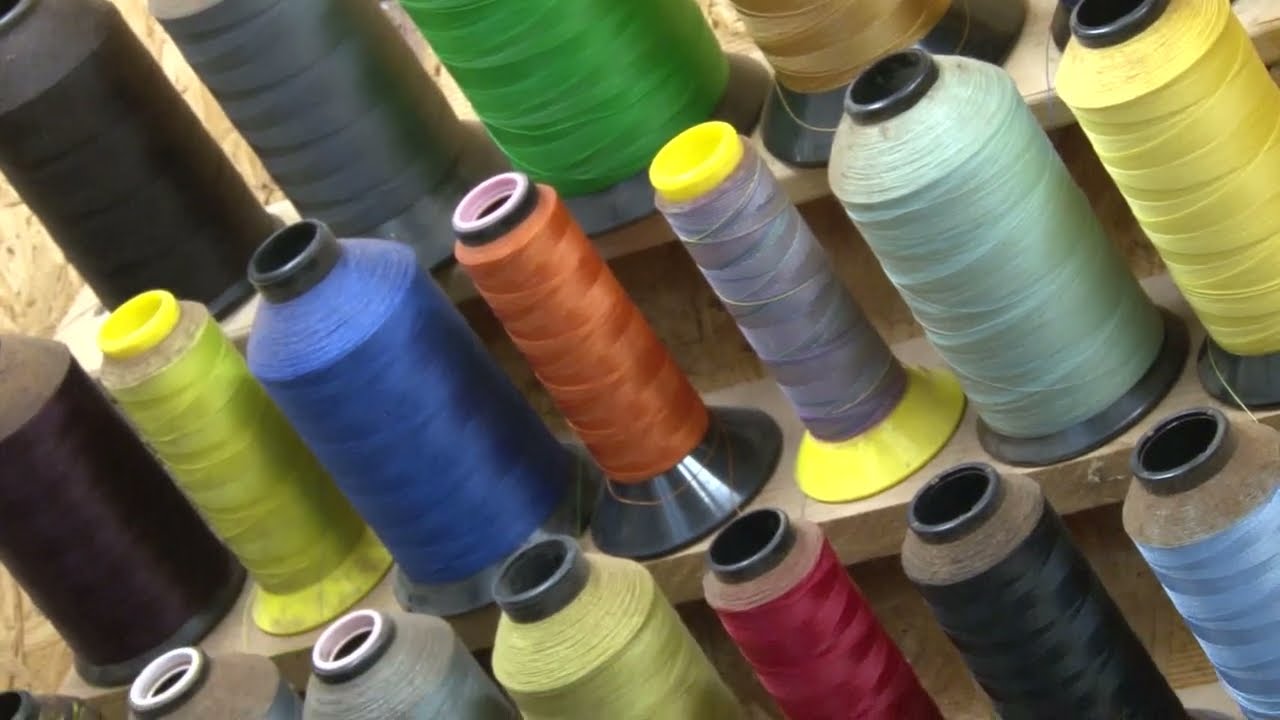
Now here's all your different threads, you know, and a guy can choose even the color of his thread. Everything that I want on the boot, no matter if I want a rainbow, you got it here. And here's some of the thread that you use. Boy, now this is interesting. I can see this boot beginning to come together. This is the back of the boot. This is the part we just saw you sew on, that counter. And then again, this is the front of the boot, again where the foot is.
Yes, Craig. The boot is sided up on one side. As you can see, the front and back together. And then on the inside, you can see the vamp lining on the foot.
Yeah, and that's where the foot's going to go in the front of the foot here.
That's where the foot's going to go in. And that's the hard counter that I sewed the counter cover over a while ago.
Well, now we're going to take it over and put it on the last and begin to sew it together.
Yep.
I think this is one of the most interesting parts of making the boot. When you get everything cut out, you're actually going to get the last and build this boot around the last. It's like building— having the guy's foot here and you build the boot around it.
Yep, Craig. And something I do that you can't get in a store-bought boot is I use a genuine leather insole.
Wow, that's going to be comfortable and get that great fit.
Yep.
Now you can see that he's making this thing right here. I mean, look at the fit, and the last is actually inside this boot that he's building. I mean, it's literally inside there, so That's why the fit gets so perfect. I mean, that just is amazing to me. So boy, by the time you pull that last out and the guy puts his foot in, boy, it's, it's just going to fit like a glove.
Yep, because when you're lasting the boot, you take the rest of the stretch out of the leather as much as you can. Crimping takes the biggest part of it, and hand lasting it takes the rest of it out.
Now you got a boot over here. What are you doing to that boot over there? Now Mike, you're actually Sewing all this leather onto that last right there, which gives it that comfort and great fit.
Yes, Craig. Here you can see I've sewn the welt on. All that's done by hand.
And the last is actually inside here.
It's still in there. It doesn't come out till the boot's finished. And here I use a 60-penny nail as a shank, and I sew it in on each end, and that's what gives you the support in your boot.
That's going to last forever, whereas a factory-made boot, that thing is really kind of puny and weak and is going to break. You lose that support.
You do.
Now here is this boot, the other side, the other half of these, this pair of boots. The last is inside it. You can see the boot really taking shape. And again, that last is in there. It's as if he's built this boot around the customer's foot, giving it that great custom fit. Hey, we're going to be right back with more Mike Vaughn custom-made boots, and we're going to see the finished product. That's coming up next on Ride Smart.
We'll be back with more on Ride Smart with Craig Cameron, American Horsemanship. Welcome back to Ride Smart with Craig Cameron, American Horsemanship.
Welcome back. We're talking to Mike Vaughn, one of the best custom boot makers in the world. And, you know, we're almost down to the point where you're sewing on the soles and the heels. When it comes to heels, you know, you get a lot of different choices. You actually custom make these heels.
I do, Craig. Here is a heel base that's already pre-made, and I don't use these just for the fact that they will not fit the shank area. I literally build each boot one layer at a time. Each layer is pegged on. I don't use any nails whatsoever in my boots.
Wow, that is amazing. That's one of the reasons they stay together. You know, you buy a factory-made boot, it's okay, but they always seem to fall apart. When you got these custom made like that, they fit the boot, they fit the customer, and you get the style you want. You know, one of the fun things about that custom boot, you can get anything you want, including the heel. You get different types of heels, and that's important to individual customers.
It is, Craig. Here we have 4 different types of heels. We have a walking heel with a medium slope. We have what we call an inch and a quarter shoe heel. which is the green top boot. The cactus boot, we have an inch and 7/8 walking heel with a good slope on it. And then the elephant boot, we have a 2-inch walking heel with a good slope on it.
You know, one thing on those heels, I always get you to put a spur ridge because I've always got my spurs on. And so why don't you show them and tell them a little bit about what a spur ridge is, say on this cactus boot right here.
This boot here, I have a spur ridge, and it serves 2 purposes. For guys who wear spurs, that cowboy all the time, a lot of them leave their spurs on their boots, and that spur will rest right here on this spur ridge. A lot of people who don't wear boots cannot stand their pants dragging, and so it'll hold your pants from dragging on the floor.
Boy, I like that too, boy, because when I do— don't have my spurs on, I like them pants to stack up right there and not get underneath that heel and get all worn out. Another thing we talked about was the heel counter right there. So sometimes on a boot like this one, you have one color and one type of leather here, another type of leather here that gives it more strength and also again just makes it more custom and a good, better looking boot with a little change of color.
It does. Some boots like this one, for instance, we have French cap on the foot and camel on the heel counter. If we didn't put the camel on the heel counter, the French cap Yeah, the calf would be wore out pretty quick with some spurs. So that's why we usually use the tougher leather on the counter for people who wear spurs. Yeah.
You've got all the experience. Obviously got the artistic value. And I think, you know, a custom boot certainly outperforms, outlasts, and says a lot about the individual wearing it.
It does. When you get into custom-made boots, you run into 2 or 3 different variables. You get people who just cannot get boots in the store to fit. And so that's where part of your customers come from. You get people who can tear up a store-bought boot in 2 or 3 months. That's where part of your customers come from. And then you get the other third is people who just like a good quality boot.
Yeah, well, you know, I kind of like all 3. And, you know, I love it. You know, like the old California vaquero, his equipment said a lot about him. You know, it's like great horsemanship. You know, great horsemanship when it's done right is an art form, just like this great boot making. Mike, I want to thank you for allowing us to come in here and take up your time and your space. I hope y'all learned something. I got a couple boots on order right now and I can't wait to get them. I think cowboys all their lives were ordering boots. It's exciting when they come. There's nothing better than to get a great boot that really fits and really works. Now, Mike, I believe you've made, what, about 3,600 pair of boots? That's a lot of boots.
Yes, correct. Somewhere in that neighborhood. I've been doing it 31 years now and got a lot of practice.
You know, that's the experience. That's the one thing you can't buy and the one thing nobody can give you.
Nope.
Well, I'll tell you what, I've got some boots on order now. I'll be excited to get them. I think cowboys have been waiting all their lives when they order their boots, and they're fun when they come, and they're certainly great when they fit and they really work.
Thanks, Craig.
Hey, well, you're an artist. It's been a pleasure. Hope y'all have enjoyed this as much as I have. How can they find you, Mike?
I have a website. It's MikeVaughnHandmadeBoots.com.
MikeVaughnHandmadeBoots.com. Hey, we'll see you next week on Ride Smart.
We'll be back with more on Ride Smart with Craig Cameron, American Horsemanship. Ride Smart with Craig Cameron, American Horsemanship is brought to you in part by United Vet Equine.







