Do Email Sequences Increase Sales?
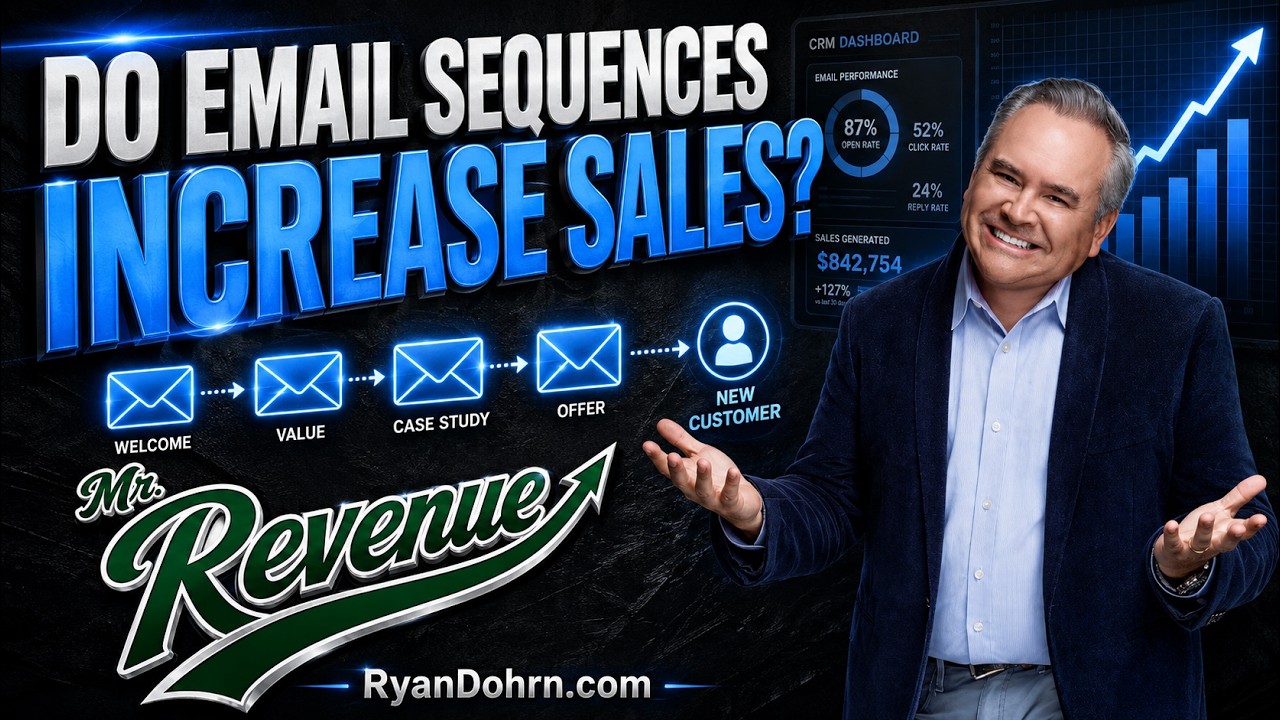
Ryan Dohrn breaks down a six-email sequence sent every three business days to boost sales meetings and renewals. He recommends Mixmax, Apollo AI, or MailSuite, warns that AI-generated copy needs human editing to avoid hallucinations, and suggests using send-later at least 20 times daily with A/B tests of 30-40 emails.
Chapters
Hey there, friends and fans. Welcome to this week's episode. This is the Mr. Revenue Show, where we talk all things sales and marketing to hopefully give you some tips that'll make you more successful in your sales life. All right, let's kick things off with our quick sales tip of the week. Friends, one of the areas of strategy that I focus on with my teams a lot is email sequencing. We've talked about email strategies here on the show before. But not specifically about sequences. So there's tools out there to create these sequences. Some of your CRM tools have sequencing marketing built into the CRM tool. But let's kind of just back up briefly, not spend a lot of time on it, but back up briefly. What is the reason for an email sequence and what is it? So an email sequence in my life is typically 6 emails, a total of 6 emails. And then what I typically do is I send those emails every 3 business days. Now typically, typically I'm using sequences on new customers. I'm trying to set meetings with people, but then sometimes I use sequences to warm people up when I start getting into renewal season as well. Now what you do is you use a tool, whether it's in your CRM, you use a tool like MailSuite, or you might use a tool like Mixmaxx. I like also like the tool Apollo AI, and what you can do then is you can set up those six emails, pre-build them in advance, and then you can set them up that the system will automatically deliver those emails every three business days. Now why every three business days? Well, there's five business days in a week. If you use every three business days as a general rule, then you're typically not going to be sending an email. On the exact same day of the week until about 4 weeks have gone through the process. So after your 4th or 5th email, that's when you're finally getting back on the same day. I just like the 3 on 5, a little bit of deliverability there. But then also, I'm real big on the power of 3, as you know. 3 words in my subject line, 3 sentences max. I'm gonna follow up every 3 business days. I send my sequence every 3 business days. I give 3 pricing options. I'm the oldest of 3 kids. Father, Son, Holy Ghost. I mean, we could go on and on about the power of 3. 3 Little Pigs, 3 Musketeers, 3 Blind Mice, Goldilocks and the 3 Bears. I mean, the power of 3 is real, right? So that's why I tend to use it that way. Now, whatever sequencing tool you're actually using is completely up to you, but just recognize that you want to use a tool that allows you to add a certain level of relevance or customization to the emails. Now, what I don't like— this is just me— what I don't like is when AI writes the emails, because a lot of times they'll get facts, figures, relationships, they'll get that stuff wrong. Like, for example, I received mail 3, email 3 of a sequence from someone selling software, and it made references to Augusta, Georgia, where I reside, It made references to some restaurants that were actually not very good. It just made a lot of references that you could tell that it was written by AI. I like to keep it a little bit simpler than that, and I find that if the email is direct to the point, but I can put in a company name, I want to make sure I personalize it. But more than anything, I don't want it to look like a letter. So emails and sequences that work well are not like, dear Ryan, comma, enter, enter, how are you, question mark, enter, enter. You know, It looks like a letter. Instead, I want the conversation to appear to be a little bit more casual. So think about email sequencing. Some people call it drip marketing. Think about how your tool sets work, but just don't forget, if you like to do email sequences, friends, if you're doing it correctly, you can't just start emailing 700 people a day. I mean, you can. It's not smart to do that because you're really gonna be seen as a spammer and you're gonna get yourself in some trouble. So you do want to choose a tool set that will help you warm up your emails so that you're not just boom sending out 700 and then you become a spammer, you get blocked, your deliverability is terrible, and things like that. So the main sequencing tools that I use either through my CRM, Mixmaxx, Apollo, and MailSuite are the 3 main ones that, that I use. And by the way, all 3 of you should be sponsors of the program. So friends, use email sequences. I wouldn't do everything through an email sequence, but use email sequences effectively, friends, and you'll find that you're going to get further faster when it comes to booking sales meetings. All right, I hope that helps. Now it's time for your prospecting tip of the week. Well friends, I guess we just talked about prospecting, didn't we? But let me give you another tip. If you're not using delayed delivery at least 20 times a day, I would be suggesting to you that you're prospecting or emailing at times that are good for you and not necessarily good for your customer. Now, I've mentioned this before to folks, and a lot of times people give me a little challenge. That's fine. I don't mind being challenged at all. Just remember, if you're gonna do a test, make sure you do a complete test. What do I mean by that? If you're gonna try a new subject line, if you're gonna try sending emails at a certain time of day. Make sure you do a good quality test, like 30, 40 emails. Don't send out 4 emails, 5 emails, and say, oh darn, it didn't work. Okay, that's not a very big test. Make sure when you're testing things, you actually do thoroughly test it. Because friends, I would tell you that all too often people try a couple of times, they don't get the result that they want, and they're like, oh, I'm scared. I don't know that I want to keep doing this. Be proud of yourself. Be confident in yourself. Give yourself a good test and a good try. Just remember, friends, if you're not using delayed delivery or send later, probably like 20 times a day, probably you're sending emails at times that are good for you and not necessarily for your customers. So just make sure that you think about that as a part of your sales strategy. All right, friends, up next, here comes your sales tech tip. Tip of the week. Now, friends, here's something we haven't talked about. As you know, I'm a big lover of AI. I use ChatGPT all the time, Claude all the time. But one of the reasons that I get such good results— not one of the reasons, but one of the many reasons I get such good results from ChatGPT and the other tools that I use— is because I've trained it and I've given it rules. Now, let's just say that you use ChatGPT on a regular basis and you're doing research and, and things like that. And what you find is that it's not giving you exactly what you kind of want. Well, that's because you're letting it do it the way it wants to do it. Now, one of the cool things about AI is that you can train it. So what I've done is I've written in a Word document my rules that I want AI to follow. Let me give you a couple of examples. If it can't find an email, I don't want it to make that email up. So I tell it, if you can't find an email, Tell me what you think it is, and then put not verified to the right next, right next to it. Put not verified. That way I'll know that it's not hallucinating, just couldn't find the right information. Another rule is I like all the files that I'm going to be pushing out of ChatGPT. I like them to be CSV files, comma-separated files, rather than Excel files. And the reason is because, I mean, I can go into Excel and convert it. It's not a big deal. But I like CSVs because of the formatting, and then I can use it in other tools. It's a little bit easier as a CSV file. The other thing that I put in my rules is I don't ever want it to give me more than about 10 results because it's just going to think too long. So everything that you kind of want from AI, what you want to be thinking about is, okay, what are my rules? Now, here's a huge mistake. Don't say to ChatGPT, Hey, I need to create some rules for you. What rules should I create? I mean, that's, that's silly. That's like going to your kid and saying, what time do you want your bedtime to be? I want it to be midnight, Dad. Okay, good luck with that one. So recognize the rules that you create are gonna guide the chatbot or the bot further, the AI model further. And then you wanna make sure you tell it to remember the rules. Now, you might have rules for prospecting. Great. You might have rules for how you want graphics created. Great. So get those rules going. Make sure you know what they are, where they are. Put them in a Word file, copy and paste them. Tell ChatGPT or whatever you're using to remember it. But an AI tool without any rules is normally not going to give you as good of results as when you clearly define what you want back from it. Now, some people have kind of challenged me on this. Well, what if the rules you give restrict it and then it can't do what it does best? I haven't found that necessarily to be the case. So friends, create rules for AI and you're almost always gonna get more done in the way that you actually want it done. All right, up next, here comes your retention idea of the week. Friends, one of the things that I pump out is I try to pump out a monthly e-newsletter for my clients. Now, now my clients are gonna watch this and go, oh, you don't personally write all that stuff? I've built a project inside ChatGPT and inside of Claude for this duty. And so what I'm looking for it to do is I look each month for it to find 3 or 4 marketing tips depending on the industry that I'm serving. I look for facts, figures, stats, and things like that. So specifically inside of Claude, because it's real good with design and kind of writing, I've created a skill inside of Claude, and it's called my monthly e-newsletter. Using the advice that I just gave you during the sales tech tip, what I also do is create rules so it knows exactly what I'm looking for each month. Now, I don't wanna ruin it for everybody or spoil it or jinx it or whatever, but when I run that project every month, and I've got it set up to run at the first of the month, I don't usually have to do anything. It usually is formatted correctly. It's in HTML. I drag it across over to my CRM and able to launch it from there. I don't actually create much of anything. Now I read it, but I try to keep it pretty short, but I read it to make sure it's accurate and it makes sense. I want to click on the sources, make sure the sources work, but quite honestly, I mean, Claude is doing all of the work in the background for me. So why is it a retention idea? It's just another touchpoint to stay in front of your customers on a regular basis. And position yourself as being a person of authority. I position myself as being a thought leader, and it seems to have worked out. I've got a lot to share, and I think that you can do the exact same thing for your industry as well. All right, now my favorite time of the show is when we get to answer your listener questions sent in to ryan@ryandohrn.com. If you don't get a reply from us, friends, we didn't receive it. We'll always give you a reply. I take a lot of pride in that. So, all right, here comes the question then. Barb from Florida. Hey Barb, down in Florida. She asks, Ryan, how many questions do you actually ask on a sales call? I'm being told that I need to ask 6 or 8 questions. I'm not asking enough questions. How many do you ask on any call? So Barb from Florida, I think the answer is not going to be exactly what you're looking for because the answer is It depends. Now, I just did a video, uh, which I'd love for you to check out, Barb, if you didn't. That's, that's entitled Stop Asking What's Your Budget. Okay, so that's one of the questions I don't ask, and that video really will explain why. Real briefly, for those that missed it, I don't ask people what their budget is because if, if they're unrealistic, um, then everything I say after that point is gonna sound expensive, right? So I've got another way to handle that. So go check out that video, uh, for that, Barb. But it really does depend. I don't ask questions just to create a conversation. I used to, and that was very good sales advice back in the day. But now I've got so much to talk about. I really don't need to ask questions that I already know the answer to. That's how we used to be taught. Never ask a question like a lawyer. Never ask a question that you don't know the answer to, right? And I find now that for the most part, it's a waste of time. The other thing is, remember, younger buyers, they don't like this whole inquisition thing, like asking 1,000 questions, especially if the questions that you ask can be found online, if those answers can be found online. Now, Barb, I imagine the reason your boss is saying you need to ask more questions is potentially because you're not closing at a high enough rate or something like that, or the, uh, the supervisor of yours is is telling you that because they're listening or watching your sales calls and you're not digging deep enough with the customer. So I ask questions if I need to ask questions. I don't ask questions, Barb, just to get the conversation going. And when I do ask questions, I try to make them super relevant to that moment in time. Some of the questions that I love to ask: when you granted me this meeting, I'm sure it wasn't out of pure curiosity. I'm sure you've had some specific questions or problems that you'd like to pose to me, so let's start there. How can I be of the most help to you today? Right? And that's a great conversation starter, and it will really identify the things that they're trying to, uh, trying to ask. So, um, Barb, I would ask my supervisor. I would say, hey, why do you want me to ask this many questions? Then I would say, what questions might you suggest that I ask? Review the questions that you do ask. And make sure that the best— they are the best questions out there. So, Barb, I really can't say always ask 10 questions, always ask 8 questions. It just really does depend upon the circumstance and the situation. All right, last section of the show, one of my favorites also is called Brain Works. And here comes your brain work tip of the week. How many breaks do you take a day? I mean, is it a lot? Maybe it is a lot if you work remote. Maybe you need to get back to work. But if you're like me, once these lights come on, once I sit in front of the keyboard, once the email starts flowing, I don't get up enough. I don't take enough breaks. And actually, it was causing me physical harm. I was having to go to the chiropractor more frequently. My hips were locking up, kind of all kinds of problems. Now, you've heard me talk about the Pomodoro technique before. That's where you work on a task for 25 minutes and then you take a 5-minute break. You come off of task. If you follow that, you know, that philosophy, good for you. I do it all the time. One of the things you need to remember to do is get up. Like, don't just come off of task, come off of task and get up, go do something. So one of the things, it's kind of, kind of sound a little crazy, but a couple times of day, I cleared a space here in my studio in front of my desk. Where I can actually lay on the floor and stretch out. I can stretch my back, I can stretch my neck, I can lay and cross my legs and stretch my hips. I physically get up and block out time for an afternoon break where I go and take a walk. I've actually altered my schedule coming up here in the next few weeks because of travel. I've also altered my schedule to make sure that I'm walking more than in the airport, and I'm looking at my steps. and things like that. But friends, when you don't take breaks, you do cause yourself physical harm. Your brain heats up, it doesn't have a chance to cool down. Now, I'm not a psychologist, I'm not a psychiatrist, and I'm not a neuroscientist or a neurosurgeon or anything like that. I'm just telling you my observation. My observation of the clients that I work with and myself, those that schedule breaks and actually come off task And actually take breaks. Those are the people that are still vibrant in the afternoon. Those that are just like literally just powering through and never taking a break, by 2 or 3 o'clock in the afternoon, they are exhausted and kind of worthless later on in the day. So of course, sleep matters, what you eat matters, getting to the gym and working out or taking a walk matter. All of those things— meditating matters— all of those things matter. But from a brain perspective, I would just ask you this. Do you understand what burnout really is? Burnout is a psychological phenomenon, if you will, maybe not a phenomenon, but a psychological situation, if you will, where your brain gets so hot and so overwhelmed that it just says, hey, Ryan, you're not going to shut yourself down. So now I'm going to shut you down. And that's when those breaks occur. You can prevent them. Big time dramatically. If you've got a problem that you need to talk to a doctor about, make sure you do that. But I'm just telling you right now, one of the secrets really is taking a lot more breaks. Now, what's interesting and kind of funny about this is I used to work in an office where one of my good friends was a smoker. And so he would take a lot of breaks and he would say, hey, Ryan, you want to come with me? Oh, no, no, no, I'm good. I'm good. I'm good. I realized in the afternoons he was a lot happier. Maybe it's because he was smoking. I don't know. But in the afternoon, he was a lot happier. And so I realized, you know what I'm going to do for a couple weeks? I'm going to take breaks and just visit with him. And so I did. I took breaks, I visited with him, and, you know, obviously the smoke was blowing that way or whatever. And I found myself being better off in the afternoon because I was giving my brain a little bit of a break. So if you're like a clinical psychologist— I'm just a sales guy— a guy— if you're a clinical psychologist or a neuroscientist or whatever, but give us some comments down below. I'm pretty sure that I'm pretty accurate, that you do need to give your brain a break. Because if you don't, your brain will give you the break that it needs to be successful. Friends, you know, sales really isn't that complicated, but it is pretty tough these days. I've never been in an environment— well, I guess I have been in a few, you know, when it comes to like COVID and the great resignation and things like that. I've never sold in a time where I've had so much Extra work I'm doing to sell these customers. So if you're feeling that way, you are not alone. Stay trained up out there, friends. That's vividly important. And never forget, if sales was easy, everybody'd be doing it, and they're not. You're not crazy, friends. This is a great career. It'll feed your family for a lifetime. Hey, I'm out on the road a lot. Love to come to your sales meeting, your national sales meeting, and get your team all pumped up. My coaching schedule's pretty full, but I got plenty of time to get on the road and get to your sales meetings. I've got 4 of them coming up, and I'm super stoked to pump up your teams and really get you set on records for success here this fall. All right, God bless you. Get out there and sell something. Make us all proud. We'll see you on the next episode, and be sure to go back and watch the one about what's not asking, what's your budget? Why that's such a crazy question. Back up one video. You'll see that one as well. All right, take care, friends. We'll see you next week.







