Fix Your Pipeline, Grow Your Sales
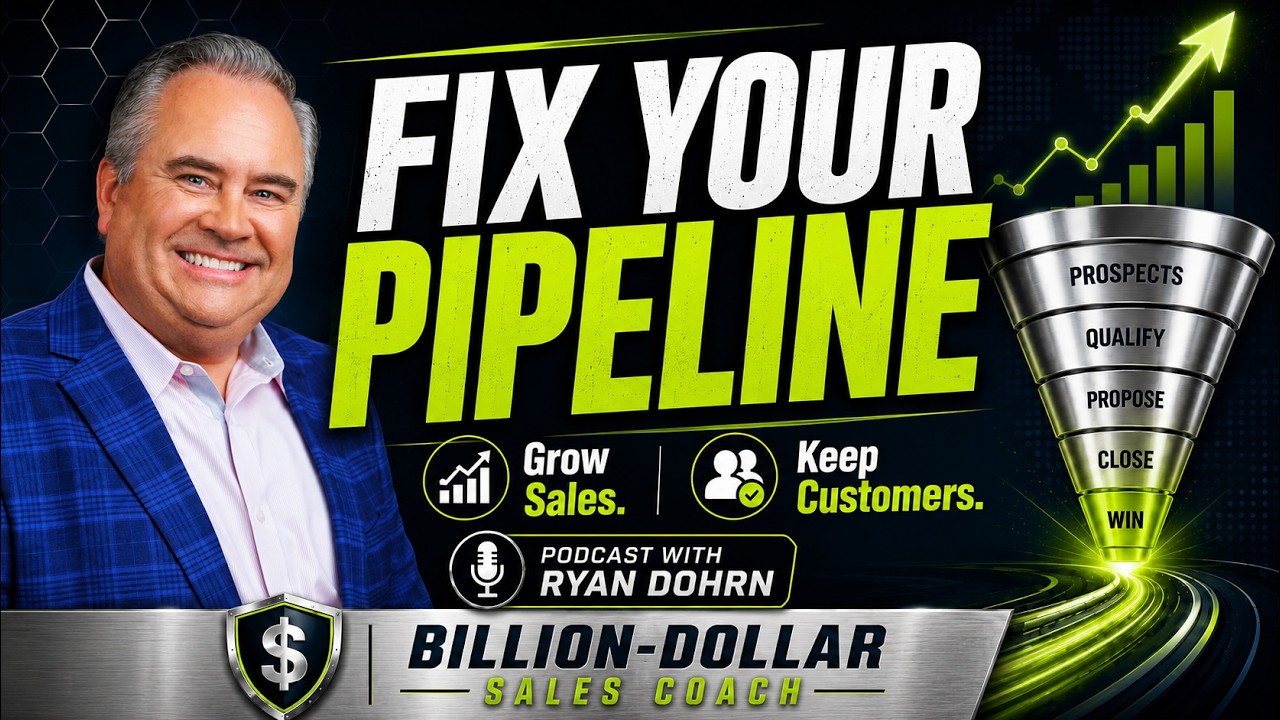
Ryan Dohrn teaches how to manage your sales pipeline by balancing new customers and retention, keeping churn under 20%, and using time-blocking and CRM systems as daily tools. He answers listener questions on reviving pipeline habits and countering economy objections with focus and urgency.
Questions this video answers
1) Stop treating the CRM as a second‑step; let it drive your daily activities. 2) Use built‑in dictation (Windows + H or Mac Accessibility dictation) to capture notes hands‑free. 3) Invest time in proper CRM training—watch tutorials, read help docs, and become a CRM expert to increase hireability.
1) Identify and target ‘carpe diem’ clients who want to invest during downturns. 2) Explain the Law of Loud: staying loud (maintaining spend) makes you louder when competitors cut back. 3) Challenge the ‘survey of one’ mindset by showing examples (Zoom, Kellogg’s) of businesses that thrived by staying visible.
Chapters
What is going on, friends and fans? Welcome to another edition of the podcast and the show here on YouTube. And hey, I sure appreciate all of your support. All right, this month we're going to be focusing in, friends, on what you can do to be a pipeline management monster or a master, whichever direction that you want to go, because we all know that it's all about pipeline management. Those that manage your pipeline well tend to kill it when it comes to getting those bonuses at the end of the quarter, month, or year. Then we've got listener questions. We've got your questions sent in from David that's up there in Minneapolis and then Renee down in Florida. David just wants to give up on his CRM. He says there's no value in the CRM, what can I do? And David, don't give up. There's a lot of value you can get from your CRM. And then Renee, she is really concerned because she's getting— all of her clients are really beating her up about the economy. They don't want to wait, or they want to wait and they don't want to buy right now. All that and so much more coming up straight ahead on this month's show. Live from the BrainSwell Media Studios, this is the Ryan Dohrn Business Show. All right, friends, welcome back to the program. Sure appreciate all of you joining us each and every month. Hey, if you've got questions or topics that you'd love for us to consider on the show, drop me an email, ryan@ryandohrn.com. Unlike a lot of trainers that are out there on the internet, I actually love to hear from you. And love to answer all of your questions. So we've got questions from David about a CRM, we got questions from Renee about objections, and that, friends, is all going to be coming up here in just a couple of seconds. All right, let's dig in on our main topic of the month, which is really all about pipeline management. What is it that you can do to become like a pipeline management monster or pipeline management master? I think one of the first things that you need to think about, friends, is that this really is not just something that your boss wants you to do. I mean, I guess it probably is something that your boss wants you to do, but you've got to be thinking about it from a little bit different perspective. When a pipeline is managed correctly, it's not just about incoming business. And that is one of the real fundamental problems that I think a lot of sales organizations have. You see, they spend so much time on getting things to come in the pipe. A lot of times they don't recognize that one of the most fatal flaws in the sales business is not monitoring how much is going out the other end of the pipe. So let's talk about that. In my opinion, and this is just my opinion, if your churn rate, or if you're kicking out the other side of that pipeline, let's just say more than 20% a year, unless you're in like a weird circumstance, one-off sales, that kind of thing. I try to keep my churn rate way down, less than 20%. So first thing you need to figure out is, are you losing customers and what's your churn rate? This might be surprising to you though, the number of times that I'm reaching out to customers of mine and they're like, hey Ryan, I don't have a churn problem. And then when we really dig in, they're misunderstanding churn and retention. They're the same thing. How many folks are you retaining? So that could be, say, 80%, and then your churn is, say, 20%. I don't care how you calculate it, but I do truly believe it's a fatal flaw if all you do is worry about what's coming in the pipeline and you don't spend time worrying about what's going out the other side of the pipeline. All right, so some retention strategies. I use companies like sugarwish.com, use companies like thanks.com without the A, T-H-A-N-K-S. You can do handwritten thank you notes. And, and look up here on YouTube the videos all about retention, because we do a tremendous amount when it comes to retention. Because I think we all recognize it takes 5 times the money Statistically 5 times the effort to keep somebody, you know, to get a new customer. I'd rather just keep them around. And now keep in mind though, a lot of you, you tend to go back to the well a lot. So just remember, always going back to the same customers all the time, okay? That's— that you can do that from a retention perspective, but if you're always selling them all the time, I think that gets to be a little frustrating for a lot of folks as well. Okay, so now let's go to the front of the pipe, okay? We want to make sure we don't have a lot going out the other end. Let's talk about the front of the pipeline. One of the first things I'd love for you to consider doing is if you would set up projects for yourself. Now I know a lot of you that are watching, you're not in my main media sales business. I spend a tremendous amount, 90% of my life— well, not 90%, but 80% of my life in doing media sales, marketing solution sales, technology-related sales. Now all of these ideas and all these strategies, friends, it applies no matter what it is that you're doing. So So let's talk about projects and what do projects look like. So as an example, I have an event that's coming up. I need to sell sponsorships for that. I break that out as a project and then I manage that project inside of my CRM. Now, no matter what your CRM is, you should be able to create lists, focused lists inside the CRM. So the project is really the same as a list. Now, for all of you like me that do fractional sales management or you're managing folks or coaching folks, When you manage from your CRM, you almost always have more success getting salespeople to use the CRM. See, a lot of times we'll talk about it because I think it was David that has a question on the CRM. When we talk about that, we'll spend a little time on using the CRM more. But when you manage from the CRM, you almost always have more success getting people to use the CRM. Okay, so the first thing I want you to consider is what do the projects look like? Okay, so I've got an event coming up, I've got a project for that. I have a special edition of an issue that I'm selling, I've got a project for that. Those that participate here in my podcast or YouTube channel, I have a project for that. So what I do is— and you can divide these up on a Google Sheet or Excel if you want to do that. I just prefer to put it all in my CRM and keep it there. Now, do I have some Google Docs and Google Sheets and Excel files? Yes. But what I don't have is a bunch of just files sitting on my desk, okay? I try to keep a moderately clean desk And I try to keep everything electronic because I don't want to lose all those papers, you know, and, and things like that. Okay, so the first step in pipeline management is make sure you're working projects because money's gonna flow where the focus is gonna go. Let me say it again: money's gonna flow where the focus is gonna go. Okay, and that's something that I always profess and I teach. It's important, friends. Focus creates success. Okay, and that's what it's all about, the projects and the lists. Okay, now the next thing that you want to do inside of those projects is you want to have sales math to know how many people you need to have in each one of those lists. Now in my case, I'm always working account lists of 50. I call it my Big 50. But I recognize that a lot of you, like, 50 is just daunting. You're like, there's no possible way. I look at it as, hey, the more I work, the more chances I have to kill, you know, a deal. And if I can kill a deal, I make more bonuses and more commission. I mean, that's just kind of how I operate. So maybe you're not a money-driven person. Why are you in sales? I don't know, but I just, I love the commission part of the sales process and seeing those deals close. So from a sales math perspective, I usually advise people, you probably need about twice as many people on the list as you think that you need. So let's just say that we're talking in a sales meeting and we're like, hey, we've got 10 people on that list. Well, using your sales math— we've talked about it a bunch, look it up on YouTube or on Spotify or wherever you listen to the podcast— sales math normally is you need to know your booking rate. And then, friends, you also need to know your closing rate. What's your close rate? Okay, your booking rate would be, hey, if I reach out to 20 people, can I usually book 5 meetings or, or 10 meetings. So if you're booking 10 meetings out of 20, your booking rate is 50%, right? If you're booking 5 out of 20, your booking rate is 25%. That is very different than your closing rate, okay? It's pretty common for most people to have a closing rate somewhere between 25% and 35%. Now, I did have somebody the other day that said, well, you know, Ryan, you know, I'm closing 80%. What can I do to close that last 20%? And I was like, okay, listen, Jesus of Nazareth didn't close at a rate of 80%, all right? And he was really good at his job. So just recognize you're probably not closing 80% unless you're discounting or selling something that's kind of a turn-and-burn kind of product. So in general, if you don't want to use my spreadsheet, I'll put a link to that in the description. From a sales math calculation perspective, probably if you think you need 10 you probably need 20. I mean, it's just a good simple way to kind of figure it out. So make sure you're using sales math to know how many people you need inside of each of those projects. Okay, and then the third thing that you need to do from a pipeline management perspective is you need to map out your day to make sure you're actually working these projects. Now, you might be somebody that only has one product to sell. Okay, if that's the case, what you might want to do is either break out your clients based on demographic profiles, you could do that, You might want to break out your clients based on where they live so that you're not calling West Coast first thing on East Coast morning. I mean, there's a bunch of different things that you can do to make sure that you're, you're time blocking correctly. But if you've got 5 projects, you probably need 5 time blocks. Now don't forget, I'm a really big fan of the Pomodoro Technique, and we've talked about it many, many times here on the channel. The Pomodoro Technique is Working 25 minutes on a list and then giving yourself a 5-minute break, and then go to your next list, your next group, and then work 25 minutes on it, and then take a 5-minute break. A lot of times what we do, friends, is we don't come off of task, we just change tasks. And that, quite honestly, is not— it's a way you're going to go and get burnt out. So I love the Pomodoro Technique. When I read about it first online, my understanding is it was developed by an MIT student. That was having trouble focusing. Now, neuroscientists will tell us, I mean, your brain heats up when you're working, and you do need to give yourself time for your brain to cool down. So what you might be recognizing, friends, is 25 minutes on and 5 minutes off. I mean, that might very much work out for you in your favor. So it is something that you very much want to consider. All right, so for me, becoming a pipeline— a pipeline management monster or master is about those 3 things. First, creating projects. Secondly, make sure you have sales math so you make sure you have the right number of people inside of all of those projects. And then the third thing that you want to consider is, are you blocking out enough time? Are you dedicating enough time to the pipeline process? Now, before we wrap up, I think it is important for me to share with you when you have the prospects on the inward side of your pipeline, That's perfectly fine, friends. But then also make sure you're dedicating time to the retention side of your business. I try to be, and we've talked about it a bunch, I try to be a retention machine, friends. I just think it's so important to retain customers because I know that it takes so much more effort. Oh my gosh, so much more effort to get a new customer. It's so much easier to just keep a customer around. So be thinking about those strategies as you think about pipeline management. Because we know, friends, and I've said it here on the show and I'll say it one more time today, money flows where the focus goes. And if you pay attention to that, you will almost always be more successful out there in sales land. All right, we've got 2 listener questions that we're going to answer here in just a couple of seconds. We've got David up in MSP, Minneapolis-St. Paul. He's super concerned about his CRM. He's not finding value and he just wants to quit using it. Don't quit, David. And then we've got Renee down in Florida who is asking about objections related to the economy. So if you'd be so kind, let me pay a couple bills. We'll be back here in just 60 seconds and we'll answer your listener questions. Hey friends and fans, you've been hearing me talk about my sales coaching app, and thanks to my friends over at Passion.io, that app is up and ready to go. So when you go to the iTunes Store or the Google Play Store, this is what you're going to see is you just search for the Sales Coach, My Sales Coach, or Ryan Dohrn. And then you're going to see daily motivational tips on your phone. And so this is where we've got all kinds of daily tips for you. You're going to get 14 for free, so you'll be able to watch on your phone. Like, this is a video I did on the secret sauce of sales. Then what you also have access to in the pro version is you have access to strategy reboots where you can actually go and watch all of the training that I've ever done online. Like, here is one on stop being ghosted by clients using video. Uh, in your sales process. Another thing that's pretty cool about the sales app is you get access to all these podcasts also, friends, in one place, so you don't have to go and find it anyplace else. So that's in My Sales Coach over on the iTunes Store, the App Store, or also in the Google Play Store as well. All right, friends, welcome back to the program. Sure appreciate all of your listener questions you sent into ryan@ryandohrn.com. If you didn't get a reply from us, either on the show, an email, a video that we might have recorded. I love your listener questions, and so we take a lot of pride in responding to those. But you know how the internet is, sometimes things get a little bit funky. So if you don't hear back from me, please resend that email and we'll make sure that your questions get answered. I take a lot of pride in that, so let us know. All right, first question comes in from David up in Minneapolis-St. Paul, and David says, Ryan, I'm just gonna give up on my CRM. seems like a complete waste of my time. I think it's a good CRM. I'll keep the name to myself, but I also feel like it's just a waste. What can I do to make it more exciting and get more out of my CRM? So, David, it is not necessarily uncommon for me to hear from salespeople that they don't like using their CRM. So there's really kind of 3 things that I'd love really for you to consider. The first is Most salespeople, they tend to make the CRM a second step rather than using your CRM to kind of drive your day. A lot of salespeople use the CRM as kind of a second step. So that'd be the first thing that I would love for you to consider. Now, you will need to take some time, obviously, to get your notes in order and that kind of stuff and, and get the CRM kind of working. But most CRMs are going to allow you to, at the very basic level, keep notes inside the CRM. Most CRMs will do way more than that, but I mean, they should anyway. If not, find a new one, right? But now let me pause for a second, David. I mean, that, that could be the problem. There's a lot of options out there, so maybe the CRM you're using is like not a good CRM because you didn't give me the name, and I'm not here to throw shade on any of the CRM companies. Recognizing though, David, that when it's not your guide and it's always a second step, then guess what you're doing? You are always constantly just putting notes in the system. You're not using it to drive your day. So what I like to do is I want to use the CRM to keep up with my notes, but then if you go back to the beginning of this video, I use my CRM to create projects and lists. Every CRM that's out there that's worth a darn, friends, you can create lists inside the CRM, whether it's by category searches or tagging clients or Whatever your circumstance is, pipeline status can be updated, a deal count, all those kind of things. So David, you really want to use it for a purpose, and then what you'll typically find is that you will have better success. Now, the second thing you want to consider, David, is do you dictate or talk to your CRM? Now, I'm not talking about AI. I don't actually like a lot of the AI plugins on some of the CRM products because I feel like, like, get out of my business, right? I don't need AI to help me with that. Side of the business. So you really want to be thinking about, are you using— so if you're on a PC, you click Windows, okay, H, and then that's going to turn on your dictation tool. Now if you're cool like all of us that have Macs out there, then what you do is you go under the Apple menu. I think it's under Accessibility or Dictation, General Settings, and turn on your dictation tool. Then what I do is I can just put my cursor there in the box Just the way I talk to my phone, I can talk to my computer and I can dictate notes into my CRM. So David, come on, man. If you're so lazy you can't talk to your CRM, then I don't know what to tell you. But I think that's an important piece. Now the last thing I'll share with you on the CRM, and this is super common, David, and everybody. And David, you know, I don't know that we know each other, but I will share this with you. Normally when I hear questions like this, it's because you are not a CRM expert, meaning you have not taken the time to get properly trained. Now, here's the problem. Most CRM providers are great at providing the CRM, not necessarily so great at training. So you've got to be asking yourself, am I watching the videos? Have I been properly trained? Can I learn about it on places like YouTube or Spotify or iTunes or, or whatever? What can I do to really become a CRM expert? Because never forget this, friends, it is very attractive In the sales business, if you can actually use a CRM very effectively. Like, if I'm going to interview you and you're going to say to me, hey, Ryan, I'm like an expert at CRMs. I love my CRM. Listen to those words. If you say, I love my CRM, I love my CRM, the next hire— person that hires you is going to go, oh, heck yeah. If you say, I want to use my CRM every day, I live and die by it. It's a very hireable trait. Okay. So that is something for you to consider, right? So David, don't give up on your CRM. Figure out ways to potentially use it better. All right. All right. Next question here comes from Renee, and Renee's question is this. Hey Ryan, we're getting beat up about the economy out here. I am in the advertising sales business, just like you. Please explain to me if someone says, I'm not going to buy anything until the economy is back in order, Really, what should I do about that? So Renee, this is a super common objection. It does apply to almost everybody that's in the sales business. I was recently working with a rather large company, a lot of you know, that sells products related around waste management and those type of things, and they're hearing the exact same thing. So this really is not isolated just to the advertising and media space. So there's 3 things I'd love for you to consider. First, those businesses that take advantage of economic downturns, so they carpe diem the moment, those are the businesses that tend to not only get through a crisis, but they tend to thrive or grow on the other side of the crisis. I would say probably the biggest example of that is Zoom. I mean, look what Zoom did during COVID They spent every last dollar that they had On advertising when what did everybody else do? They just went silent. I mean, when is— I mean, seriously, when's the last time you've been on a GoToMeeting or the last time you've been on a WebEx? Some of you don't even know what WebEx is. You don't even know what GoToMeeting is. And keep in mind, it's not because people say, well, it's because Zoom was free during COVID I don't think— I think that was a good marketing campaign, but that really isn't why people began to understand how to use Zoom and use video components to drive their business and help, help their business excel. So, there's people that will carpe diem the moment. So, what you might wanna do, Renee, is look for that type of attitude. If you've got business owners that wanna carpe diem the moment, really take advantage of that. Now, the next thing though, Renee, that I would point out is that there's a thing called the Law of Loud. And I think for those of you that aren't in the advertising business like I am, I do a lot of technology sales work as well. But when you think about the idea behind, you know, just making sure that the Law of Loud, works in your client's advantage. So let me explain the Law of Loud. So have you ever been like in a restaurant talking to your spouse or partner or whatever, your friend, and then everybody else in the restaurant started eating? So the restaurant got quiet, but the person you were talking to just kept talking at the same volume. Well, then all of a sudden you're like, hey, hey, you're really loud. They just don't realize it, how loud they are, because the Law of Loud, what happens is when others reduce their volume, you artificially seem louder even though you're not talking any louder. Okay, so let me explain the Law of Loud in advertising. The way that it works is this: if an advertiser is running, say, a full-page ad in a magazine, or they're running a $10,000 campaign online, and all of their competition is doing the same thing, well, the moment that their competition goes from $10,000 to $5,000, and they stay at the $10,000 level, they are louder by the nature of the law of loud. They just get louder even though they're not spending any more money. Okay, let me explain that in a different way. If you've got 3— let's say you're in the TV business and you have 3 advertisers that are lawyers, okay? And 2 of those folks, they decide that they're not going to advertise much anymore, but this particular person here, They keep right on advertising. When those other 2 drop out and that one stays, it makes them appear louder from a share of voice perspective, because guess what? Everybody else turned the volume down. So, Renee, look for clients that want a carpe diem in the moment. Understand and explain what the Law of Loud really is. And then it's also a subtle recognition that when you back off of things, A lot of times you're not following trends, you're following your own survey of one. Okay, so what is the survey of one? The survey of one is when a business owner or you yourself survey yourself. And so you might say to yourself, well, as a business owner here, I live in the Augusta, Georgia area. As a business owner in Augusta, Georgia, you know, right now the economy's tough and so every business is cutting back. Well, is every business cutting back? Or is that how you feel about it? That's called the survey of one. So you do need to be strong, Renee, and push back on people that you're like, yeah, but is everybody else making that decision? So a lot of times I might say, I understand why you might think about cutting back, but what I'm observing is that people aren't doing that. And we actually have examples, of course, across the course of, of history, like Zoom. You can go back to the Great Depression and see that post-cereals got Honestly, kind of got their butt kicked during the Great Depression. And Kellogg's—I mean—they came in and they spent a lot of money, and they rose to fame. What did they do? They just got loud. So a lot of times when times are tough, it's incumbent upon us as salespeople to make sure we point out to folks that you know not everybody is making the same decision that you're making, especially if it results in cancellations and all of those types of things. So I'm David. Renee, thank you for those questions. I hope that is helpful. And then friends, what we're also going to do here coming up in the next couple of weeks is we're going to take a bunch of questions and we're just going to go live on YouTube and Facebook and answer all your questions as well. I love those questions. Keep those questions coming in. Send them into ryan@ryandohrn.com. D-O-H-R-N. ryan@ryandohrn.com. You know, friends, I really appreciate all of your support, all your good wishes, especially here recently when I got pretty sick with bronchitis. After traveling. So thank you so much for the flowers that you sent and all that kind of stuff. I really do personally appreciate all of your support. And what I'd love to do is I'd love to come train your sales teams. I'd love to come speak at your sales conferences. I've got 40 topics to get your team really, really pumped up. But just like was said in that commercial break, also love for you to go onto the Google Play Store or the Apple App Store and download my sales coaching app. So just look up Sales Coach Ryan Dorn, and you always get 14 days for free. There's something I can do for you. Reach out to me, ryandorn.com. D-O-H-R-N, ryandorn.com. So never forget, friends, if sales was easy, everybody'd be doing it, and they're not. I used to say we're crazy. I mean, we are a little crazy. We're not crazy, friends. This is a career, friends. It will really feed your family for a lifetime. So get out there and sell something today. Take this information and put it into action. And just remember, sales is a great business to be in. Never, ever forget that. All right. God bless y'all. We'll see you out there on the street. Get out there and sell something and make us all proud today. Stick around. Stay close. Another episode coming up on prospecting and using AI for research. So stick around for that. All right. We'll see you on the next episode.







