This content was created by Ryan Dohrn. This content was uploaded by Ryan Dohrn. This is a YouTube video titled "Horse First Aide, Equine Clot Trama Gauze for Horses" (posted June 15, 2012) presenting a product demonstration and promotional interview. Presenter Craig Cameron interviews Allison, a company representative, about Equine Clot — a kaolin-impregnated gauze developed from a military product for stopping bleeding on horses. The clip explains the product's composition (kaolin mineral), safety (inert, natural, no side effects), use (pack wound, apply pressure, wrap with elastic bandage), typical application scenarios (lacerations, punctures), shelf life (~3 years), and its portability for riders and horse owners.
Chapters
Hi, I'm Craig Cameron, and I want to tell you about a super cool new product that I've come across called Equine Clot. Hey, whether you're at home or out on the trail, it's a product where if your horse got cut or lacerated, you could stop the bleeding. It's simple and so easy to use, light to carry. Now, Allison— I got Allison here with me from the company— how did this product ever get started?
Well, Craig, I work for the company that developed this for the US military, and I was carrying the military product myself in my saddlebags every ride I went on and felt that every horse owner should have the same opportunity to carry it with them. So I approached the company about making an equine product, and they thought it was a good idea, and thus Equine Clot came about.
Now, Alison, what makes this product work? What actually stops the bleeding?
There's a mineral impregnated in the gauze. The mineral is kaolin.
Kaolin.
And it's an inert mineral.
Which means?
Which means it's natural, it's safe, it doesn't have any side effects.
Interesting.
And it speeds up the body, the horse's body's natural clotting process.
Exactly. Now this is a natural product that's in there.
Yes, it is, and it forms a natural clot.
It sort of comes from like a clay or something like that.
It's a derivative of clay.
Wow, that's amazing. So again, very natural, safe for the horse, no side effects, and you know, it's so easy to carry. And now again, because of you actually, it's, it's It's available to the general equine public. A guy can carry this bandage with him all the time. Hey, it's light, it's easy to use, and it's very effective, and it's something that we're going to all want to have all the time.
Craig, it's important to note that it's a gauze. It's soft, pliable, easy to use, conforms to any wound, and it's not going to leave anything in the wound or affect any future necessary procedures by a vet, like stitching.
Again, it's safe, it's easy to use, it's natural, no side effects. It's now available to the general equine public. Hey, this is a must product with a shelf life of over 3 years. And just about anybody can do it. I mean, you don't got to be a vet or a doctor or anything like that to use this.
It's in a gauze form.
Let's take a look.
It looks and feels like normal gauze, and the mineral's impregnated in the gauze.
Wow. So it— what, it's just like a regular Just a bandage or anything like that.
Like a surgical gauze.
And it's just the ingredient is just within the gauze itself.
It's impregnated into the gauze, so it doesn't flake out or leave anything in your wounds.
It doesn't come off, yeah. And you know, and so what you do, depending on the wound, you just sort of stuff it in there and that'll stop the bleeding.
It works with contact and pressure.
Right.
So you want to get as much of the gauze in contact with the bleeding site.
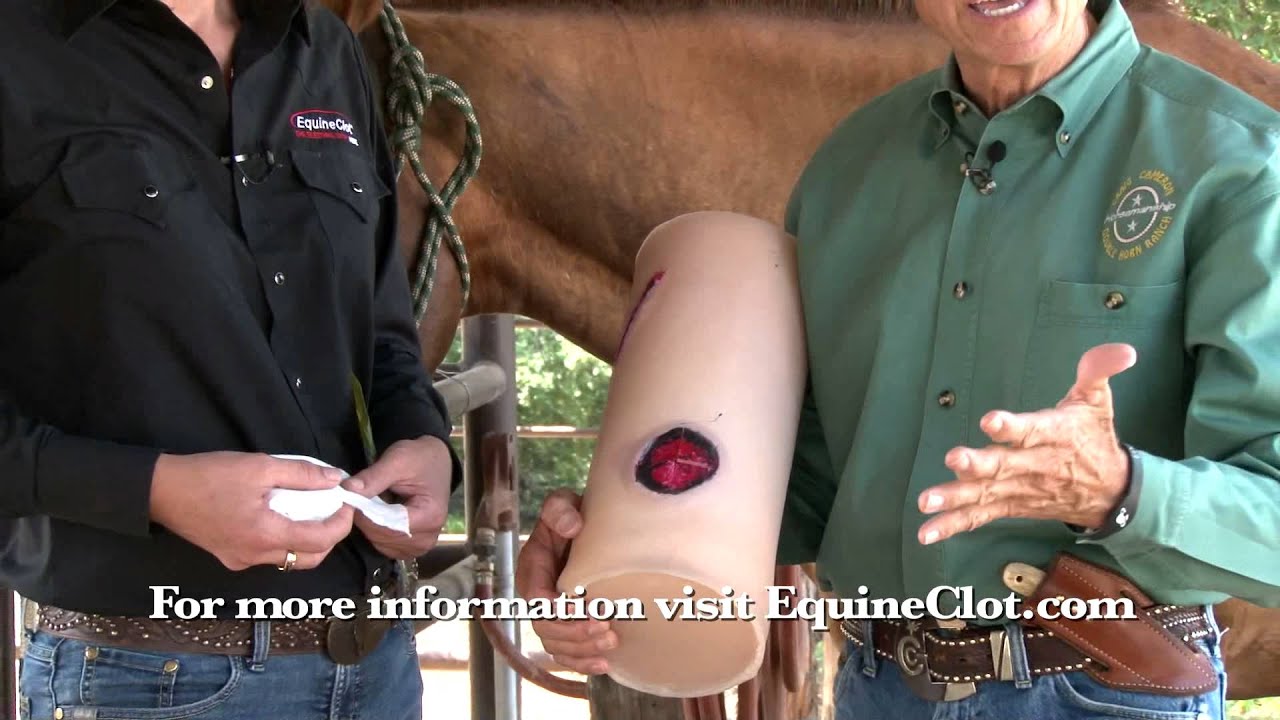
You know what, let's bring up this military tool that they actually use, let the troops pray Practice with and it simulates a wound or anything like that and you get a chance to really practice with this thing. Let's bring that up right now. Now this is a military training tool. The military actually uses this to simulate wounds so the soldiers, just the everyday soldier, can practice with this type of equipment to stop the bleeding of a soldier. We're going to do the same thing with our horses. So again, if the horse had a big wound like this that was bleeding, show them how you would actually use this and apply it, what would you do?
You want to pack as much of the product into the wound.
Just pack it into that wound.
Because again, it works with contact and pressure.
So you just stuff it in there.
So you want as much contact with the wound as possible.
And then once you get enough in there, you just— that's probably as much as we can get in this one here, just about. You can see you start really stuffing it in there. That's about right. It's packed in there pretty nice. And then just—
Hold pressure.
Right. And then within seconds, it's going to stop the bleeding.
It depends on the type of bleeding you're dealing with. If it's just a surface laceration, then 2 minutes. If it's an arterial wound, a pumping blood, then you want about 5 minutes of manual pressure.
Right. And boy, that, that's pretty easy to do. Now again, if we went over to this type of a wound here, Right here, which is very typical of a lot of horses where they come in with these cuts and all of a sudden they're bleeding, which is very scary. You do the same thing, you just stuff it in there.
Do the same thing, stuff as much as you can into the laceration. And with the laceration, the pressure, if you wrapped it with an elastic stretch wrap, would be enough.
And then, you know what, so you could just take almost like a vet-type wrap After you've put this in there, wrap it on there to help with that pressure, and that bleeding is going to be under control.
That's going to stop it.
And then if it's a bad enough wound, then you could call the vet or haul them to the vet, and you're not having that continual bleeding, which again can be fatal to the horse and of course scary to the owner. You know, another typical wound right here, the Army uses this, the military, that would be like a bullet wound. But man, I have seen so Many wounds like that on a horse. We call them puncture wounds, and they come from sticks and nails and in the trailer. So it would be the same thing, we could stuff it into a puncture wound as well. So again, you can see how easy this is to use, how effective it is, how easy it is to carry. You know, it's so lightweight and all that type of stuff. I mean, you know, I'm going to start having it in my saddlebags, in my vet kit, and it's one of those tools You know, better to have it and not need it than need it and not have it. Allison, I got Twister here. Why don't you show me how this would actually work on a wound on a horse? Now, if Twister had a wound or laceration in this big fleshy spot, that would bleed a lot. You know, again, really scary, a lot of blood coming out. How would we apply our tool to this right here? How would we apply the Equine Clot?
We would take the gauze and again pack as much as we can into that wound, and then holding pressure, right, and go ahead and use that elastic wrap.
Then you could just get an elastic wrap, put that thing around there, and start with— and start applying pressure right here. And boy, it wouldn't be long, that thing would Right quick, you'd have that wound under control.
Craig, this has a shelf life of 3 years. You can keep it in your hot trailer, in the cold barn, your saddlebag. It's lightweight, easy to open, even in your pocket if you had to.
Well, that comes out to be just pennies a day for the safety and security of your horse. I think that's a product that's more than well worth it. I know it's one that I'm going to have with me At all times. You know, what a great tool, what a great product. I think it's going to catch on immediately. But you know what, in reality, for that price, for that kind of assurance and security, you know, it's one of those tools that, you know, is really all about the love of the horse.