10 Lessons Learned Scaling to $1B Valuation with Drift Co-founders David Cancel and Elias Torres
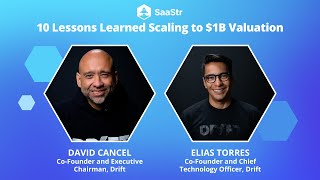
Drift co-founders David Cancel and Elias Torres share 10 lessons from scaling to $1B+. They stress that people matter most, advise burning the ships with no plan B, and say winning in crowded markets means building strong brand and messaging first, not chasing valuation headlines.
Chapters
Please welcome Drift Co founder and Executive chairman David Cancel and Drift Co founder and Chief Technology Officer Elias Torres.
The cups are up there already. Both. How's it going? How's it going? Nice. Thanks for having us. They told us the only rule was to stay in this box. We can do anything outside the box. So I'm David Cancel. I'm the executive chairman and co founder of Drift.
I'm Elias Torres, Chief Technology officer and co founder of Drift.
So welcome to day one. We're so excited to kick off Saastor. This is my first time being here in a long time. We were banned for four years. Note to self, don't ever do any guerrilla marketing tactics here.
Here.
We'll talk about that later. All right, so we launched Drift in 2015 to really focus on the way that businesses connect with other businesses. And we saw something happening in the world where the power is moving from the seller to the buyer. So today we're proud to have over 5,000 customers. We're on a bunch of lists that we're not allowed to talk about. And we have 600 employees globally and happy to be partnered with Vista Equity.
But how did we get here where we are today? It's been a long road. The early days of Drift were really amazing. Back in the day, our name was drift with two T's because David was too cheap to buy the drift.com domain for $100,000. And in those days, we could have off sites and we can hang out with the team at somebody's house because David didn't want to spend money. It's too cheap to go to a restaurant with the whole team.
True.
You get it, right? And so then what happened was that in our first offices, we just bumped office space from our VCs because David was too cheap to get real office space. But we come a long way. We were just merely a product, a chatbot product. And I'm overwhelmed just thinking and the joy that I have of how great of a company we have built. But I want to tell you something. There's something I think about all the time. Whoa, whoa, whoa. Startups are hard, okay? So you gotta. If you're a founder, you gotta put that. You have to commit. You have to commit. And it's something. You have to look at yourself in the mirror every day and think about it, that it's not going to be a straight journey, right? There's going to be a lot of ups and downs. In fact, David and I relationship started. It was a little rocky at first, right? I remember the first thing I did is I emailed him on LinkedIn and I said, david, I'm interested in getting an intro. I want to get a job. I want to leave IBM and get into the tech space. And I'm going to make the story short, but next thing you know, I'm working with David at a company called Lookery, and on the first day, David tells me, you know what I hate the most is when people message me on LinkedIn trying to get a job. Don't do it. And then I was like, okay, good, I'm here. I'm glad I made it. Then the next thing I know, I know from Twitter that he used to go to this beach with his family. So I said to him, hey, David, I was thinking of inviting him. And we go together, small startup, and we go to the beach. And David is like, you know what I hate the most after people message me on LinkedIn, hanging out with coworkers after work. And so that's kind of how our relationship started. And the truth is that we're complete opposite. And this is like, I think the first day ever in, like, 15 years that we're on stage together.
So we'll see how it goes after this.
A lot has gone on. Rocky start.
Mm. So you could say that our initial meeting was confusing. But, you know, when I got to meet Elias and spend time with him, I thought, oh, wow, a couple things stood out. One, we had kind of a shared vision of what we wanted to create and a shared set of values. Although we are complete and utter opposites, we're never allowed to stand this close to each other. And I knew that, you know, he wanted to do the same things that I wanted to do. The other thing that really stood out to me was that we both had this passion for wanting to create role models and help other Latinx founders. In fact, alias, this was 2008 when I met Elias the first time, and that was the first time that I had ever met another Latino in tech, if you can believe that. My first series of startups were in New York and Boston, and I had never worked with one. Obviously, I knew there were others. So it was amazing to meet Elias and we had kind of the shared same experience. We were raised by single mothers. We both taught ourselves to speak English. You could tell by our English. And. And we both learned everything that we had to learn to create a company.
It's been a long journey to get here. And again, I'm reminding you that our startups are really, really hard. So today we're proud and privileged to be here sharing the tips and lessons, just 10 of them. We have hundreds. We have many scars that we have learned throughout the years, but we want to share with you 10 of the most important lessons on building a unicorn.
So, all right, so lesson one that we want to share with you is that the most important thing, and I think Elias says this all the time, is that is the people, right? I used to think as a product based founder, I was an engineer a long time ago, like Elias was. I used to think everything was about building the product right, getting the product right. And the more time that I've spent doing this, the more that I figured out that it's like it's actually 99% people and the team that you build and surround yourself, the community, your investors, everyone, your customers. And it's like 1% product and process. And so it's really around getting that team right? And in the early days that's super important because in the early days we all did, you know, 10 to 100 jobs, right? Your job is going to constantly change. But you know, as you scale a company, scaling a company is not just about hiring people. Scaling a company is about really enabling the people that are on your team. And we had to set out to do a lot of teaching and helping people understand what are their strengths, what are their weaknesses, how can they complement each other. We did everything from internal podcasts to leadership principles and trying to like help everyone scale themselves and scale the company. Alright? So it's never going to be smooth failing, you're going to continue to fail. And I think the one thing that's hard for doing this over and over and being doing a startup more than one time or being a serial entrepreneur is that you're constantly in this state of discomfort, which is not a normal state to be in. But it's okay.
Lesson number two, do not be afraid to venture into uncharted territories. How many of you are thinking of starting a company? Raise your hand. Okay, we got some. How many of you have already started a company? Oh, look at that. Right? So this is amazing, right? So you know this very well, but I just want to make sure that we keep reminding you this startups are hard, right? And so what happens is that you really have to have this no plan B mentality. You have to burn the ships. The good thing is for us, we really had nothing to fall back on, so we had no choice. Immigrants, not a lot of networks and not a lot of like parents with a lot of money. And so we Were like, this is it. This is everything that we have, and we want to give it everything every single day. And so one of the things that we thought all about, that we had an idea, we knew the problem. Having been at HubSpot, we understood the problem of how customers were not being able to get in touch with their businesses, right? But the problem is that this was a red ocean, right? Fancy word for lots of SaaS. Companies like, look at all your hands, right? And so we were entering a red ocean with a lot of blood in the water, Many, many companies. And we were trying to figure out, how do we turn this red ocean into a blue ocean. A blue ocean is where there's no companies, where then you have. You can create new demand, create a new category. And so what we did is we set ourselves out to carve out a wedge in the market. We carved out our own blue ocean in an existing red ocean. And that's how we started Drift, right? We started with a small slice of the product, which is building a chatbot for sales on your website. But before we set ourselves to do that, we had to make sure that the team was aligned, and we had to get a team that was ready to go along in this journey with us. And that was one of the most important things that we could have done early on, right?
So lesson three, right? And this is the one that took me a long time to figure out throughout my career, which is it's not about focusing on idea. I think when many of us try to start a company, the first thing that we focus on is the idea. What is the idea? I want to bring an idea to market. I want to build something, whether it's a product or service or what have you. And it's not about an idea. I learned this through lots and lots of years of pain, that it's not about the idea, but it's about what is the shift that's happening in the world, right? And so when I talk to founders now who want to start companies, the first question and the only question that I ever ask them is, why now? Right? I think that's the most important question. Why now? Is this the time for you to start this business? Right? What is changing in the world that's undeniable, that's leading to behavior change, that's going to create an opening to let you create this company? And most of us, including myself in the early days, could never answer that why now? Question. We always wanted to go to what? Here's what I want to build, right? Instead of first Starting with why, why is now the time to build this company? And so when we started drift, we saw a couple things happening, but we saw two major things happening. The first we kind of mentioned, which was we saw this shift happening from a world where there was lots of supply, a very limited supply. And so in that world, the companies or the sellers had all the power. So from a go to market standpoint, from a marketing and sales standpoint, that meant that they could make you come to a website, fill out a form, make you wait, wait weeks, get a bunch of emails, never get in contact with the person that you're looking for. We saw the shift happening quickly that was leading to a world basically because of, especially in SaaS, all of us in this room today, lots of alternatives in the market, which meant the power was now shifting to the buyer. So when the power shifted to the buyer, everything in the go to market world, whether it's a marketing tool, a sales tool or a service tool, had to be reimagined at some point, right? To go from a world from CRMs and marketing automation built for sellers to worlds for tools built for buyers and helping them to buy easily. The second shift that we saw was that we were moving to a messaging first world, right? And so I always tell people, you always want to look for kind of an undeniable shift, an undeniable trend, because that is what creates behavior change. I think when you start with what to build and not why, you ultimately build a better tool. But it's really hard to shift someone's behavior to use your tool. And that's where most early stage startups die and that kind of valley of trying to cause behavior change. And so the behavior change that we saw was that we were moving from a world where it was primarily phone calls and emails as a contact point to all of us, from our kids to our grandparents to our co workers defaulting to a messaging first world. So we said we're going to use messaging messaging as our wedge into a market and to penetrate this red ocean.
Lesson number four, hire people that are smarter than you. This is how David and I separate our jobs. He does all that vision and great ideas and I go hire the people to make it happen.
Because I don't like to talk to people.
Because he doesn't like to talk to people. He's an introvert, I'm the extrovert. And so what happens is that first of all you gotta go find a great co founder. I hope you have a great co founder, one like me maybe, right? And Then he hired someone that was smarter than him, and then I had to go hire everybody else that was smarter than me. That's the key. That's how it works.
That's the key.
And so, you know, I have on my LinkedIn, like a cliche, a tagline, and I say I build teams first, products, then follow, right? Because I can do this alone. He cannot do this alone. For sure, right? But what I want you to think about is how are you going to go about finding those people? You have to love talking to people. I know a lot of founders call me and they're like, how do I hire? Which agency should I use? Where are the leads? How do you contact them? It's so hard to find the right person. How do you convince good engineers? And so it's like, you know what? Startups are hard. So what happens is that one of the things you have to do. I'm really good at hiring engineers because I'm an engineer myself, right? I'm extrovert. I go talk to them and I can tell a good engineer in about five minutes of a conversation. I kind of know whether I want to pursue this person or not. However, when I have to hire people in the other roles in the company, I've learned also to follow, to be more disciplined. I cannot use the same gut feeling and experience that I have for engineering and. But I have to check references. We have to involve the team. We have get more people interviewing. But most important is that you have to understand what you're trying to find out about that candidate. Don't be fooled. If they sound smart, if they're smart on paper, if they look, if they went to the great schools, because I don't believe in any of that, right? It's like they can sound smart. I have hired too many people out of mit, out of Google, and they're not really a good student if they're not aligned to the mission, the vision of your company, if they're going to work hard, if they think like you, if they have your same experiences, if they think, no plan B. And I want to go hard at this, right? And so really you have to learn how to find those people. And so at Drift, you know, for example, one of our principles is seek feedback, not consensus. You need to find people that are willing to make decisions before everybody, before waiting for everybody to tell them what a great idea that is. They have to go and just start and try it out and not be afraid to fail. And so just because someone is smart on paper doesn't mean that you should just hire them. So very important that you learn how to hire smarter people than you that are aligned with your mission.
So hopefully someday you'll be giving this talk without me. You'll be at that level. All right, Lesson five, find investors that act as partners. Now, not every business here or any business that you're thinking about starting is going to require investors. But we did at Drift and we were a venture backed company. And so if you're going to go that route, if you're going to raise from investors, you really have to figure out and find those investors that align with some of the things that Elias was talking about. Right. What is your mission and vision? Do you have the same kind of values that you have? And that's really, really hard because, you know, usually your exposure to investors is during the dating phase, right? And so the dating phase looks great, right? So like you don't know what's. Everything is great, you're being courted, you're going through that dating phase. And then later comes the hard marriage phase, if you actually end up working with them. Right. And so that's a hard thing to do. We were lucky at Drift. When we started Drift, we weren't first time founders and so we could work with investors that we had worked with in the past that we trusted. But if you don't have that advantage, you have to really spend time digging into, not them so much, but once you go beyond them, but all the companies that they have founded, all the investors, the entrepreneurs that they've worked with, especially the failed ones, the ones that have gone through acquisitions and really talk to them, figure out like, is this someone that you want to bring on the team? So I have a knack of only starting companies in recessionary times. So, you know, I've had to really deal with investors during some really hard times. And luckily we've been lucky, especially at Drift, with amazing investors.
Because we work with them over and over too. Stick with the good ones. Lesson number six, pivoting isn't a bad thing. I think that pivots and tax. I think everybody is really afraid to talk about them, but I think it really boils down to ego. I think that we have an idea and we're so excited and we want to start a company around it. And we don't want to change that path from that idea because we might, we're afraid that we might look dumb, right? Or like, oh, we had the wrong idea. But guess what? Drift did not know what we were. We didn't know what we were going to build right at first. In fact, it took us a few years of experimentation and doing a lot of pivots. We had to think about, okay, what are we going to work on? And we would try something, and if it didn't feel right to us, if it wasn't big enough, we would scrap it and we would start over. In fact, I remember one day one of our board members came up to me and said, I really appreciate that you guys come strong to us when you have a new idea, a new hypothesis, a new conviction, and you're willing to let it go. At the same time, we're trying to advise our founders to not stick to that, to make sure that they listen to the market, that they talk to their customers, that they check for the competition, that they understand the ocean that they're working in. To make sure that you're doing the right thing and looking for the best outcome. Right. Because you want to be able to address the biggest problem that you can find in the market. And so don't be afraid to make a mistake to change tags. But what's most important is that you bring along the team with you. Every time we would make a tag, the team would get tired because they would be so excited, and they would pour all their energy into building something. And. And then we're like, we have to change. So when you do that, you have to bring them along. And one of the mechanisms that we used to bring them along with was off sites. And I'll tell you, the first time, David was like, we got to do an off site. And he brought a friend of ours, advisor, who's now CEO of Drift, actually, we brought him in, and I said to him, I hate off sites. I hate brainstorming. I don't like doing sticky notes, affinity diagrams, trust falls, all that bullshit. I hate it. I hate it. We just got to make a decision and go. That's usually how the conversations go between him and I. And now I realize how important they were because we could bring the team together and collaborate and everybody understand why we were making this shift and that they were part of the decision and they were understanding of the strategy instead of us doing it behind closed doors. So that was an important tool that we used. And in reality is that the power of the pivot is what got us to where we are today.
Absolutely. So lesson seven, don't fear incumbents and Alias touched on this a little bit. Right? So, like, for most of us, we live in a world now where we're going to start a company in what we call what we know as the red ocean, right? Somewhere where there's lots of competition. And early on I remember founders talking to me when, when we were starting Drift or we were starting other companies and they were like, weren't you afraid of competition? I was like, I'm not afraid of competition. Competition means there's a market, it means there's demand, it means people care that they give a shit, right? Like I'm scared of markets that have no competition in them because they're usually not a market. Right. Especially in our world in software. And so you can't be afraid of incumbents there. What you have to figure out is again, how do you use a shift in the world? How do you use something that's changing to kind of resegment a market to create your own blue ocean out of that red ocean, right? So for Drift, we were the first to provide chat for sales and marketing, right? There were lots of companies for as long as I can remember that provided chat for support reasons. But we were the first to do it in a sales and marketing use case, right? And so we did that early on we segmented that market and now we've created this category, conversation marketing. There's hundreds if not thousands of companies in that today. And so you have to figure out how you're going to create and resegment a market and then how are you going to stand out? And so one of the things that we did because we knew we were in a saturated market when we started the company was like, from a marketing and branding standpoint, we focused on never doing anything that was conventional. So our motto, internal was doing the things that don't scale. And so everyone would look at us marketers and salespeople from other companies and they'd say, that doesn't scale, that doesn't scale. And those were the tactics that we used early on in order to stand out. And we actually wrote a book about it. It's called this Won't Scale and you can download it free on our website. It's like the 56 plays we used in the first few years of the company to really stand out from a branding and marketing standpoint. So we took that same approach to everything that we did. We created and Alias hated most of these things at the time. Created a podcast again a long time ago. Now it's hard to stand out in that world we created, but that was not about us, but was about people that we wanted that had the same interests as us. We created an event called Hypergrowth which is, this reminds me, much like Hypergrowth, we did that for the first year of 1,000 people, second year 2,000 or 5,000 people, last year 10,000 people. And we kept doing these things because no one else at that time was willing to do it.
Lesson number eight, in a saturated market, you can't win on product features alone. You have to win on brand. And it's kind of weird. I don't know why I got this slide because I'm the engineer and he's the marketer. But I guess the story of this is that back in the day when we were just starting, we neither had a product nor a brand. David would go and get into the room and work on this podcast and. And they would be recording this podcast and they would be all excited about it. And I would be saying, why are you even doing this? This is not going to get us any sales, right? And so we had these arguments all the time because he was spending all his energy and focus on creating a brand. And then I realized that was one of the most valuable things he could have done for the company. But what's important is that you have to follow that brand creation, that audience, that content with the product that serves the needs of the customer. And we had to do a fast follow to create drift as it is built today, right? And so because what happens is that you need to understand what stage of the market your company is in. David taught me that there's like three major categories for marketers, for markets, right? The first stage is the Edison stage. When you're inventing something new. That's. No one has built that before. So you don't need brand, you don't need marketing. You just gotta focus on making sure that you make that happen, make it a reality. Stage two is the Model T. When you're building products at scale factories, assembly lines, it's about efficiency. How can you build the most of these things that now they already have been invented? And the third stage is the P and G Procter and Gamble stage, right? Where now you have to win on brand and differentiation. And so you have to understand what stage of the market your product is in and make sure you build for that. Sometimes you don't have to create a brand, but if you do, start creating that brand early and make sure that you involve everyone, including your engineers.
All right, lesson number nine. So as Elias was saying, it's not just about building a brand. For us, it wasn't just brand building exercises. In the beginning, it was about there was an audience that we wanted to build for, that we had empathy for. And we wanted to figure out how do we connect with that audience. And we started to create things like podcasts and events that we thought would target or would be liked by that audience that would be shared common interest. And so we built the company, the product, the brand and everything that we did was built around that initial set of that audience that later became customers, right? Those early fans, there were people like us that we had this empathy for, that we wanted to build for. And that was the important thing to do. Sometimes, you know, marketers want to focus on measuring everything and the effectiveness of brand or your demand generation campaigns. But you can measure whether your brand is resonating. Those early days, we resonated it by actually talking to people, by actually talking to them and having conversations with someone instead of saying, oh, I heard the podcast or I heard you speak at an event, or I came to your event. And that's how we knew it didn't show up in Google Docs, it didn't show up in any stats tool. But we knew it because we were there talking to our customer and our product that we created at Drift Aloud. Companies like us to do that at scale.
Lesson number 10, don't use stock photography. I'm sorry, Run Les.
This violates all my stock photographs.
This is not us. Don't solely focus on valuation.
Right?
And I think it's easier for me to say that here. Like we, you know, we became a unicorn, we sold to a private equity firm. It's fantastic, right? But you know what, I'll tell you the truth, what I really enjoyed the most, it was building the company, right? What's most important is finding the right people. You gotta find how are you going to create that brand. Talking to customers, right? Building the product, building the culture, our principles, those are the things that are most important, I think that we are so focused on, on the valuations and what was happening during COVID and we wanna get there, but you have to be patient. I mean, it took us seven years, right? And it took us 20 something years. We've been working together for 15 years before that. This is the fourth company we worked on, right? It's not overnight success, but what really resonates with me, what really stays with me is that we're building a company with the right principles. And now after this market downturn, we all have to think how do we build companies more efficiently? And there's not an infinite pool of money we have to think about, do we have the right people? Are we Paying them the right amount of money? Are we building the right features? Are we solving for the right pain? Are we talking to our customers? And that's really what matters. If you do those things right, everything will pay off and you will get and achieve the outcome that you're looking for.
All right, so we're gonna have three takeaways after those 10 lessons, we have three takeaways for all of you, right? And so takeaway number one is right? And everything is like, all of these things are, like, cliche until you actually live through this stuff. And then you're like, ah, that's what it means. It's not a straight line, right? Obvious. But you don't know until you go through it, right? Well, you know, many of us could talk. We could continue and talk for hours and hours and hours about this stuff. And we used to on a podcast, right? No journey is going to be a straight line. It's going to be up and down. It's going to be this emotional toil. And the thing that actually, you know, is the hard thing is sticking with something once you've actually started it. Right? We talked about pivoting, but once we found something, we had to stick to with it for a long time.
So many stories, curled up in a ball, fetal position, gagging, throwing up, all that stuff. It's real. I think takeaway number two really is that it's exhausting to try to come up with an idea and find a product, find a market. Like, it's just so saturated. And you always think that you can never start anything new, right? But I think the lesson that we want you to take away with today is that it's okay. It's like if there's a market, every company in that market is at a different stage. The reality is that the power is within your own control to create momentum, to move with speed, to solve for the customers, to find a specific segment of the market that you're serving, right? To create a brand that connects directly with your customers. The problem is that you have to do that. It's hard work, right? And so if you don't do that, you're not going to be able to carve out your own space to succeed and to create a team, a company that solves a problem in a way that you wanted it solved, only you had that pain, that problem, that need for that solution.
So why do you have the only cool photo in the deck?
That's my photo. That's me. That one is. That's good. You gotta use.
I get Stock photography.
This is my one hobby I have. You know, it's like, you know, kite surfing.
It's ridiculous. All right, Takeaway number three. It's ridiculous. Put people on purpose first. I mean, that's. We started with that in the very beginning, right? It's 99% people. Everything else is easy. The people part is never solved. It's a constant thing that's constantly changing as you introduce new people, new markets, new customers, new ideas. Like, it's never a solved thing. Right. Product and processes are much easier to solve. So really just focus on putting people first.
Yeah. And I think one last message, really, is that you look at here. You have two Latinos, two brown guys. I can barely speak English. Don't ask me to write in English. Right. It's. It's really bad. But I just want to say that I have a podcast called the American Dream, and we are so emotional about this, that if people like us could make it right and create a great unicorn, a great company in the valley, in the whole world, anyone can make it. So this is a great country. We're really honored that you want to hear our tips. I only saw two people sleeping, so that was not bad. It seems you were engaged. And please reach out to us on any of the social media channels afterwards. We'll be here for a little bit.
Thank you so much.
You took your.










